The Pantocrator Orthodox Icon
Price range: $700 through $2250
Available sizes: 17×21 cm (6.7×8.3 in), 20×24 cm (7.9×9.4 in), 27×31 cm (10.6×12.2 in), 30×40 cm (11.8×15.7 in). Iconostasis sizes by request.
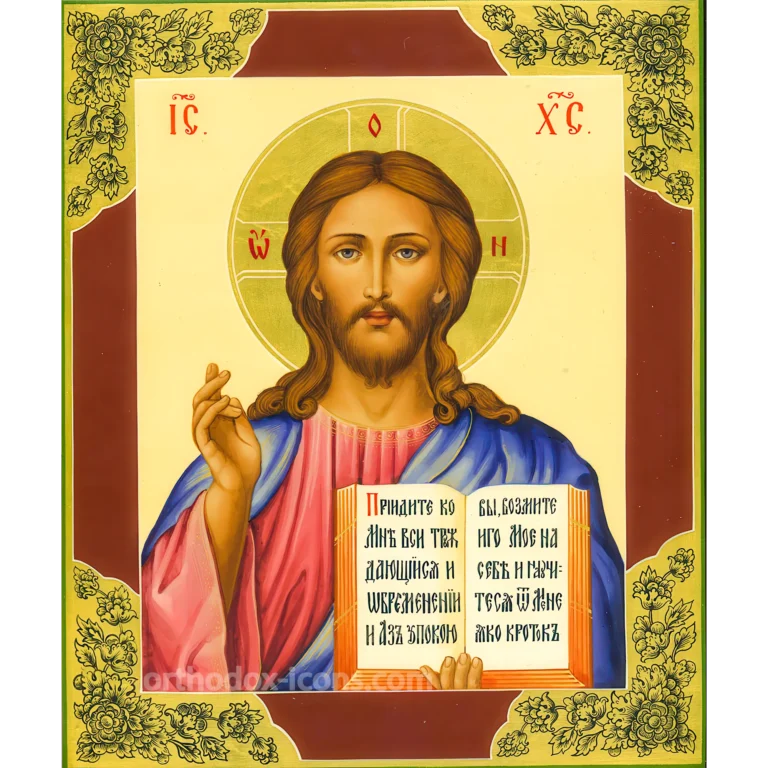
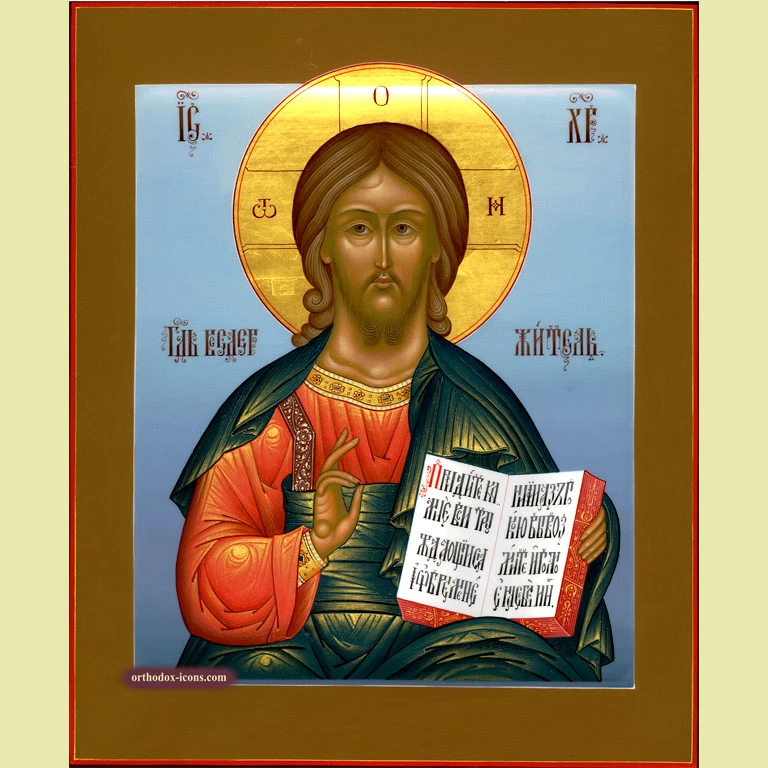
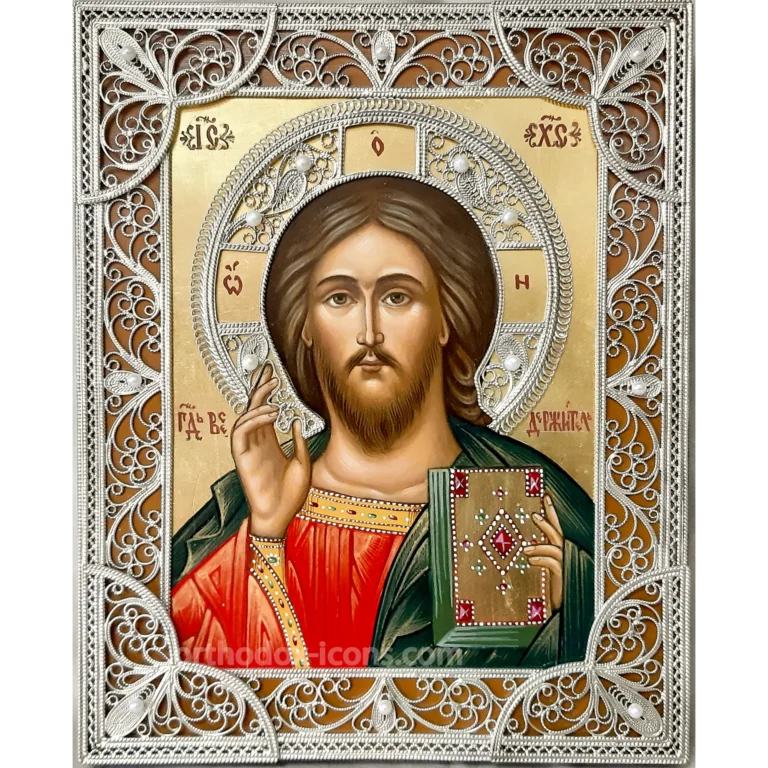
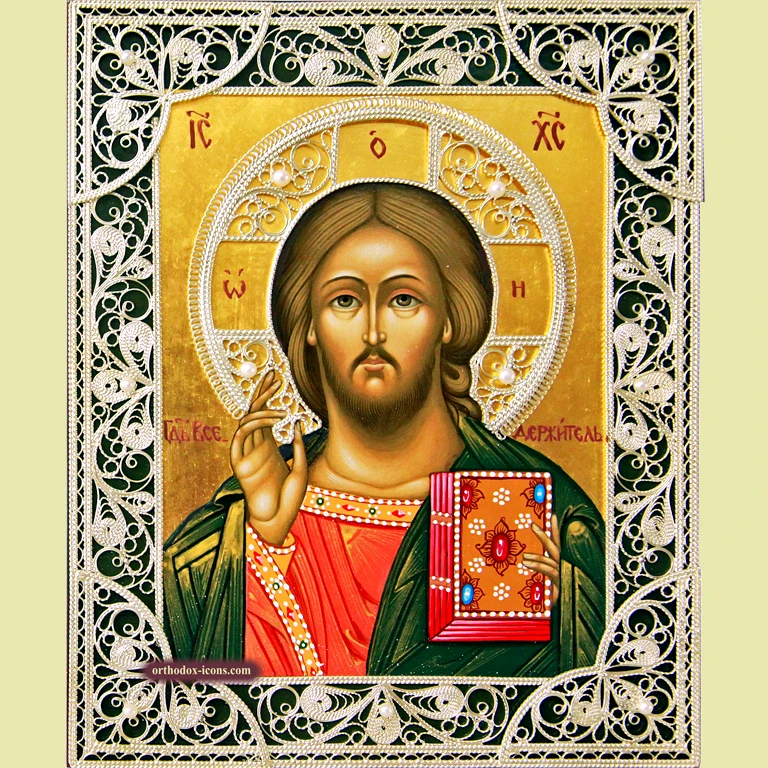
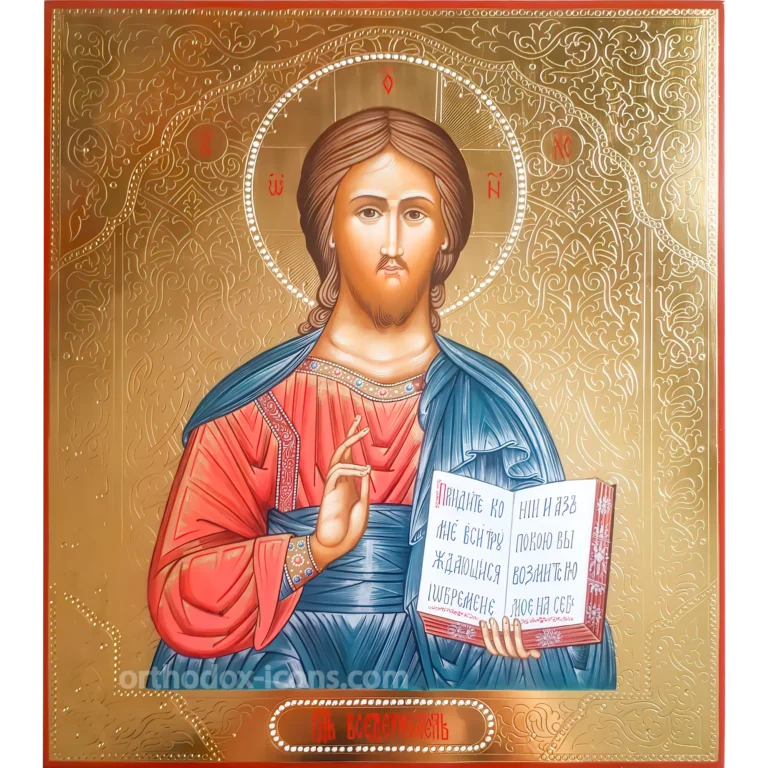
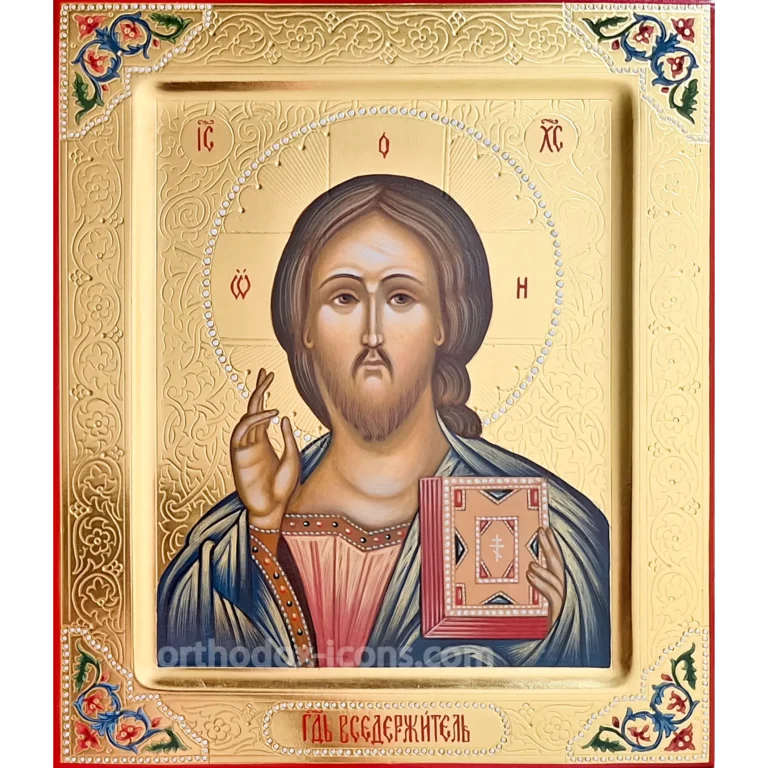
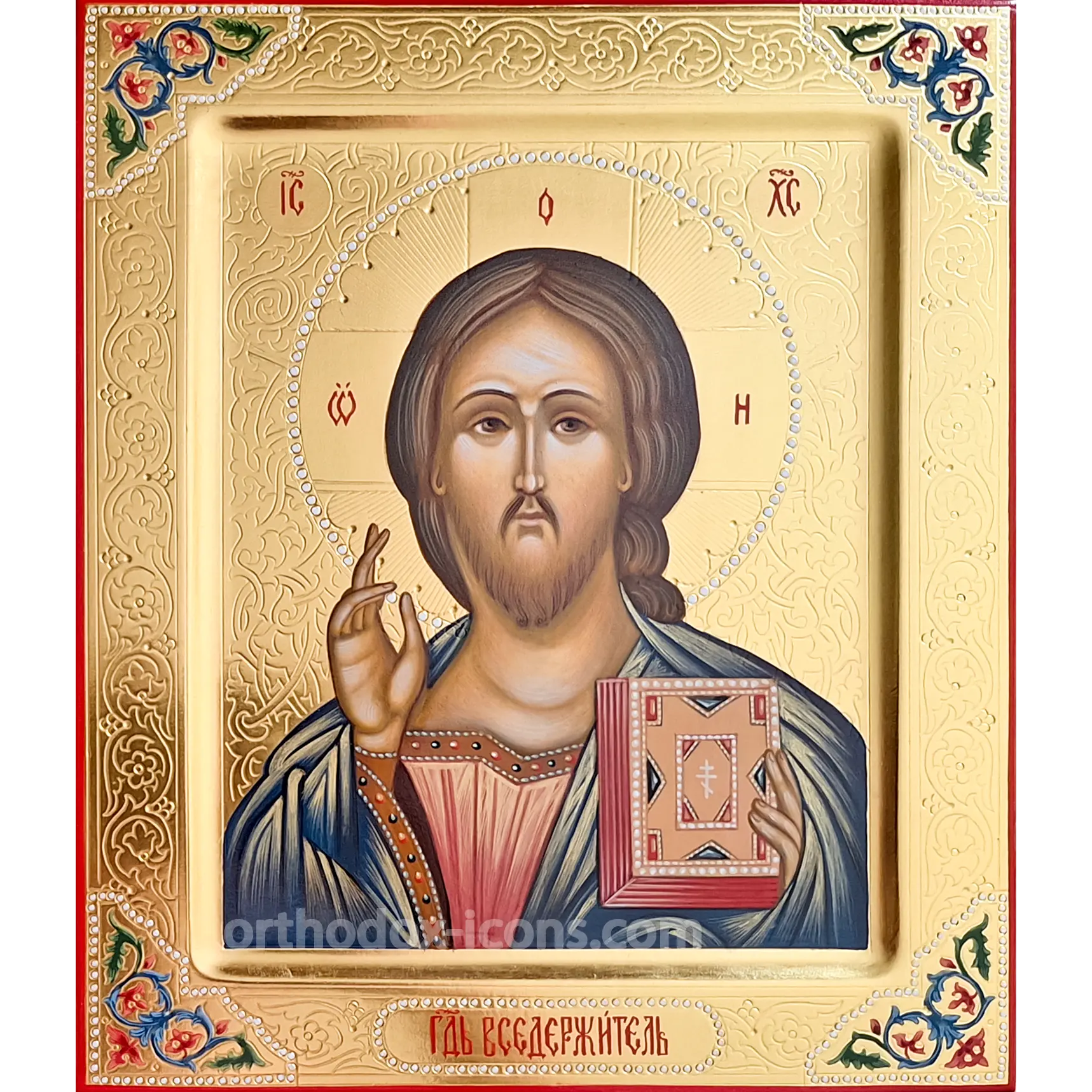
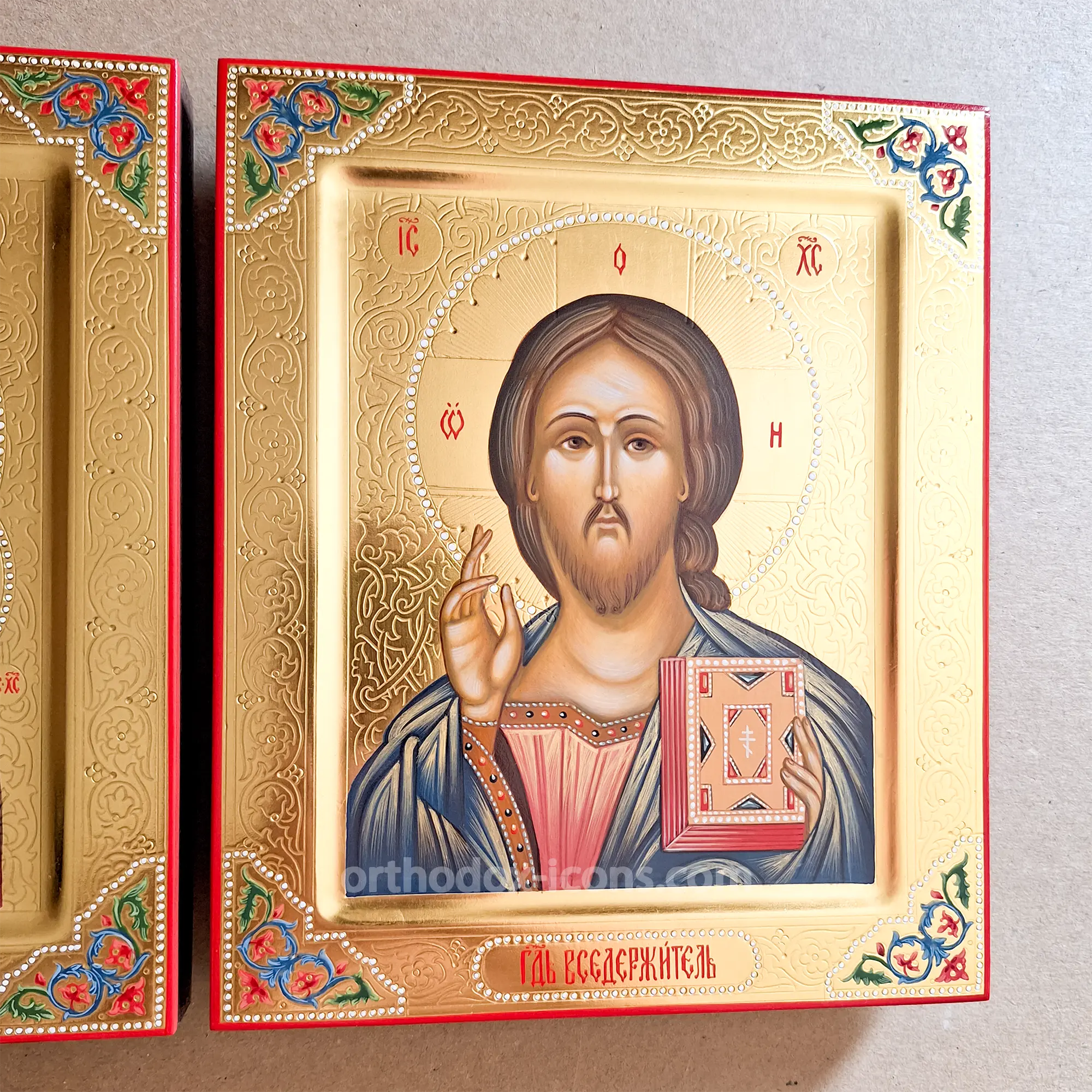
The Pantocrator Orthodox Icon is a hand-painted Lord Almighty icon in the Mstyora tradition, with Christ blessing and holding the Gospel.
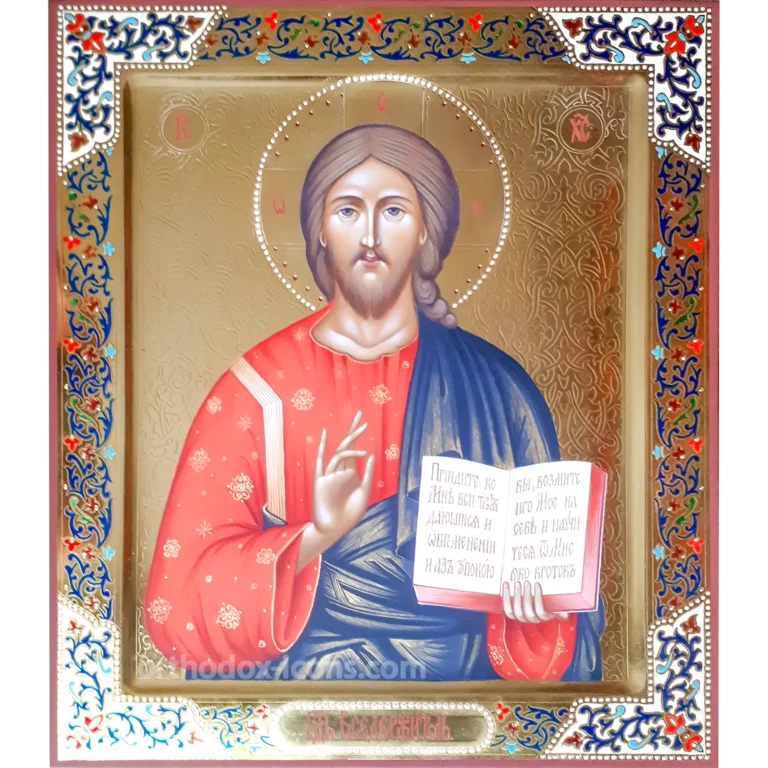
Painted on a linden wood board with kovcheg, oak splines, gesso, and mineral egg tempera. The gold leaf background has fine chased plant ornament, with pearl-like detailing, colored enamel fields, blue-steel himation, and rose-ochre chiton. Free international shipping. Payment after receiving.
It is possible to paint an image in any size to order
Free shipping worldwide
The Pantocrator Orthodox Icon is a hand-painted icon of Christ the Lord Almighty, one of the principal images of Orthodox Christianity. This icon is a richly decorated Mstyora icon on a linden wood board with kovcheg, 23K gold leaf (960 purity), fine relief chasing, colored enamel, and pearl-like ornamental details.
Christ is shown in the half-length Pantocrator type: the right hand is raised in blessing, and the left hand holds the Gospel, the Word of God addressed to every person. This icon is suitable for a home iconostasis, family prayer corner, wedding blessing pair, Orthodox gift, church, chapel, and iconostasis setting.
Meaning of the Lord Almighty Icon
The Lord Almighty, or Pantocrator, is the central image of Christ in Orthodox iconography. The Greek word Pantocrator means the One who holds all things. It is not merely one image among many, but a name that reveals Christ as Lord and ruler of all that exists.
The Pantocrator icon expresses the two natures of the Savior: Christ is both God and Man, Judge and Merciful One, the Word and the Word made flesh. His right hand blesses; His left hand holds the Gospel. The blessing is given, and the divine word has already been spoken to the world.
The inscription in the halo means “He Who Is,” the divine name revealed to Moses. It directly confesses the divinity of Christ and His unity with God the Father. The monograms of Jesus Christ and the title of the Lord Almighty complete the theological program of the image.
From Byzantium to Mstyora Icon Painting
The Pantocrator type reaches back to the earliest centuries of Christian iconography. The image of Christ as Lord of the world appears in early Christian art and reaches its completed canonical form in Byzantium. Mosaics in churches such as Hagia Sophia, Daphni, and Nea Moni express the same sacred prototype: the half-length Pantocrator with blessing hand and Gospel.
In Rus’, the Lord Almighty became central in the church iconostasis from the earliest centuries of Orthodoxy. The Deisis row, where Christ is surrounded by the Theotokos, Saint John the Forerunner, and the apostles, became an essential part of Russian churches.
The Mstyora icon-painting school developed its own refined approach to the Pantocrator image: delicate facial modeling, rich gold backgrounds, chased ornament, elegant decorative detail, and strict fidelity to the canon.
Theological Meaning of the Details
An icon is theology in color, and the image of the Lord Almighty is especially full of meaning. The gaze of Christ is directed toward the person praying. It is not distant, but personal and knowing. The believer feels seen and received.
The blessing gesture of the right hand is not a gesture of domination, but of love and acceptance. The fingers confess the two natures of Christ and the Holy Trinity, and also form the name of Jesus Christ in the traditional blessing.
The Gospel in the left hand is a sign of divine revelation and judgment. Everything needed for salvation has been spoken; the person is called to respond. The decorated Gospel cover emphasizes the sacred character of the book.
Artistic Features of This Icon
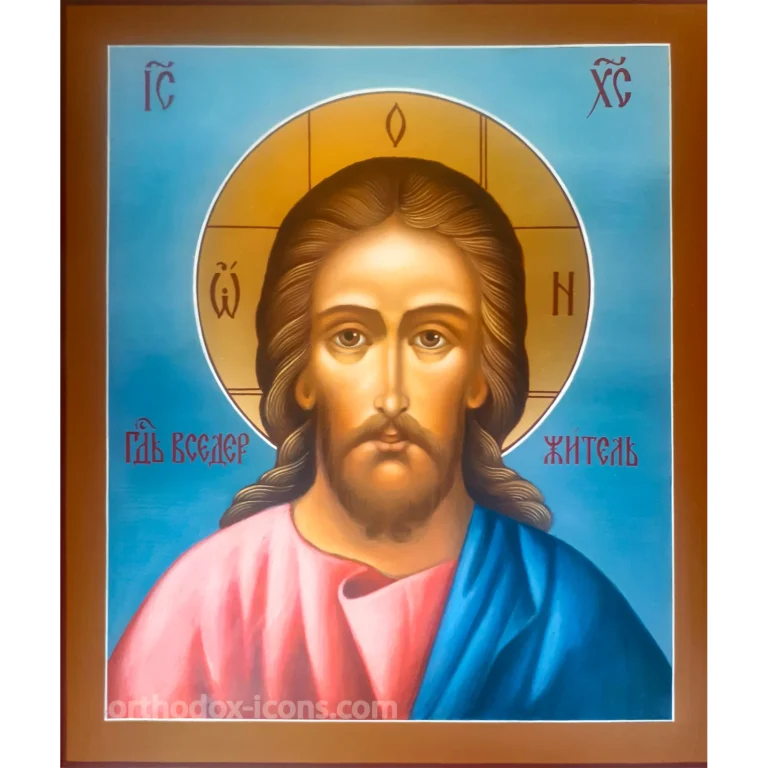
This is a high-level canonical Mstyora icon. The face of the Savior is painted in a strict academic manner, with correct features, a deep focused gaze, and soft light and shadow that give the feeling of living presence. Dark chestnut hair falls to the shoulders, and the beard is worked with fine lines.
The background is covered with rich 23K gold leaf (960 purity). Across the gold surface runs a fine chased plant ornament, a characteristic feature of Mstyora work that gives the image solemnity and depth. The round gold halo is edged with pearl-like ornament, strengthening the royal dignity of Christ.
The chiton is painted in soft rose-ochre tones. The collar and shoulder area are dark golden with pearl-like decoration. The himation is a deep blue-steel color with carefully worked folds. The broad icon fields are richly decorated with chased gold and colored enamel inserts in blue, green, and red tones. A pearl-like border runs around the image, and the board edge is finished in a rich red tone.
The kovcheg is clearly visible: the sacred image is painted in the recessed central field, while the borders rise above it. This is the classical relief structure of a traditional Russian icon board.
Prayer Before the Lord Almighty
The Lord Almighty icon is a universal prayer image. It is often the first icon placed in a home icon corner and the first image before which a person turns in sorrow or joy.
Before the Lord Almighty Icon, Believers Pray:
- for strengthening of faith and spiritual guidance in moments of doubt;
- for forgiveness of sins, especially before confession and during fasting seasons;
- for protection of the home and family;
- for health and healing of body and soul;
- for help in work, studies, travel, and important beginnings;
- for peace of soul in grief, anxiety, and loss.
Traditional Materials and Technique
Each hand-painted Lord Almighty icon is created according to traditional methods. The base is a natural linden wood board, strengthened on the reverse side with inset oak splines to reduce deformation caused by humidity and temperature changes.
The board has a kovcheg, the traditional recessed field where the painted image is placed. The surface is prepared with gesso, a chalk ground made with natural glue, polished to a smooth surface. The icon is painted with mineral tempera on an egg-based emulsion.
The background and halo are gilded with genuine 23K gold leaf (960 purity). Chased ornament is worked by hand over the gold using special tools. Colored enamel inserts are added as a final decorative element. The icon is then protected with a traditional finish.
Who This Icon Is Suitable For
- For a home iconostasis: the icon of Christ holds the central place in a traditional Orthodox prayer corner.
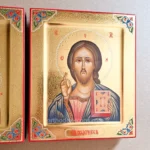
- For a wedding blessing pair: together with an icon of the Theotokos, it forms a classic wedding blessing pair.
- For a church or chapel: the icon is suitable for the Deisis row, local iconostasis row, or a separate kiot.
- As a gift: appropriate for baptism, ordination, monastic tonsure, anniversary, house blessing, and name day.
- For iconostasis projects: larger iconostasis formats can be discussed for architectural settings.
Icon Characteristics
| Name | The Pantocrator Orthodox Icon |
| Iconographic type | Christ Pantocrator, half-length image |
| Main spiritual meaning | Lord of all creation, Judge and Blesser, the Word made flesh |
| Board | Natural linden wood |
| Board reinforcement | Inset oak splines |
| Board construction | Traditional kovcheg |
| Ground | Gesso |
| Painting | Mineral egg tempera |
| Gilding | 23K gold leaf (960 purity) with chased plant ornament |
| Decoration | Colored enamel, chasing on the fields, pearl-like border |
| Available sizes | 17 x 21 cm, 20 x 24 cm, 27 x 31 cm, 30 x 40 cm, and iconostasis sizes |
| Purpose | Home iconostasis, prayer corner, church, iconostasis, and Orthodox gift |
Ordering, Shipping, and Payment
The icon is available in standard sizes and larger iconostasis formats by request. Free international shipping is included, and payment is made after receiving the icon.
Questions and Answers
How is the Pantocrator icon different from other icons of Christ?
The Pantocrator shows Christ as both Son of Man and Lord of the universe, with blessing hand and Gospel, revealing Him as Judge and Savior.
What do believers pray for before the Lord Almighty icon?
They pray for forgiveness, strengthening of faith, health of loved ones, protection of the home, help in difficulties, and peace of soul.
Where should this icon be placed at home?
Traditionally, the icon of Christ holds the central or right place in a home icon corner, where the family can pray before it.
What does the inscription in Christ’s halo mean?
The inscription means He Who Is, the divine name revealed to Moses, confessing Christ’s eternal unity with God the Father.
What is a kovcheg on an icon board?
A kovcheg is the recessed central field of the icon board, with raised borders around the painted image.
Can this icon be given as an Orthodox gift?
Yes. It is suitable for baptism, name day, wedding blessing, house blessing, ordination, anniversary, and other important occasions.
What materials are used for this icon?
The icon is made on a linden wood board with oak splines and kovcheg, gesso, mineral egg tempera, 23K gold leaf (960 purity), chasing, enamel, and pearl-like decoration.
What size should be chosen for a home iconostasis?
For a small prayer corner, 17 x 21 cm or 20 x 24 cm is suitable; for a larger home iconostasis, 27 x 31 cm or 30 x 40 cm is stronger.
What is characteristic of the Mstyora icon-painting school?
Mstyora icon painting is known for refined faces, light gold backgrounds, restrained yet rich color, and decorative gilding, chasing, and enamel.
How long does it take to create this hand-painted icon?
Depending on size and decoration, a hand-painted icon with gilding, chasing, and enamel usually takes several weeks.
| Dimensions | 17x21cm (6.7×8.3 in), 20x24cm (7.9×9.4 in), 27x31cm (10.6×12.2 in), 30x40cm (11.8×15.7 in) |
|---|---|
| Name | Jesus |