Saint Victor Orthodox Icon
Price range: $700 through $2250
Available sizes: 17×21 cm (6.7×8.3 in), 20×24 cm (7.9×9.4 in), 27×31 cm (10.6×12.2 in), 30×40 cm (11.8×15.7 in), with larger iconostasis sizes available by individual order.
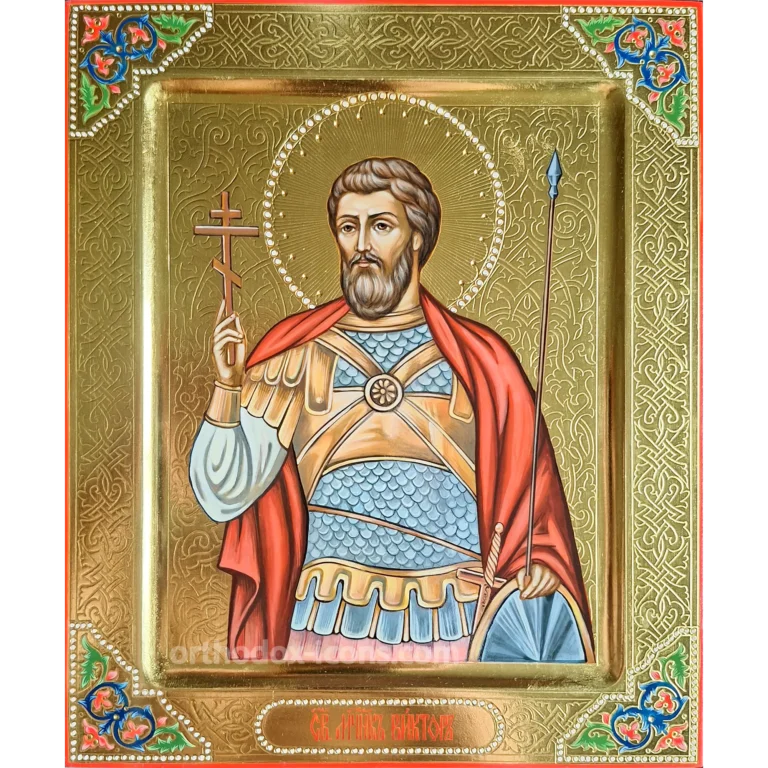
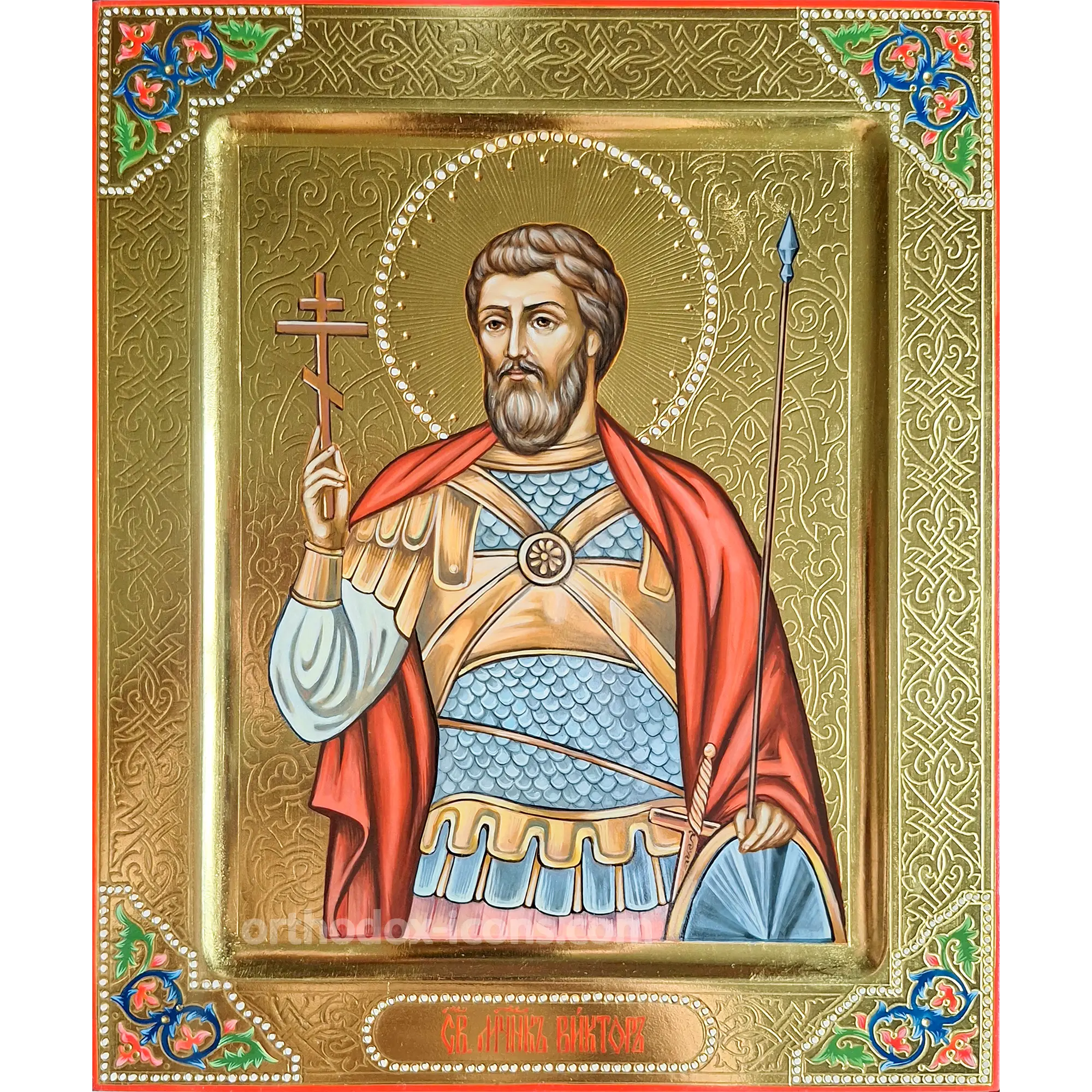
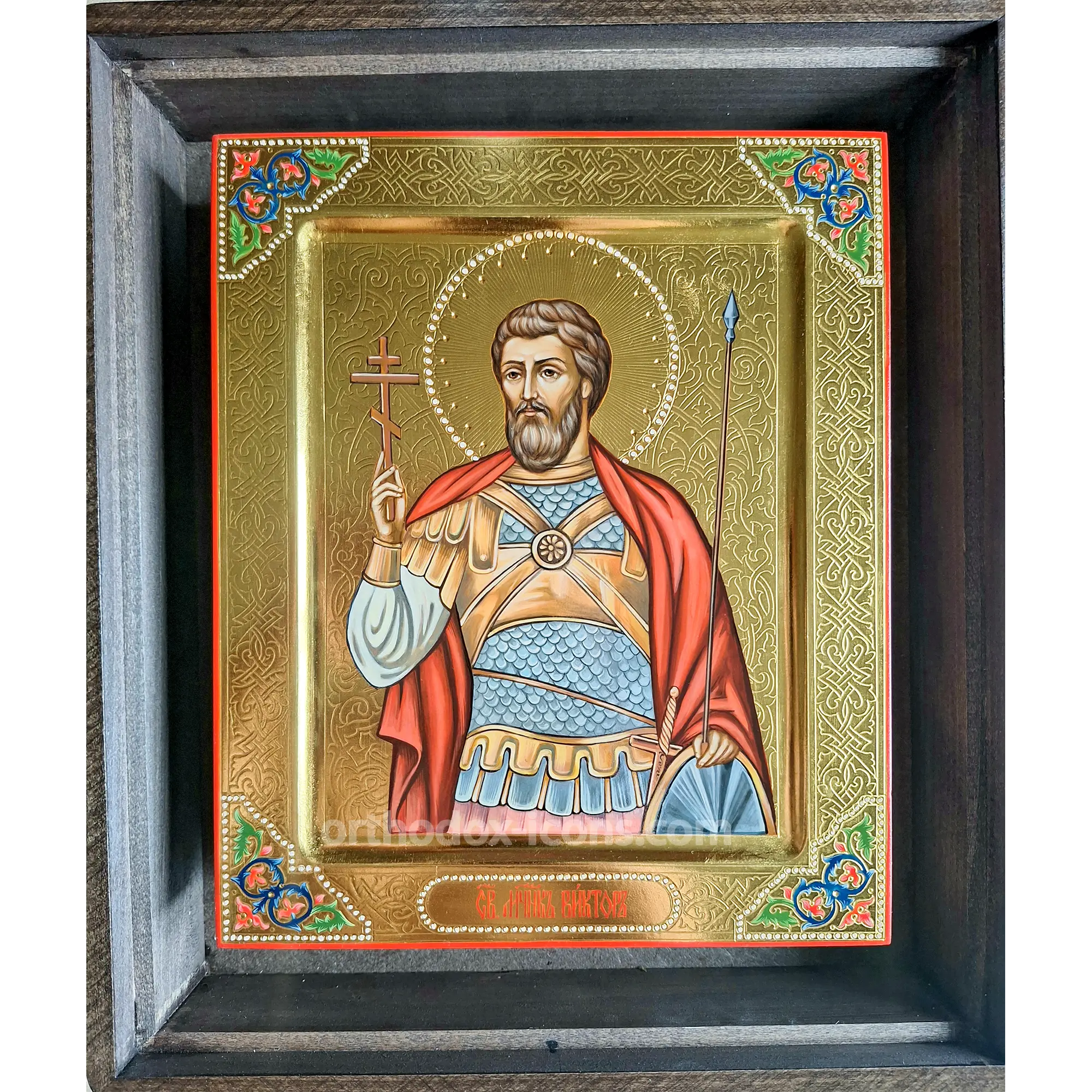
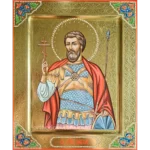
Saint Victor Orthodox Icon is a hand-painted icon of the Holy Martyr Victor of Damascus, an early Christian soldier who witnessed to Christ with courage and steadfast faith. The saint is shown in Roman armor, with a red mantle, a martyr’s cross, spear, and shield.
Prayer focus: courage in trials, protection from enemies and false accusations, spiritual strength, and prayerful support during illness, especially according to the tradition connected with Saint Victor’s sufferings.
Materials: linden wood board, oak splines, pavoloka, natural chalk gesso, egg tempera, 23K gold leaf (960 purity), hand-tooled gold ornament, painted enamel-style corner details, and protective finish.
Best suited for: men and boys named Victor, Orthodox families, military and protective-service gifts, namedays, birthdays, baptisms, and a home icon corner.
It is possible to paint an image in any size to order
Free shipping worldwide
The Saint Victor Orthodox Icon is a hand-painted icon of the Holy Martyr Victor of Damascus, a soldier of the early Christian centuries and a witness of steadfast faith. The name Victor means “winner” or “conqueror” in Latin, and in the life of this saint the word receives a deeply Christian meaning: he conquered fear, coercion, and the threat of death by remaining faithful to Christ.
This icon is painted in the tradition of Orthodox iconography and has a rich ceremonial appearance: full gold leaf, hand-tooled ornament, and painted enamel-style corner details. Saint Victor is shown as a Christian warrior in Roman armor, with a red mantle, a martyr’s cross, spear, and shield. The image is suitable for a home iconostasis and can become a meaningful patron saint icon for a man or boy named Victor.
At the same time, this is not simply a military image. The armor, cross, spear, and shield point to spiritual struggle: courage, fidelity, protection of the weak, and the refusal to betray Christ under pressure. The icon is intended for prayer and veneration, not as a printed decoration or mass-produced souvenir.
Icon Characteristics
| Holy image | Holy Martyr Victor of Damascus, Christian soldier |
| Iconography | Waist-length image in armor, with cross, spear, and shield |
| Board | Linden wood board, oak splines, pavoloka, and chalk gesso |
| Painting technique | Egg tempera on gesso, in the traditional icon-painting manner |
| Gold and ornament | 23K gold leaf (960 purity), hand-tooled gold background, and painted enamel-style details |
| Available sizes | 17×21 cm (6.7×8.3 in), 20×24 cm (7.9×9.4 in), 27×31 cm (10.6×12.2 in), 30×40 cm (11.8×15.7 in) |
Who This Icon Is For
The choice of a saint’s icon is often connected with the desire to find a heavenly patron for a particular person. The icon of the Holy Martyr Victor is especially meaningful for men and boys who bear the name Victor. It may be given for baptism, nameday, birthday, coming of age, or another important family occasion. A patron saint icon helps a person remember his spiritual connection with his heavenly intercessor and learn courage of character from him.
Since Saint Victor was a soldier, his icon may also be chosen as a prayerful gift for military personnel, protective-service workers, rescuers, and those whose vocation involves risk, discipline, and the defense of others. The image of a warrior of Christ supports those who need courage without cruelty and firmness without pride.
This icon is also appropriate for a person passing through a difficult trial: injustice, false accusation, serious illness, or a crisis of faith. The image of Saint Victor the “conqueror” reminds the faithful that true victory is not revenge or outward power, but steadfastness in Christ, patience, and trust in God.
Prayer Before the Icon of Saint Victor
The prayer tradition connected with the Holy Martyr Victor is closely tied to his life and sufferings. Orthodox believers ask him for courage, protection, and spiritual strength in circumstances where a person must stand firm before fear, slander, injustice, or betrayal.
Saint Victor is also approached with prayers during illness. In the hagiographical tradition, he endured bodily torments, and through God’s grace remained steadfast; this is why believers may ask his intercession in suffering, including ailments of the hands, joints, skin, and sight. Such prayer should be understood reverently, without treating the icon as a substitute for medical care or as a mechanical promise of healing.
Spiritually, Saint Victor is asked to help a person receive firmness and courage. People pray before his icon when they need to withstand false accusations, unfair pressure, hostility, or inner weakness. The prayer is not directed against other people, but asks for peace of soul, protection from evil, and the strength to remain faithful to Christ.
Life of the Holy Martyr Victor of Damascus
Saint Victor lived in Damascus in the second century and served as a legionary in the army of the Roman emperor Marcus Aurelius. During the persecution of Christians, soldiers were required to offer public sacrifice to pagan gods as a sign of loyalty to the empire.
Victor, who was a Christian, refused to take part in idolatry. He openly declared before the commander Sebastian that he was a soldier of the Heavenly King and would not betray his faith. For this confession, the young soldier was subjected to severe torture. According to the traditional account, he was tormented, thrown into a heated furnace, and made to drink deadly poison, yet the Lord preserved His witness.
Seeing these miracles, the magician who had prepared the poison believed in Christ and burned his books of magic. Later, when soldiers attempted to blind Victor, they themselves lost their sight and received it back only through the merciful prayer of the martyr.
The final trial came during Victor’s scourging. A young woman named Stephanida, the wife of a Roman soldier, saw radiant crowns descending from heaven upon Victor and publicly confessed Christ. She was executed, and after her Saint Victor was beheaded, completing his earthly path as an unconquered witness of Christ.
Feast Day of Saint Victor
The Russian Orthodox Church commemorates the Holy Martyr Victor of Damascus, together with the Martyr Stephanida, on November 24 according to the civil calendar, or November 11 according to the old calendar. This date is a nameday for many Orthodox men baptized with the name Victor.
If the icon is intended as a gift for this day, it is best to order in advance. A hand-painted icon with gold leaf, relief ornament, and detailed tempera work requires careful stages of preparation, drying, painting, gilding, and finishing.
Features of This Saint Victor Icon
The presented icon has a festive, solemn, and luminous character. The iconographer created an image in which martial courage and heavenly glory are joined without theatrical excess. Saint Victor is shown waist-length in a strict frontal position. His face is calm and noble, with dark hair, a small neat beard, and a direct clear gaze turned toward the person praying.
The detailed Roman scale armor immediately draws attention, together with leather straps, golden clasps, and the falling red mantle. These elements identify the saint as a soldier, but within Orthodox iconography they also point to the armor of faith and the spiritual battle of the Christian life.
The background gives the icon special artistic value. It is not simply colored, but covered with gold leaf and carved with a complex floral relief pattern that plays with light and shadow. A wide golden frame with a tooled braided pattern surrounds the image. In the four corners are bright floral compositions, painted in an enamel-like manner, adding a joyful note of Paradise to the composition.
Iconography: Armor, Cross, Spear, and Red Mantle
The iconography of the Martyr Victor is deeply symbolic. The Roman armor, or lorica, points to the saint’s historical service in the imperial army. In Orthodox interpretation, martial armor also signifies spiritual armor: readiness to resist evil and stand firmly in the truth.
Over the armor lies a bright red mantle. In icon painting, this color has a double meaning. It is the color of blood shed for Christ and a sign of sacrificial witness; at the same time, it carries the dignity and joy of the saint who has entered the Kingdom.
In his right hand the martyr holds an eight-pointed Orthodox cross. A cross in the hand of a saint is a sign of voluntary endurance and witness to Christ. In his left hand Victor holds a spear and shield, symbols of the defense of faith, and the hilt of a sword can be seen at his belt.
Materials, Gold Leaf, and Custom Options
The icon is made according to traditional techniques intended for durability and beauty over many years. The base is a strong linden wood board. Oak splines are set into the back of the board to help prevent warping as humidity changes. The front is covered with pavoloka and several layers of carefully polished chalk gesso.
The main decorative element is gold leaf. Thin sheets of 23K gold leaf (960 purity) are applied to the background and border fields. The distinctive feature of this work is the hand-tooled relief pattern: before the gold is laid, the master forms a delicate ornament in the gesso. When the gold covers this relief, it catches the light with depth and movement.
The corners are decorated with colored ornament styled like cold enamel. The figure of the saint is painted in egg tempera, using natural dry pigments mixed with egg emulsion. The finished icon receives a protective finish that helps shield the painting from dust.
For an individual order, the decorative solution can be discussed: a tooled or smooth gold background, the presence or absence of floral corner ornaments, a more academic or a more strictly canonical manner of painting, a kiot, or a larger format for church use. Free international shipping is included. Payment is made after you receive and approve the icon.
How to Choose the Size
The 17×21 cm (6.7×8.3 in) size is compact and suitable for a patron saint gift to a child, godson, or family member, and for placement on a small shelf, desk, or bedroom icon corner.
The 20×24 cm (7.9×9.4 in) size is a balanced home format. It fits most home icon corners and already allows the details of the armor and tooled ornament to be seen clearly.
The 27×31 cm (10.6×12.2 in) size is a strong gift or analoy format. It is often chosen for significant anniversaries and important family occasions, because the gold leaf and ornament are revealed more fully.
The 30×40 cm (11.8×15.7 in) format is solemn and more monumental. It is suitable for larger rooms, a central place in a home iconostasis, a chapel, or as a donation to a parish church. Larger iconostasis sizes can be discussed individually.
Blessing and Care
Before placing a newly painted icon in a home iconostasis or giving it to a loved one, it may be blessed in an Orthodox church. You can bring it to your parish for blessing after receiving it.
A hand-painted icon requires careful handling, especially when it has gold leaf. Do not wipe the surface with a wet cloth and do not use household cleaners, alcohol-based liquids, or abrasive materials. Dust should be removed gently with a dry soft brush.
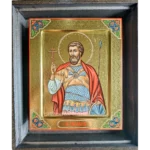
The icon should not be placed in direct sunlight, near radiators, or close to drafts, because sudden changes of temperature and dryness can harm the wood and paint layers. For long-term protection, a wooden glazed kiot is recommended, especially for an icon with gold leaf and relief ornament.
Questions and Answers
Which Saint Victor is shown on this Orthodox icon?
This icon depicts the Holy Martyr Victor of Damascus, an early Christian soldier-martyr of the second century and one of the best-known Orthodox saints named Victor.
Why does Saint Victor hold a simple cross?
The simple eight-pointed Orthodox cross is a martyr’s cross. It signifies voluntary endurance for Christ and the saint’s witness that eternal life is given through the Cross of the Savior.
Can this icon be given to a soldier whose name is not Victor?
Yes. Because Saint Victor is shown as a Christian warrior, his icon can be a meaningful Orthodox gift for a soldier, rescuer, or anyone whose service is connected with protection and courage.
What do the flowers in the corners mean?
The colored floral ornaments are painted decorative elements in the Mstyora tradition, styled like enamel accents. They give the icon a festive character and point symbolically to the beauty of Paradise.
Is tooled gold ornament required for this icon?
No. The tooled relief pattern on the gold makes the icon more ornate and festive, but a smoother gold background can be discussed for a stricter and more restrained version.
What are the oak splines on the back of the board?
Oak splines are wooden supports set into the back of the linden board across the grain. They help the board remain stable as wood naturally reacts to humidity and temperature.
When is the feast day of Saint Victor of Damascus?
The feast day of the Holy Martyr Victor of Damascus, together with Saint Stephanida, is celebrated on November 24 in the civil calendar, corresponding to November 11 in the old calendar.
May this icon be hung on a wall?
Yes. The back of the icon board usually has a hanging recess. For better protection of the painting and gold leaf, a glazed wooden kiot may also be ordered.
Who was Saint Stephanida?
Saint Stephanida was a martyr who saw Saint Victor’s sufferings, confessed Christ openly, and suffered with him. The Church commemorates Saint Victor and Saint Stephanida on the same day.
How should one pray before an icon of Saint Victor?
One may pray with the Church’s prayers to the martyr or in simple words from the heart, asking for courage, faithfulness to Christ, protection from evil, and strength to endure trials without hatred or despair.
| Dimensions | 17x21cm (6.7×8.3 in), 20x24cm (7.9×9.4 in), 27x31cm (10.6×12.2 in), 30x40cm (11.8×15.7 in) |
|---|---|
| Name | Victor |