Eve Orthodox Icon
Price range: $700 through $2250
Available sizes: 17×21 cm (6.7×8.3 in), 20×24 cm (7.9×9.4 in), 27×31 cm (10.6×12.2 in), 30×40 cm (11.8×15.7 in). Larger iconostasis sizes can be made by agreement.
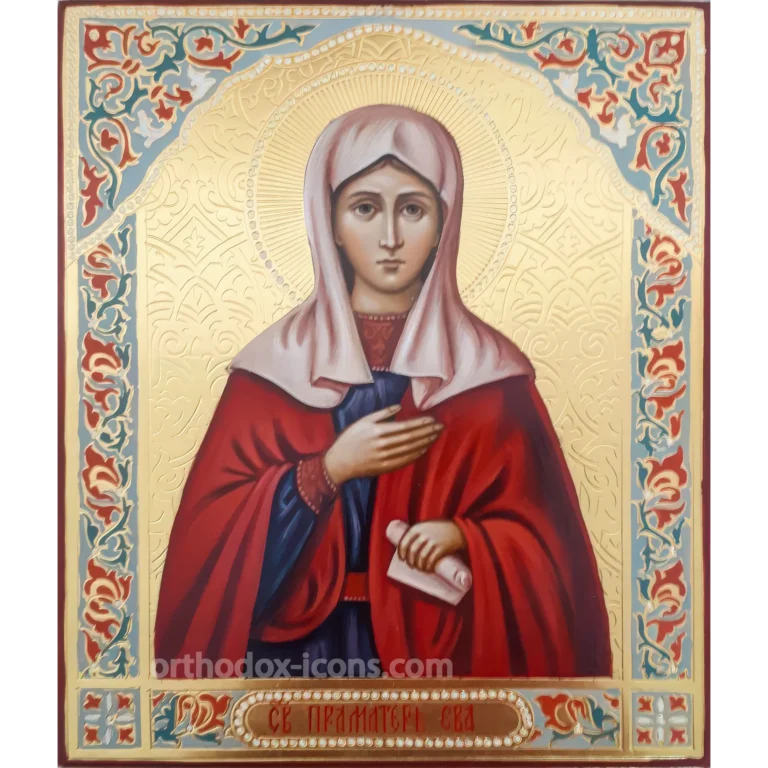
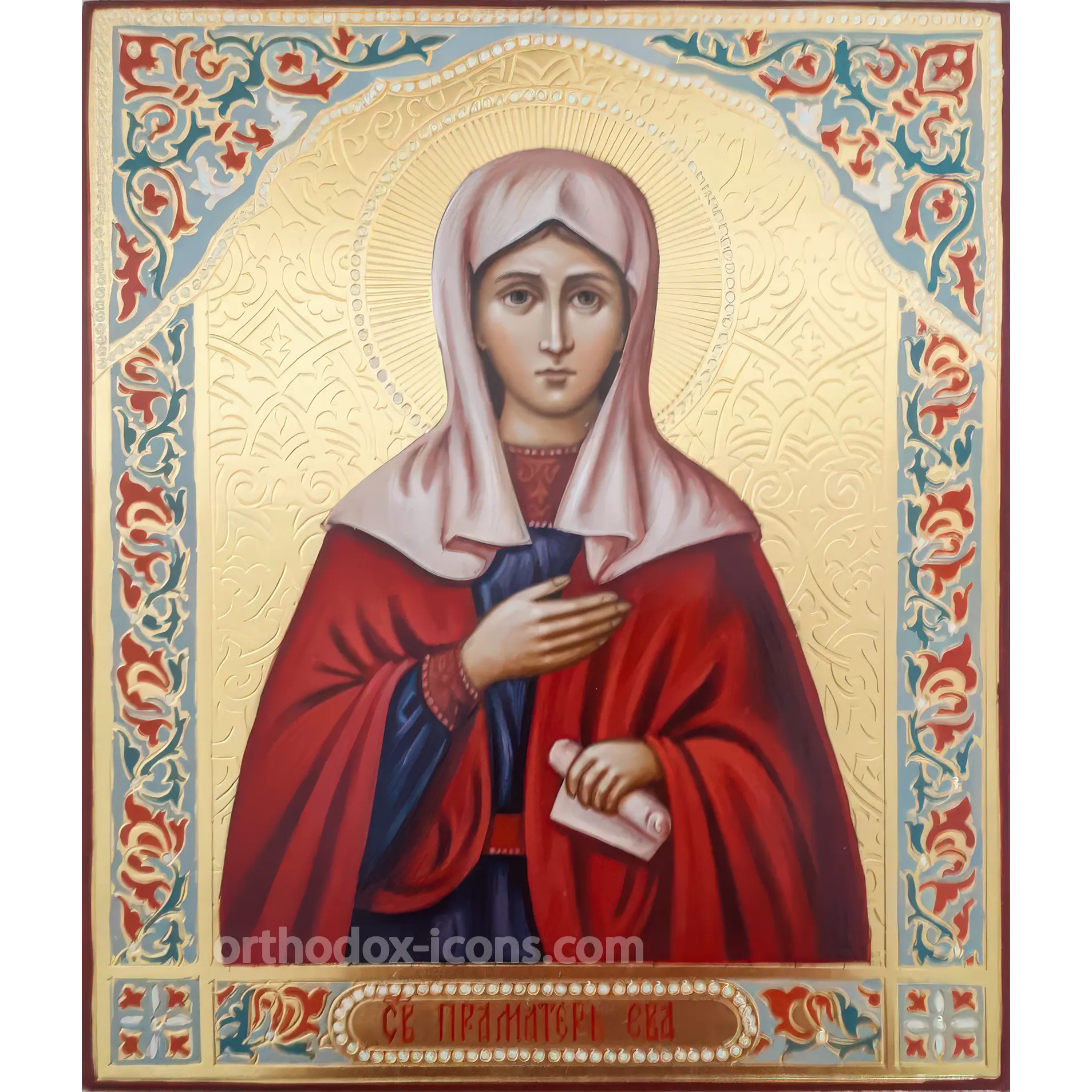
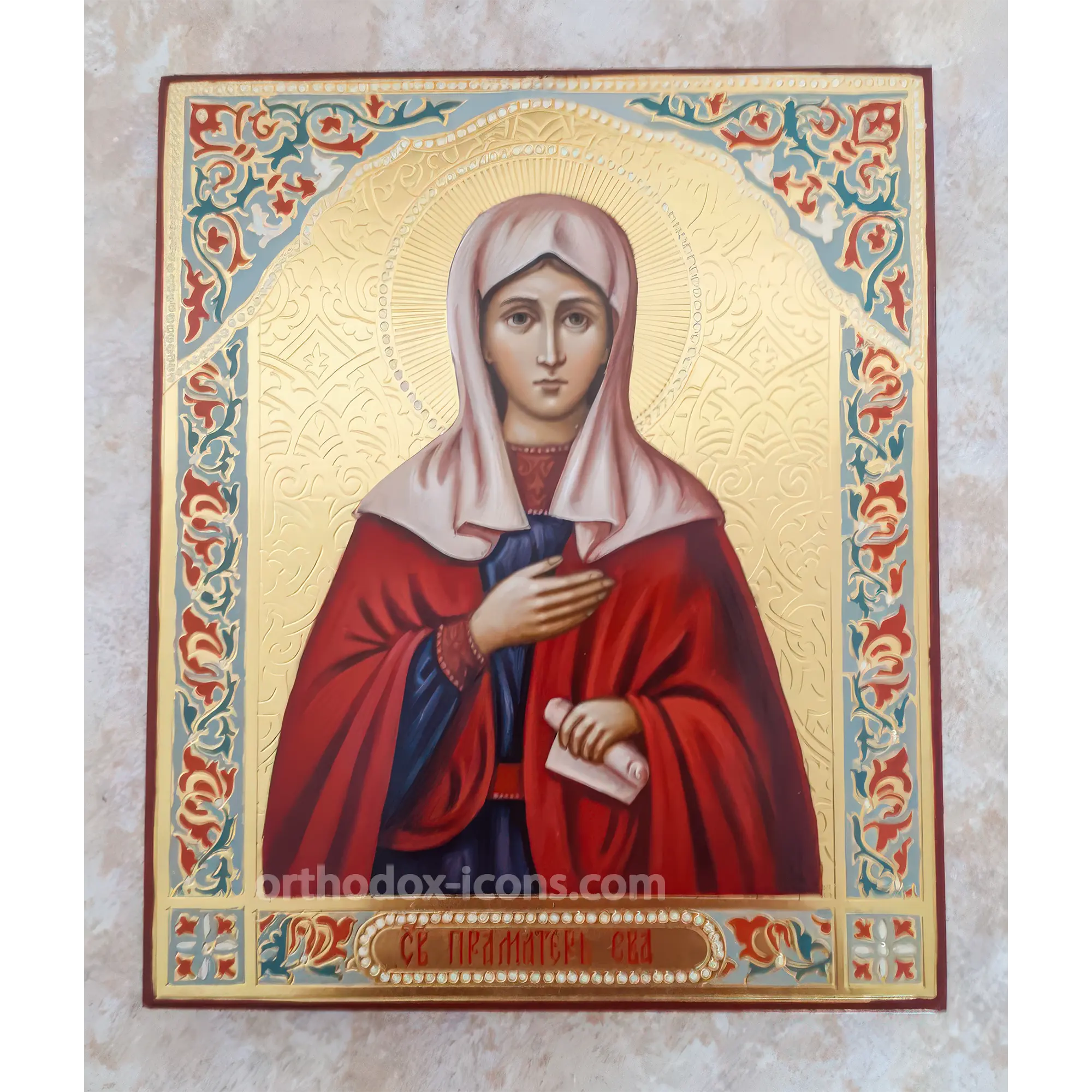
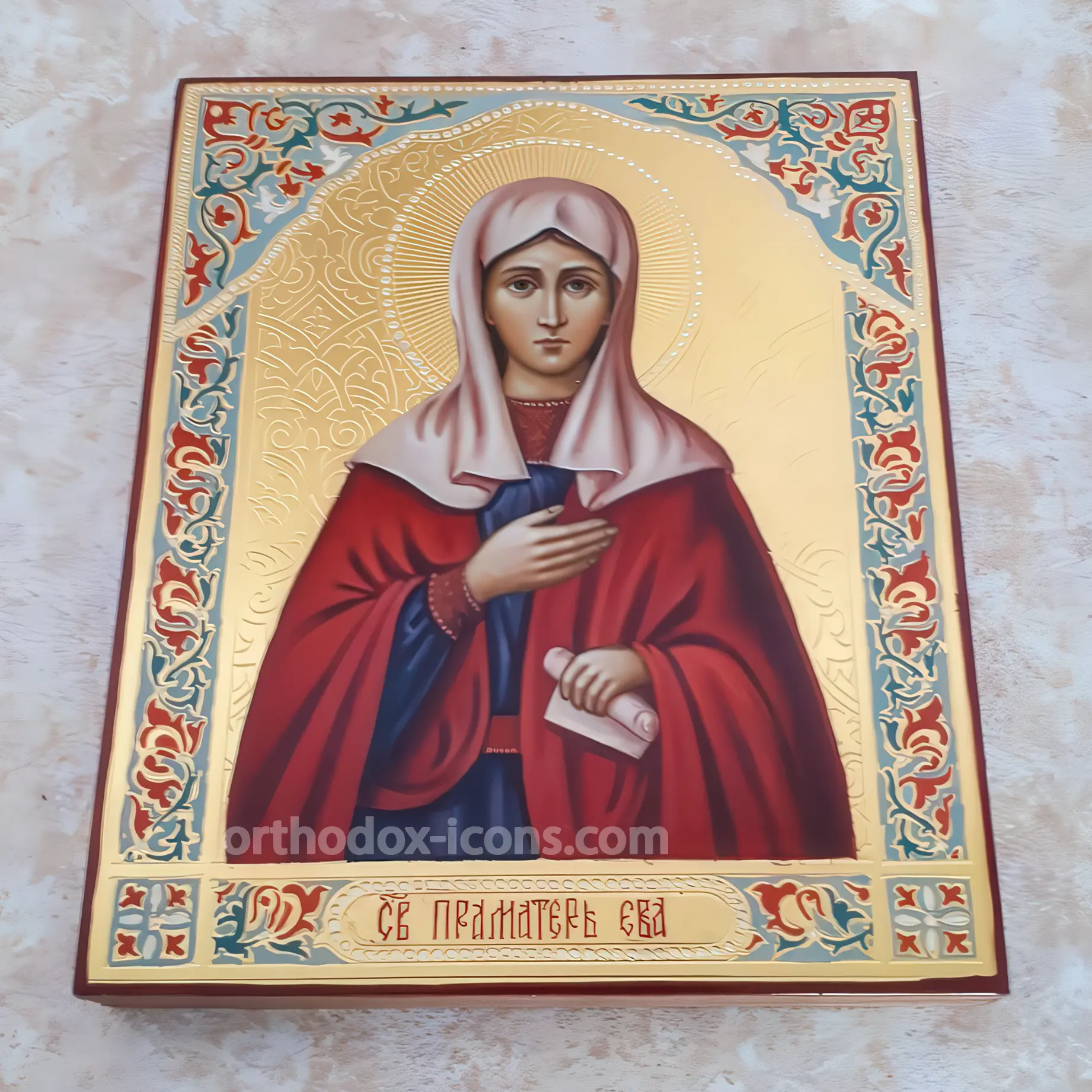
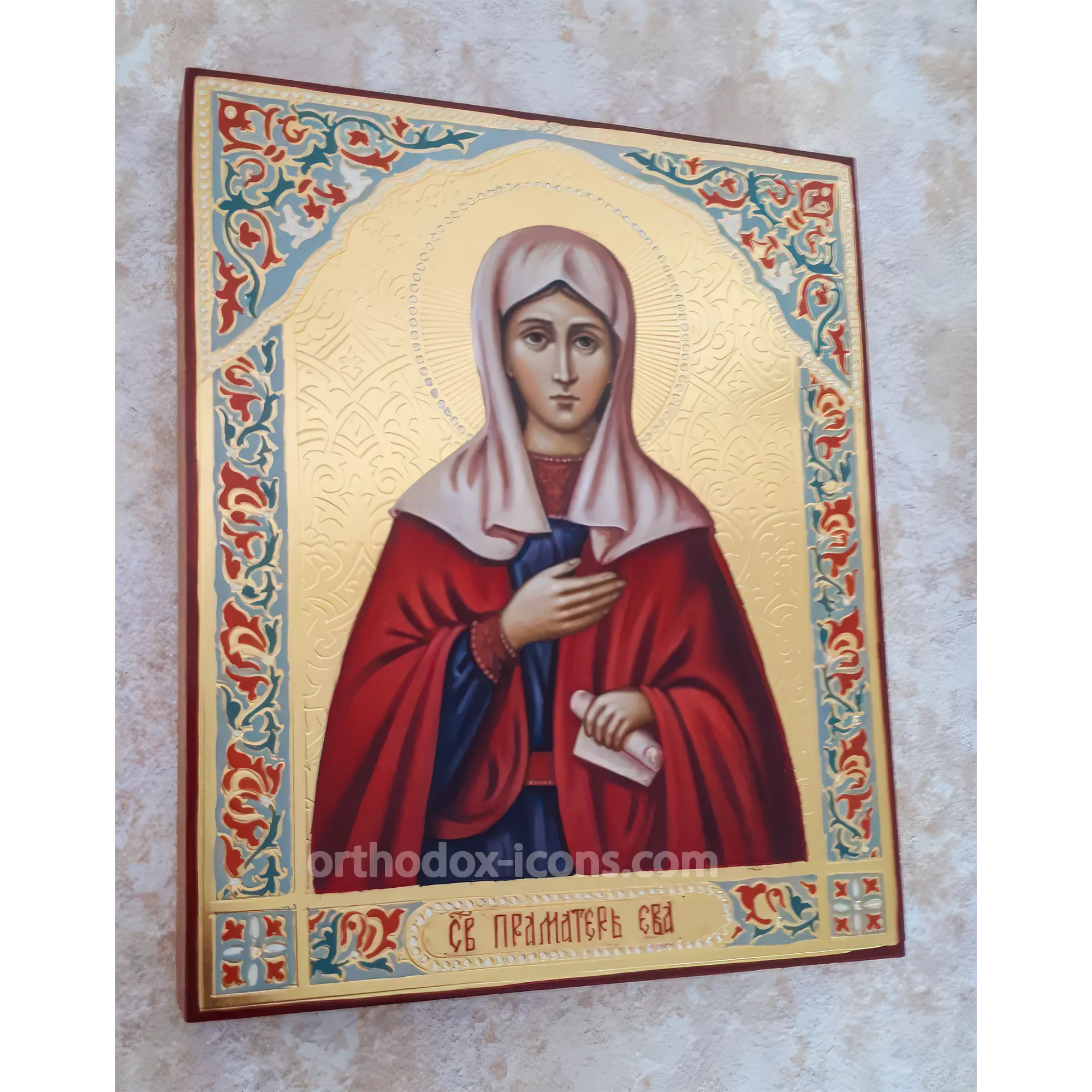
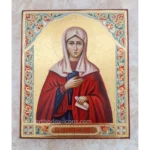
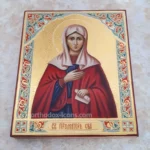
This hand-painted Eve Orthodox Icon depicts Holy Foremother Eve, the wife of Adam, the first woman, and the foremother of the human race. She is shown half-length, wearing a light veil and red maphorion, with one hand at her breast and a scroll in the other hand; the gilded background, ornamental borders, and cool enamel accents give the image a solemn, penitential, and hopeful character.
Prayer before this icon is often connected with peace in the family, motherhood, children, good ordering of the home, repentance, wisdom in choices, spiritual sobriety, and patron saint protection for girls and women named Eve. The icon is painted on a linden wood board with braces, pavoloka, chalk gesso, egg tempera, 23K gold leaf (960 purity), cold enamel accents, and a protective finish. Free international shipping is included. Payment is made after you receive and approve the icon.
It is possible to paint an image in any size to order
Free shipping worldwide
This hand-painted Eve Orthodox Icon is a rare and deeply symbolic image of Holy Foremother Eve, the wife of Adam, the first woman, and the foremother of the human race. In Orthodox tradition, Eve is remembered not only in connection with the fall, but also as the one through whose descendants the first promise of the Savior was given. Her image speaks about the beginning of human history, the drama of disobedience, repentance, and the hope that the Lord did not take away from humanity even after the expulsion from Paradise. For this reason, the icon of Saint Eve is especially appropriate where people pray for family, motherhood, children, spiritual understanding, and the mercy of God.
In this icon Foremother Eve is shown half-length, wearing a light veil and a red maphorion. Her right hand rests at her breast, and her left hand holds a scroll. The face is painted softly and attentively: there is no outward theatrical drama in it, but there is inner quiet, repentance, and prayerful standing before God. The gilded background and ornamental borders with red and blue enamel accents make the image solemn without making it cold. The icon keeps a warm, domestic character and is well suited for personal prayer.
Available sizes: 17×21 cm (6.7×8.3 in), 20×24 cm (7.9×9.4 in), 27×31 cm (10.6×12.2 in), and 30×40 cm (11.8×15.7 in). Larger iconostasis sizes can be made by agreement. The 17×21 cm and 20×24 cm formats are convenient for a home icon corner, bedside shelf, personal prayer area, or patron saint gift. The 27×31 cm size reveals the saint’s face, the scroll, the gold leaf background, and the ornamental borders more clearly. The 30×40 cm format is suitable for more solemn placement in a spacious home, family prayer place, chapel, church, or separate kiot.
This image is especially appropriate as a patron saint icon for a girl, young woman, or woman named Eve. At the same time, the prayerful meaning of the icon is wider than name patronage. Holy Foremother Eve reminds the faithful of the dignity of womanhood, the mystery of motherhood, responsibility before God, the power of repentance, and hope for salvation. This is not an image about guilt in a narrow everyday sense, but about the whole human story: the human person falls, yet God does not leave him without promise, mercy, and a path of return.
Features of This Icon
The main feature of this icon is the rare iconography of Holy Foremother Eve as an independent prayer image. Eve is more often encountered in compositions of the creation of the world, the fall, the expulsion from Paradise, or among the forefathers and foremothers. Here she is presented separately, as a holy foremother to whom one may turn in personal prayer. This is especially important for a patron saint icon, because the image becomes not a part of a larger narrative scene, but its own prayerful center.
The face of the saint is painted calmly and attentively. Large eyes, soft features, a light veil, and a quiet expression create not portrait likeness, but prayerful depth. Foremother Eve is shown without outward luxury. Her dignity is revealed through inner collectedness. This is a fitting solution for an image connected with repentance, humility, and hope. Before such an icon, it is natural to pray not only about earthly needs, but also about the right ordering of the heart.
The right hand of the saint rests near her breast. This gesture may be understood as a sign of heartfelt repentance, inner prayer, and personal standing before God. It does not look theatrical; on the contrary, it makes the image very human. Foremother Eve seems to keep in her heart the memory of the fall and, at the same time, hope in God’s promise. This detail has quiet warmth: the icon does not press upon the one who prays, but gently recalls that repentance begins within.
The scroll in the left hand deepens the meaning of the image. In icon painting, a scroll often points to word, prophetic witness, spiritual memory, or a meaning that the saint carries to people. In the icon of Foremother Eve, it recalls the beginning of biblical history, the first pages of Genesis, and God’s promise that Church tradition understands as the first announcement of the Gospel. Through this image, the faithful remember that the history of salvation begins not with human strength, but with divine mercy.
The red maphorion of the saint is especially expressive against the gold. Red may be understood here as a sign of life, motherhood, pain, and sacrifice. The light veil softens the color harmony and gives the image purity and feminine restraint. Together with the dark blue inner clothing, it creates a deep contrast: the earthly, sorrowful, and penitential are joined with the light of hope.
The ornamental borders are made with colored accents. Red and blue elements on the gilded background create a festive but balanced frame. The name of the saint is placed in the lower part. Fine decorative work is visible around the perimeter. Because of this, the icon looks complete and noble: solemn enough for a gift, yet still warm for home prayer.
Iconography of Holy Foremother Eve
Holy Eve is the wife of Adam and the first woman created by God. Her name is connected with life: in the biblical narrative she becomes the mother of all living. In Orthodox understanding, the image of Eve must not be reduced only to the episode of the fall. Through the disobedience of the first people, death, labor, illness, and spiritual woundedness entered human history. Yet immediately after the fall the Lord gave humanity hope: the promise was spoken concerning the Seed of the Woman who would crush the power of the serpent. Therefore the memory of Eve is both tragic and luminous.
In this icon Foremother Eve is not shown in the scene of Paradise, not beside the tree of knowledge, and not near the serpent. She is shown as a prayerful figure. This is an important emphasis. Before us is not a scene of temptation, but an image of repentance and hope. Such iconography helps the faithful look at Saint Eve in a Church-minded way: as the foremother of the human race, who endured the consequences of the fall and awaited the salvation fulfilled in Christ.
In theological tradition, the theme of Eve often stands beside the theme of the Most Holy Theotokos as the New Eve. Through the disobedience of the first Eve, death entered the world; through the humble consent of the Virgin Mary, the Savior came. The icon of Foremother Eve therefore helps us understand more deeply the veneration of the Mother of God. The history of salvation is revealed as a movement from fall to restoration, from fear to hope, from exile to the return of the human person to God.
The half-length format makes the icon especially personal. There are not many narrative details, and attention is focused on the face, hands, scroll, and color harmony. Such an image is well suited for a patron saint icon: it does not overload the space, remains easy to read in a home iconostasis, and keeps a warm prayerful tone.
Prayer Before the Icon of Saint Eve
Before the icon of Holy Foremother Eve, Orthodox Christians may pray for family peace, motherhood, children, woman’s dignity, repentance, and spiritual understanding. Her image is especially close to those who experience family difficulties, want to learn humility without weakness, responsibility without bitterness, and hope without self-deception. Foremother Eve reminds us that humanity has needed God’s mercy from the very beginning of its history.
- for peace, love, and mutual understanding in the family;
- for the gift of children and blessed motherhood;
- for spiritual wisdom for a woman, mother, wife, and daughter;
- for help in raising children;
- for repentance, humility, and correction of mistakes;
- for protection from temptation, hasty decisions, and spiritual blindness;
- for restoration of trust in the family after conflicts;
- for good ordering of home life;
- for hope during sorrow, loss, or inner confusion;
- for heavenly patronage for girls, young women, and women named Eve.
Prayer before the icon of Foremother Eve is not an appeal to a magical helper for everyday problems. It is a request to God, through the memory of the saint, for peace, responsibility, purity of heart, and correction of life. It is especially important that the image of Eve teaches the faithful not to remain trapped in guilt. Repentance in Orthodox tradition does not destroy the person, but returns him to God. The icon of Saint Eve gently reminds us that even after the fall, the path to mercy is not closed.
Biblical and Church Meaning
Holy Eve was created by God as the wife of Adam. The Book of Genesis speaks of her creation from Adam’s rib, which Church interpretation connects with the mystery of unity between husband and wife. Adam recognizes Eve as bone of his bones and flesh of his flesh. Thus at the very beginning of human history the meaning of family is revealed: man and woman are not strangers to one another, but are called to unity, mutual help, and life before God.
After the fall, Adam and Eve lost the state of Paradise. Their disobedience led to expulsion from Paradise, labor, sorrow, illness, and death. Yet in the same biblical account there is hope: the Lord does not destroy humanity and does not leave it without a future. The promise of victory over the serpent became the first light of salvation. For this reason, the Church’s memory of the first parents is not limited to sorrow. It always carries expectation of Christ.
Eve is the foremother of all people. Through her, the themes of motherhood, birth, responsibility, and human vulnerability are revealed. She is not idealized as a faultless character, and she is not judged one-sidedly as only a symbol of guilt. The Church’s understanding is deeper: Foremother Eve reminds us that the human person is free, but that freedom requires trust in God. The mistake of the first people became the tragedy of the whole human race, yet God’s mercy proved stronger than human fallenness.
For an Orthodox home, the icon of Saint Eve can be a meaningful image. It helps speak with children about the first people, sin and repentance, family and responsibility, God’s love, and hope for salvation. In a family icon corner, such an image is especially fitting beside icons of Christ, the Mother of God, the righteous Joachim and Anna, holy women, martyrs, and the heavenly patrons of the family.
Commemoration and Patron Saint Meaning
The memory of Holy Foremother Eve is connected with the movable Sundays before the Nativity of Christ: the Sunday of the Holy Forefathers and the Sunday of the Holy Fathers. These dates change from year to year, so for the name day of Eve they should be checked in the Orthodox calendar for the particular year. Calendar traditions may also note old-calendar dates corresponding to these Sundays.
The icon of Saint Eve is especially suitable as a patron saint icon for a girl, young woman, or woman named Eve. It may be given for baptism, name day, birthday, graduation, wedding, birth of a child, new home, or an important family occasion. Such a gift is not merely beautiful, but personal: the name Eve is connected with life, motherhood, the beginning of the human race, and hope for salvation.
When choosing a patron saint icon, it is important to know in honor of which saint the person was baptized. In the Orthodox calendar the name Eve may be connected with Foremother Eve and also with other saints, but the image of the Foremother reveals the most ancient biblical meaning of the name. For a home iconostasis, this icon becomes a reminder of family responsibility, repentance, hope, and God’s mercy.
Materials, Gold Leaf, Enamels, and Custom Options
The icon of Holy Foremother Eve is painted on a linden wood board. Applied or mortise braces are used for stability. Pavoloka and chalk gesso are applied to the board, and then the image is painted in egg tempera.
In this version, 23K gold leaf (960 purity) and cold enamels are used. Gold is especially visible in the background, halo, inner frame, and ornamental elements. Cold enamels emphasize the colored details of the borders: red, blue, and light accents make the decoration festive and expressive. At the same time, the figure of the saint remains calm, does not disappear into the ornament, and preserves its prayerful character.
The face, hands, scroll, veil, maphorion, inner clothing, inscriptions, gilded background, and decorative borders are painted by hand. Hand-tooled work on the gold leaf gives the surface a noble relief and makes the light in the background more alive. The final protective finish helps preserve the painting, gilding, and enamel elements.
For an individual commission, the size, character of the ornament, tone of the borders, degree of gilding, halo design, inscription, kiot, and format for a home, church, chapel, or iconostasis row can be discussed. A board with a kovcheg can also be ordered as a custom option. In a larger version it is especially important to preserve the balance between the saint’s face, gold background, and decorative borders, so that the image remains not only beautiful, but prayerfully gathered.
Choosing the Size
The 17×21 cm (6.7×8.3 in) size is suitable for a small home shelf, personal prayer place, bedside area, or compact patron saint gift. In this format the main details remain readable: the saint’s face, veil, red maphorion, scroll, and gold halo.
The 20×24 cm (7.9×9.4 in) size remains convenient for the home, but gives more space for painting the face, hands, folds of clothing, inscriptions, and ornamental decoration. This format is often chosen for a goddaughter, daughter, wife, mother, or woman named Eve.
The 27×31 cm (10.6×12.2 in) size better reveals the decorative side of the icon: the tooled gold background, enamel accents, lower name inscription, ornamental borders, and soft color harmony of the clothing become more visible. This is a good option for a family iconostasis or separate kiot.
The 30×40 cm (11.8×15.7 in) size is suitable for more solemn placement in a spacious home, prayer room, church, chapel, or iconostasis row. Iconostasis sizes are selected individually with attention to placement height, lighting, neighboring icons, and the whole rhythm of the church space.
Placement, Blessing, and Care
The icon of Holy Foremother Eve may be placed in a home icon corner beside icons of Christ, the Mother of God, the Guardian Angel, the holy patrons of the family, righteous Joachim and Anna, holy women, and patron saints. For a woman named Eve, this image can become a personal patron saint icon and a constant reminder of heavenly help, repentance, family, and hope in God’s mercy.
After receiving the icon, it may be blessed in an Orthodox church. A blessed icon is intended for prayer, thanksgiving to God, and petitions for family peace, motherhood, children, spiritual wisdom, repentance, and the right ordering of life.
A hand-painted icon should be protected from direct sunlight, moisture, overheating, smoke, soot, and sudden temperature changes. Do not wipe the surface with wet cloths, alcohol, household cleaners, or rough fabric.
Dust should be removed gently with a soft dry brush and without pressure. For long-term protection of the painting, gilding, and cold enamels, a wooden glazed kiot is recommended. It helps preserve the icon from dust, humidity, and accidental damage, especially when the image is placed in an active home area or intended for long-term church use.
Questions and Answers
Who is depicted in the Eve Orthodox Icon?
The icon depicts Holy Foremother Eve, the wife of Adam, the first woman, and the foremother of the human race.
Why is Eve called the foremother?
Eve is called the foremother because she became the mother of the first people after Adam and the ancestor of the whole human race.
What do Orthodox Christians pray for before this icon?
Prayer before this icon is often connected with family peace, motherhood, children, spiritual wisdom, repentance, protection from temptation, and good ordering of home life.
Who may choose this icon as a patron saint icon?
This icon is especially suitable for a girl, young woman, or woman named Eve, and also for a family where motherhood, peace, repentance, and hope in God’s mercy are especially meaningful.
What does the scroll in Saint Eve’s hand mean?
The scroll recalls the biblical history of the first people, spiritual memory, repentance, and God’s promise of the future Savior.
Why is the image of Eve connected with repentance?
The life of Foremother Eve is connected with the fall of the first people, but in the Church’s understanding her image also speaks of repentance, hope, and God’s mercy.
When is Holy Foremother Eve commemorated?
The memory of Foremother Eve is connected with the movable Sundays before the Nativity of Christ, especially the Sunday of the Holy Forefathers and the Sunday of the Holy Fathers. The exact dates are checked in the Orthodox calendar for each year.
What sizes are available?
Available sizes are 17×21 cm, 20×24 cm, 27×31 cm, and 30×40 cm. Larger iconostasis sizes can be made by agreement.
Does this icon have a kovcheg?
This version is not listed with a kovcheg. A board with a kovcheg can be discussed as a custom option.
How should a hand-painted icon with gold leaf and enamels be cared for?
Keep the icon away from moisture, direct sunlight, heat, and mechanical damage. Dust it gently with a soft dry brush, and consider a glazed kiot for long-term protection of the painting, gilding, and enamel accents.
| Dimensions | 17x21cm (6.7×8.3 in), 20x24cm (7.9×9.4 in), 27x31cm (10.6×12.2 in), 30x40cm (11.8×15.7 in) |
|---|---|
| Name | Eve |