Mary the Egyptian Orthodox Icon
Price range: $600 through $2100
Available sizes: 17×21 cm (6.7×8.3 in), 20×24 cm (7.9×9.4 in), 27×31 cm (10.6×12.2 in), 30×40 cm (11.8×15.7 in). Larger church and full-length icons can be made by individual commission.
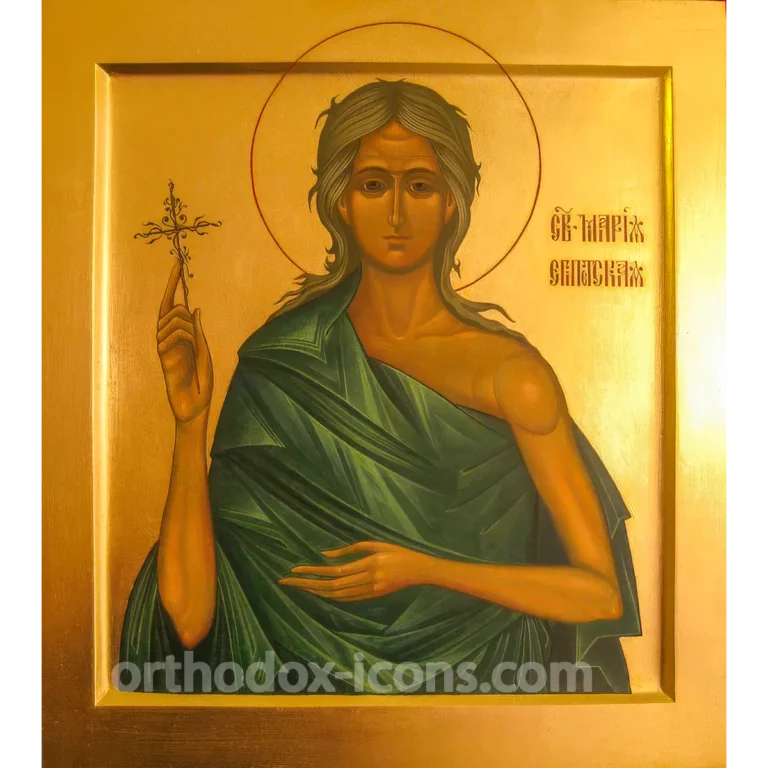
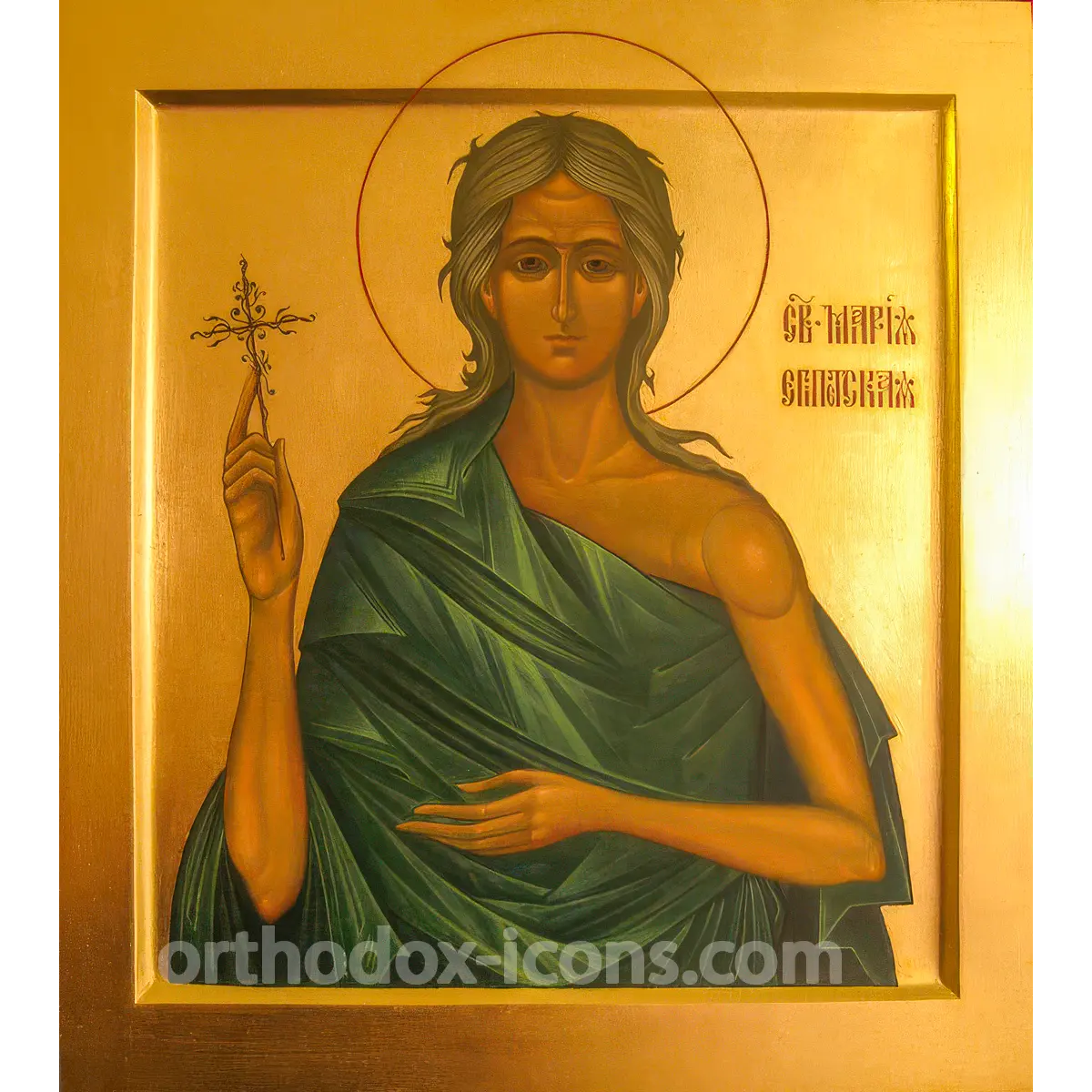
Mary the Egyptian Orthodox Icon is a hand-painted icon of Saint Mary of Egypt, the great saint of repentance and desert asceticism. The image is strict and minimal: Saint Mary is shown with loose gray hair, an ascetic face, a worn green himation, an exposed shoulder and hand, and a slender cross in her hand. The smooth polished gold background emphasizes the severity and light of her penitential path.
Materials: linden wood board with kovcheg, oak splines, pavoloka, chalk gesso, mineral egg tempera, 23K gold leaf (960 purity), and natural linseed oil finish. Free international shipping is included. Payment is made after you receive and approve the icon.
It is possible to paint an image in any size to order
Free shipping worldwide
Mary the Egyptian Orthodox Icon is a hand-painted icon of Saint Mary of Egypt, the great desert ascetic and one of the strongest Orthodox images of repentance. This icon is strict, quiet, and spiritually concentrated. The smooth polished gold background has no rich engraving or basma-style ornament; its still light emphasizes the severity of Saint Mary’s desert path and the grace that illumined her soul after repentance.
Saint Mary is shown with loose gray hair, an ascetic face, and a worn green himation covering her body. Her exposed shoulder and hand recall the years of poverty and desert struggle described in her life. In her hand she holds a slender cross, like a dry branch, a sign that the Cross of Christ and penitential prayer became her only weapon in the struggle against passions.
Mary the Egyptian Orthodox Icon – A Saint of True Repentance
The Life of Saint Mary of Egypt is among the most powerful stories in Christian tradition. Born in Egypt in the fifth century, she left home in youth and lived for many years in grave moral disorder. Her story is not told to dwell on sin, but to reveal the boundless mercy of God and the real possibility of complete spiritual change.
Her conversion began in Jerusalem, when she tried to enter the church to venerate the Life-Giving Cross of the Lord. An invisible force prevented her from entering. Understanding that her sins stood between her and the holy place, she prayed before an icon of the Mother of God and promised to change her life. After this, she was able to enter, venerate the Cross, and then went beyond the Jordan into the desert.
There Saint Mary spent forty-seven years in solitude, fasting, prayer, and fierce inner struggle. The first years were especially difficult, as memories and old desires tormented her. Yet she did not turn back. Through repentance, prayer, and the mercy of God, she became a saint whose life gives hope to all who feel trapped by the past.
Iconography of Desert Asceticism
The appearance of Saint Mary in this icon is very different from richly clothed images of royal or episcopal saints. Every detail bears witness to her desert asceticism and inward transformation.
- Green himation. Saint Mary is covered with a simple green cloak. According to her life, the monk Zosimas gave her part of his cloak when he met her in the desert, because her own clothing had worn away during many years of ascetic life.
- Ascetic body. The thin shoulder, arm, and face show the severity of fasting, hardship, and life in the desert. The icon does not idealize suffering, but reveals the seriousness of spiritual struggle.
- Loose gray hair. The sun-bleached hair falling freely around her shoulders signifies her complete renunciation of worldly vanity and concern for outward appearance.
- Slender cross. The cross in her hand signifies the crucifixion of sinful passions and her lifelong bearing of the cross of repentance.
- Smooth gold background. The polished 23K gold leaf points to divine light. Its simplicity is important: the absence of rich ornament matches the strictness of her desert life.
Prayer Before Saint Mary of Egypt
In Orthodox tradition, Saint Mary of Egypt is a powerful sign of hope. Her life teaches that no fall is beyond the mercy of God when repentance is honest, deep, and joined to the decision to change. For this reason, people turn to her when they need courage to break destructive habits and return to Christ.
Orthodox Christians pray before her icon for repentance, freedom from passions, chastity, the healing of wounded relationships, preservation of marital faithfulness, help in overcoming addictions, and the strength to begin a new life. Families may also ask her prayers for loved ones who are caught in harmful behavior or have lost their way spiritually.
Prayer to Saint Mary is not a quick formula. Her own life shows that healing can involve struggle, perseverance, fasting, tears, confession, and trust in God’s mercy. The icon encourages a person not to despair, but also not to justify sin.
Great Lent and the Standing of Saint Mary
Saint Mary of Egypt is commemorated on April 14 according to the civil calendar, and she is also especially remembered on the Fifth Sunday of Great Lent. During the same week, the Church serves the Standing of Saint Mary of Egypt, when the Great Canon of Saint Andrew of Crete and the Life of Saint Mary are read.
This connection with Great Lent makes her icon especially meaningful for a period of confession, spiritual renewal, fasting, and serious inner work. The image is also suitable as a name icon for women named Mary and as a prayerful gift for someone beginning a new spiritual path.
Where to Place the Icon
This strict and deep image may become an important part of a home prayer corner. It can be placed near icons of Christ and the Mother of God, or in a quiet place where a person prays, reads Scripture, and prepares for confession. The icon is especially appropriate during Great Lent and in any season of repentance and spiritual renewal.
Because the icon has polished gold leaf, it should be placed away from direct sunlight, moisture, candle smoke, radiators, humidifiers, and sudden temperature changes. A wooden icon case with glass is recommended for the best long-term protection.
Materials and Creation of the Icon
This icon is made by hand in the traditional technique of Orthodox icon painting. The base is a seasoned linden wood board with a kovcheg, the recessed central field on the front side. Oak splines are inserted into the board to help prevent warping over time.
The board is prepared with pavoloka, a linen cloth layer, and many layers of chalk gesso. The gesso is carefully smoothed to create a firm, even surface for painting. The face, hair, hands, green himation, cross, and inscriptions are then painted with mineral egg tempera.
The green tones of the cloak are created with natural mineral pigments, and the flesh tones are painted to express the ascetic severity of the desert life. The background is covered with 23K gold leaf (960 purity) on bole and polished with agate for a mirror-like shine. This smooth gilding is deliberately restrained, matching the spiritual minimalism of the image.
The final stage is a natural linseed oil finish, which deepens the colors and helps protect the painted surface. Because the icon is hand-painted, every finished image has individual nuances in the face, gold, green garment, cross, and inscriptions.
| Characteristic | Materials and Technique |
|---|---|
| Icon board | Seasoned linden wood with kovcheg and oak splines. |
| Ground | Pavoloka and multiple layers of natural chalk gesso. |
| Painting | Mineral egg tempera with natural pigments, including green earth tones for the himation. |
| Gilding | 23K gold leaf (960 purity), smoothly polished with agate. |
| Protective finish | Natural linseed oil finish for depth of color and protection. |
Icon Characteristics
| Icon name | Mary the Egyptian Orthodox Icon |
|---|---|
| Saint depicted | Venerable Mary of Egypt |
| Iconographic type | Ascetic image of Saint Mary in the desert, with green himation and cross |
| Main meaning | Repentance, victory over passions, chastity, spiritual struggle, hope, and return to God |
| Decorative features | Kovcheg, smooth polished gold background, restrained composition without rich ornament |
| Materials | Linden wood board, oak splines, pavoloka, chalk gesso, mineral egg tempera, 23K gold leaf (960 purity), natural linseed oil |
| Available sizes | 17×21 cm (6.7×8.3 in), 20×24 cm (7.9×9.4 in), 27×31 cm (10.6×12.2 in), 30×40 cm (11.8×15.7 in) |
| Feast days | April 14; Fifth Sunday of Great Lent |
Who This Icon Is Suitable For
This icon is a meaningful spiritual support for a person who has begun the path of repentance, confession, fasting, and moral renewal. It is also suitable as a name icon for women named Mary, and as a deep Orthodox gift for Great Lent or another serious spiritual occasion.
The image may be placed in a home icon corner, prayer room, monastic cell, parish space, or a quiet place used for reading Scripture and penitential prayer. It is not a decorative image in the ordinary sense, but a strict and hopeful reminder that God’s mercy can raise a person from even the deepest fall.
Available sizes are 17×21 cm (6.7×8.3 in), 20×24 cm (7.9×9.4 in), 27×31 cm (10.6×12.2 in), and 30×40 cm (11.8×15.7 in). Larger church and full-length icons can be made by individual commission. Free international shipping is included. Payment is made after you receive and approve the icon.
Care of the Icon
Polished gold leaf is very delicate. Do not rub it with cloths, wet wipes, or fingers. Dust should be removed only gently with a soft dry brush. To protect the icon from humidity changes, dust, and candle smoke, a wooden icon case with glass is recommended.
The icon should also be kept away from direct sunlight, heat sources, damp places, and household cleaning products. With careful care, mineral egg tempera and gold leaf can preserve their beauty for generations.
Questions and Answers
Why is Saint Mary of Egypt shown with an exposed shoulder and arm?
This follows her life in the desert. After many years of ascetic struggle, her clothing had worn away, and she was covered with the cloak given to her by the monk Zosimas.
Why are her face and body painted so thin and sun-darkened?
The ascetic appearance points to her long years in the desert, fasting, hardship, and spiritual struggle. It shows the severity of repentance and the transformation of the body through prayer.
What does the cross in her hand mean?
The cross signifies her voluntary crucifixion of sinful passions and her lifelong bearing of the cross of repentance before Christ.
Why is the gold background smooth rather than richly ornamented?
The smooth polished gold emphasizes the strict simplicity of Saint Mary’s desert life. Its mirror-like light points to divine grace shining through repentance.
What do people ask Saint Mary of Egypt for?
Orthodox Christians ask her intercession for repentance, freedom from passions, healing of destructive habits, chastity, spiritual strength, and the courage to change one’s life.
What is the Standing of Saint Mary of Egypt?
It is a special Lenten service, served on Thursday of the fifth week of Great Lent, when the Great Canon of Saint Andrew of Crete and the Life of Saint Mary of Egypt are read.
Why is Saint Mary important during Great Lent?
Her life is one of the strongest Orthodox examples of repentance. The Church places her memory before the faithful during Great Lent as a call to conversion, hope, and spiritual struggle.
How should an icon with polished gold be cared for?
Polished gold leaf is delicate and should not be rubbed with cloths, wet wipes, or fingers. Dust should be removed very gently with a soft dry brush, and an icon case is recommended.
Will the colors of the icon fade over time?
The icon is painted with mineral egg tempera, a traditional and durable technique. The icon should still be protected from strong direct sunlight, moisture, heat, and household chemicals.
Should this icon be blessed after receiving it?
If the icon has not already been blessed, it may be brought to an Orthodox church for blessing. This is a traditional practice for a prayer icon used at home.
| Dimensions | 17x21cm (6.7×8.3 in), 20x24cm (7.9×9.4 in), 27x31cm (10.6×12.2 in), 30x40cm (11.8×15.7 in) |
|---|---|
| Name | Mary |