Mary of Egypt Orthodox Icon
Price range: $600 through $2100
Available sizes: 17×21 cm (6.7×8.3 in), 20×24 cm (7.9×9.4 in), 27×31 cm (10.6×12.2 in), 30×40 cm (11.8×15.7 in). Larger church and iconostasis sizes can be made by individual commission.
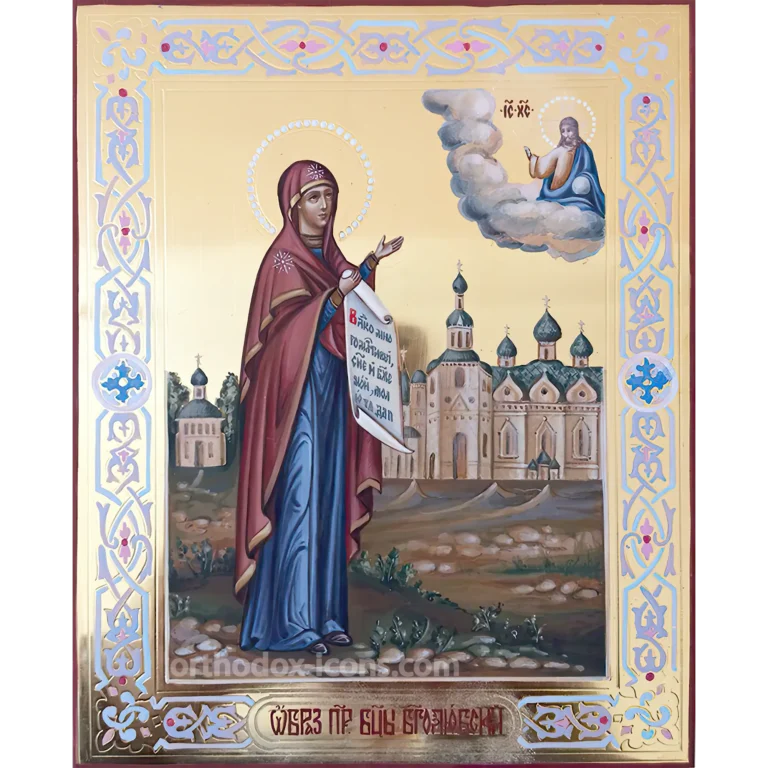
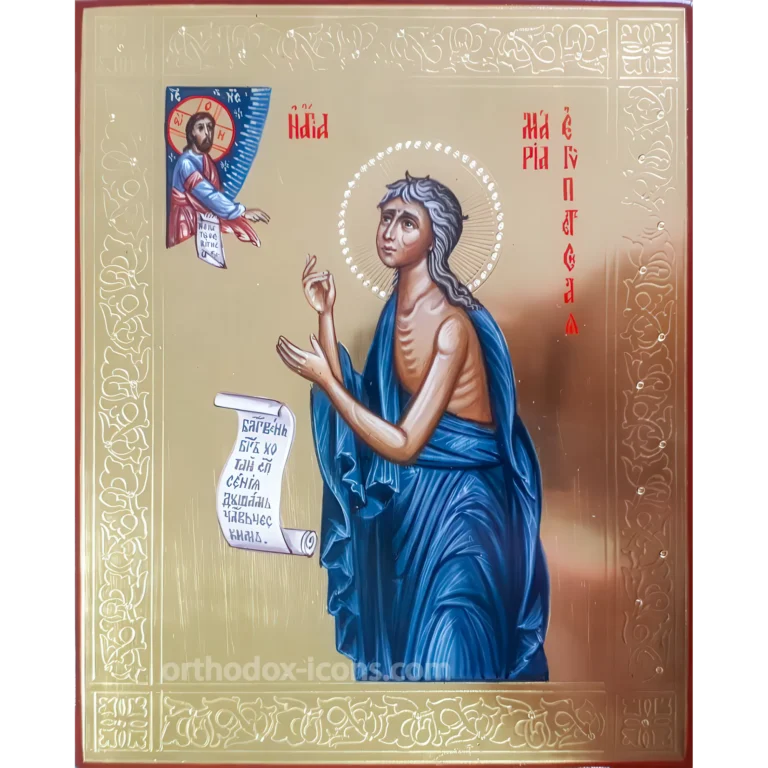
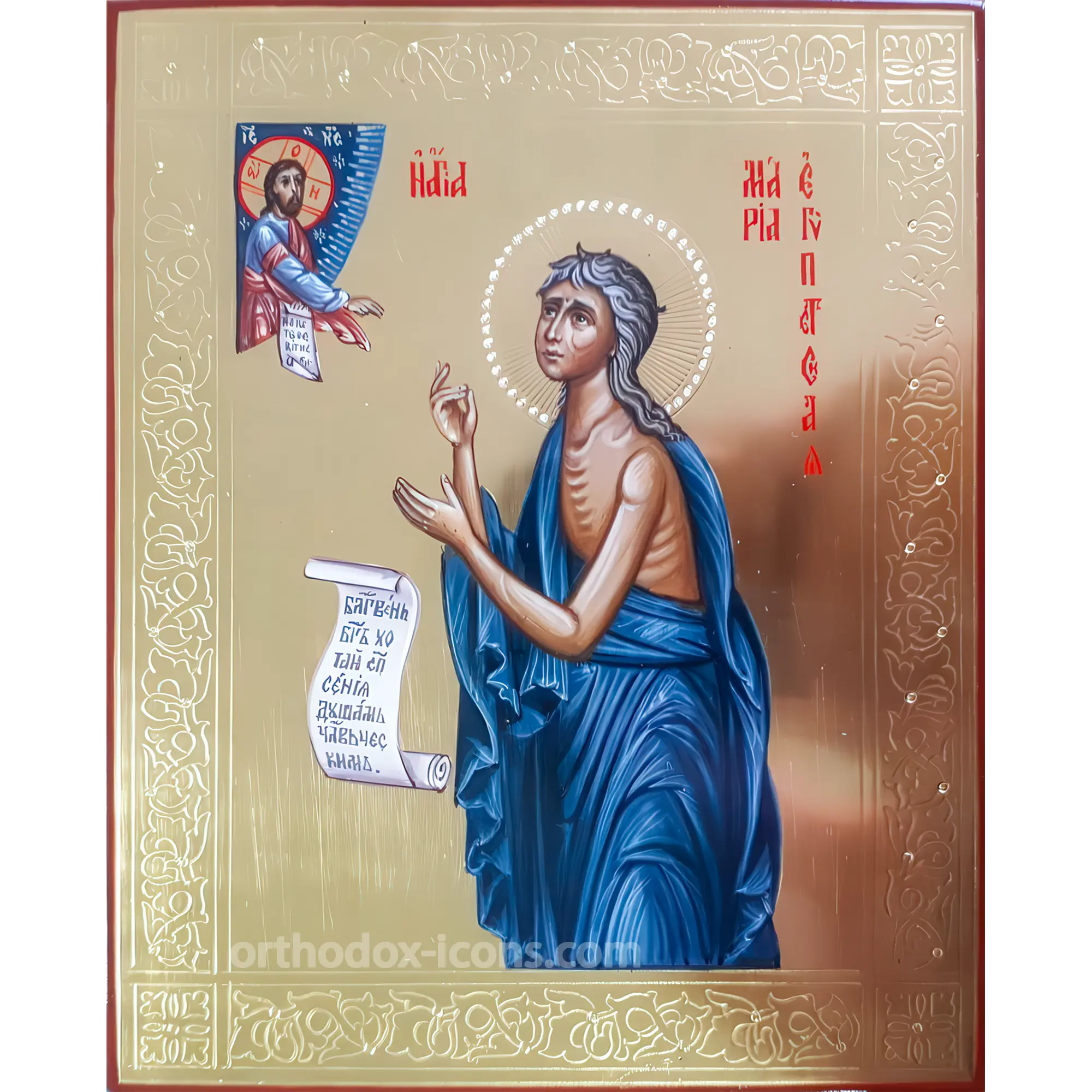
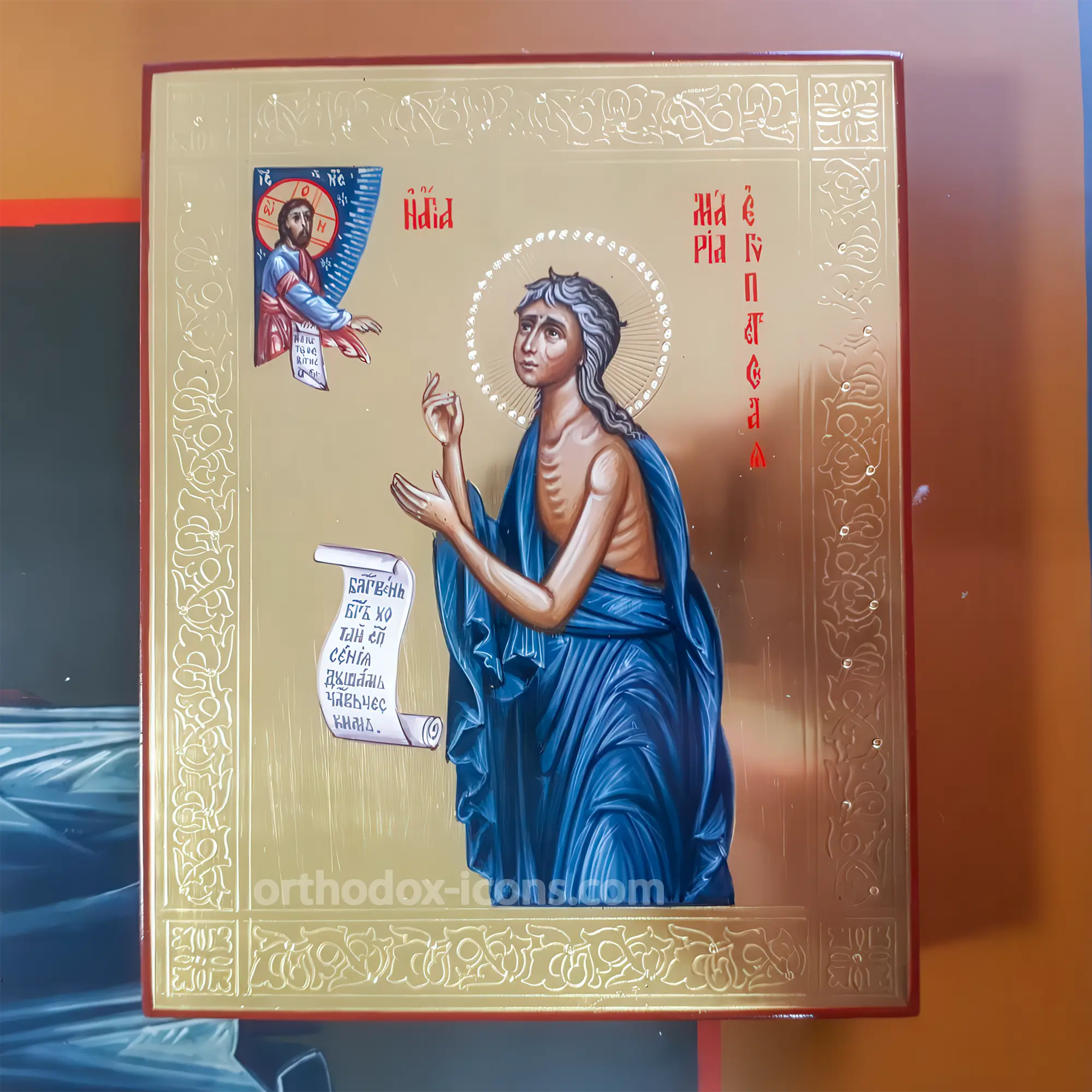
Mary of Egypt Orthodox Icon is a hand-painted icon of Saint Mary of Egypt, the great desert ascetic and saint of repentance. She is shown in blue garments, with hands raised in prayer, a scroll beside her, and an image of Christ in the upper part of the composition. The gilded background and ornamental borders give the icon a solemn, prayerful character.
Materials: solid linden wood board, oak splines, natural chalk gesso, mineral egg tempera, and 23K gold leaf (960 purity). Free international shipping is included. Payment is made after you receive and approve the icon.
It is possible to paint an image in any size to order
Free shipping worldwide
Mary of Egypt Orthodox Icon is a hand-painted icon of Saint Mary of Egypt, the great desert ascetic and saint of repentance. This icon speaks to every person who longs to return to God, cleanse the heart, and begin a new spiritual life. Saint Mary is shown in blue garments, with her hands raised in prayer, a scroll beside her, and an image of Christ in the upper part of the composition. The gilded background and ornamental borders make the image solemn, luminous, and deeply prayerful.
The icon of Saint Mary of Egypt is especially meaningful for those who are going through inner change, struggling with passions, seeking freedom from sinful habits, returning to confession and the life of the Church, or asking for strength during Great Lent. Her life is one of the most powerful Orthodox witnesses that no person is beyond repentance, renewal, and salvation when the soul truly turns to Christ.
Mary of Egypt Orthodox Icon – Saint of Repentance
Saint Mary of Egypt was born in Egypt and left her home in youth. For many years her life was far from Christian purity and spiritual sobriety. This is why her life touches so many people: it does not present an outwardly flawless righteousness from childhood, but the true power of repentance when a wounded soul turns completely toward God.
The turning point came in Jerusalem. According to church tradition, Mary tried to enter the church to venerate the Life-Giving Cross of the Lord, but an invisible force did not allow her to cross the threshold. Then she understood the depth of her fall, prayed to the Most Holy Theotokos, and promised to change her life. After this, she was able to enter the church, venerate the Cross, and then crossed the Jordan into the desert.
In the desert Saint Mary spent many years in repentance, prayer, fasting, solitude, and spiritual struggle. Her ascetic life was not a romantic legend, but a deep inner transformation. She fought memories of her former life, bodily passions, hunger, thirst, loneliness, and temptations, yet she did not return to the past. Her holiness shows that repentance is not only regret, but a real path of human transfiguration.
Spiritual Meaning of the Icon
The icon of Saint Mary of Egypt reveals the themes of repentance, humility, spiritual freedom, and hope. She is not shown in rich garments or earthly glory. Her image is ascetic, concentrated, and turned toward God. The blue clothing creates a feeling of inward depth, spiritual silence, and penitential focus.
Her raised hands form a prayerful gesture. This is not a gesture asking for ordinary earthly success, but a sign of the whole soul turning toward the Lord. The face of Saint Mary is marked by repentance, humility, and hope. Her gaze is lifted toward Christ, making the composition feel alive: this is a moment of prayerful encounter, not a static portrait.
The image of Christ in the upper part of the icon is especially important. Saint Mary’s repentance was not a psychological self-improvement project or a moral effort alone. It was directed to Christ, and the strength for change came from God. The icon reminds the faithful that the Lord receives a repentant person when repentance is joined to the decision to leave the old path behind.
The scroll beside the saint deepens the meaning of the image. In iconography, a scroll may point to prayer, spiritual testimony, sacred teaching, or the memory of a saint’s life. Here it reminds the one praying that a person should neither despair because of the past nor justify sin. True repentance requires honesty, resolve, and faith in God’s mercy.
The gold background signifies divine light and heavenly glory. This is especially expressive in the image of a saint who spent years in the desert without human comfort. The icon shows not only the severity of ascetic struggle, but its end: a repentant person can become a participant in the light of God.
Prayer Before the Icon of Saint Mary of Egypt
Before the icon of Saint Mary of Egypt, Orthodox Christians pray for repentance, freedom from passions, strength in fasting, return to God, and inner renewal. This icon is especially close to those who no longer want to make peace with sinful habits, spiritual coldness, despair, or the heaviness of the past.
Saint Mary helps a person neither to excuse sin nor to fall into hopelessness. Her life shows that God’s mercy is stronger than any fall when a person truly turns to the Lord.
Before this icon people often pray:
- for the gift of repentance and the cleansing of conscience;
- for freedom from passions, addictions, and sinful habits;
- for chastity, spiritual sobriety, and purity of heart;
- for strength during Great Lent and in personal prayer;
- for return to confession, Holy Communion, and church life;
- for overcoming despair, shame, and inner heaviness;
- for women named Mary;
- for family members and loved ones who are in a difficult moral or spiritual struggle.
This icon can be especially important for someone beginning a new spiritual stage: returning to church, preparing for confession, entering a period of fasting, struggling with dependency, experiencing deep remorse, or looking for a way out of an inner dead end.
Feast Days of Saint Mary of Egypt
The feast day of Saint Mary of Egypt is celebrated on April 14 according to the civil calendar. She is also especially remembered on the Fifth Sunday of Great Lent. These dates are meaningful when choosing an icon as a gift for a woman named Mary, for a name day, for Great Lent, for confession, or for a personal spiritual milestone.
If the icon is being made for a particular date, it is best to allow enough time for board preparation, gesso, gilding, painting of the face and garments, the image of Christ, the scroll, ornament, and inscriptions.
Features of This Hand-Painted Icon
In this icon Saint Mary of Egypt is shown in prayerful turning toward Christ. Her figure is almost full-length, but the main attention is on the face, hands, and inner movement of prayer. The composition is not dark or hopeless; the gold background and blessing image of Christ show that repentance leads not to despair, but to light.
The garments are painted in blue and light-blue tones. Blue helps express depth of repentance, inner silence, and detachment from the former life. The ascetic body and exposed parts of the figure recall the desert struggle, deprivation, and complete refusal of earthly luxury.
The image of Christ with a scroll in the upper left part of the icon completes the composition theologically. Saint Mary is not simply looking upward; she is turned to Christ, before whom her penitential prayer is offered. The red inscriptions on the background emphasize the sacred character of the image.
The background and borders are worked in golden tones with ornamental details. Fine plant motifs and decorative elements along the edges give the icon a solemn appearance, while the central figure remains spiritually focused and readable.
Icon Characteristics
| Icon name | Mary of Egypt Orthodox Icon |
| Saint depicted | Venerable Mary of Egypt |
| Iconographic type | Saint Mary in penitential prayer, with the image of Christ and a scroll |
| Feast days | April 14; Fifth Sunday of Great Lent |
| Main meaning | Repentance, return to God, freedom from passions, chastity, spiritual renewal, hope in divine mercy |
| Decorative features | Gilded background, ornamental borders, image of Christ in the upper part, scroll, gold halo |
| Materials | Linden wood board, oak splines, chalk gesso, mineral egg tempera, 23K gold leaf (960 purity) |
| Available sizes | 17×21 cm (6.7×8.3 in), 20×24 cm (7.9×9.4 in), 27×31 cm (10.6×12.2 in), 30×40 cm (11.8×15.7 in) |
Materials and Creation of the Icon
The icon of Saint Mary of Egypt is painted on a natural solid linden wood board. Linden is traditionally used in icon painting because of its even structure, stability, and ability to receive the prepared ground well. Oak splines help the board keep its shape and reduce the risk of deformation when humidity and temperature change.
After the wooden base is prepared, natural chalk gesso is applied. This traditional multi-layer ground creates a firm and smooth surface for painting. In the icon of Saint Mary, the quality of the ground is especially important because the painter must render the face, ascetic body, hands, blue garments, scroll, image of Christ, gilded background, and ornamental borders.
The painting is done with mineral egg tempera on egg emulsion. This technique allows depth of color, soft transitions, noble matte surfaces, and durability. The image is developed gradually, from general silhouette to the details of the face and hands, from main color areas to highlights, from background to ornament and inscriptions.
The gilding uses 23K gold leaf (960 purity). Gold is used in the background, halo, decorative details, and ornamental frame. In Orthodox iconography, gold means divine light and heavenly glory. In this icon, the gold shows that the penitential path of Saint Mary ended not in the darkness of the desert, but in glorification by the Church.
This icon is painted on a flat board without a recessed kovcheg. A board with kovcheg can be requested individually before the icon is made.
Who This Icon Is Suitable For
The icon of Saint Mary of Egypt is especially suitable as a name icon for women named Mary. It may be given for baptism, name day, birthday, return to church life, the beginning of Great Lent, an important spiritual milestone, or a period of inner renewal.
It is also suitable for a monastery, church, chapel, confession area, prayer room, home icon corner, or monastic cell. The image is often chosen by people who especially venerate saints of repentance, desert ascetics, and those who show the transforming mercy of God.
Choosing the Size
The sizes 17×21 cm (6.7×8.3 in) and 20×24 cm (7.9×9.4 in) are convenient for a home icon corner, personal shelf, monastic cell, or gift. The size 27×31 cm (10.6×12.2 in) makes the face, hands, scroll, image of Christ, and gold background easier to see. The size 30×40 cm (11.8×15.7 in) is suitable for a spacious home, prayer room, chapel, or church.
For iconostasis or church use, the icon can be commissioned in a larger size. In a large format, the ornamental borders, gilding, figure of the saint, inscriptions, and upper image of Christ can be developed with greater detail.
Blessing and Care of the Icon
If desired, the icon may be blessed in an Orthodox church before it is given, or after receiving it in one’s own parish. Blessing helps the icon be received not as decoration, but as a sacred image for prayer, repentance, and turning to God through the intercession of the saint.
A hand-painted icon should be cared for gently. Dust is best removed with a soft dry brush or cloth, without pressure. Do not wipe the icon with a wet cloth, place it in direct sunlight, keep it near a radiator or humidifier, or expose it to sudden temperature changes. Gilded and ornamental areas should be treated with special care.
Free international shipping is included. Payment is made after you receive and approve the icon.
Questions and Answers
Who is depicted in the Mary of Egypt Orthodox Icon?
The icon depicts Saint Mary of Egypt, a great desert ascetic and saint of repentance who passed from a sinful life to holiness through prayer, fasting, and complete turning to God.
What do Orthodox Christians pray for before Saint Mary of Egypt?
They pray for repentance, freedom from passions, return to God, spiritual sobriety, chastity, strength in fasting, and help in overcoming sinful habits.
Is this icon suitable as a name icon?
Yes. It is especially suitable as a name icon for women named Mary, honoring a saint who shows the transforming power of true repentance.
When is Saint Mary of Egypt commemorated?
Saint Mary of Egypt is commemorated on April 14 according to the civil calendar, and she is also especially remembered on the Fifth Sunday of Great Lent.
Why is Saint Mary of Egypt called a saint of repentance?
Her life was completely changed after her conversion to God. She left her former life, went into the desert, and spent many years in prayer, fasting, and spiritual struggle.
What does the image of Christ in the upper part of the icon mean?
The image of Christ shows that Saint Mary’s repentance is directed to the Lord and that her transformation was accomplished through God’s mercy and grace.
Does this icon have a kovcheg?
No. This icon is described as having a gilded background and ornamental borders, but not a recessed kovcheg. A board with kovcheg can be requested individually.
Is this icon suitable for Great Lent?
Yes. The icon is especially appropriate during Great Lent, because the life of Saint Mary of Egypt is closely connected with repentance, spiritual struggle, and return to God.
What materials are used for this hand-painted icon?
The icon is painted on a linden wood board with oak splines, natural chalk gesso, mineral egg tempera on egg emulsion, and 23K gold leaf (960 purity).
What sizes are available?
Available sizes are 17×21 cm (6.7×8.3 in), 20×24 cm (7.9×9.4 in), 27×31 cm (10.6×12.2 in), and 30×40 cm (11.8×15.7 in). Larger church and iconostasis sizes can be made by commission.
| Dimensions | 17x21cm (6.7×8.3 in), 20x24cm (7.9×9.4 in), 27x31cm (10.6×12.2 in), 30x40cm (11.8×15.7 in) |
|---|---|
| Name | Mary |