Emmelia of Caesarea Orthodox Icon
Price range: $600 through $1500
Available sizes: 13×25 cm (5.1×9.8 in), 18×31 cm (7.1×12.2 in), 30×50 cm (11.8×19.7 in). Larger iconostasis sizes can be made by agreement.
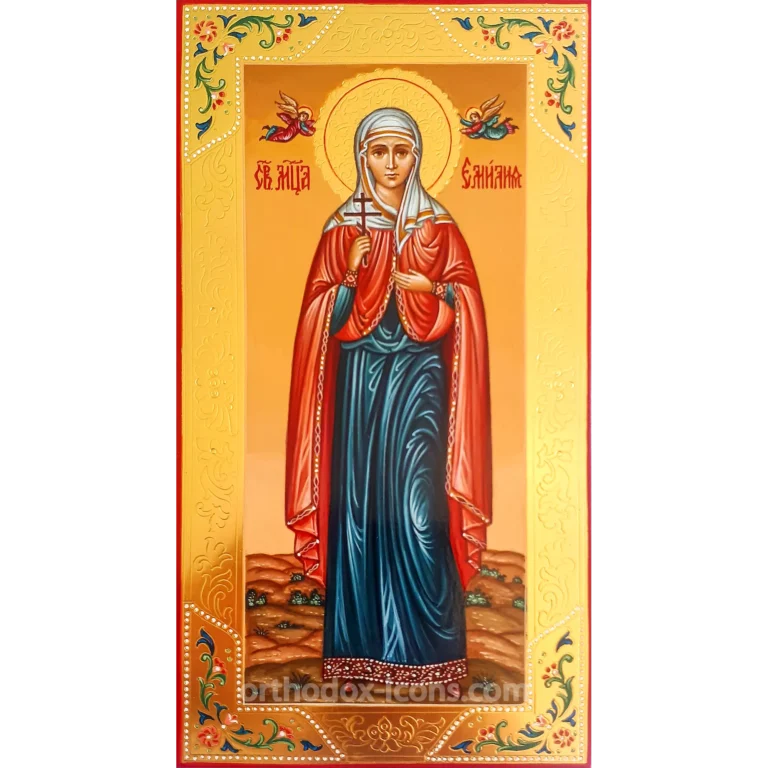
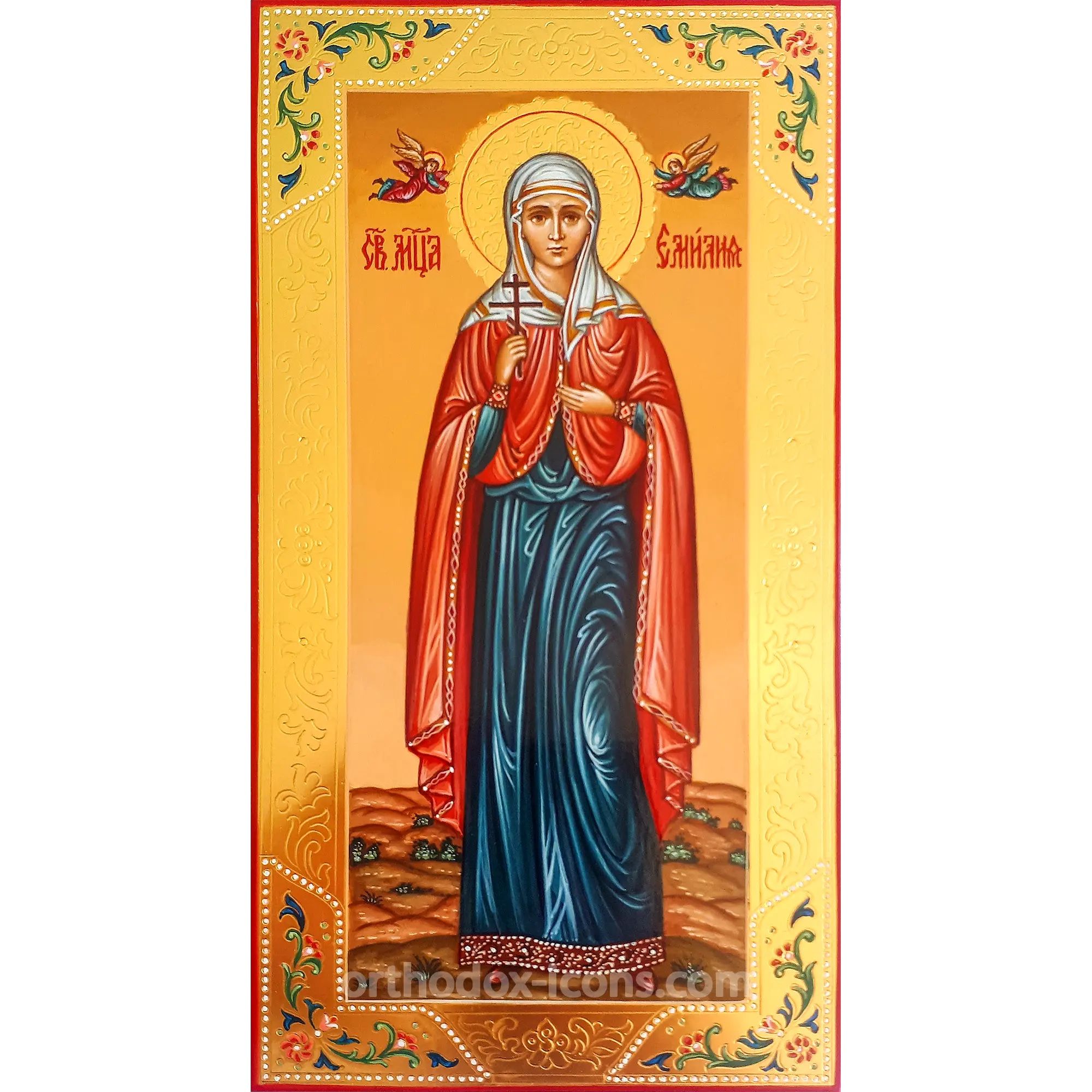
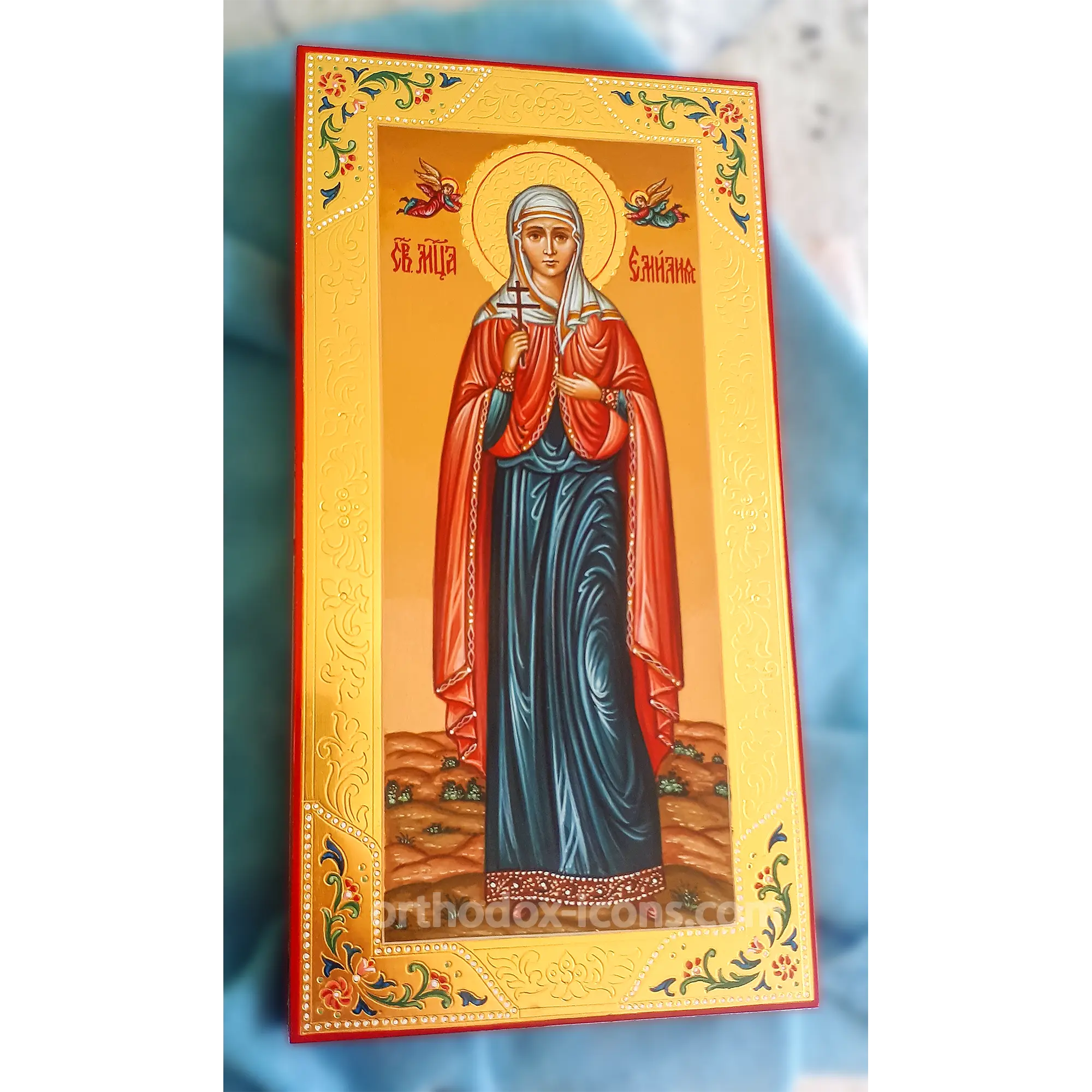
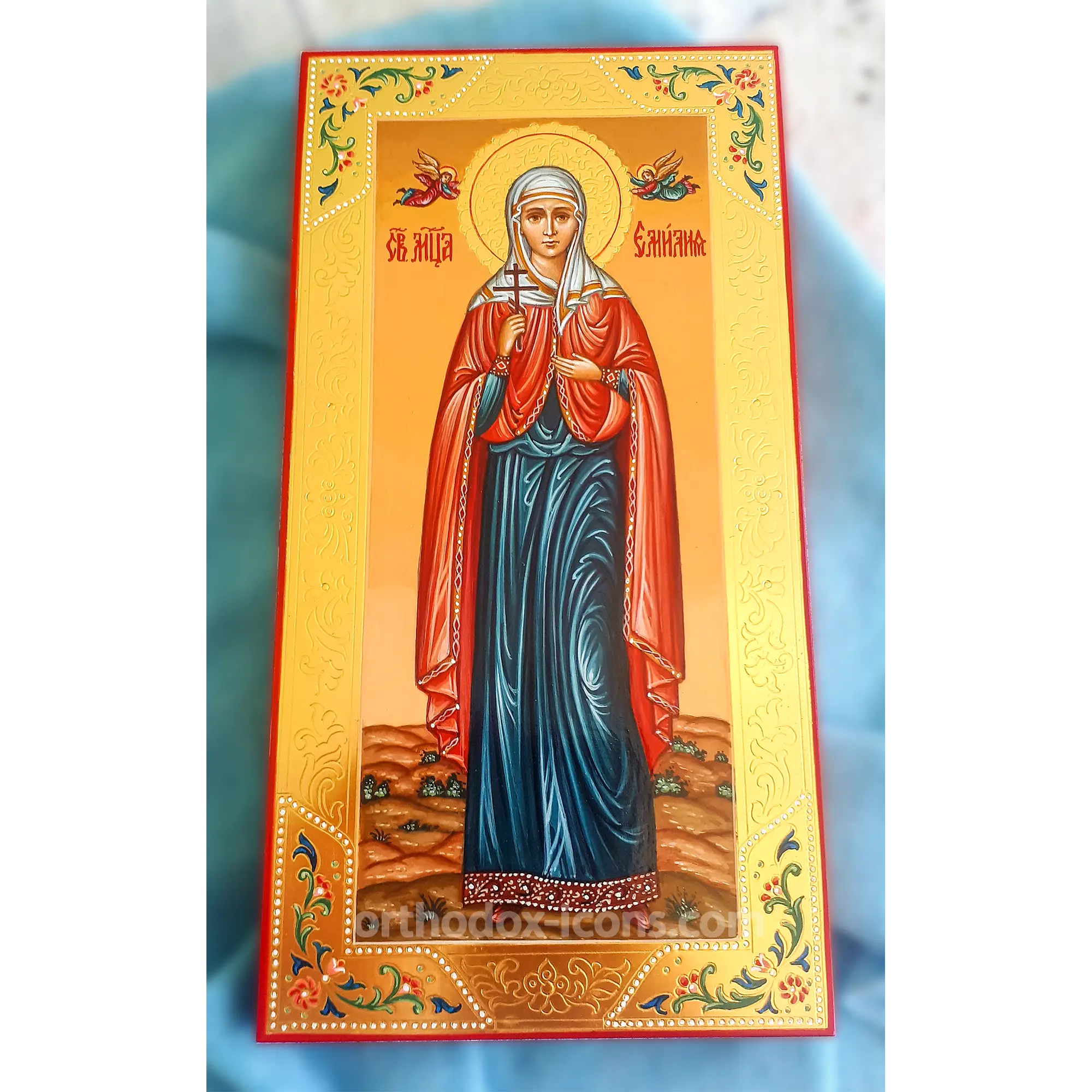
This hand-painted Emmelia of Caesarea Orthodox Icon shows the holy venerable Emmelia, a fourth-century Christian mother of Saint Basil the Great, Saint Gregory of Nyssa, Saint Peter of Sebaste, and Saint Macrina. She is painted full-length, holding a cross, with a light head covering, red mantle, blue-green garment, gilded background, ornamental borders, floral corner motifs, and small angelic figures near the halo.
The icon is painted on a linden wood board with oak braces, gesso, egg tempera, mineral pigments, 23K gold leaf (960 purity), hand-tooled ornament, and a protective finish. It is suitable for a home iconostasis, patron saint gift for Emmelia or Emilia, a mother, godmother, daughter, wife, family with children, church, chapel, or iconostasis row. Free international shipping is included. Payment is made after you receive and approve the icon.
It is possible to paint an image in any size to order
Free shipping worldwide
This hand-painted Emmelia of Caesarea Orthodox Icon is a prayerful image of a devout fourth-century Christian woman whom the Church honors as the mother of great saints and as an example of deep family faith. Her life did not unfold through public triumph, military courage, or martyrdom, but through another difficult and lofty path: building a Christian home, raising children in love for God, enduring sorrow, remaining faithful to the Church, and later turning with her daughter Macrina toward a more monastic way of life.
For this reason, the icon of Saint Emmelia of Caesarea is especially close to families, mothers, women named Emmelia or Emilia, and all who pray for children, peace in the home, patience, and the right spiritual ordering of family life.
In this icon Saint Emmelia is shown full-length, frontal, in a restrained and noble posture. In her right hand she holds a cross, the sign of following Christ, personal faithfulness to the Gospel, and readiness to bear her life-s cross without complaint. Her face is calm and attentive. There is no outward severity in it, but there is the inner concentration of a woman who passed through a demanding life and left behind not only the memory of personal piety, but a whole spiritual family of saints.
Available sizes are 13×25 cm (5.1×9.8 in), 18×31 cm (7.1×12.2 in), and 30×50 cm (11.8×19.7 in). Larger iconostasis sizes can be made by agreement. The narrow vertical formats are well suited to the full-length image: the figure remains coherent, the prayerful rhythm of the composition is preserved, and the gilded borders and ornament do not compete with the face.
Features of This Icon
The main feature of this icon is the union of solemn gilded decoration with a very personal and warm image of the saint. Emmelia of Caesarea is not shown as an abstract symbol of motherhood, but as a living Christian ascetic: with an open gaze, calm posture, cross in hand, and softly falling garments. The composition is not overloaded with unnecessary details, yet it looks festive because of the gold background, ornamental borders, and floral motifs.
The light head covering emphasizes modesty and purity. The red mantle adds depth and warmth to the composition. The blue-green lower garment is painted with soft folds that reveal the full-length silhouette well. This color combination makes the icon expressive: red and warm ocher tones speak of love, vitality, and spiritual self-giving, while the deep blue helps preserve prayerful restraint.
The cross in Saint Emmelia’s hand is the central meaningful detail. For her, it does not point to an outward military or public feat, but to Christian cross-bearing: patience, faithfulness, maternal responsibility, spiritual struggle for her children, and the willingness to live according to Christ-s commandments. In family life such labors are often hidden from public view, yet they shape the atmosphere of the home and pass living faith to children.
The golden halo around the saint-s head is set off by tooled radiance and fine ornament. Small angelic figures are shown on either side of the halo, strengthening the heavenly character of the composition and making the upper part of the icon more festive. The wide gilded borders are decorated with plant ornament, and floral motifs are painted in the corners. Because of this, the image feels bright, solemn, and warmly domestic rather than cold or severe.
The background and borders are covered with gold, with decorative ornament visible on the surface. This setting is especially fitting for an icon of Saint Emmelia. It does not make the image luxurious merely for effect; it helps show the dignity of a holy mother whose quiet family life bore great fruit for the Church. The gold creates a sense of light, while the floral ornament recalls the spiritual fruitfulness of a family raised in faith.
Iconography of Saint Emmelia of Caesarea
Saint Emmelia of Caesarea, or of Cappadocia, is most often venerated as the pious mother of a holy family. Her iconography can be restrained: she may be shown in a woman-s veil, with a cross, either full-length or half-length. In this icon, the full-length type is chosen, presenting her as a saint in her own right, not only as the mother of famous hierarchs.
The full-length image helps reveal the wholeness of Emmelia’s spiritual labor. She stands calmly and directly, without outward drama. Her posture speaks of inner stability. Her life was connected with family responsibility, the upbringing of children, losses, widowhood, and later a movement toward a monastic way of life together with her eldest daughter, Macrina. The icon is therefore an image of firmness, mature faith, and maternal prayer.
The cross in her hand is especially important for prayerful perception. It reminds the viewer that the path of a Christian mother is not only the joy of bearing and raising children, but also daily self-giving. In this sense Saint Emmelia is close to many families today: her image helps people pray for patience, wisdom, tenderness, and the inner strength needed to keep peace in the home.
The floral ornament on the borders may be seen as an artistic continuation of the theme of spiritual fruitfulness. Saint Emmelia raised children among whom the Church glorified great hierarchs and ascetics. For a Christian family, this is a powerful image: faith passed to children through love, example, and prayer becomes fruit that can live far beyond the earthly life of the parents.
Prayer Before the Icon of Saint Emmelia
Before an icon of Saint Emmelia of Caesarea, Orthodox Christians may pray for family, children, motherly wisdom, and peace in the home. Her image is especially close to those who carry responsibility for raising children, experience difficulties in family life, seek patience in parental cares, or ask God for strength to preserve a good and believing atmosphere in the home.
People may pray to Saint Emmelia for help in raising children in faith, love, and diligence; motherly wisdom, patience, and gentleness of heart; peace between spouses, parents, and children; support for large families; help for women who worry about their children; spiritual strengthening of mothers and godmothers; guidance for teenagers and grown children; preservation of faith in the family; patience in sorrow, widowhood, and life changes; and heavenly protection for women named Emmelia or Emilia.
Prayer before Saint Emmelia’s icon is not a request for every family difficulty to disappear instantly. It is an appeal to God through the intercession of a saint who herself passed through family care, upbringing, responsibility, and spiritual maturity. Her image helps a person not to grow hard, not to give up, not to act only out of irritation, but to seek a Christian way of living with loved ones: patiently, honestly, prayerfully, and with love.
Brief Life of Saint Emmelia
Saint Emmelia of Caesarea lived in the fourth century in Cappadocia. She came from a devout Christian family, knew sorrow and trial from early life, yet remained faithful to God. Her husband was Basil the Elder, also from a Christian family. Their household became one of the best-known examples of Christian family piety in Church history.
The Lord blessed Emmelia with many children. In Orthodox tradition she is especially honored as the mother of saints: Saint Basil the Great, Saint Gregory of Nyssa, Saint Peter of Sebaste, Saint Macrina the Younger, Righteous Naucratius, and Blessed Theosebia. Such fruit of family upbringing was not accidental. In Emmelia’s home, faith was not a formality, but the very air in which the children lived.
After the death of her husband and the growth of her children, Emmelia and her eldest daughter Macrina turned toward a stricter ascetic way of life. They withdrew to an estate near the River Iris and formed a Christian community where life was built around prayer, labor, restraint, and mutual love. For Saint Emmelia, this became the continuation of her earthly path: from family service to monastic concentration and preparation for eternity.
Her life is especially important because it shows that holiness can grow in ordinary circumstances. A home, children, daily cares, household responsibilities, sorrow, upbringing, and patience can all become a path to Christ when a person lives with faith and prayer. This is why her icon naturally belongs in a home iconostasis: it speaks not only about the past, but about family life today.
Commemoration and Patron Saint Meaning
Saint Emmelia of Caesarea is commemorated on January 14 according to the civil calendar, January 1 according to the old calendar. For a woman or girl named Emmelia or Emilia, this icon can be a personal patron saint image for baptism, name day, birthday, or another important family occasion.
The meaning of the icon, however, is wider than the name alone. Saint Emmelia is a saint of the Christian home: of motherhood, patience, faithful upbringing, and quiet spiritual fruit. For this reason, her icon is also suitable as a gift for mothers, godmothers, wives, daughters, grandmothers, and families with children.
Materials and Technique
The icon is hand-painted on a linden wood board strengthened with oak braces. The surface is prepared with gesso, and the image is painted in egg tempera with mineral pigments. 23K gold leaf (960 purity) is used for the background, halo, and sacred accents. The gilded surface includes hand-tooled ornament, and a protective finish is applied after painting.
Because this is a hand-painted icon, small differences in gold tone, tooling, inscriptions, facial painting, floral details, and color accents are natural. They do not change the iconographic meaning of the image. They show that the icon is a painted devotional work rather than a printed reproduction.
Choosing the Size
The 13×25 cm size is compact and convenient for a personal prayer shelf or patron saint gift. The 18×31 cm size looks more expressive in a home iconostasis while preserving the narrow vertical rhythm of the full-length figure. The 30×50 cm size is suitable for a spacious home, chapel, church, separate icon case, or iconostasis row. Larger iconostasis sizes can be discussed individually.
Placement and Care
The icon should be placed in a clean and dignified area, away from moisture, direct sunlight, overheating, soot, and mechanical damage. Dust should be removed only with a soft dry brush, without pressure. For additional protection of the painting and gilding, an icon case is recommended.
Free international shipping is included. Payment is made after you receive and approve the icon.
Questions and Answers
Who is shown in the Emmelia of Caesarea Orthodox Icon?
The icon shows Saint Emmelia of Caesarea, also known as Emmelia of Cappadocia, a fourth-century Christian woman and mother of Saint Basil the Great.
Why is Saint Emmelia venerated as a patron of families?
Saint Emmelia raised her children in deep Christian faith, and several of them were glorified by the Church. For this reason, people ask her prayers for family life, children, upbringing, and peace in the home.
What does the cross in Saint Emmelia’s hand mean?
The cross recalls her following of Christ, patience, faithfulness to the Gospel, and readiness to bear her life-s cross in family and spiritual service.
What do people pray for before an icon of Saint Emmelia?
People may pray for motherly wisdom, the Christian upbringing of children, peace in the family, patience, help in parental cares, and spiritual strengthening of the home.
Who is this icon suitable for as a gift?
It is suitable for a woman or girl named Emmelia or Emilia, a mother, godmother, wife, daughter, grandmother, and families who pray for children and peace in the home.
What sizes are available for this icon?
The available sizes are 13×25 cm, 18×31 cm, and 30×50 cm. Larger iconostasis sizes can also be discussed before painting.
When is Saint Emmelia of Caesarea commemorated?
Saint Emmelia of Caesarea is commemorated on January 14 according to the civil calendar, January 1 according to the old calendar.
Is this icon suitable for a home iconostasis?
Yes. The icon of Saint Emmelia is especially suitable for a home iconostasis in a family that prays for children, peace, patience, and Christian upbringing.
Can this icon be ordered in a church size?
Yes. The icon can be painted in a larger or iconostasis size for a church, chapel, prayer room, family icon case, or separate icon row.
How should a hand-painted icon with gilding be cared for?
Keep the icon away from moisture, direct sunlight, overheating, soot, and mechanical damage. Dust it only with a soft dry brush; an icon case is recommended to protect the painting and gilding.
| Dimensions | 13x25cm (5.1×9.8 in), 18x31cm (7.1×12.2 in), 30x50cm (11.8×19.7 in) |
|---|---|
| Name | Emmelia |