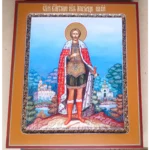
Saint Alexander Nevsky Icon 27×31
$850
Available size: 27×31 cm (10.6×12.2 in); larger and iconostasis sizes can be made by agreement.
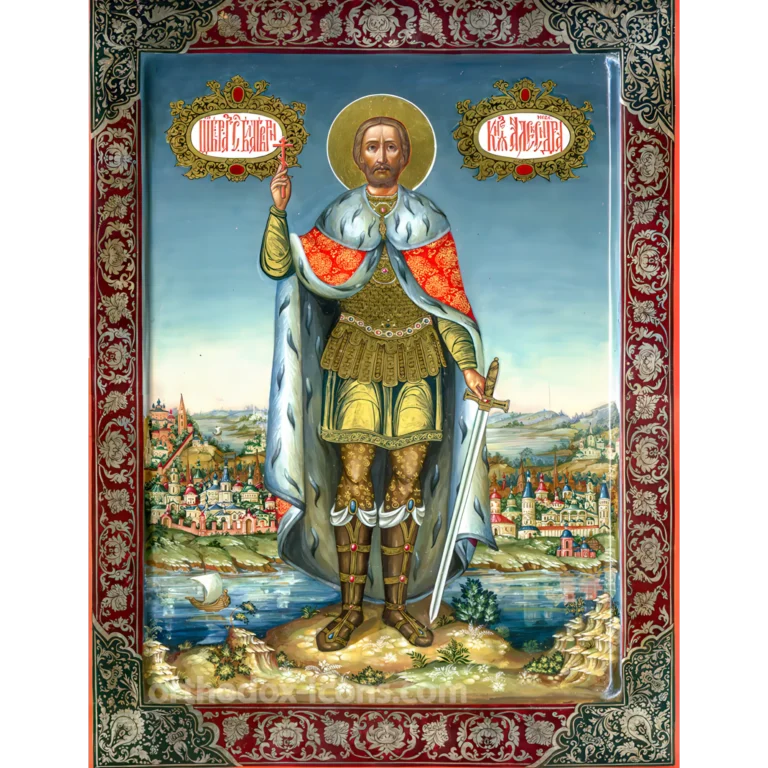
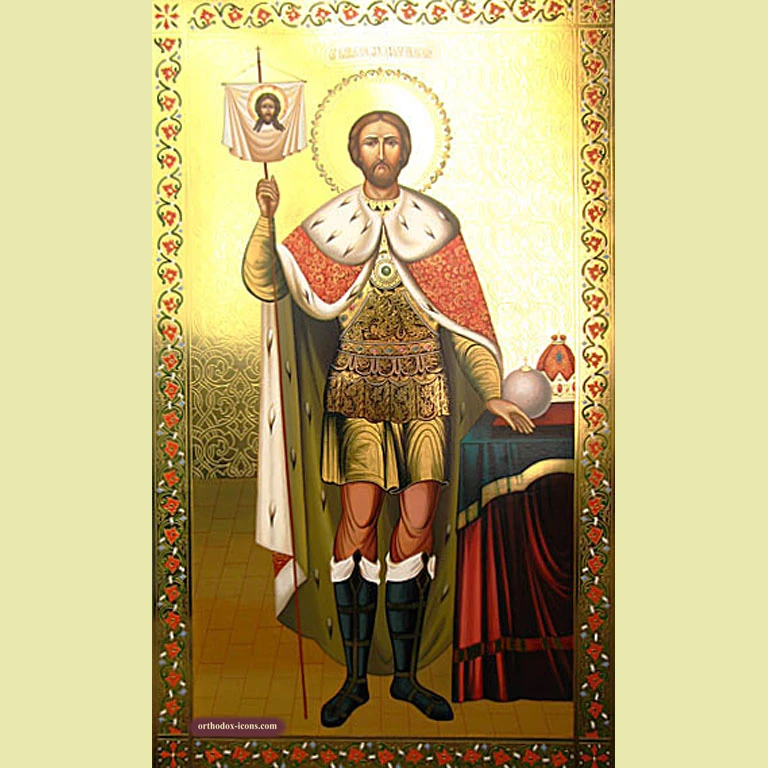
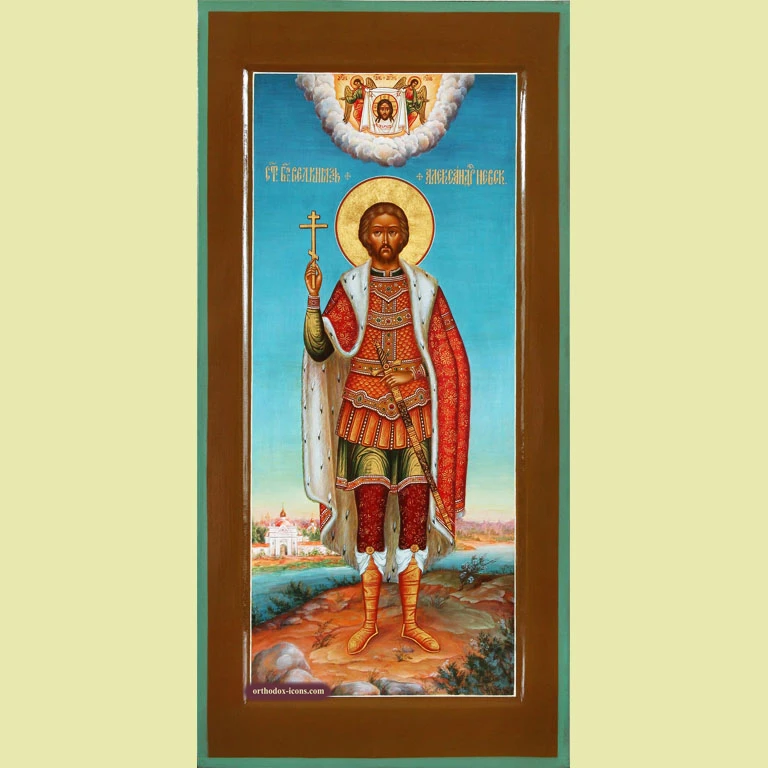
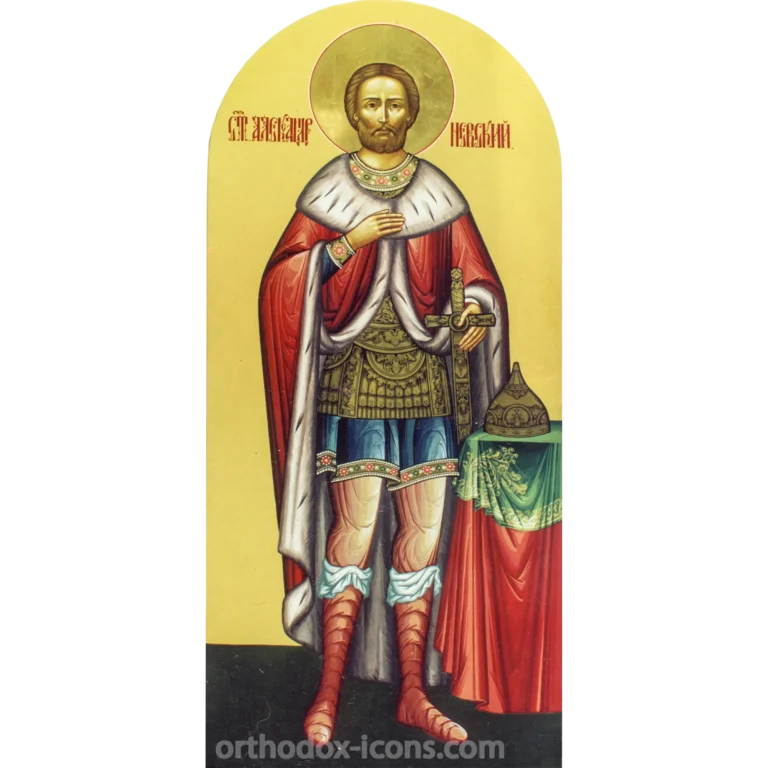
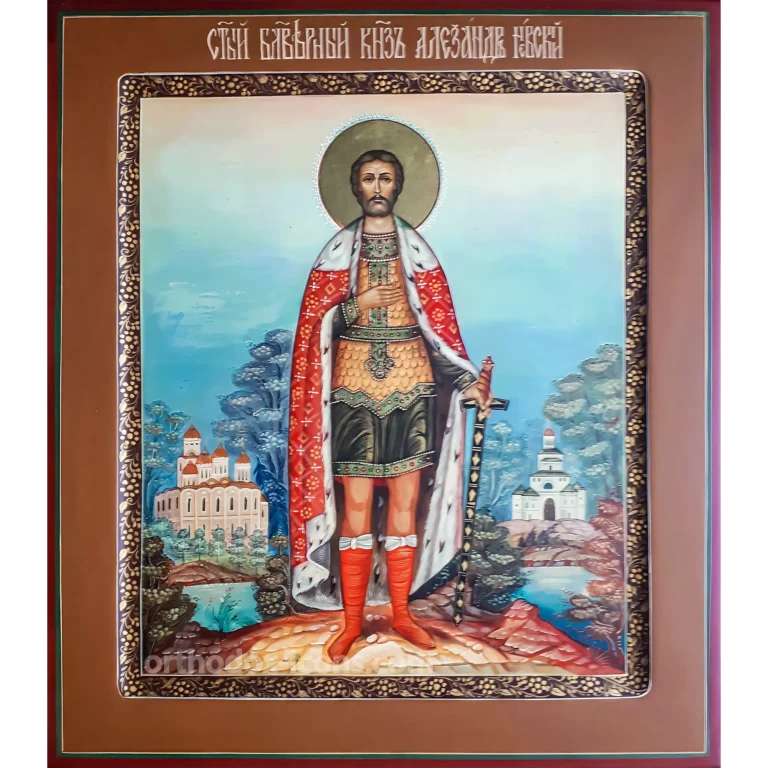
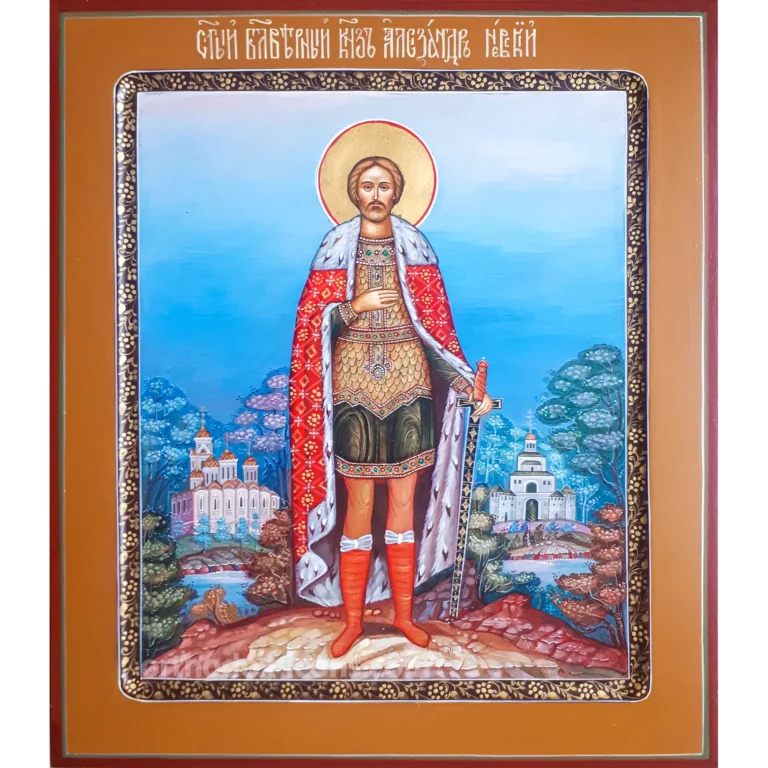
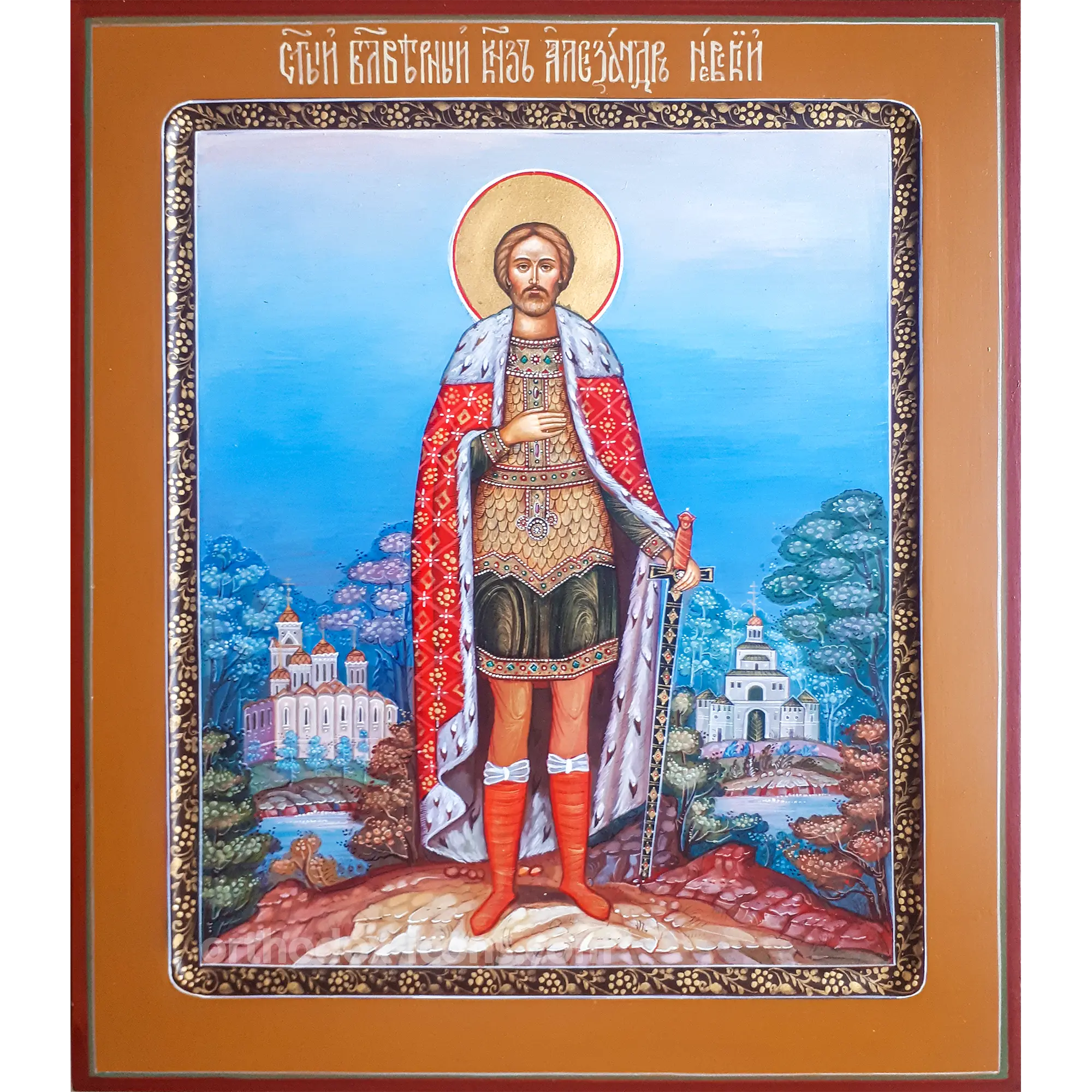
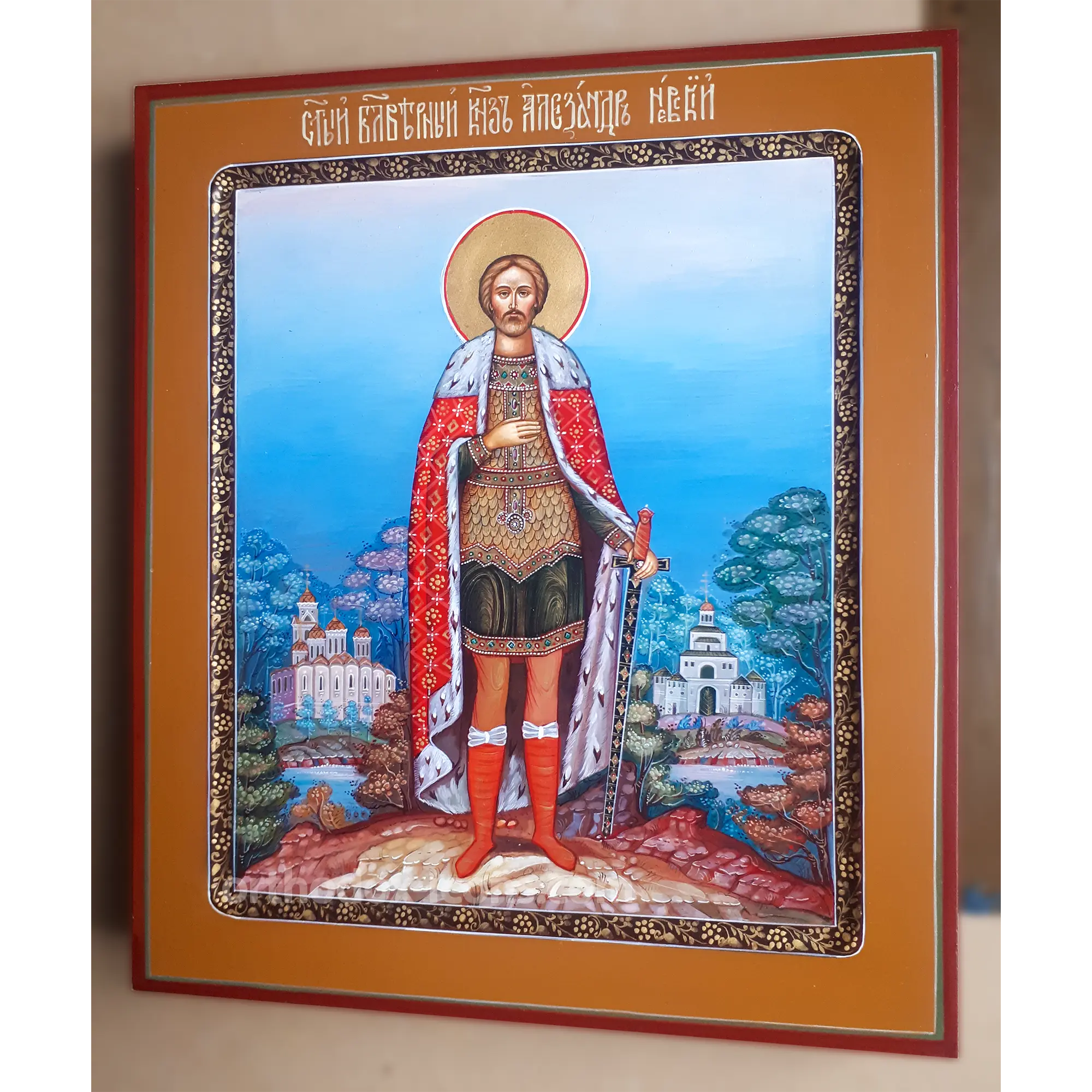
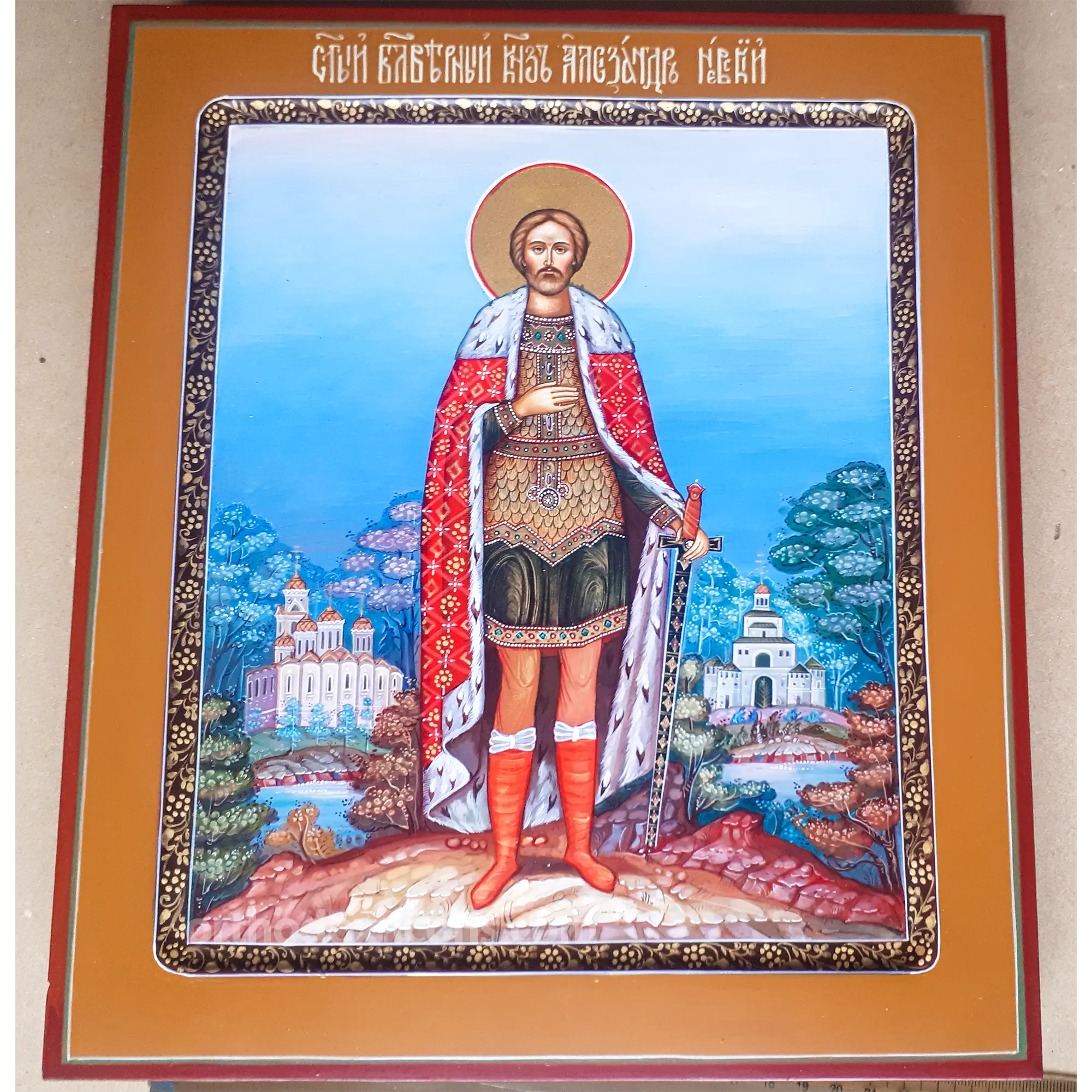
Saint Alexander Nevsky Icon 27×31 is a hand-painted Orthodox icon of St. Alexander Nevsky, the right-believing prince, defender of the Orthodox faith, and heavenly patron of those who bear responsibility for family, service, leadership, and difficult decisions. The saint is shown full-length in princely vestments and armor, with a lowered sword, red mantle, gold halo, churches, trees, and a calm landscape behind him.
- Prayer: for strengthening of faith, courage, protection of family and homeland, wisdom in leadership, help in military service, steadfastness in hard choices, and patronage for people named Alexander.
- Materials: linden wood board, braces, recessed kovcheg, linen cloth, chalk gesso, egg tempera, 23K gold leaf (960 purity), protective varnish.
- Suitable for: a name icon for Alexander, a gift for a man, soldier, officer, leader, godson, son, father, husband, or for a home icon corner, chapel, church, or iconostasis row.
It is possible to paint an image in any size to order
Free shipping worldwide
Saint Alexander Nevsky Icon 27×31 is a hand-painted Orthodox icon of St. Alexander Nevsky, the right-believing Russian prince, warrior, ruler, and intercessor whose name is connected with the defense of the Orthodox land, wise public service, and faithfulness to Christ. Alexander Nevsky entered church memory not only as a victor in battle, but also as a man of deep inner responsibility. He knew how to unite courage with discernment, strength with meekness, political wisdom with faith. For this reason his icon is especially close to those who carry responsibility for family, military service, leadership, protection of others, and difficult decisions.
In the presented icon, St. Alexander Nevsky is shown full-length. He stands before a light blue sky, churches, trees, and a water landscape. He wears princely vestments with a red mantle, fur trim, decorated armor, and belt. In his left hand he holds a sword pointed downward, while his right hand rests on his chest. This gesture makes the image not only martial, but also prayerful: the saint stands not as a self-confident conqueror, but as a Christian prince who understands that strength must serve truth and the protection of one’s neighbor.
The available size is 27×31 cm (10.6×12.2 in); larger and iconostasis sizes can be made by agreement. The 27×31 cm format is suitable for a home icon corner, separate kiot, study, name icon for Alexander, or gift for a man. In this size the main details remain readable: the saint’s face, gold halo, red princely mantle, armor, sword, church landscape, and upper inscription. Larger versions are chosen for a spacious home, chapel, church, military prayer corner, or iconostasis row.
An icon of Alexander Nevsky is especially often chosen as a name icon for a man or boy named Alexander. It is a strong, noble, and deeply ecclesial image. It may be given for Baptism, a name day, birthday, entrance into school, beginning of service, military oath, appointment to a responsible position, new home, or an important family occasion. Yet the meaning of the image is wider than name patronage. St. Alexander Nevsky reminds us that true Christian strength is not hardness or outward superiority, but faithfulness to God, sobriety of mind, duty, and readiness to defend truth without pride.
Features of This Icon
The main feature of this icon is the full-length image of the holy prince in solemn military and princely clothing. Alexander Nevsky is shown not in the monastic schema that he received before his repose, but as a right-believing prince and defender of Rus. This iconographic type is especially understandable for home veneration: the saint stands before the praying person as a heavenly patron of soldiers, men, leaders, protectors of the family, and people who need to preserve conscience under responsibility.
The red mantle with fur trim emphasizes the princely dignity of the saint. The red color sounds solemn in the icon and also recalls sacrifice, courage, and readiness to stand for truth. The armor reveals the military side of the image, but it is not painted aggressively. The saint does not swing the sword and is not shown in the middle of battle. The sword is lowered, giving the composition calmness and restraint. This is not an image of violence, but a sign of protection, lawful strength, and service to the good.
The saint’s right hand rests on his chest. This detail is important because it softens the military solemnity and turns attention to the inner state of the prince. Here is a man for whom power and weapons are not ends in themselves. He stands before God with a heart turned toward truth. Therefore the icon is suitable not only for soldiers, but also for all who answer for others: fathers, leaders, mentors, public servants, teachers, and people who make decisions in difficult circumstances.
The background shows a landscape with churches, trees, water, and soft open sky. These details connect the image of the saint with the Russian land that he defended and served. The churches in the composition remind us that Alexander Nevsky’s labor was not only political or military. He defended the Orthodox people, church life, faith, and the very possibility of living in a Christian order. Because of the landscape, the icon is not a dry portrait of a prince, but a complete image of a saintly protector of land, family, and homeland.
The gold halo distinguishes the saint’s face and reveals his glorification in the Church. The inner dark ornamental frame with golden patterns gathers the composition and gives it a festive character. The broad ocher borders make the image warm and solemn. The upper inscription gives the full church name: the right-believing Prince Alexander Nevsky. Such a composition looks natural both in a home setting and in a more solemn church environment.
Iconography of St. Alexander Nevsky
In Orthodox iconography, St. Alexander Nevsky may be shown in several ways: as a right-believing prince in princely garments, as a warrior with a sword, and sometimes in monastic clothing connected with the schema he received before his repose. In the presented image, the princely-warrior type is chosen. It reveals Alexander Nevsky as a defender of the Orthodox land, a wise ruler, and a man whose service unfolded in the middle of severe historical trials.
The sword in the saint’s hand is not merely a sign of military glory. In the icon it becomes a symbol of the defense of truth. Alexander Nevsky is not glorified by the Church as a conqueror seeking earthly power. His veneration is connected with the protection of his people, the Orthodox faith, and the land from outside danger, while in relations with the Horde he showed diplomatic wisdom and tried to spare Rus from destruction. Therefore the sword should not be understood as strength for its own sake, but as an image of responsibility for others.
The princely mantle, armor, and landscape with churches reveal several meanings at once. The mantle speaks of authority, the armor of military service, the churches of the church foundation of his labor, and the gold halo of holiness. Together they form the image of a Christian ruler who did not separate earthly service from faith. This is especially important today, when people often have to choose between advantage and truth, comfort and duty, outward success and inner faithfulness.
The saint’s face is calm and strict. There is no youthful heat in it, although Alexander Nevsky entered history as a very young victor. Here he appears spiritually mature: attentive, collected, and free from empty bravado. Such a face helps the praying person focus not on military romance, but on the Christian meaning of the saint’s labor: courage, discernment, prayer, protection of the weak, and faithfulness to God.
Prayer Before the Icon of Alexander Nevsky
Before the icon of St. Alexander Nevsky, Orthodox Christians pray for strengthening of faith, courage, protection of family and homeland, wisdom in leadership, help in military service, and steadfastness in difficult circumstances. His image is especially close to men, soldiers, leaders, protectors, fathers, sons, godsons, and people who need to preserve firmness without cruelty and responsibility without pride.
- for strengthening of faith and faithfulness to the Orthodox path;
- for protection of family, home, and loved ones;
- for help in military service and dangerous work;
- for courage before a difficult choice;
- for wisdom for leaders, mentors, and fathers of families;
- for protection from enemies, slander, and injustice;
- for peace, discernment, and inner collectedness;
- for a blessed path through service, study, or an important stage of life;
- for the upbringing of boys and young men in honesty, faith, and duty;
- for the heavenly patronage of people named Alexander.
Prayer before this icon is especially fitting where a person needs not harshness, but strength of spirit. St. Alexander Nevsky teaches that truth can be defended in different ways: sometimes by the sword, sometimes by diplomacy, sometimes by patience, and sometimes by refusing to surrender to fear or make a hasty decision. Therefore people ask before his icon not only for outward victory, but also for inner order: that strength not become pride, authority not become self-love, and responsibility not become a burden without prayer.
Brief Life of the Saint
St. Alexander Yaroslavich Nevsky was born in the thirteenth century into a princely family. His life fell during one of the most difficult periods of Russian history. From the west, Rus was threatened by Swedes and German knights; from the east, the Horde pressed upon the land. Princes had to seek a path between military defense, diplomacy, and preservation of the people. Alexander showed himself early as a ruler and warrior, but his strength was not only bravery. He could see the consequences of decisions and think about the fate of the whole land.
In 1240 Prince Alexander defeated the Swedes on the Neva River, receiving the name Nevsky. In 1242 came the Battle on the Ice on Lake Peipus, where the Russian army stopped the advance of western knights. These victories entered the people’s memory as signs of military courage and defense of the Orthodox land. Yet the Church’s veneration of the saint is not limited to battles. His whole life matters: prayer, care for the people, the ability to humble personal pride for the common salvation, and faithfulness to Christ and the Church.
His diplomatic mission in relation to the Horde was especially difficult. The holy prince understood that open revolt at a certain moment could lead to new destruction of cities and the death of many people. Therefore he made decisions that could look outwardly heavy, but were aimed at preserving Rus. This was not weakness, but the wisdom of a ruler able to think not about his own glory, but about the life of the people.
Before his repose, Alexander Nevsky received monastic schema with the name Alexius. He reposed in 1263, completing his earthly path in repentance and prayer. Veneration of the saint began soon after his death, and his churchwide glorification took place in the sixteenth century. His name became one of the most honored among Russian holy princes. Soldiers, rulers, families, and all who saw in him an example of strength united with faith turned to him in prayer.
Commemoration and Name Icon Meaning
The main commemoration of St. Alexander Nevsky is kept on December 6 according to the new calendar, corresponding to November 23 according to the old calendar. The translation of his relics is also celebrated on September 12 according to the new calendar, corresponding to August 30 according to the old calendar. For a man or boy named Alexander, this icon may become a personal name icon and a constant reminder of his heavenly patron.
The name Alexander appears in the Orthodox calendar with several saints, so when choosing a name icon it is important to know after which saint the person was baptized. The image of Alexander Nevsky is especially suitable for those close to themes of protection, service, courage, responsibility, military duty, and public labor. It is a strong icon for a son, husband, father, godson, serviceman, leader, or person facing an important choice.
This icon can be given for Baptism, a name day, birthday, graduation, entrance into a military school, beginning of service, receiving an officer’s rank, wedding, house blessing, or family celebration. In the home it reminds us that Christian courage begins not with loud words, but with faithfulness to God, readiness to protect others, and the ability to preserve truth in the heart.
Materials, Gold Leaf, and Custom Options
The icon of St. Alexander Nevsky is painted on a linden wood board. Applied or recessed braces help stabilize the wooden base. In the presented version the image is made with a kovcheg: the central field is recessed and separated from the borders, so the saint’s figure appears especially gathered and solemn. Linen cloth and chalk gesso are applied to the board, and the icon is then painted in egg tempera.
23K gold leaf (960 purity) is used in the icon. Gilding is especially important for the halo and decorative elements: it emphasizes the holiness of the prince and reveals not earthly luxury, but church glorification. The gold halo gently distinguishes the saint’s face, while the warm ocher range of the borders makes the icon noble and calm.
The armor, mantle, sword, face, hands, churches, and landscape are painted by hand. For this icon, the harmony between military solemnity and prayerful restraint is especially important. The red mantle, fur trim, ornamental details of the clothing, blue sky, churches, and water landscape should sound as one whole, without turning the image into a historical illustration. The main focus remains the holy prince, his spiritual collectedness, and his blessed memory in the Church.
For an individual order, the size, background tone, degree of gilding, character of the borders, inscriptions, kiot, and format for a home, study, chapel, church, or iconostasis row can be discussed. In a larger version it is especially important to preserve the expressiveness of the face, clarity of the sword, dignity of the princely clothing, and depth of the landscape background.
Choosing the Size
The 27×31 cm (10.6×12.2 in) size is a convenient and expressive format for a home icon corner or name icon. It is compact enough for a shelf, kiot, or prayer corner, but still reveals the full-length figure of the saint, princely mantle, sword, armor, halo, and landscape background.
If the icon is purchased as a gift for Alexander, the 27×31 cm format looks dignified without overwhelming the space. It is suitable for a son, godson, husband, father, serviceman, leader, or someone to whom you want to give not a formal souvenir, but a true prayer image.
A larger size is worth choosing for a spacious home, study, church, chapel, or iconostasis row. In a large format the whole composition becomes clearer: the churches in the background, ornamental frame, armor, mantle, sword, halo, and expression of the saint’s face. Iconostasis sizes are selected individually, taking into account placement height, lighting, neighboring icons, and the general color harmony.
Placement, Blessing, and Care
The icon of St. Alexander Nevsky can be placed in a home icon corner near icons of Christ, the Mother of God, the Guardian Angel, St. Nicholas the Wonderworker, St. George the Trophy-Bearer, Archangel Michael, and other saints venerated by the family. For a person named Alexander, this image can become a personal name icon before which he prays for help, guidance, protection, and spiritual strength.
After receiving the icon, it may be blessed in an Orthodox church. A blessed icon is intended for prayer, thanksgiving to God, and asking St. Alexander Nevsky for strengthening of faith, wisdom, courage, protection of family, help in service, and worthy endurance of life’s trials.
A hand-painted icon should be protected from direct sunlight, moisture, overheating, soot, and sudden temperature changes. Do not wipe the surface with wet cloths, alcohol, household cleaners, or rough fabric. The saint’s face, gilded halo, hands, sword, mantle, landscape, inscriptions, and decorative borders require careful handling.
Dust should be removed gently with a soft dry brush, without pressure. For protection of the painting and gilding, a wooden glazed kiot is recommended. It helps preserve the icon from dust, moisture, and accidental damage, especially when the image is placed in an active home area, study, church, or is intended for long-term devotional use.
Questions and Answers
Who is depicted in the Saint Alexander Nevsky Icon?
The icon depicts St. Alexander Nevsky, the right-believing Russian prince, defender of the Orthodox land, wise ruler, and saint who received monastic schema with the name Alexius before his repose.
Why is Alexander Nevsky venerated as a saint?
The Church venerates him for faithfulness to Christ, defense of the Orthodox people, wise rule, care for his land, humility, and the ability to unite courage with discernment.
What does the sword in the icon mean?
The lowered sword points to military service and the defense of truth. In the icon it is not a sign of aggression, but a symbol of responsibility, lawful strength, and protection of others.
What do Orthodox Christians pray for before this icon?
People pray before this icon for strengthening of faith, courage, protection of family and homeland, wisdom in leadership, help in military service, and steadfastness in difficult decisions.
Who may receive this icon as a gift?
It is suitable for someone named Alexander, a soldier, officer, leader, father, son, godson, husband, or any man who carries responsibility for family, service, or an important duty.
What size is available?
The available size is 27×31 cm (10.6×12.2 in). Larger formats and iconostasis sizes can be made by agreement for a church, chapel, spacious home, or iconostasis row.
When is St. Alexander Nevsky commemorated?
The main commemoration is kept on December 6 according to the new calendar, corresponding to November 23 according to the old calendar. The translation of his relics is celebrated on September 12, corresponding to August 30 according to the old calendar.
Why is the saint shown in princely vestments?
This iconographic type presents Alexander Nevsky as a right-believing prince, ruler, and defender of Rus. The mantle, armor, and sword show his earthly service illumined by faith.
Is this icon suitable for a soldier or officer?
Yes. The image is often chosen for servicemen, cadets, officers, and people whose lives are connected with protection, discipline, responsibility, and service.
How should a hand-painted icon with gold leaf be cared for?
Keep the icon away from moisture, direct sun, overheating, soot, and mechanical damage. Dust should be removed with a soft dry brush, and a glazed kiot is recommended to protect the painting and gilding.
| Dimensions | 27x31cm (10.6×12.2 in) |
|---|---|
| Name | Alexander |