Filigree Icon of Saint Nicholas the Wonderworker
$950
Available size: 17×21 cm (6.7×8.3 in). Larger church and iconostasis sizes may be discussed individually. The production time for a filigree icon is about two months.
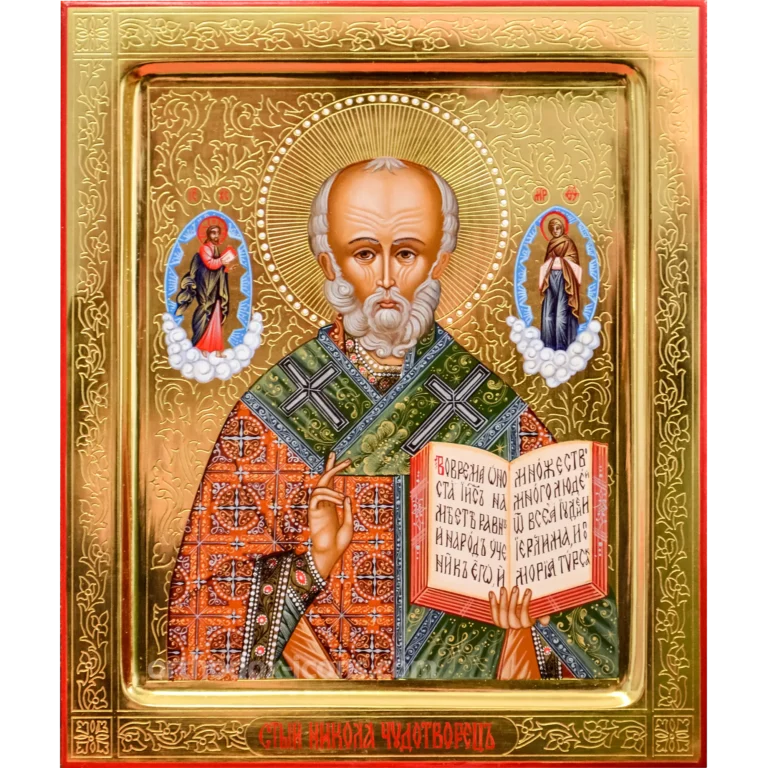
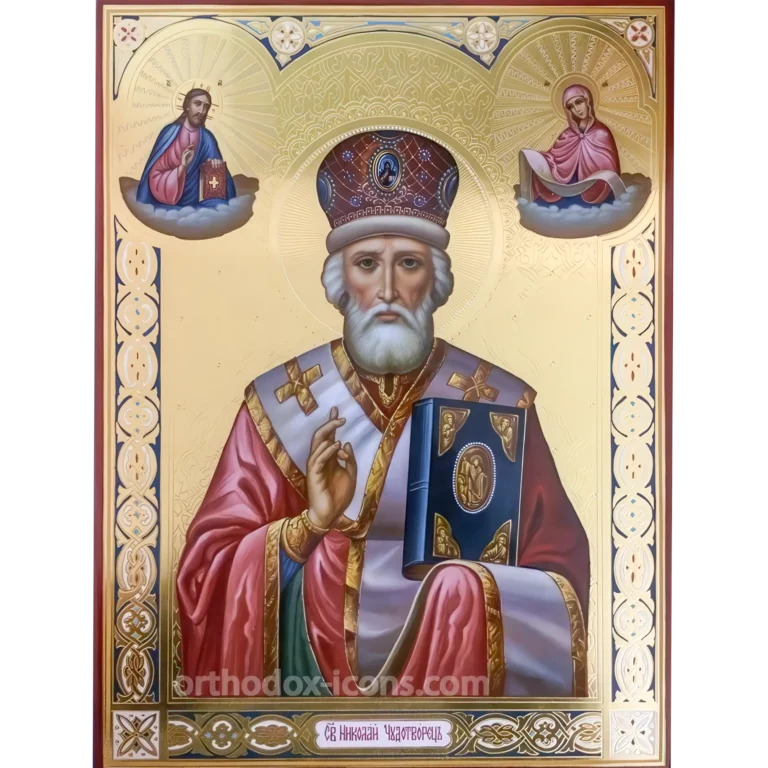
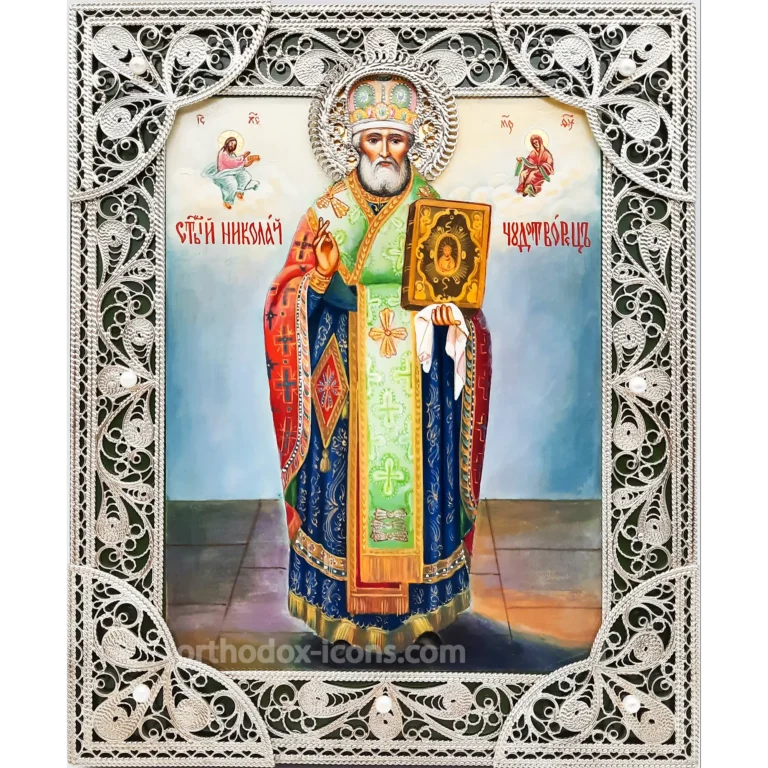
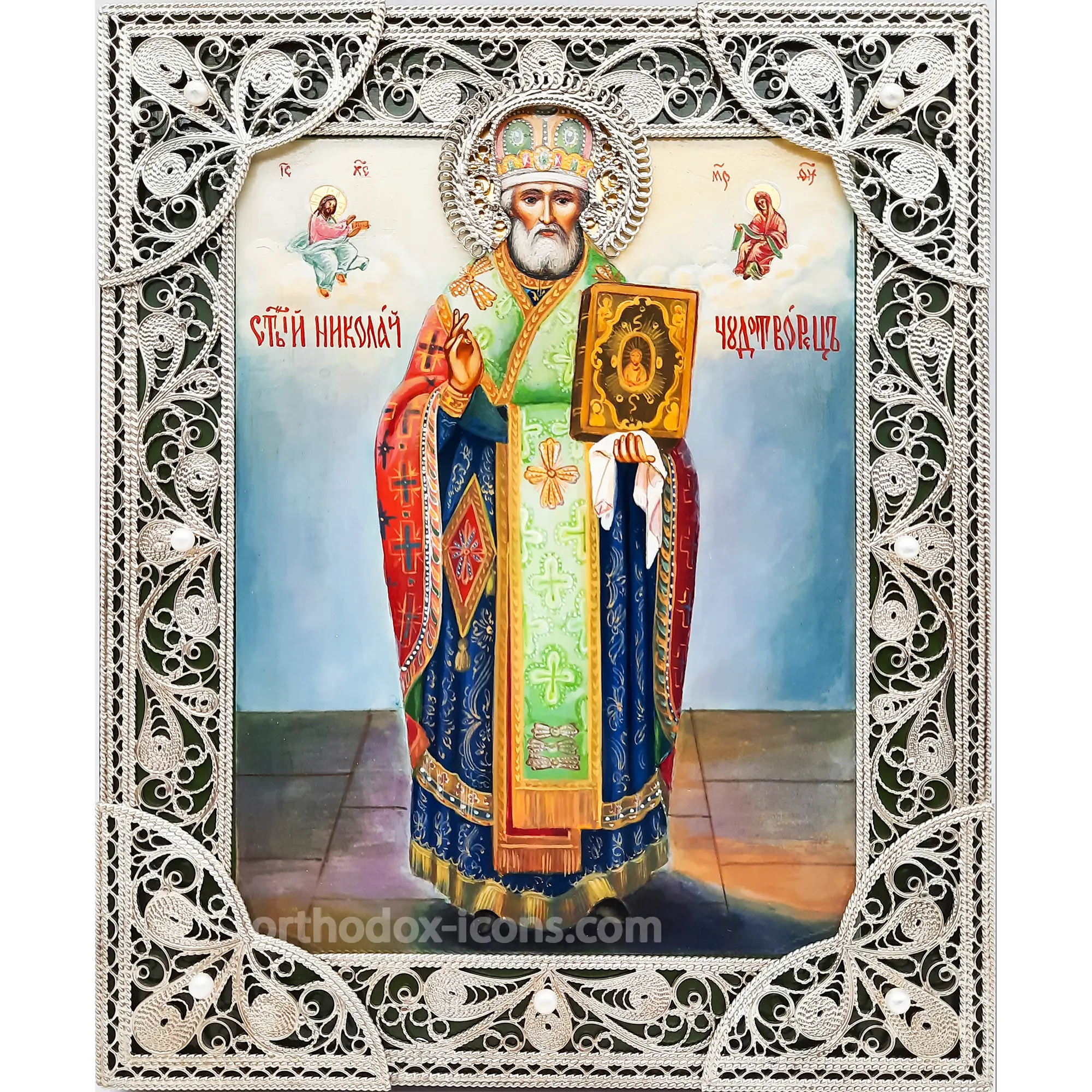
Filigree Icon of Saint Nicholas the Wonderworker is a hand-painted full-length icon of Saint Nicholas of Myra in a solemn filigree setting. The saint is shown in episcopal vestments, with a blessing hand and Gospel, while the upper part of the icon includes the traditional images of Christ and the Mother of God.
The icon is painted on a linden wood board with oak splines, chalk gesso, egg tempera, gilded elements, a light painted background, decorative halo, and openwork filigree border. It is suitable for a home iconostasis, church, chapel, name-day gift, family shrine, or prayerful gift for a man or boy named Nicholas.
It is possible to paint an image in any size to order
Free shipping worldwide
Filigree Icon of Saint Nicholas the Wonderworker is a hand-painted Orthodox icon of Saint Nicholas of Myra in a solemn filigree setting. It presents Nicholas the Wonderworker as a quick helper, merciful intercessor, and one of the most beloved saints in Orthodox tradition. Orthodox Christians pray before him for travel, children, family peace, healing, help in need, protection from injustice, and support in difficult circumstances.
In this icon Saint Nicholas is shown full-length, in episcopal vestments, with his right hand raised in blessing and the Gospel in his other hand. The openwork filigree border, decorative halo, upper images of Christ and the Most Holy Theotokos, and light painted background make the icon festive, dignified, and especially suitable as a meaningful Orthodox gift.
Icon at a Glance
- Name: Filigree Icon of Saint Nicholas the Wonderworker
- Saint: Saint Nicholas of Myra, Nicholas the Wonderworker
- Icon type: full-length bishop icon with Gospel and blessing hand
- Visible features: episcopal mitre, Gospel, blessing gesture, Christ and the Theotokos above, light background, openwork filigree
- Available size: 17×21 cm (6.7×8.3 in); larger sizes by agreement
- Production time for a filigree icon: about two months
Features of the Presented Icon
Saint Nicholas is shown full-length. This format reveals the hierarchal dignity of the saint more fully than a waist-length image: the mitre, vestments, omophorion, blessing hand, Gospel, and overall composition are all visible. A full-length image makes the icon especially solemn and well suited for larger home, church, and iconostasis formats.
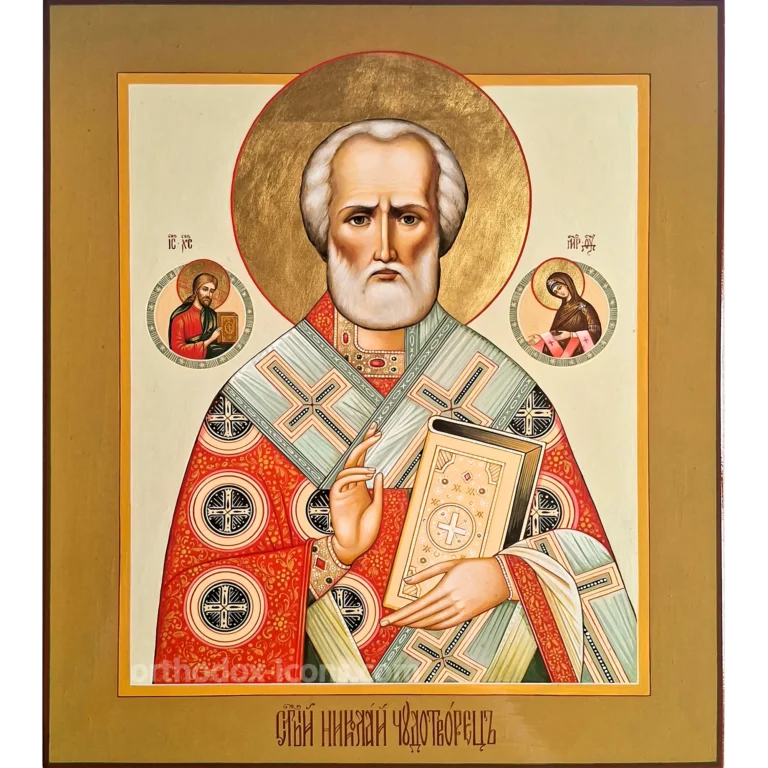
The face of Saint Nicholas is painted with restraint and attention. His gray beard, calm gaze, collected expression, and upright posture convey the image of a spiritual shepherd whom believers approach with trust in many different circumstances. A good icon of Saint Nicholas must hold together episcopal seriousness and merciful intercession; here this is expressed through the steady figure and the prayerful face.
The saint wears bright episcopal vestments with green, blue, red, and golden tones. The mitre emphasizes his dignity as bishop, while the omophorion and crosses on the vestments recall his pastoral responsibility and faithfulness to the Church. His right hand is raised in blessing, and in the other hand he holds the Gospel, the chief sign of episcopal service and fidelity to the teaching of Christ.
In the upper part of the icon are the images of Christ and the Most Holy Theotokos, traditionally connected with the iconography of Saint Nicholas. They complete the composition and emphasize the churchly meaning of the image. The main decorative feature is the openwork filigree setting, which creates a refined frame around the saint without distracting from the face, blessing hand, Gospel, and episcopal vestments.
Iconography: Vestments, Gospel, and Filigree
Saint Nicholas is shown in episcopal vestments because he was Archbishop of Myra in Lycia. The mitre, omophorion, crosses, and Gospel all point to his service as a bishop. These details show that he is not only a wonderworker and popular helper, but first of all a hierarch of the Church, guardian of faith, and teacher of Christian life.
The blessing gesture reveals the prayerful meaning of the icon. Saint Nicholas is not shown as distant from the person praying before him; his hand blesses, and the Gospel reminds us that all help of the saint is connected with Christ and life according to the commandments. For this reason, prayer before his icon is not a charm or magical act, but a turning to God through the intercession of the saint.
The small images of Christ and the Theotokos above the saint strengthen the ecclesial context of the icon. They do not compete with the central image, but spiritually frame it: Saint Nicholas stands as a bishop of Christ’s Church, not merely as a historical figure.
The filigree decoration has an important compositional role. The openwork ornament visually separates the sacred image from the surrounding space, creates a festive border, and gives the icon depth. This type of setting is especially appropriate for a solemn gift, family shrine, church, or chapel.
Materials, Filigree, and Custom Options
The icon is painted on a solid linden wood board strengthened with oak splines. Linden wood is traditionally used for hand-painted icons because of its even structure and suitability for a stable ground. Oak splines help the board keep its form during natural changes of humidity and temperature.
A natural chalk gesso ground is applied before painting. The image is painted in egg tempera, the traditional technique of Orthodox iconography, allowing the iconographer to convey the face, vestments, inscriptions, and small upper images with clarity and depth. The icon includes gilded elements, decorative halo work, and an openwork filigree frame.
For an individual order, the size, character of the filigree setting, degree of decoration, color of vestments, background, inscriptions, halo design, and overall artistic character may be discussed. The icon can be made in the listed 17×21 cm format and in larger church or iconostasis formats by agreement.
Icon Characteristics
| Full name | Hand-Painted Filigree Icon of Saint Nicholas the Wonderworker |
| Saint | Saint Nicholas the Wonderworker, Archbishop of Myra in Lycia |
| Iconographic type | Full-length bishop icon with Gospel and blessing hand |
| Feast days | December 19, May 22, August 11 |
| Decorative features | Full-length image, episcopal mitre, Gospel, blessing hand, Christ and Theotokos above, openwork filigree, decorative halo and borders |
| Materials | Linden wood board, oak splines, chalk gesso, mineral egg tempera, gilded elements, filigree setting |
| Available size | 17×21 cm (6.7×8.3 in); larger sizes by agreement |
Choosing the Size
The 17×21 cm (6.7×8.3 in) size is suitable for a small prayer shelf, personal corner, office, bedside space, or compact name-day gift. Even in a small format, the icon preserves the essential features: the figure of Saint Nicholas, blessing hand, Gospel, and openwork border.
Larger sizes may be chosen for a family iconostasis, spacious home, living room, chapel, church, or solemn gift. In larger formats, the filigree, mitre, vestments, upper images, and painted background become easier to read. Iconostasis sizes are selected with attention to placement, lighting, viewing distance, and neighboring icons.
What People Pray for Before Saint Nicholas
Saint Nicholas the Wonderworker is venerated as a quick helper in many circumstances of life. People turn to him before travel, during illness, in anxiety for children, family difficulties, financial need, danger, injustice, and difficult decisions. His image is especially close to the faithful because he is remembered as a saint who does not abandon those who ask for help.
- for protection during travel, relocation, and journeys;
- for children, their health, upbringing, and well-being;
- for peace in the family, reconciliation, and love among relatives;
- for healing of the sick and consolation of the grieving;
- for help in need, debt, and difficult circumstances;
- for protection from injustice, slander, and offense;
- for sailors, drivers, and travelers;
- for right choices, good works, and peaceful ordering of life.
The icon is not a charm or magical object. Orthodox prayer before Saint Nicholas is prayer to God through the intercession of the saint. Requests for help should be joined with faith, gratitude, mercy toward others, and a desire to live according to the commandments.
Who This Icon Is For
A filigree icon of Saint Nicholas the Wonderworker is suitable for an Orthodox home, family iconostasis, church, chapel, or meaningful gift. Because of its openwork decoration, the icon looks especially solemn and is often chosen for important occasions: a name day, birthday, baptism, wedding, house blessing, thanksgiving gift, or donation to a church.
As a name icon, it is especially suitable for men and boys named Nicholas. It may be given for baptism, name day, birthday, beginning of independent life, an important family event, or a professional milestone. It is also appropriate for people connected with travel, responsibility, and care for others: sailors, drivers, travelers, soldiers, rescuers, doctors, business owners, leaders, and those who often make difficult decisions.
Feast Days and Life of Saint Nicholas
In Orthodox tradition, several feast days of Saint Nicholas are especially venerated. December 19 commemorates his repose. May 22 commemorates the translation of his relics to Bari. August 11 commemorates the Nativity of Saint Nicholas. These dates may be considered when choosing an icon as a name-day gift, baptism gift, family shrine, or thanksgiving offering.
Saint Nicholas, Archbishop of Myra in Lycia, lived in the third and fourth centuries and became known for mercy, firm faith, pastoral care, and many miracles. From youth he sought Christian life, helped those in need, and often did good secretly, avoiding human praise. One of the most beloved stories tells how he secretly helped a poor father of three daughters, saving the family from disaster. As a bishop, he was a good shepherd and defender of the Orthodox faith.
Blessing and Care
At the customer’s request, the icon may be blessed in church before delivery, or it may be blessed after receiving it in one’s own parish. The blessing helps the icon be received not as a decorative picture, but as a sacred image for prayer, thanksgiving, and appeal to God through the intercession of Saint Nicholas.
A hand-painted icon with filigree should be cared for especially gently. Dust should be removed with a dry soft brush without pressure, avoiding pulling on the openwork elements. The icon should not be wiped with a wet cloth or placed in direct sunlight, near a radiator, humidifier, or source of sharp temperature changes. Particular care should be taken with the filigree, painted surface, halo, inscriptions, and decorative details.
Free international shipping is included. Payment is made after you receive and approve the icon.
Questions and Answers
Who is shown on the Filigree Icon of Saint Nicholas the Wonderworker?
The icon shows Saint Nicholas of Myra, Archbishop of Myra in Lycia, one of the most venerated Orthodox saints, also known in Slavic tradition as Nicholas the Pleaser.
What does filigree mean in this icon?
Filigree is an openwork decorative setting that gives the icon solemnity, depth, and jewelry-like refinement. Here it forms a festive frame around the sacred image.
What do people pray for before Saint Nicholas?
People pray for help while traveling, protection of children, family peace, healing, help in need, support in difficult circumstances, and protection from injustice.
Who is this icon suitable for as a name icon?
It is especially suitable for men and boys named Nicholas, and may be given for baptism, name day, birthday, or another important occasion.
What are the main feast days of Saint Nicholas?
The main feast days are December 19, the repose of Saint Nicholas; May 22, the translation of his relics to Bari; and August 11, the Nativity of Saint Nicholas.
Why does Saint Nicholas hold the Gospel?
The Gospel points to his episcopal ministry, faithfulness to Christ’s teaching, pastoral guidance, and defense of the Orthodox faith.
What do the images of Christ and the Theotokos above mean?
The small images of Christ and the Mother of God belong to the traditional iconography of Saint Nicholas and emphasize his episcopal dignity and churchly service.
What size is available?
The listed size is 17×21 cm (6.7×8.3 in). Larger church and iconostasis sizes may be discussed individually.
Is this filigree icon suitable as a gift?
Yes. The filigree setting makes the icon especially solemn, suitable for a name day, anniversary, baptism, wedding, house blessing, family gift, or church donation.
How should a filigree icon be cared for?
Keep the icon away from moisture, direct sunlight, and sharp temperature changes. Remove dust with a dry soft brush, taking special care around the filigree and painted surface.
| Dimensions | 17x21cm (6.7×8.3 in) |
|---|---|
| Name | Nicholas |