Smolensk Icon of the Virgin Mary
Price range: $600 through $1850
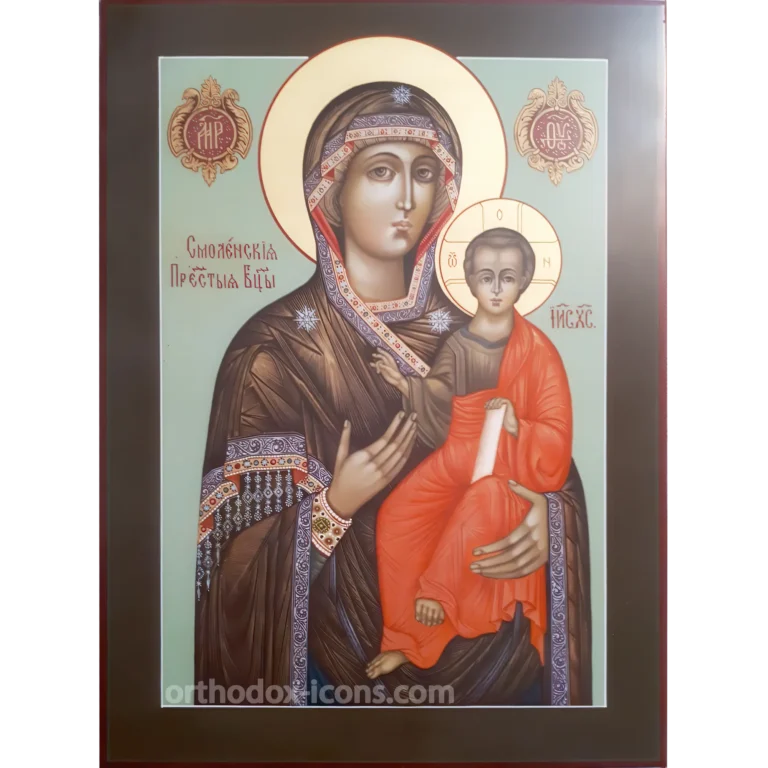
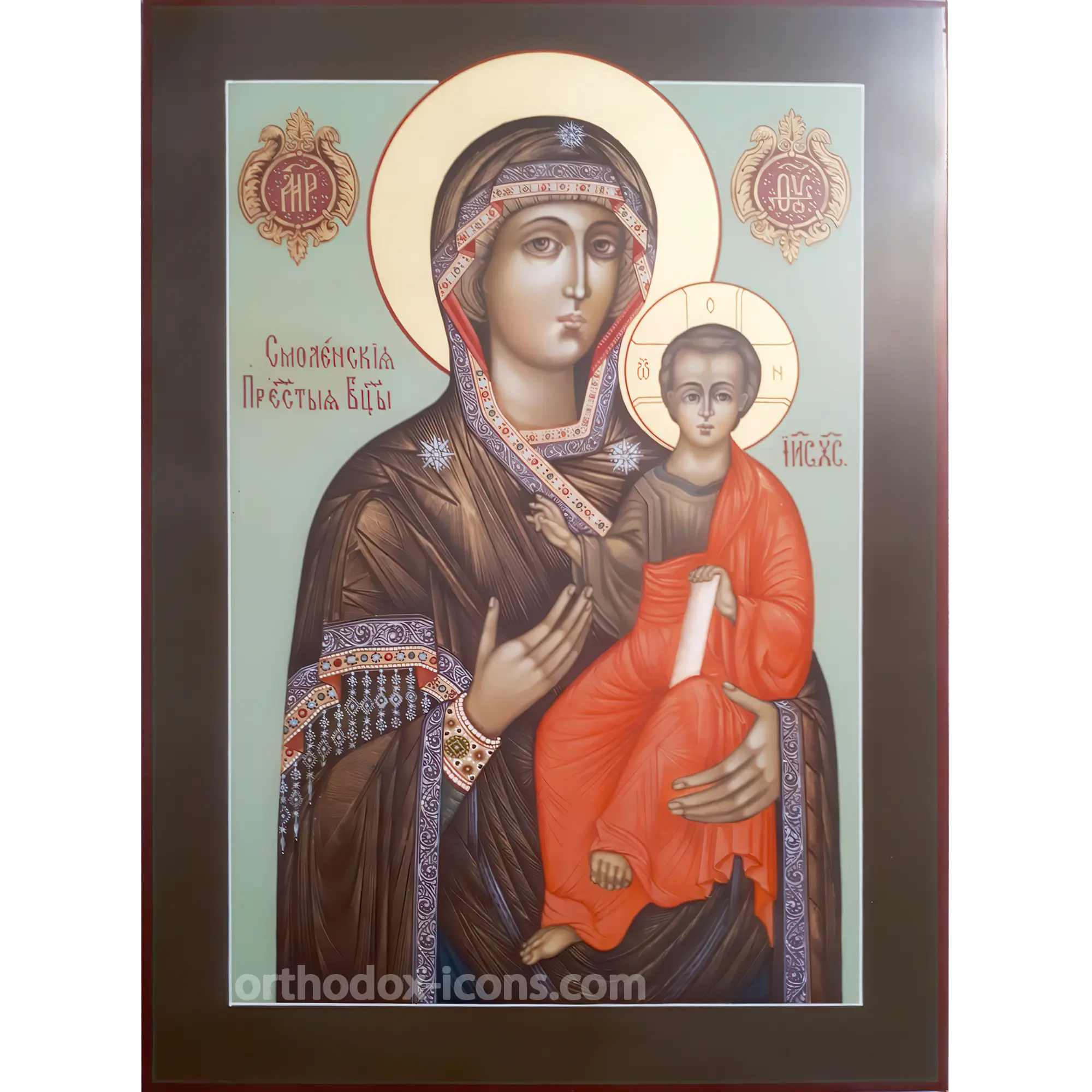
Smolensk Icon of the Virgin Mary is a hand-painted Hodegetria icon on a flat linden board without kovcheg, with a deep sky-blue background and 960 gold leaf halos.
Available sizes: 13×25 cm (5.1×9.8 in), 18×31 cm (7.1×12.2 in), 30×50 cm (11.8×19.7 in). Larger iconostasis sizes may be discussed before painting.
Materials: flat linden board without kovcheg, oak braces, linen pavoloka, chalk levkas, 960 gold leaf on the halos, mineral egg tempera, protective finish.
Technique: hand icon painting in the Mstyora tradition, natural mineral egg tempera, deep blue background, smooth gilded halos, traditional board preparation.
It is possible to paint an image in any size to order
Free shipping worldwide
Smolensk Icon of the Virgin Mary is a hand-painted Orthodox icon of the Mother of God in the Hodegetria type. The Smolensk Hodegetria is one of the great holy images of the Russian Orthodox tradition, connected with guidance, protection, family peace, healing, and the defense of the faithful in times of danger.
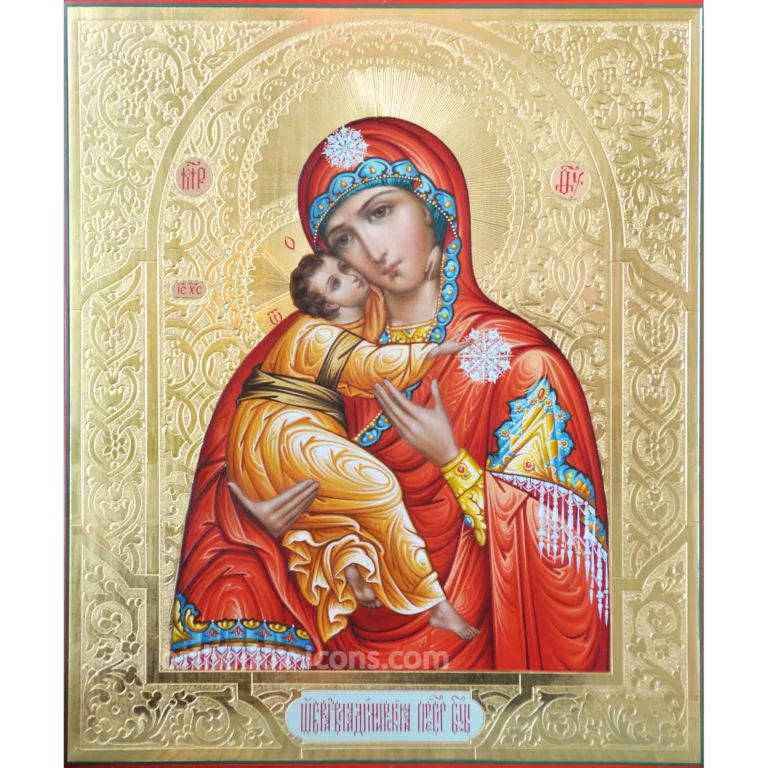
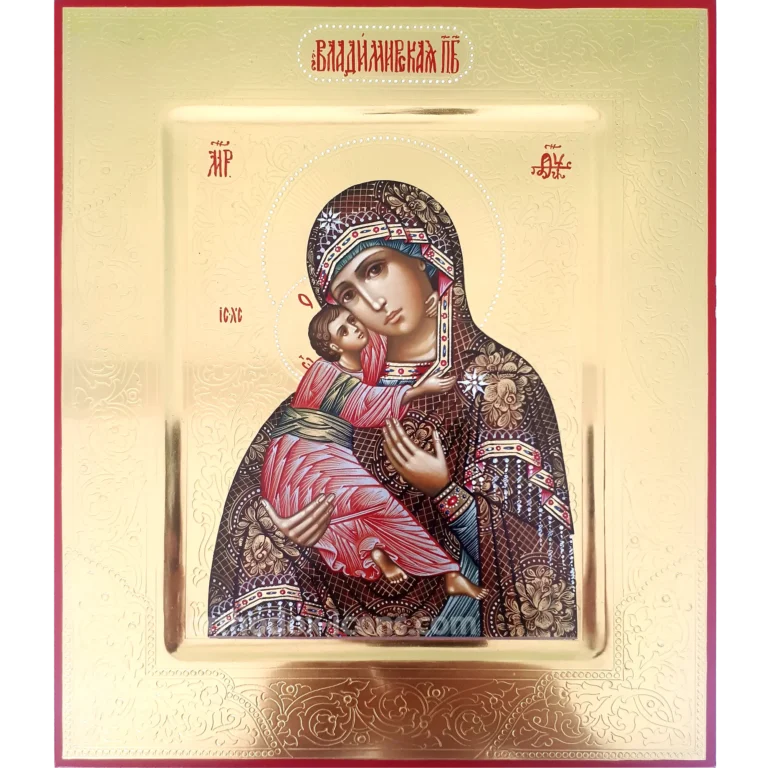
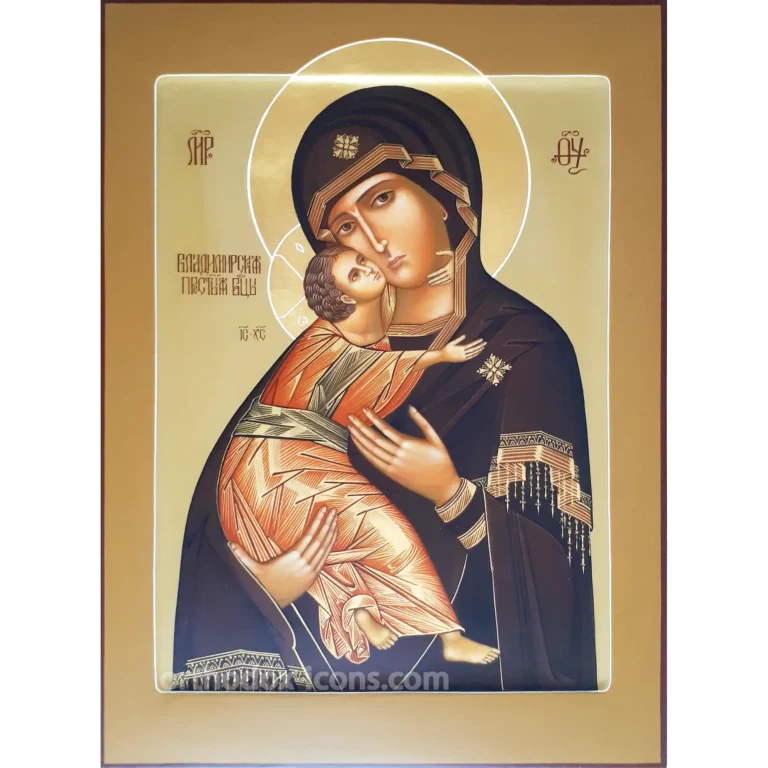
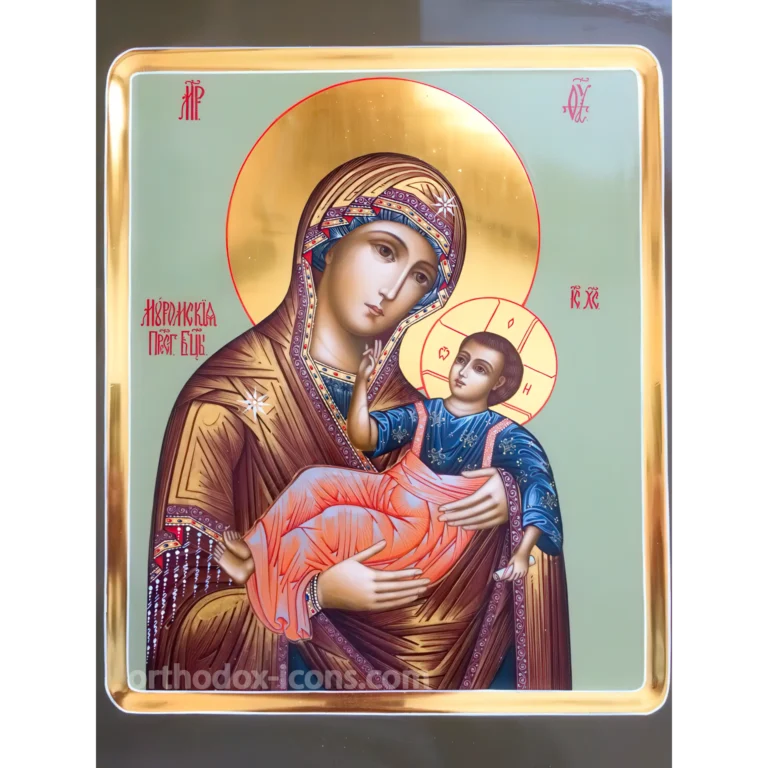
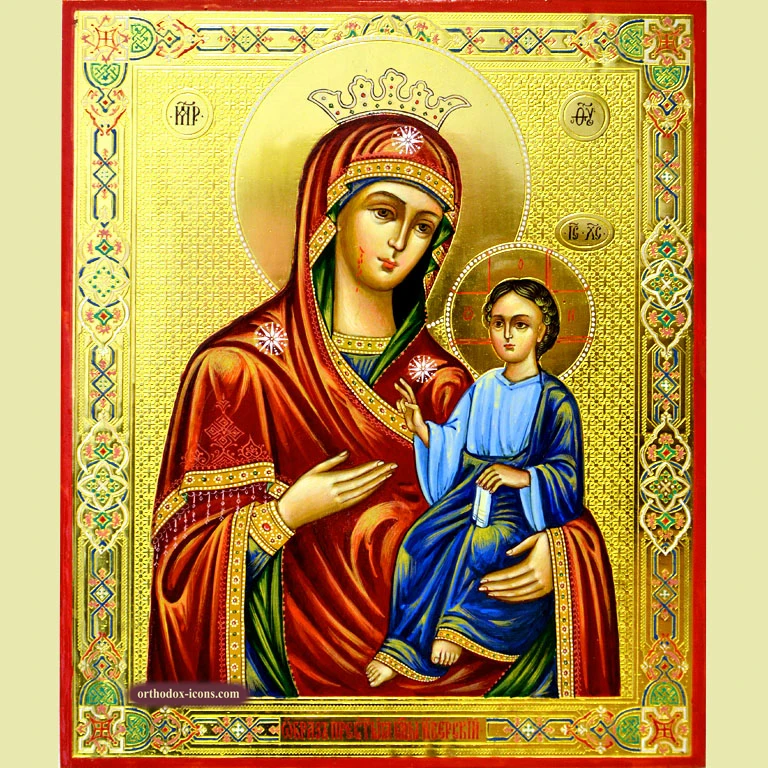
The icon shows the Mother of God with a strict, calm, and wise face. Her gaze is directed toward the one who prays, while her hand points to Christ. This is the heart of the Hodegetria image: the Theotokos does not keep attention on herself, but leads the faithful to her Divine Son, the true Way, Truth, and Life.
This version has a restrained and clear artistic solution. Instead of a fully gilded background, the icon is painted on a deep heavenly blue field. The board is flat, without kovcheg, and the shining 960 gold leaf halos stand out against the calm blue background, focusing attention on the faces of the Mother of God and the Savior.
History of the Smolensk Hodegetria
According to ancient church tradition, the first Hodegetria icon was painted by the holy Apostle and Evangelist Luke during the earthly life of the Most Holy Theotokos, at the request of Theophilus, ruler of Antioch. In the fifth century, the Byzantine Empress Eudocia brought the holy image to Constantinople, where it was venerated in the Blachernae church.
The icon came to Rus in 1046, when the Byzantine Emperor Constantine IX Monomachos blessed his daughter Anna with it as she traveled to marry the Russian prince Vsevolod Yaroslavich, son of Yaroslav the Wise. The icon became her guide and protection on the long road from Constantinople.
Anna and Vsevolod’s son, Vladimir Monomakh, inherited this blessing. In 1097 he brought the icon from Chernigov to Smolensk, and in 1101 he placed it in the Dormition Cathedral that he had founded. From that time the holy image became known as the Smolensk icon.
One of the greatest miracles associated with the icon took place in 1239, when the forces of Batu Khan approached Smolensk. According to tradition, the Mother of God appeared in a dream and called the pious warrior Mercury to defend the city. Through his courage and the help of the Theotokos, Smolensk was saved, and the icon became especially honored as a protector of the western borders.
Theological Meaning of the Hodegetria
The Hodegetria is one of the most solemn and dogmatically precise types of Orthodox iconography. The Mother of God is shown half-length, facing forward or with only a slight inclination of the head. On her left arm sits the Christ Child, enthroned as the heavenly King.
The gesture of the Mother of God defines the whole icon. With her right hand she points to Christ, silently witnessing that salvation is found in Him. This gesture is not decorative; it is theological. It teaches the faithful where to look, whom to follow, and where true help is found.
The Christ Child is not painted as a helpless infant, but as Emmanuel, the pre-eternal Word of God. He holds a scroll, the sign of divine teaching and the Gospel, and blesses with His right hand. In the Smolensk version, the figures are especially frontal and still, giving the icon a royal and solemn presence.
Prayer Before the Smolensk Icon
For many centuries, both rulers and ordinary believers have prayed before the Smolensk Hodegetria. The icon is approached in many needs, but several themes are especially traditional.
- For family peace: prayer before the icon asks for reconciliation between spouses, protection of marriage, and blessing for children and the household.
- For healing: the Smolensk icon is approached in serious illness, including infectious diseases and eye diseases, asking for both physical and spiritual sight.
- For travelers: as Hodegetria, the Directress, the Mother of God is asked to protect those far from home, those moving, driving, flying, or beginning a difficult journey.
- For soldiers: remembering the military history of the icon, families pray for the protection of those serving and for deliverance from enemies.
- For guidance: when a person is confused, discouraged, or facing a difficult choice, the Hodegetria is asked to enlighten the mind and show the saving path.
Blue Background, Flat Board, and Gold Halos
This Smolensk icon is painted in the Mstyora tradition with a deep blue background. In Christian symbolism, blue is the color of heaven, purity, chastity, and the mystery of the Mother of God. It makes the image calm and spacious, helping the person who prays become inwardly quiet.
A key feature of this icon is the flat linden board without kovcheg. A recessed kovcheg is common in many icons, but it is not obligatory. Here the flat plane gives the icon a strict classical appearance and can be understood as a sign that there is no barrier between the praying person and the heavenly world represented in the holy image.
The halos of the Mother of God and Christ are covered with genuine 960 gold leaf. Against the blue background, the gilded halos shine especially clearly. In iconography, gold represents divine, uncreated light, and high-purity gold does not darken or oxidize in ordinary air.
Materials and Traditional Technique
The icon is painted on a solid linden board. Oak braces are inserted into the back to help protect the wood from warping when humidity changes. The front is covered with linen pavoloka and natural chalk levkas, polished to a smooth surface before painting.
The image is painted in natural mineral egg tempera. Pigments are prepared from finely ground minerals and earths, such as lapis-based blues, ochres, glauconite, and cinnabar tones, and mixed with egg emulsion. This traditional technique gives the icon a deep, velvety surface and long-lasting color.
The available sizes are 13×25 cm (5.1×9.8 in), 18×31 cm (7.1×12.2 in), and 30×50 cm (11.8×19.7 in). Larger iconostasis sizes may also be discussed before painting. The compact size is suitable for travel-related devotion, while the larger sizes are more appropriate for a family icon corner or church setting.
Characteristics of the Hand-Painted Icon
| Icon name | Smolensk Icon of the Virgin Mary |
|---|---|
| Iconographic type | Hodegetria, the Directress |
| Board form | Flat board without kovcheg |
| Background | Deep sky-blue color |
| Gilding | Halos covered with genuine 960 gold leaf |
| Painting technique | Natural mineral tempera on egg emulsion |
| Board | Solid linden board, linen pavoloka, chalk levkas, inserted oak braces |
| Available sizes | 13×25 cm (5.1×9.8 in), 18×31 cm (7.1×12.2 in), 30×50 cm (11.8×19.7 in) |
| Shipping | Free international shipping is included; payment is due upon delivery. |
Questions and Answers
What does Hodegetria mean?
Hodegetria means Directress, or She Who Shows the Way. The Mother of God points to the Christ Child, showing that Christ is the true Way, Truth, and Life, and the only path to salvation.
How did the Smolensk Icon come to Rus?
In 1046, the Byzantine Emperor Constantine IX Monomachos blessed his daughter Anna with this icon when she traveled to Rus to marry Prince Vsevolod Yaroslavich. The icon became her guide on the long journey and was later inherited by Vladimir Monomakh.
Why is the icon called Smolensk?
In 1097, Prince Vladimir Monomakh brought the holy image from Chernigov to Smolensk and later placed it in the Dormition Cathedral. From that time, the icon became the spiritual protector of the city and received the historical name Smolensk.
What needs are brought before the Smolensk Hodegetria?
The Smolensk Hodegetria is approached for peace in the family, protection of the home, healing from serious and eye diseases, help in travel, protection of soldiers, and guidance in difficult life choices.
When is the feast day of the Smolensk Icon?
The Orthodox Church celebrates the Smolensk Icon of the Mother of God on August 10 according to the civil calendar, remembering its many miracles and the deliverance of Smolensk in 1239.
Why is this icon painted without kovcheg?
A kovcheg is not a mandatory dogmatic requirement for an Orthodox icon. A flat board without a recessed field can be used as a traditional artistic choice, symbolizing that there is no barrier between the earthly world of the one who prays and the heavenly world of the saints.
What does the blue background symbolize?
In Orthodox color symbolism, blue is associated with heaven, purity, chastity, and the spiritual mystery of the Mother of God. The blue background makes the icon calm, airy, and prayerful.
Why are oak braces inserted into the icon board?
The linden board can react to changes in humidity, especially during heating seasons. Oak braces inserted into the back serve as a stabilizing frame, helping the board remain flat and protecting the painted surface.
Will the gold halos darken over time?
No. The halos are gilded with genuine 960 gold leaf, not imitation metal leaf. Real high-purity gold does not oxidize, react with oxygen, or blacken in ordinary air when cared for properly.
Can this icon be given for a car or travel?
Yes. Since the Smolensk icon is Hodegetria, the Directress, it is especially meaningful for someone who travels. The compact 13×25 cm size is suitable for a small prayer space connected with travel, while larger sizes are better for the home.
| Dimensions | 13x25cm (5.1×9.8 in), 18x31cm (7.1×12.2 in), 30x50cm (11.8×19.7 in) |
|---|---|
| Name | Mary |