Smolensk Icon of the Mother of God
$2250
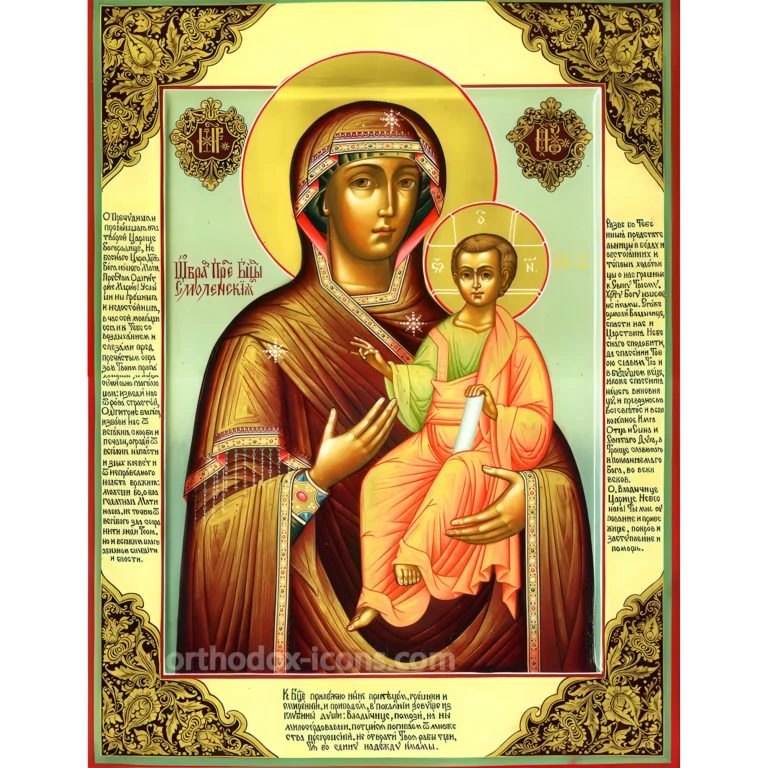
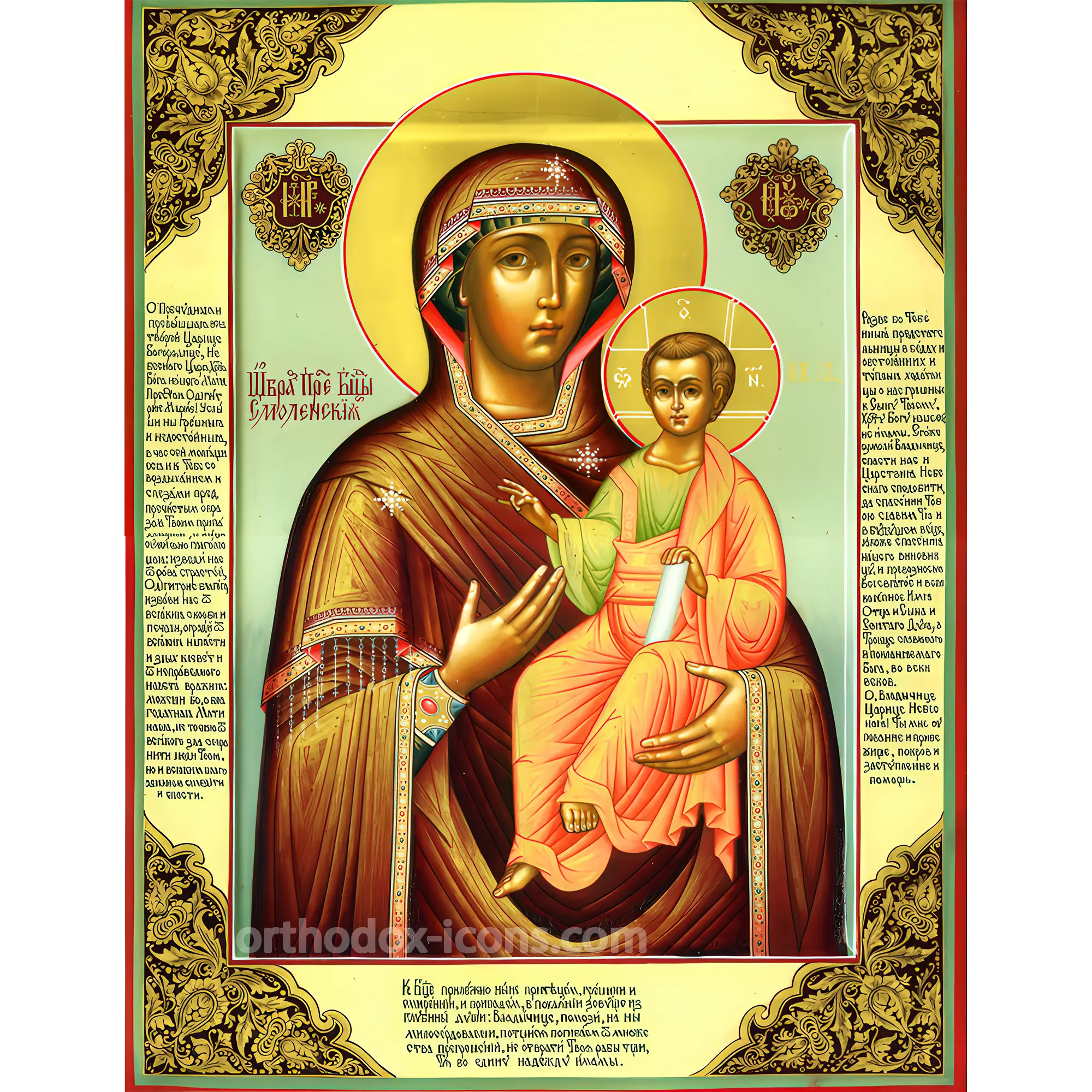
Smolensk Icon of the Mother of God is a hand-painted Hodegetria icon on a deep sky-blue background, with calligraphic prayers on the margins and painted corner ornament.
Available size: 30×50 cm (11.8×19.7 in). Larger church and iconostasis sizes may be discussed before painting.
Materials: solid linden board with oak braces, linen pavoloka, chalk levkas, natural mineral egg tempera, protective finish.
Technique: hand icon painting in the Mstyora tradition, blue mineral background, calligraphic prayer texts on the margins, hand-painted floral corner ornament.
It is possible to paint an image in any size to order
Free shipping worldwide
Smolensk Icon of the Mother of God is a hand-painted Orthodox icon of the Theotokos in the Hodegetria type. Among the many icons of the Mother of God venerated by the Orthodox Church, the Smolensk icon holds a majestic place. It is not only an image for prayer, but a visible history of faith, protection, guidance, and trust in the Mother of God.
The word Hodegetria means Directress, or She Who Shows the Way. In this iconographic type, the Mother of God gently and firmly points to Christ as the true Way, Truth, and Life. She leads the faithful through the storms of earthly life, protects them from spiritual falls and physical dangers, and directs their attention to the Savior.
This version is painted on a deep sky-blue background rather than a standard gold or ocher field. The broad margins carry calligraphic prayer texts, and the corners are decorated with painted floral ornament. The icon therefore becomes both an image to contemplate and a prayerful text to read, with consolation written directly around the holy image.
History of the Great Hodegetria
The history of the Smolensk Hodegetria stretches across centuries and lands. According to pious church tradition, the first Hodegetria icon was painted by the holy Apostle and Evangelist Luke at the request of Theophilus of Antioch, during the earthly life of the Most Holy Theotokos. Later the holy image was taken to Jerusalem and then to Constantinople.
In the fifth century, the Byzantine Empress Eudocia brought the icon to Constantinople, where it became one of the great protectors of the imperial city. A church was built for the holy image, and the icon was revered as a sign of the Mother of God guiding and defending the Christian people.
The image came to Rus in 1046, when the Byzantine Emperor Constantine IX Monomachos blessed his daughter Anna with it as she married the Russian prince Vsevolod Yaroslavich, the son of Yaroslav the Wise. The icon became a family blessing and a symbol of spiritual continuity between Byzantium and Rus.
Their son, Prince Vladimir Monomakh, later inherited the holy image. In 1097 he brought it to Smolensk, and in 1101 he placed it in the stone Dormition church that he had founded. From that time the icon became known as the Smolensk icon and was venerated as the spiritual shield of the city.
One of the most famous traditions connected with the Smolensk Hodegetria is the deliverance of the city from the forces of Batu Khan in 1239. The Mother of God is said to have appeared in a dream to a church servant and commanded that the pious warrior Mercury go out against the enemy. Through his courage and the protection of the Theotokos, Smolensk was saved.
Iconography and Theological Meaning
The Smolensk icon belongs to the classic and dogmatically precise Hodegetria type. The Mother of God is shown half-length, facing the one who prays, with only a slight inclination toward her Son. Her gaze is not turned inward only toward the Child, but outward toward the faithful, creating the sense of a living dialogue.
With her right hand, the Theotokos points to Christ, as if saying: here is the One who saves the world; go to Him. The gesture is quiet, but deeply theological. It defines the whole meaning of the icon: the Mother of God does not point to herself as the final goal, but leads the faithful to Christ.
The Christ Child sits on the left arm of His Mother as on a royal throne. He is not shown as a helpless infant, but as Emmanuel, filled with divine wisdom. In His left hand He holds a scroll, the sign of the Word of God and the Gospel, and with His right hand He blesses His Mother and, through her, the whole human race.
The Smolensk version of the Hodegetria is especially solemn and frontal. It presents Christ as the heavenly King and Judge who has come into the world, and the Mother of God as the Directress who guides the faithful toward Him.
Prayer Before the Smolensk Icon
For centuries, people have approached the Smolensk Hodegetria with many sorrows and needs. Its help is not limited to one theme, yet several traditional areas of prayer have become especially connected with this image.
- For peace and well-being in the family: the Smolensk icon is approached for the preservation of marriage, overcoming family crises, help in childbearing, and the blessing of daughters.
- For protection in travel: as the true Directress, the Mother of God is asked to protect those on the road, including drivers, sailors, pilots, pilgrims, and people moving to a new home.
- For healing: prayers before the Smolensk icon are offered in serious illness, and especially in illnesses of the eyes or danger of losing sight, both physical and spiritual.
- For soldiers and the homeland: because of the military history of the icon, families pray for the safety of those serving, for deliverance from enemies, and for peace.
- For the right choice: when a person stands at a crossroads, the Hodegetria is asked to enlighten the mind and show the saving path.
Blue Background, Prayer Texts, and Painted Ornament
This Smolensk icon has a distinctive artistic design. Instead of a usual gold or ocher background, the image is painted on a deep heavenly blue. In Christian symbolism, blue is associated with spiritual purity, the mystery of heaven, and the depth of the divine world. It brings the figures of the Mother of God and Christ forward and gives the image a light, spacious quality.
The broad margins frame the kovcheg and carry calligraphic prayer texts addressed to the Smolensk Hodegetria. These inscriptions turn the icon into a kind of prayer book in paint: the faithful may not only look at the image, but also read the words of prayer directly from the board.
The corners of the icon are decorated with hand-painted floral ornament. These patterns recall the beauty of paradise and give the large icon a finished, solemn appearance. The format of 30×50 cm (11.8×19.7 in) and larger sizes make this work suitable for a church setting or for a prominent place in a family home.
Materials and Mstyora Icon Painting Technique
The icon is painted on a solid linden board. To protect the wood from deformation caused by changes in humidity, oak braces are inserted into the reverse side. The front is covered with linen pavoloka and many layers of hot chalk levkas, a traditional ground made from chalk and animal glue. The levkas is carefully polished before painting begins.
The blue background and the figures are painted with natural mineral egg tempera. Pigments such as azurite, lapis-based tones, and traditional earth colors give the icon depth, durability, and a restrained brilliance. Egg tempera is valued in icon painting because it bonds well with levkas and can preserve its clarity for generations.
The fine prayer lettering and the corner ornament require a steady hand and careful discipline. The icon painter must keep the text legible, the composition balanced, and the faces spiritually serious. The result is a monumental icon that joins image, text, color, and prayer in one work.
Characteristics of the Hand-Painted Icon
| Icon name | Smolensk Icon of the Mother of God |
|---|---|
| Iconographic type | Hodegetria, the Directress |
| Background | Deep sky-blue background |
| Margin decoration | Calligraphic prayer texts and hand-painted corner ornament |
| Painting technique | Natural mineral tempera on egg emulsion |
| Board | Solid linden board, linen pavoloka, chalk levkas, inserted oak braces |
| Available size | 30×50 cm (11.8×19.7 in) |
| Larger sizes | Large and iconostasis formats may be discussed before painting |
| Shipping | Free international shipping is included; payment is due upon delivery. |
Questions and Answers
What does the word Hodegetria mean?
Hodegetria is usually translated from Greek as She Who Shows the Way or Directress. In this iconographic type, the Mother of God points to the Christ Child, showing that He is the true Way, Truth, and Life.
Who painted the first Hodegetria icon according to tradition?
According to ancient church tradition, the first Hodegetria image was painted by the Apostle and Evangelist Luke during the earthly life of the Most Holy Theotokos, at the request of Theophilus of Antioch. Later the holy image was brought to Constantinople.
Why is this icon called Smolensk?
The icon received the name Smolensk after Prince Vladimir Monomakh brought it to Smolensk and placed it in the Dormition Cathedral. From that time it became the chief holy image and spiritual shield of the city.
What do people pray for before the Smolensk Icon of the Mother of God?
People pray before the Smolensk icon for peace in the family, guidance in difficult decisions, protection in travel, healing from serious illnesses, especially eye diseases, and protection of soldiers and the homeland.
When is the feast day of the Smolensk Icon celebrated?
The Orthodox Church celebrates the Smolensk Icon of the Mother of God on August 10 according to the civil calendar. On this day believers remember the many miracles and deliverances associated with this image.
What is the meaning of the blue background?
In Orthodox icon painting, blue can symbolize spiritual purity, the mystery of heaven, and the divine depth surrounding the Theotokos. In this icon, the blue background gives the image air, depth, and a special focus on the faces of Christ and His Mother.
What prayers are written on the margins?
The wide margins contain calligraphic prayer texts and hymns addressed to the Smolensk Hodegetria. They make the icon not only an image for contemplation, but also a direct aid for prayer at home or in church.
What paints are used for this icon?
The icon is painted in traditional mineral egg tempera. Natural minerals and earth pigments are finely ground and mixed with egg yolk, creating durable colors with a deep and restrained brightness.
Why are oak braces used on the back of the board?
The linden board can react to changes in humidity by expanding or contracting. Oak braces inserted into the back act as a stabilizing frame, helping the board remain flat and protecting the painted surface from stress.
Can this icon be ordered for a church?
Yes. This icon is made in large sizes from 30×50 cm and above. Its monumental format, prayer texts, and painted ornament make it suitable for a church iconostasis, an analogion, or a large family prayer space.
| Name | Mary |
|---|---|
| Dimensions | 30x50cm (11.8×19.7 in) |