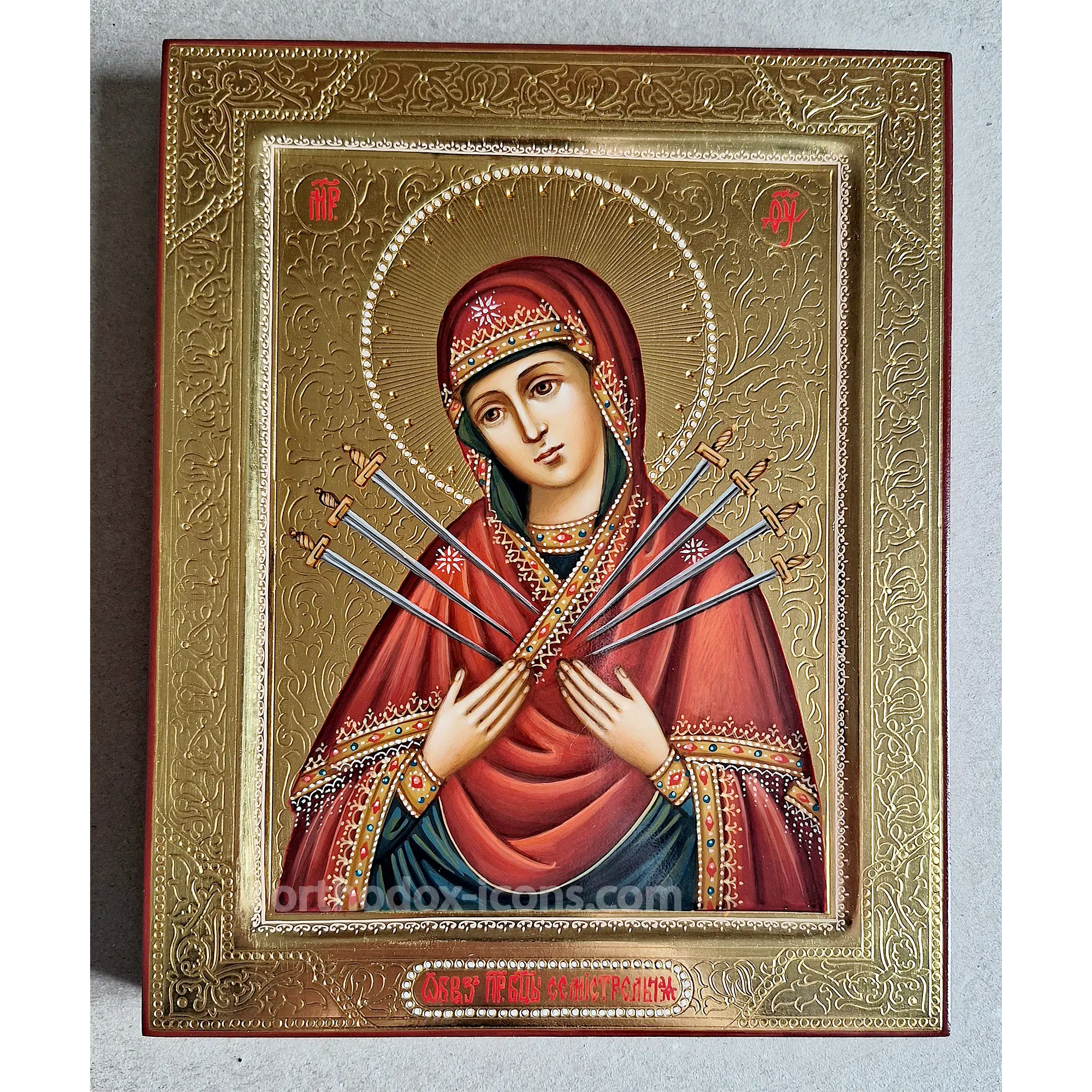
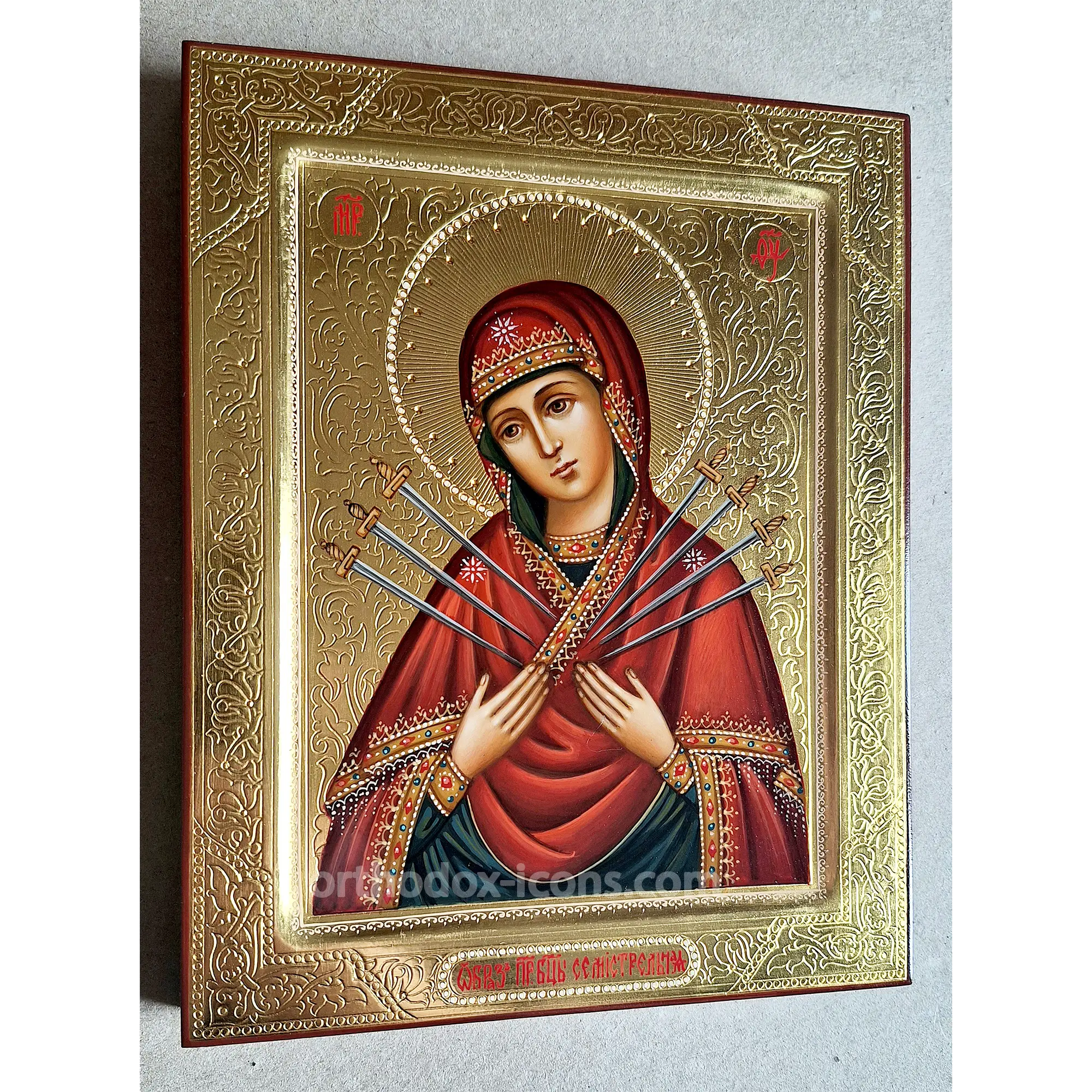
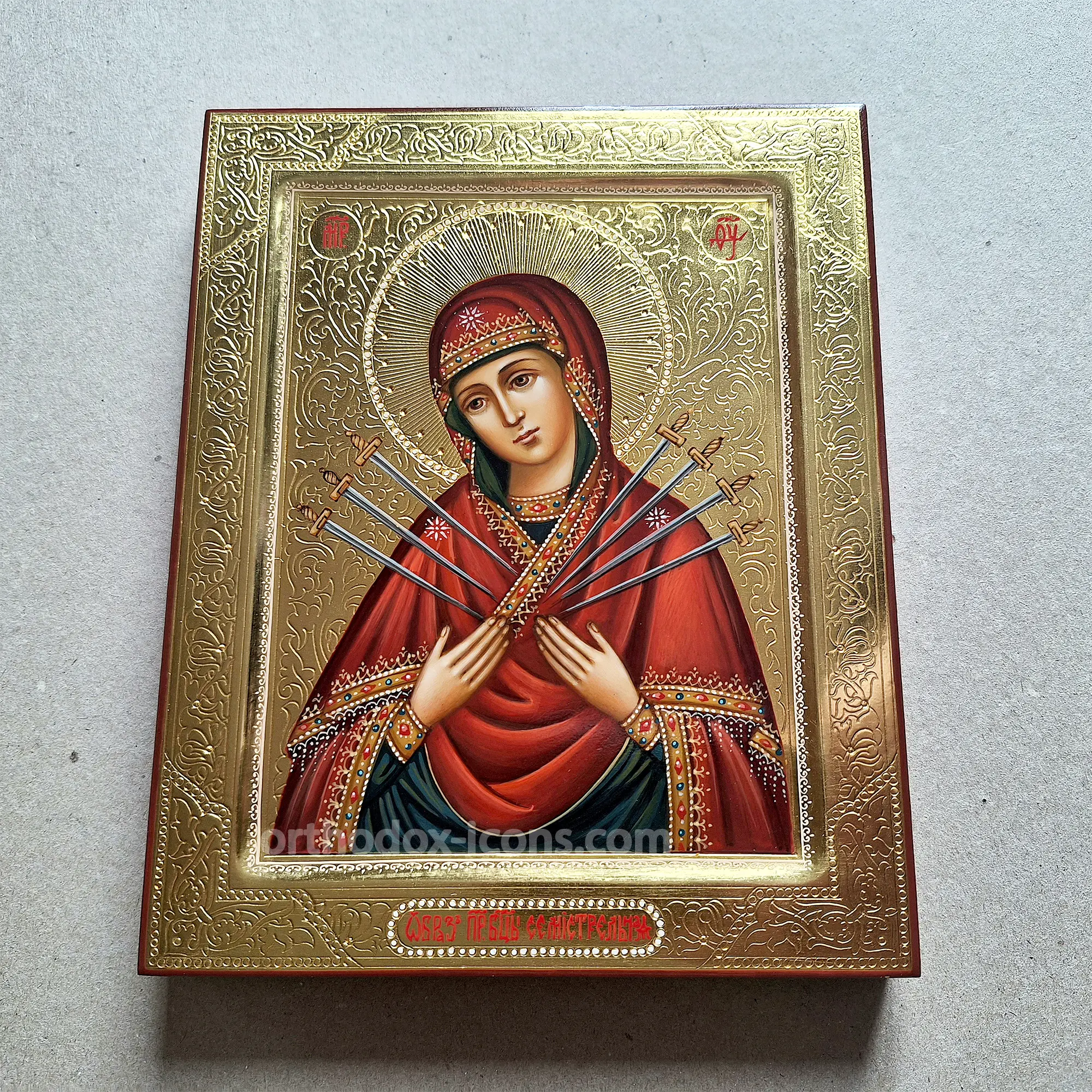
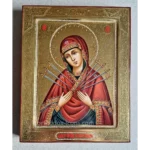
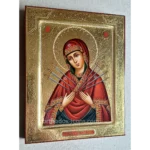
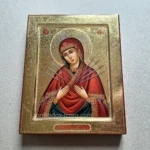
Seven Arrows Icon of the Mother of God
Price range: $700 through $2250
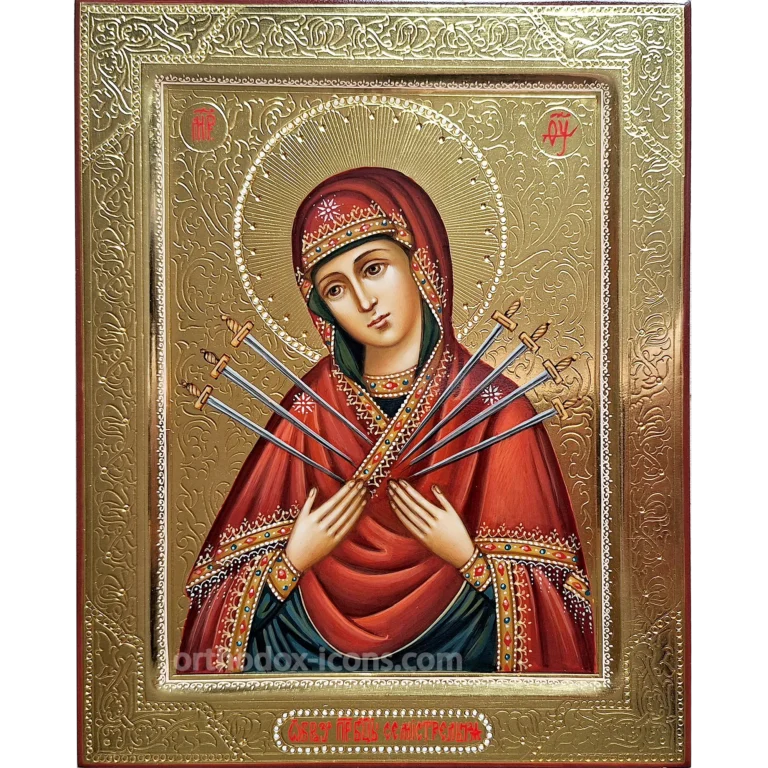
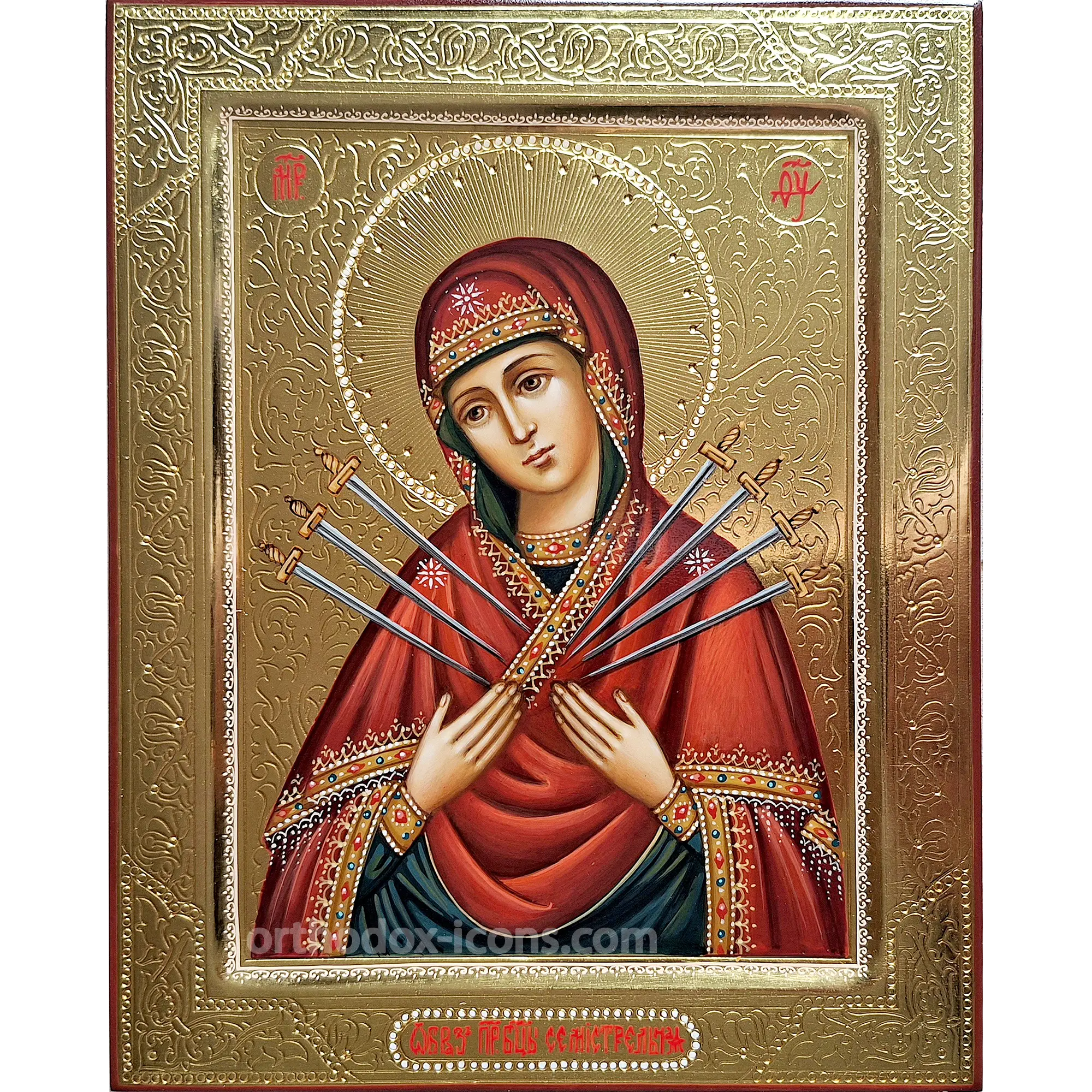
Seven Arrows Icon of the Mother of God is a hand-painted Semistrelnaya icon, also closely associated with the Softener of Evil Hearts, made for prayer for reconciliation, protection, and peace in the home.
Available sizes: 17×21 cm (6.7×8.3 in), 20×24 cm (7.9×9.4 in), 27×31 cm (10.6×12.2 in), 30×40 cm (11.8×15.7 in). Larger and iconostasis sizes may be discussed before painting.
Materials: linden board with kovcheg and oak braces, linen pavoloka, chalk levkas, 960 gold leaf, mineral egg tempera, protective finish.
Technique: hand icon painting on wood, mineral tempera on egg emulsion, full gilding of the background and margins, hand relief tooling over gold with a floral ornament.
It is possible to paint an image in any size to order
Free shipping worldwide
Seven Arrows Icon of the Mother of God is a hand-painted Orthodox icon of the Theotokos in the Semistrelnaya tradition. In the rich heritage of Orthodox iconography, there are not many images where the Queen of Heaven is shown alone, without the Christ Child. This makes the Seven Arrows icon especially concentrated and spiritually direct.
The image is tragic and saving at the same time. The Mother of God bears a sorrow that only a boundlessly loving maternal heart could bear. Yet this sorrow does not lead to despair. It gives hope, because the Theotokos, having passed through immeasurable suffering, understands human pain, fear, weakness, conflict, and the need for mercy.
This hand-painted icon is visually strong and solemn. The dark, deep tones of the maphorion contrast with the brilliant shine of tooled 960 gold leaf on the background and margins. The icon is painted on a board with a kovcheg, a recessed sacred field that gives the image the feeling of a spiritual window through which grace and forgiveness are offered.
History of the Wonderworking Seven Arrows Icon
The veneration of the Seven Arrows icon is connected with northern Russia, especially the Vologda region. According to tradition, the prototype was found through a remarkable event involving a peasant of the Kadnikov district who had suffered for many years from severe lameness and constant pain.
One night, the sick man heard a mysterious voice in a dream. He was told to go to the Church of Saint John the Theologian on the River Toshna, where an old icon of the Mother of God was hidden in the bell tower. Prayer before this icon, he was told, would bring him healing.
The man reached the church with difficulty, but the church servants did not at first believe him and twice refused to let him enter the bell tower. Only after his tearful pleas was he allowed to climb up. There he discovered that the icon had been used as a step in a wooden staircase, lying face down under dirt and dust while bell ringers had walked over it for years, thinking it was only a board.
The image was immediately cleaned, a thanksgiving service was offered before it, and the lame peasant was healed. The icon was brought into the church and became an object of reverent veneration. Its fame spread especially in 1830, when a cholera epidemic struck Vologda. After the icon was carried in procession around the city, the disease was said to have receded.
Theology and Symbolism of the Seven Arrows
The iconography of the Seven Arrows image is inseparable from the Gospel account of the Meeting of the Lord. On the fortieth day after the Nativity, Mary and Joseph brought the Child Jesus to the Temple in Jerusalem. The righteous elder Symeon held the Savior in his arms and spoke a prophecy to the Mother of God: a sword would pierce her own soul.
This weapon piercing the soul is a prophecy of the suffering the Mother of God would bear while standing at the Cross of her crucified Son. Icon painters made that invisible suffering visible as arrows or swords piercing the heart of the Theotokos.
The number seven has a special meaning in Christian symbolism: it indicates fullness, abundance, and completion. In this icon, the seven arrows express the complete fullness of maternal sorrow. They also point to the human passions and sins that continue to wound the loving heart of the Mother of God: anger, envy, pride, hatred, and all spiritual illness that divides people from one another.
The Seven Arrows icon is often associated with the Softener of Evil Hearts. The spiritual meaning is the same, but the arrangement differs: in the Seven Arrows icon the weapons are placed at the sides, usually four on one side and three on the other, while the Softener of Evil Hearts is commonly shown with three on each side and one from below.
Prayer Before the Seven Arrows Icon
The grace sought before this icon is already expressed in its related name, Softener of Evil Hearts. It is a powerful spiritual image against hatred, both the hatred directed toward us and the hatred that can take root in our own hearts.
- For reconciliation: the icon is approached during family quarrels, conflicts between spouses, and painful divisions between parents, children, and relatives.
- For protection from ill will: Orthodox Christians keep this icon with prayer against envy, slander, persecution, unfair treatment, and hidden malice.
- For peace at work: prayer before the icon asks for the calming of anger, the restoration of justice, and the softening of hostility among colleagues or superiors.
- Against one’s own aggression: the icon reminds the believer to fight irritation, impatience, harsh judgment, and hardness of heart within himself.
Kovcheg, Gold Leaf, Relief Tooling, and Mineral Tempera
This icon is made with respect for the long experience of Mstyora icon painters. It is not a printed devotional image, but a hand-painted work created on a prepared wooden board with traditional materials and a carefully finished gilded surface.
The foundation is a solid linden board. Linden is valued for its soft, even structure, which is well suited for icon painting. A kovcheg is cut into the front of the board, symbolically separating the sacred space of the image from the outer margins. Oak braces are set into the back to protect the board from warping.
The front of the board is covered with linen pavoloka and several layers of natural chalk levkas. The background and margins are then covered with genuine 960 gold leaf. Over the gilding, the master works a relief floral ornament by hand. Light breaks across the raised pattern, making the gold shimmer and giving the icon a luminous depth.
The painting itself, including the face and garments, is executed in natural mineral tempera on egg emulsion. The pigments are prepared from finely ground minerals and earths, then mixed with egg binder. This traditional technique gives the colors depth, durability, and a restrained, living brightness.
Characteristics of the Hand-Painted Icon
| Icon name | Seven Arrows Icon of the Mother of God, also associated with the Softener of Evil Hearts |
|---|---|
| Board form | Kovcheg, a recessed sacred field on the front of the board |
| Background | Full 960 gold leaf on the background and margins |
| Decoration | Hand relief tooling over gold with floral ornament |
| Board | Solid linden board, linen pavoloka, chalk levkas, inserted oak braces |
| Painting technique | Mineral tempera on egg emulsion |
| Available sizes | 17×21 cm (6.7×8.3 in), 20×24 cm (7.9×9.4 in), 27×31 cm (10.6×12.2 in), 30×40 cm (11.8×15.7 in), and iconostasis sizes by agreement |
| Shipping | Free international shipping is included; payment is due upon delivery. |
A Gift for Reconciliation and Protection
A hand-painted Seven Arrows icon is a meaningful gift for a family, for spouses seeking peace, or for someone going through a painful conflict. It may also be given for a housewarming, with prayer that the new home be guarded from evil intentions, envy, and harmful thoughts.
The icon can be placed near the entrance, above the door, or in the family icon corner together with other holy images. Wherever it is kept, its central meaning remains the same: the Mother of God intercedes for peace, mercy, repentance, and the softening of hardened hearts.
Questions and Answers
1. What do the seven arrows on the icon symbolize?
The arrows, or swords in some versions, have a double meaning. First, the number seven expresses the fullness of the sorrow borne by the Mother of God at the Crucifixion of Christ. Second, the arrows recall the human passions and sins that continue to wound the loving heart of the Theotokos.
2. Is there a difference between the Seven Arrows icon and the Softener of Evil Hearts?
Their theological meaning and prayerful use are essentially the same. The difference is iconographic. In the Seven Arrows icon the weapons are arranged at the sides, four on one side and three on the other. In the Softener of Evil Hearts, they are usually arranged three on each side with one from below.
3. Where is the Seven Arrows icon usually placed in a home?
A common Orthodox custom is to place this icon opposite the entrance or above the door, with prayer that the Mother of God protect the home from malice, envy, and harmful intentions. It may also be placed in the family icon corner with other holy images.
4. For whom is this icon a suitable gift?
It is a meaningful gift for people going through family conflict, workplace tension, misunderstanding, or reconciliation after quarrels. It is also often given to spouses or to a family moving into a new home.
5. What does the prophecy of Saint Symeon mean?
When Symeon met the Christ Child in the Temple, he foretold that a sword would pierce the soul of the Mother of God. This pointed to the spiritual suffering she would bear while standing at the Cross and seeing the death of her Son.
6. What is a kovcheg on an icon board?
The kovcheg is a recessed rectangular area on the front of the board where the sacred image is painted. The raised edges form the margins. Symbolically, the kovcheg creates the sense of a window into the spiritual world.
7. How is the relief ornament over gold made?
After the levkas ground is covered with gold leaf, the master uses special metal tools with shaped tips to press a relief pattern into the gilded surface without cutting through the gold. The light breaks across the relief and makes the ornament shimmer.
8. What if the wooden board begins to warp over time?
The icon board is made to resist warping. Oak braces are set into the back of the linden board across the grain. They work as a stabilizing frame and help protect the board during changes in humidity and indoor heating seasons.
9. Will the gold background darken?
The background is decorated with genuine 960 gold leaf, not imitation metal leaf. Real high-purity gold is chemically stable: it does not oxidize, blacken, or turn green in ordinary air when the icon is cared for properly.
10. Does the icon need to be blessed after purchase?
Yes. The icon is painted according to Orthodox tradition, but it is normally sent unblessed. The owner may bring the new icon to an Orthodox church, where a priest can bless it with the appointed prayers.
| Dimensions | 17x21cm (6.7×8.3 in), 20x24cm (7.9×9.4 in), 27x31cm (10.6×12.2 in), 30x40cm (11.8×15.7 in) |
|---|---|
| Name | Mary |