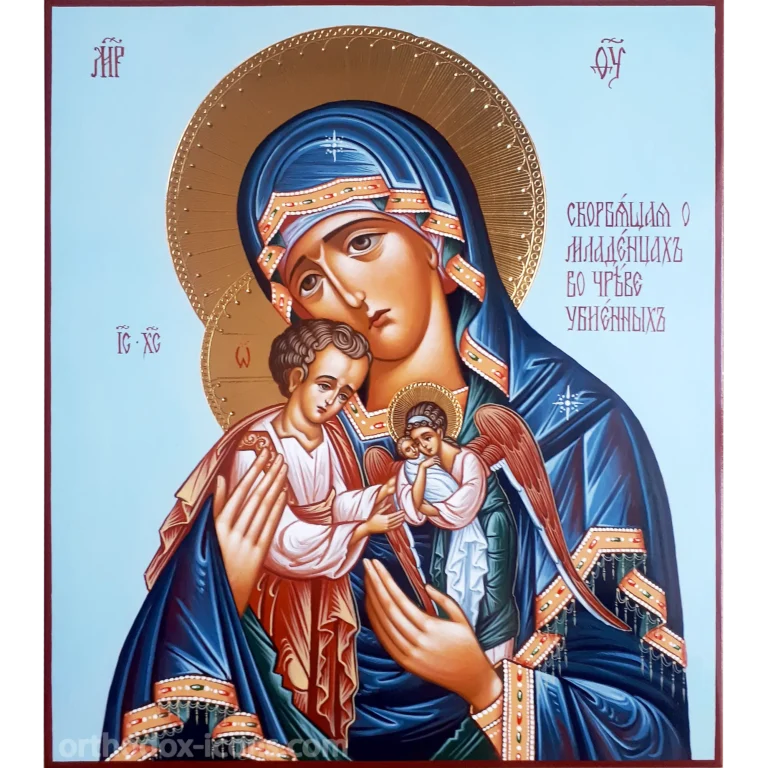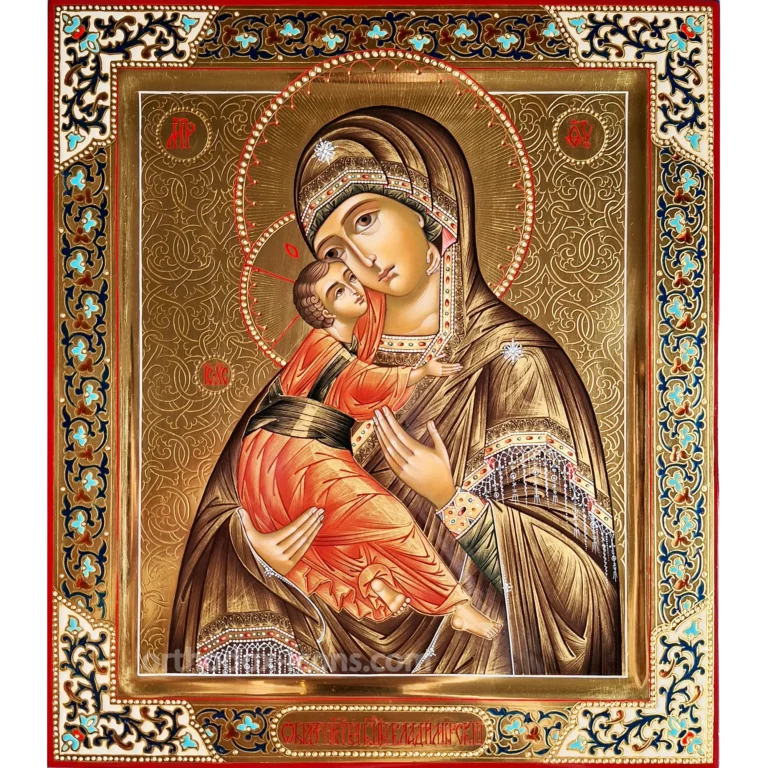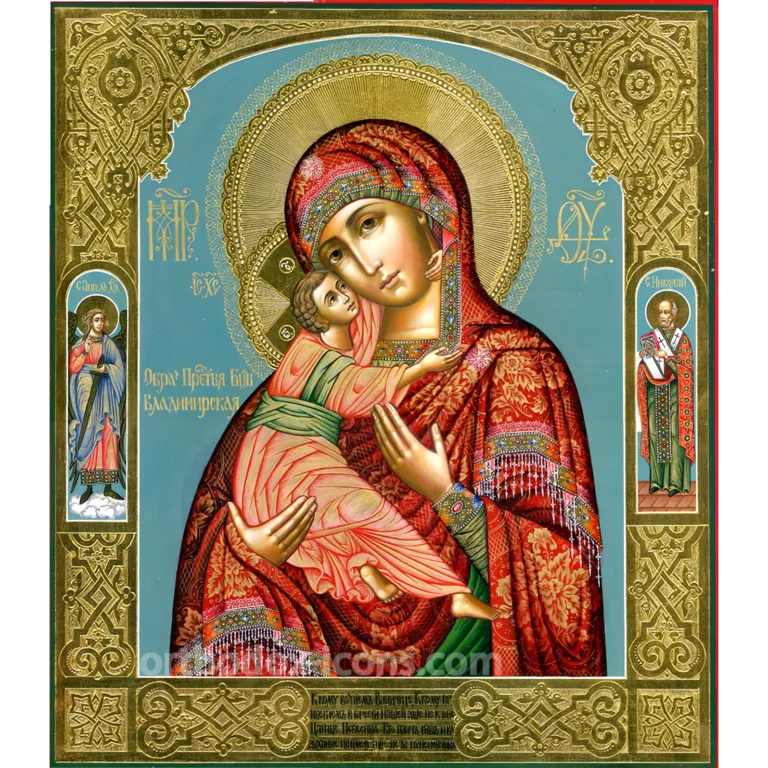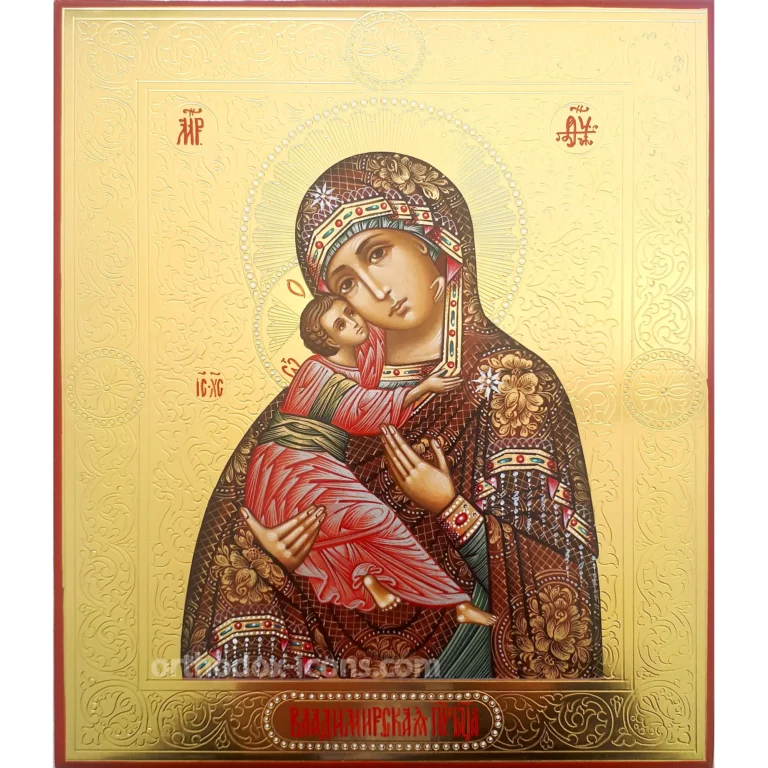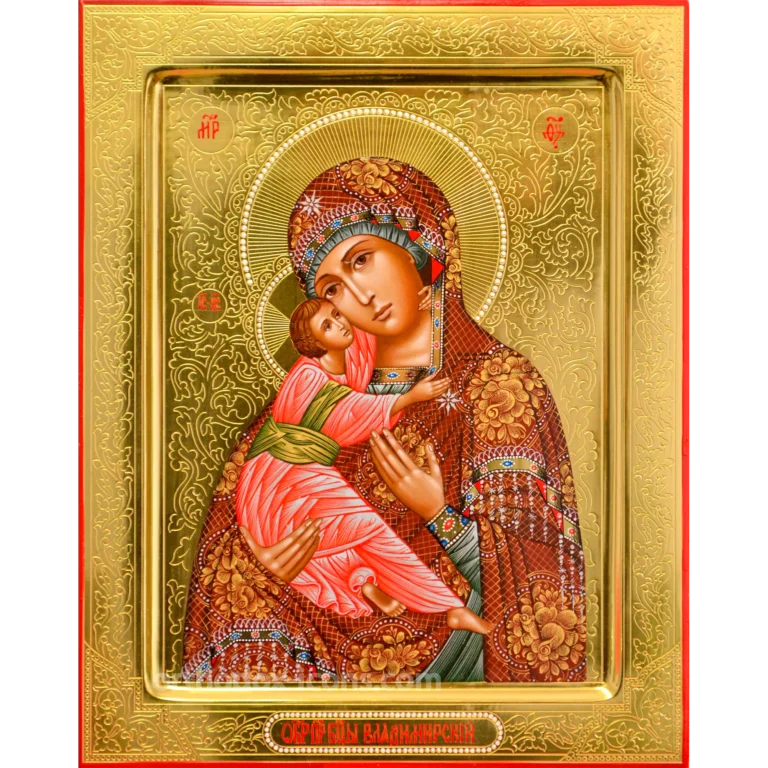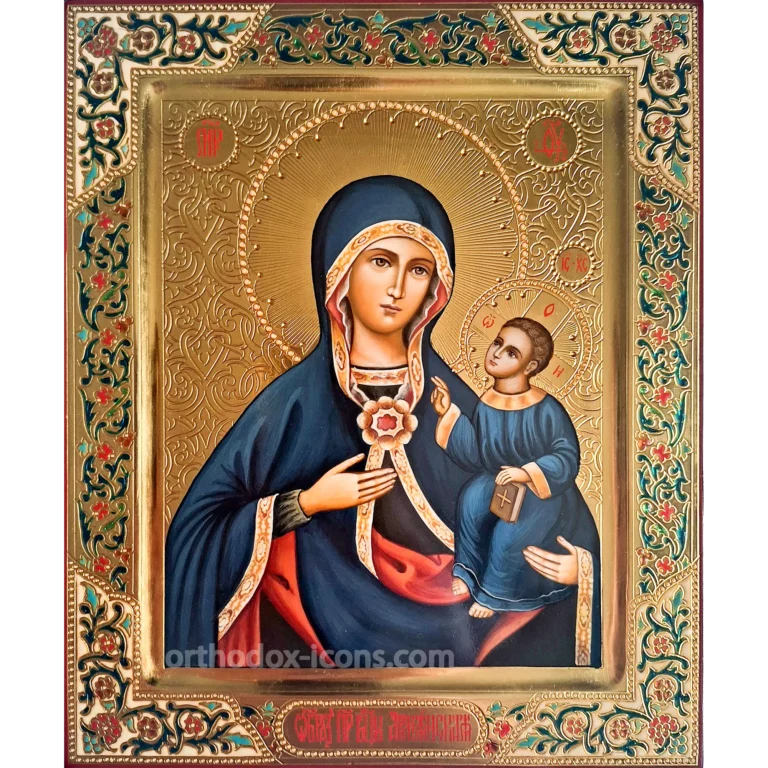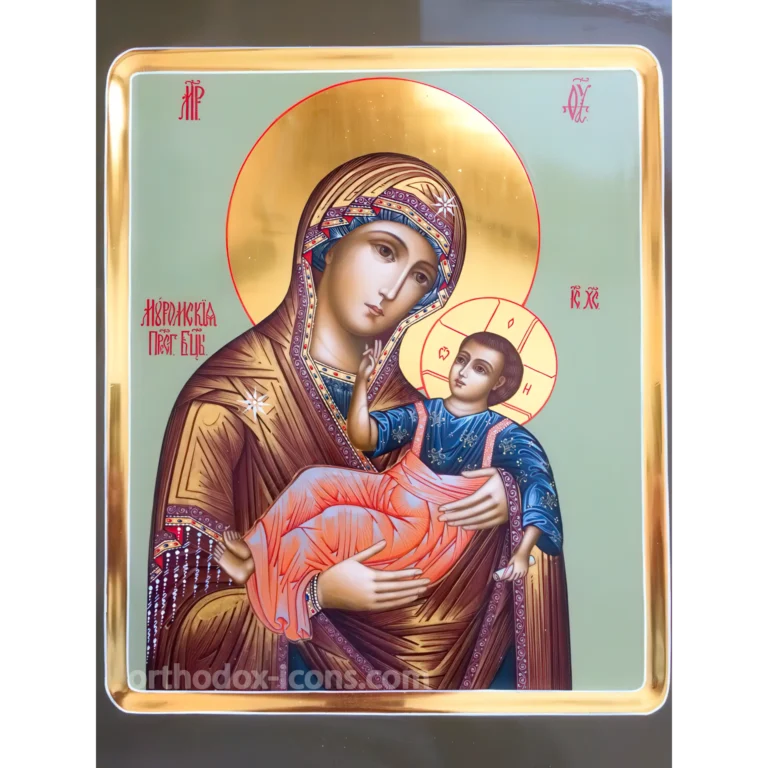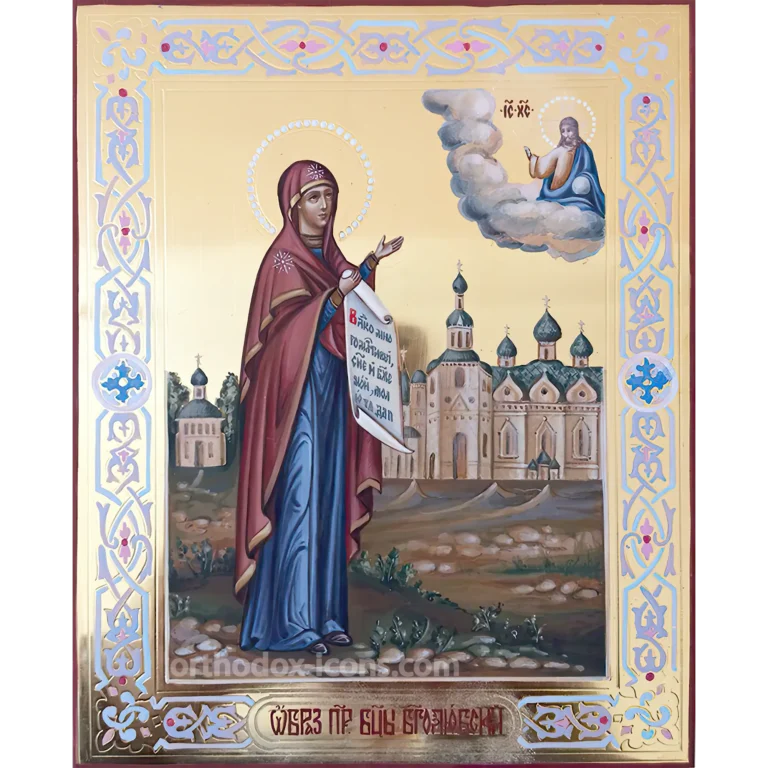
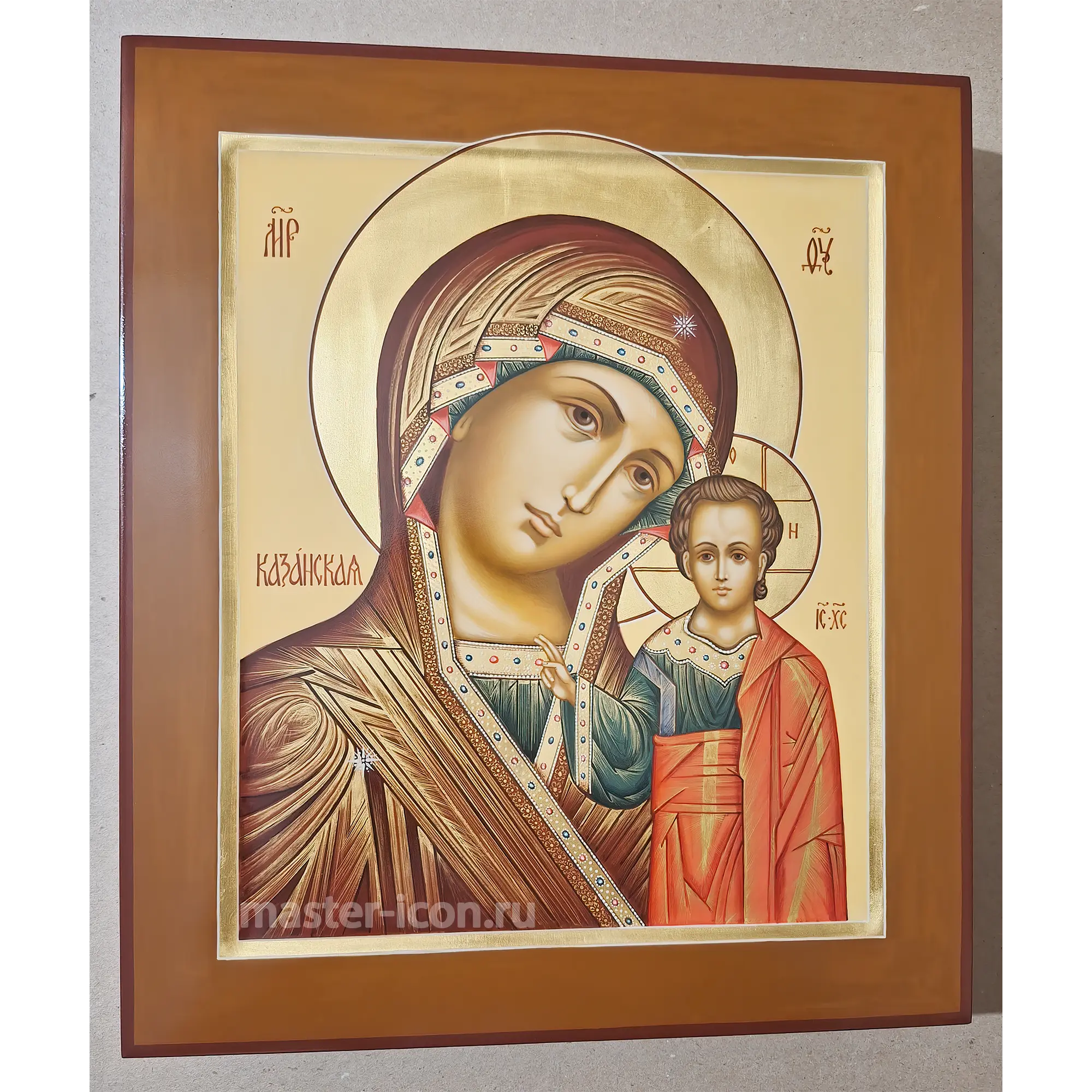
Icon of Our Lady of Kazan
Price range: $500 through $1500
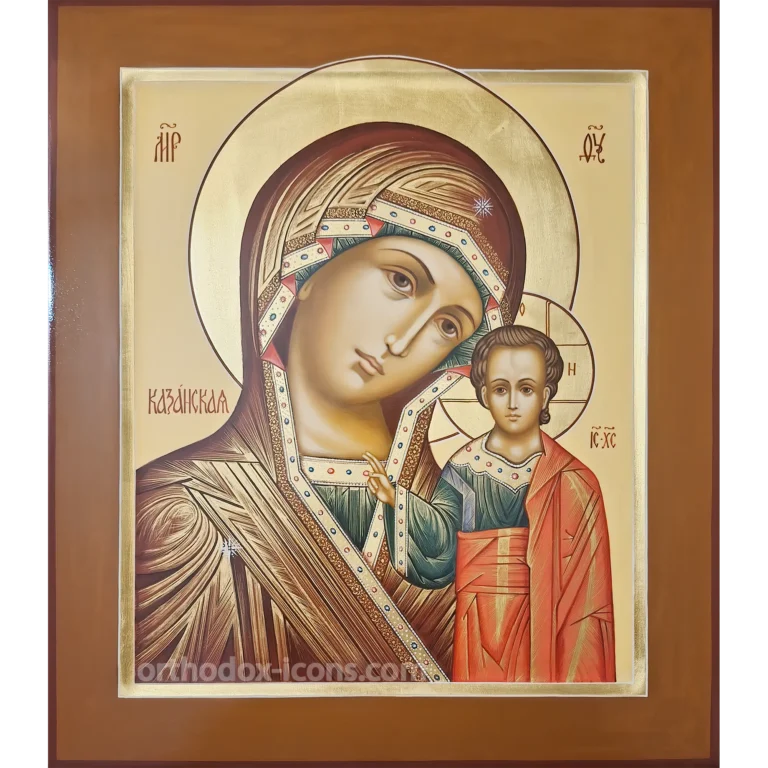
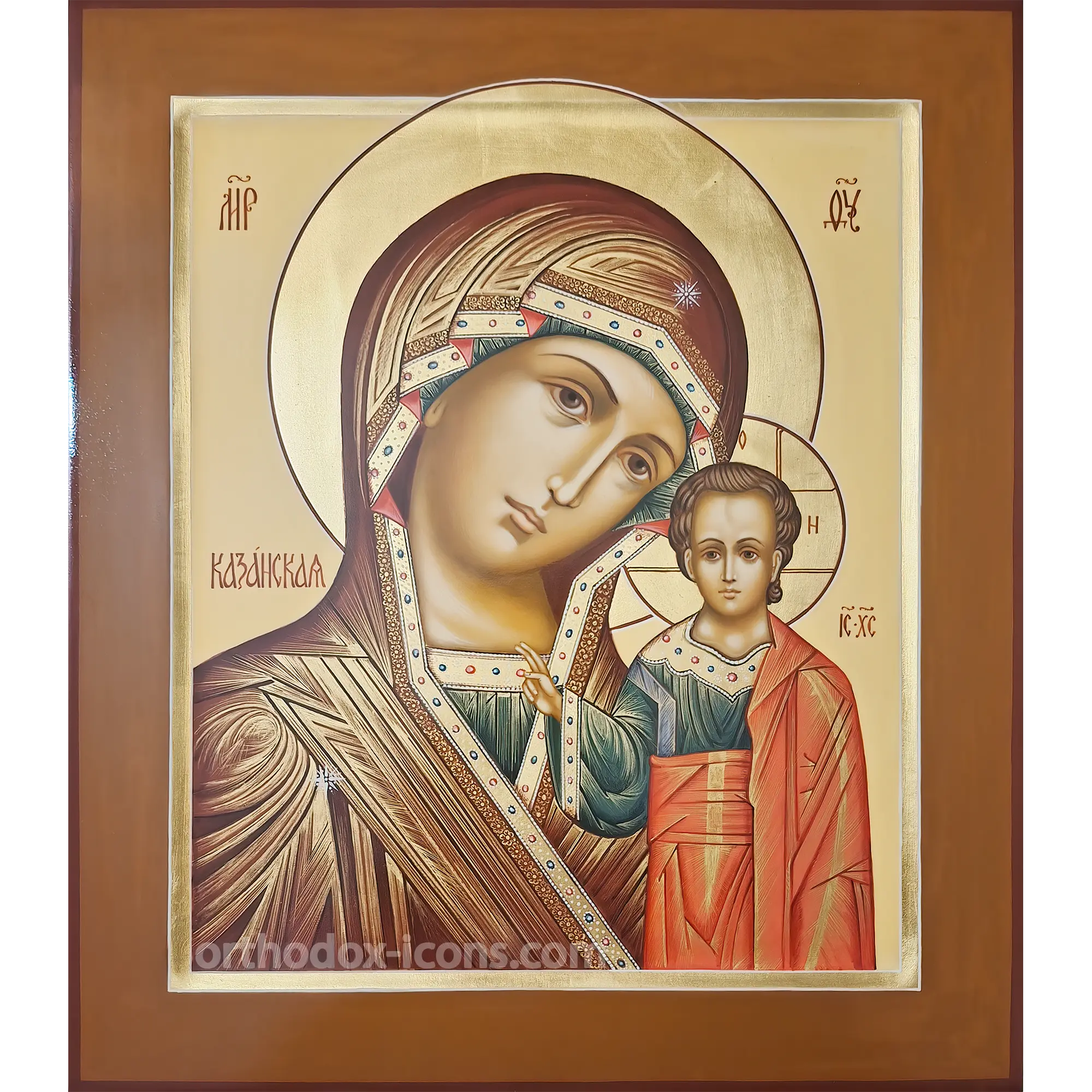
Icon of Our Lady of Kazan is a hand-painted Orthodox icon of the Kazan Mother of God, one of the most beloved images of the Theotokos in the Russian Orthodox tradition.
Available sizes: 17×21 cm (6.7×8.3 in), 20×24 cm (7.9×9.4 in), 27×31 cm (10.6×12.2 in), 30×40 cm (11.8×15.7 in). Other sizes may be discussed before painting.
Materials: linden board with oak braces, kovcheg, linen pavoloka, chalk levkas, 960 gold leaf, natural mineral egg tempera, protective lacquer.
Technique: fully hand-painted icon on wood in the Mstyora tradition, prepared to order for home prayer, family blessing, or church use.
It is possible to paint an image in any size to order
Free shipping worldwide
Icon of Our Lady of Kazan is a hand-painted Orthodox icon of the Kazan Mother of God, one of the most venerated and beloved images of the Theotokos in the Russian Orthodox Church. This icon is associated with maternal intercession, mercy, protection of the home, peace within the family, help in illness and sorrow, and spiritual unity in difficult times.
The Kazan Icon is often chosen for a home icon corner, for a married couple, for children, for a new home, or for a parish setting. Its meaning is not decorative only. It is a holy image before which the faithful turn to the Mother of God with trust, asking her to lead the heart to Christ and to protect family life from division, fear, and despair.
This icon is painted to order on a linden board with oak braces, a carved kovcheg, linen pavoloka, and traditional chalk levkas. The image is painted by hand in natural mineral egg tempera and finished with 960 gold leaf on the halos and decorative elements. The technique follows the Russian iconographic tradition of Mstyora, where fine drawing, balanced color, and careful spiritual restraint are essential.
History of the Kazan Icon of the Mother of God
The Finding of the Icon in 1579
The history of the Kazan Icon begins in 1579, after a devastating fire in the city of Kazan. The fire destroyed a large part of the city, and after it the Most Holy Theotokos appeared in dreams to a young girl named Matrona. The Mother of God showed her the place where the holy image was hidden beneath the ruins of a burned house.
At first the girl’s words were not believed, but after repeated dreams the place was searched. The icon was found in the earth, unharmed by fire and decay. This finding was received as a great miracle and as a sign of the special protection of the Mother of God over Kazan and over the Russian land.
From the time of its discovery, healings and other signs of help were recorded before the newly found icon. The tradition especially remembers healings of the blind and help in both bodily and spiritual distress. For this reason the Kazan Icon quickly became not only a local shrine, but a beloved image throughout Orthodox Russia.
Saint Hermogenes and the Spread of Veneration
The growth of devotion to the Kazan Icon is closely connected with Saint Hermogenes, later Patriarch of Moscow and All Russia. While serving in Kazan, he helped record the miracles connected with the icon and contributed to the strengthening of its church veneration.
Later, during the Time of Troubles, Patriarch Hermogenes called the people to spiritual firmness and unity. His witness made the Kazan Icon not only a beloved image of the Mother of God, but also a symbol of steadfast faith, sobornost, and fidelity to the Church in a time of national trial.
The Kazan Icon, Minin, Pozharsky, and 1612
One of the best-known historical events connected with the Kazan Icon is the liberation of Moscow from Polish-Lithuanian forces in 1612. During the Time of Troubles, when the country was suffering political and spiritual collapse, the militia of Nizhny Novgorod rose under the leadership of Kuzma Minin and Prince Dmitry Pozharsky.
The militia went toward Moscow under the protection of the Kazan Mother of God. Prayer services were offered before the icon, and the army asked the Theotokos for courage, unity, and deliverance. After the liberation of Moscow, the Kazan Icon became inseparably linked with the memory of national deliverance and with the feast now kept on November 4 according to the civil calendar.
For Orthodox believers, this history gives the icon a meaning that is both personal and communal. It is a family icon, but also an image of protection in the life of a people. Before it one may pray for the home, for children, for peace between spouses, and also for the strengthening of faith, unity, and peace in society.
Iconography and Spiritual Meaning
Hodegetria: She Who Shows the Way
The Kazan Mother of God belongs to the iconographic type known as Hodegetria, meaning She Who Shows the Way. In this tradition the Mother of God directs the faithful toward Christ, who is the Way, the Truth, and the Life. The Kazan version is especially intimate and restrained, because the figures are shown close to one another and close to the person standing before the icon.
The Theotokos is shown in a half-length composition. Her face is calm, attentive, and full of maternal compassion. Her gaze does not create emotional drama; it draws the soul toward stillness and prayer. The form of the image makes the icon especially suitable for daily family prayer, because the holy figures are near and accessible without losing their solemn dignity.
The Christ Child and His Blessing
The Christ Child is shown beside the Mother of God, blessing with His right hand. In many Kazan compositions He also holds a scroll or the Gospel, a sign of His divine teaching and His saving mission. His blessing reminds the faithful that the intercession of the Theotokos always leads to Christ, not away from Him.
This relationship between Mother and Son is central to the icon. The Mother of God is not venerated apart from Christ; she is honored because she bears Him, points to Him, and prays for those who seek His mercy. The Kazan Icon therefore combines tenderness, doctrinal clarity, and the quiet strength of Orthodox prayer.
Colors, Gold, and Sacred Form
The Mother of God is traditionally shown in a deep red or dark cherry maphorion. The three stars on her garment signify her ever-virginity: before, during, and after the Nativity of Christ. The Christ Child is often painted in golden, ocher, blue, or green tones, expressing both His divine glory and His true human nature.
Gold leaf does not serve as ordinary decoration. In Orthodox iconography, gold is a sign of uncreated divine light and the Kingdom of God. The golden halos and decorative elements lift the image beyond everyday portraiture and show that the icon belongs to the world of prayer, liturgy, and veneration.
How the Kazan Icon Differs from Other Mother of God Icons
The Orthodox tradition preserves many venerated icons of the Mother of God, and each has its own iconographic language. The Kazan Icon is not the same as the Vladimir, Smolensk, Iveron, or Tikhvin icons, even though all are images of the Theotokos with Christ.
| Kazan Icon | Hodegetria type; half-length Mother of God with Christ blessing; especially connected with family peace, children, protection of the home, and national deliverance. |
|---|---|
| Vladimir Icon | Tenderness type; the Child presses His cheek to the Mother; strongly associated with maternal love, protection, and the preservation of life. |
| Smolensk Icon | Hodegetria type; Christ is shown more frontal and solemn; often connected with protection on journeys and safety on the road. |
| Iveron Icon | A revered Mother of God image often associated with protection of the home and entrance, and with help against visible and invisible enemies. |
| Tikhvin Icon | Hodegetria type with the Child on the left arm of the Mother of God; often connected with health, children, and help in illness. |
The particular strength of the Kazan Icon is its closeness to family life. It is often given to newly married couples, placed in a family icon corner, or kept in a home where parents pray for children, peace between spouses, and protection from visible and invisible harm.
Prayer Before the Icon of Our Lady of Kazan
Prayer before the Kazan Icon is not a magical act or a mechanical ritual. It is a living appeal to God through the intercession of His Most Pure Mother. The faithful usually stand quietly before the icon, make the sign of the cross, bow with reverence, and then pray with attention and trust.
Traditional prayers may include the hymn “Rejoice, O Virgin Theotokos,” the troparion and kontakion of the Kazan Icon, or other prayers from an Orthodox prayer book. It is also appropriate to speak in simple words from the heart, bringing before the Mother of God the needs, sorrows, hopes, and gratitude of the family.
- For peace and mutual forgiveness between husband and wife.
- For the gift of children, the protection of pregnancy, and the upbringing of children in faith.
- For the health of loved ones, especially children, parents, and the elderly.
- For protection of the home from misfortune, conflict, and fear.
- For help in sorrow, illness, uncertainty, and difficult decisions.
- For peace, unity, and protection in times of social or national trial.
Where to Place the Kazan Icon in a Home
The traditional place for an Orthodox icon in the home is the icon corner, often called the beautiful or red corner. Where possible, this prayer place is arranged on an eastern wall, but in modern homes the most important thing is not geography alone, but reverence, cleanliness, and regular prayer.
The Kazan Icon may also be placed in a married couple’s bedroom as a prayer image for peace, faithfulness, and the blessing of family life. In a child’s room it reminds parents to entrust their children to the protection of the Mother of God. Near the entrance of a home it can become a quiet sign that the household is placed under her maternal care.
A small shelf, a clean wall space, a lampada, and a prayer book are enough to create a modest prayer corner. The icon should not be treated as interior decor, but as a holy image before which the family returns again and again to prayer.
How This Icon Is Painted
Linden Board, Kovcheg, Pavoloka, and Levkas
The icon is painted on a carefully prepared linden board strengthened with oak braces. The board includes a kovcheg, a shallow recessed central field traditional in many hand-painted Orthodox icons. This form visually gathers the image inward and gives the holy figure a protected sacred space.
A linen pavoloka is applied to the board, then covered with layers of chalk levkas made from chalk and natural glue. Each layer is dried and polished until the surface becomes smooth and strong enough for fine icon painting. This preparation is essential for durability and for the delicate modeling of faces, garments, and gold details.
Egg Tempera and 23K Gold Leaf (960 Purity)
The faces of the Mother of God and Christ, the garments, hands, inscriptions, and ornamental details are painted in egg tempera made with natural mineral pigments and egg yolk. Tempera allows the icon painter to build color gradually, from deeper tones to light, creating the restrained luminosity proper to Orthodox iconography.
The halos and selected decorative elements are gilded with genuine 960 gold leaf. The gold is applied to a prepared ground and carefully finished so that it gives a warm, dignified radiance. After the painting is complete, the icon receives a protective lacquer to help preserve it from dust and ordinary environmental changes.
Care for a Hand-Painted Icon with Gold Leaf
A hand-painted icon is both a holy object and a delicate work of traditional craftsmanship. It should be protected from direct sunlight, high humidity, heat sources, and sudden changes of temperature. Ultraviolet light can weaken pigments, and unstable humidity can affect the wooden board and painted surface.
Dust should be removed only with a soft dry cloth or a very soft brush, without pressure. Water, alcohol, household cleaners, polish, and abrasive materials should never be used on the painted or gilded surface. If serious wear or damage appears, the icon should be shown to a professional restorer.
Icon Characteristics
| Name | Icon of Our Lady of Kazan |
|---|---|
| Russian title | Kazan Icon of the Mother of God |
| Iconographic type | Hodegetria, half-length Mother of God with the Christ Child |
| Main meaning | Maternal intercession, family peace, children, protection of the home, help in illness and sorrow |
| Board | Linden board with oak braces and carved kovcheg |
| Ground | Linen pavoloka and chalk levkas |
| Painting technique | Hand-painted natural mineral egg tempera |
| Gilding | Genuine 960 gold leaf on halos and decorative elements |
| Available sizes | 17×21 cm (6.7×8.3 in), 20×24 cm (7.9×9.4 in), 27×31 cm (10.6×12.2 in), 30×40 cm (11.8×15.7 in) |
| Other formats | Family, analogion, church, and iconostasis sizes may be discussed before painting |
| Shipping | Free international shipping is included; payment is due upon delivery. |
Questions and Answers
Why is the Kazan Icon of the Mother of God so widely venerated?
The Kazan Icon is connected with the miraculous finding of the holy image in Kazan in 1579 and with many accounts of help, healing, and protection. In Orthodox life it is especially loved as an image of maternal intercession, family peace, and protection in times of danger.
What iconographic type is Our Lady of Kazan?
The Kazan Mother of God belongs to the Hodegetria type, the Theotokos as She Who Shows the Way. The Virgin Mary is shown close to Christ, and the Christ Child blesses with His right hand, revealing Him as Savior and Teacher.
What is the historical connection with Kazan in 1579?
According to tradition, after a devastating fire in Kazan, the Mother of God appeared in dreams to a young girl named Matrona and indicated where the icon was hidden. The image was found intact, and its discovery became one of the great events in Russian Orthodox history.
How is the Kazan Icon connected with 1612?
During the Time of Troubles, the militia led by Kuzma Minin and Prince Dmitry Pozharsky prayed before the Kazan Icon. The liberation of Moscow in 1612 became closely associated with the protection of the Mother of God and with national spiritual unity.
For what needs do people pray before the Kazan Icon?
The faithful pray before the Kazan Icon for peace in the family, protection of children, help in illness and sorrow, preservation of marriage, protection of the home, and deliverance in times of danger or national trial.
Where can this icon be placed in the home?
It may be placed in a home icon corner, on the eastern wall where possible, in a family prayer space, or in a respectful place in a bedroom, children’s room, or entrance area. The main requirement is reverent placement and regular prayer.
What materials are used for this hand-painted icon?
The icon is painted on a linden board strengthened with oak braces. The surface includes a carved kovcheg, linen pavoloka, and chalk levkas. The painting is done in egg tempera, with 960 gold leaf used for halos and decorative elements.
Is this a printed reproduction?
No. This is not a printed reproduction; it is a fully hand-painted Orthodox icon on wood. The image is painted by hand with natural mineral pigments in egg tempera and finished with gold leaf and protective lacquer.
Can this icon be ordered in another size?
Yes. The listed sizes are 17×21 cm, 20×24 cm, 27×31 cm, and 30×40 cm. Larger family, analogion, church, and iconostasis formats may also be discussed before the icon is painted.
Is free international shipping included?
Yes. Free international shipping is included; payment is due upon delivery. The icon is painted to order and prepared for careful shipment after completion.
| Dimensions | 17x21cm (6.7×8.3 in), 20x24cm (7.9×9.4 in), 27x31cm (10.6×12.2 in), 30x40cm (11.8×15.7 in) |
|---|---|
| Name | Mary |