Winged St John the Precurser Icon
$1000
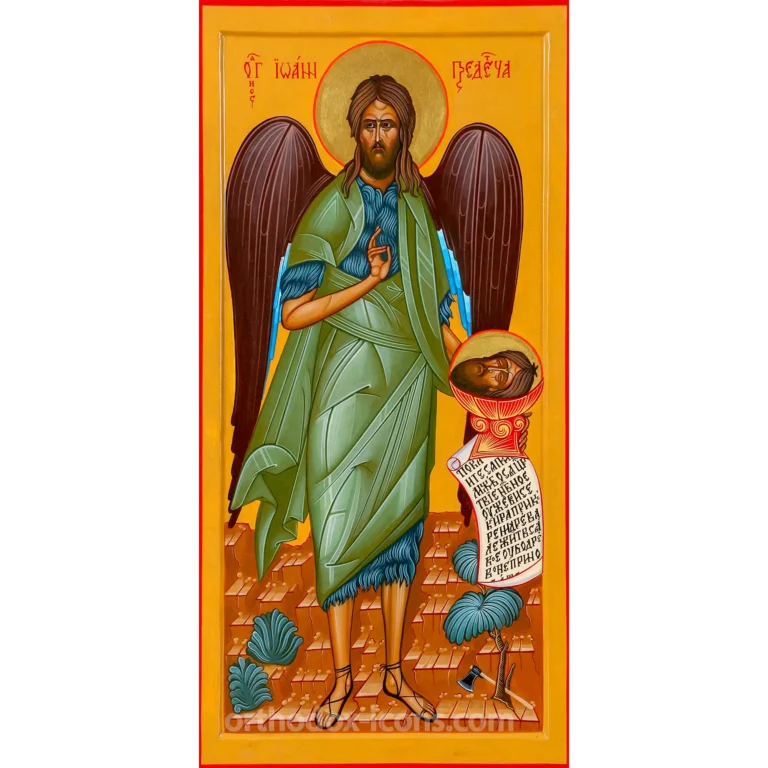
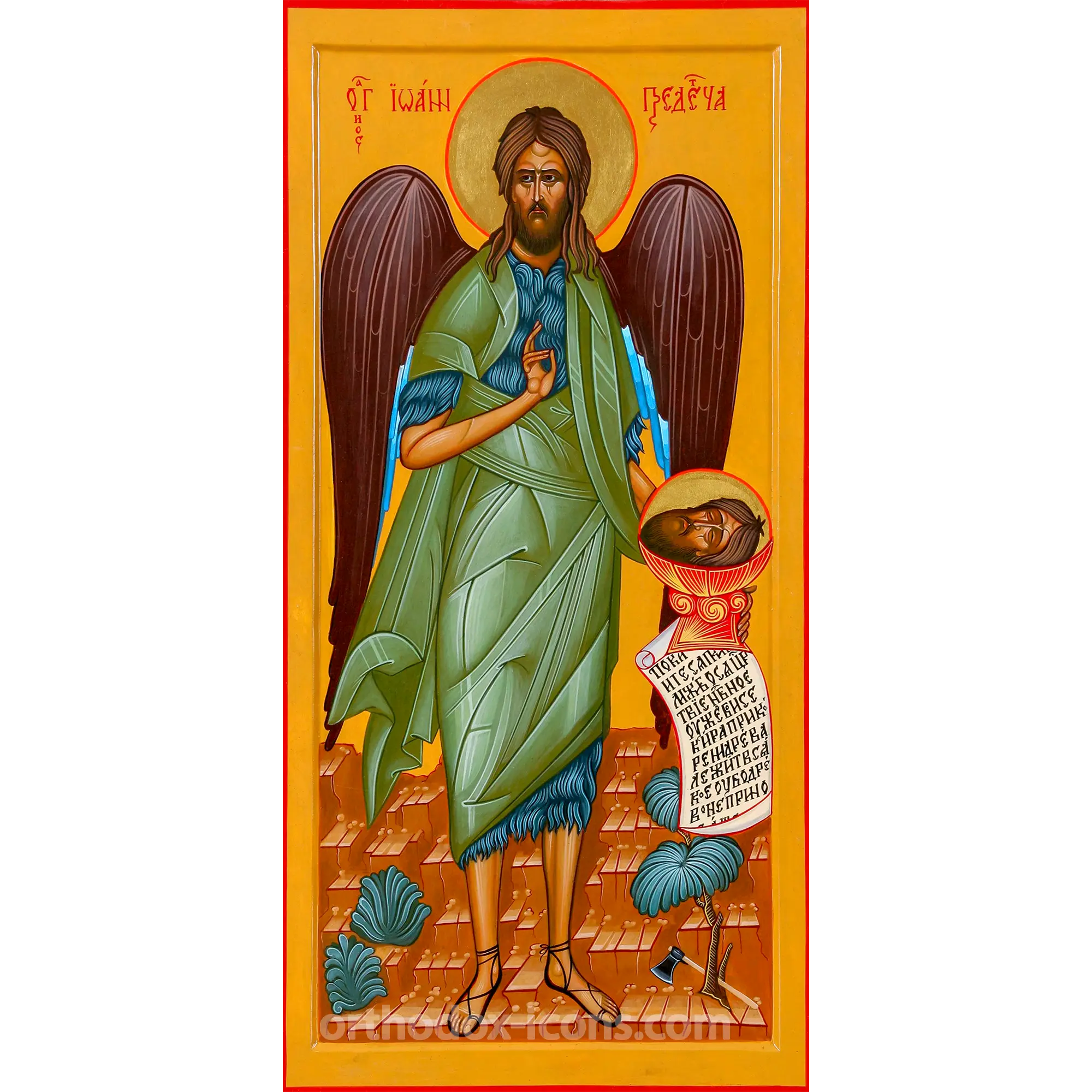
Winged St John the Precurser Icon is a hand-painted full-length icon of Saint John the Baptist in the iconographic type known as the Angel of the Desert. John is shown with angelic wings, desert garments, a chalice with his severed head, a scroll of repentance, and an axe at the root of a tree.
The standard size of this icon is 22×28 cm (8.7×11 in). Larger and iconostasis sizes can be made by agreement.
The icon is painted on a linden board with egg tempera, natural gesso, oak splines, 23K gold leaf (960 purity) on the halo, and a protective finish. Free international shipping is included. Payment is made after you receive and approve the icon.
It is possible to paint an image in any size to order
Free shipping worldwide
Winged St John the Precurser Icon is a hand-painted full-length icon of the Holy Prophet, Forerunner, and Baptist John in the deeply symbolic iconographic type known as the Angel of the Desert. This image presents Saint John not only as the prophet who prepared the way for Christ, but also as an ascetic, martyr, preacher of repentance, and heavenly messenger.
The icon is painted in a strict and prayerful manner. Saint John is shown full length with large angelic wings behind him, wearing the garments of a desert ascetic. In his hand he holds a scroll with the call to repentance and a chalice containing his own severed head, a sign of his martyrdom for truth. At the root of the tree lies an axe, recalling the words of his preaching. The warm ochre background and gilded halo give the image a sober, ancient, and spiritually concentrated character.
The standard size of this icon is 22×28 cm (8.7×11 in). This medium format is well suited to the Angel of the Desert type: it allows the iconographer to paint the face, wings, scroll, chalice, axe, desert rocks, and garments with clarity. Larger and iconostasis formats can be made by agreement.
Icon Characteristics
| Name | Winged St John the Precurser Icon |
| Saint | Holy Prophet, Forerunner, and Baptist John |
| Iconographic type | Angel of the Desert, full-length image with wings, chalice, scroll, and axe |
| Visible features | Angelic wings, desert garments, chalice with the head of Saint John, scroll of repentance, axe at the root of the tree, ochre background, gilded halo |
| Available size | 22×28 cm (8.7×11 in); larger and iconostasis sizes by agreement |
| Materials | Linden board, oak splines, cloth, natural gesso, egg tempera, mineral pigments, 23K gold leaf on the halo |
Iconography of the Angel of the Desert
The Angel of the Desert iconographic type developed in Byzantine art and became deeply loved in Russian Orthodox iconography. It gives visual form to the prophetic words: “Behold, I send My messenger before Thy face, who shall prepare Thy way.” Saint John is shown with wings because he lived an angel-like life of chastity, fasting, and complete dedication to God, and because he was sent as the messenger of the coming Christ.
The garments of the prophet are strict and canonical. The rough hair shirt recalls his life in the wilderness and his extreme asceticism. The outer mantle points to his earthly ministry and hope in eternal life. Saint John stands on stylized rocky ground, the desert setting of his preaching and prayer.
The axe at the root of the tree is a direct reference to the preaching of Saint John: the axe is already laid at the root of the trees, and every tree that does not bear good fruit is cut down. In the icon, this is not a threat for its own sake, but a severe and saving call to repentance, sobriety, and change of life.
The chalice with the severed head of Saint John is one of the most powerful details of the image. It is not shown as a literal scene of violence, but as a theological sign of his martyrdom for truth. Saint John gave his life because he would not be silent before sin, and his death points forward to the sacrificial path of Christ.
Different Icons of Saint John the Baptist
When choosing an icon of Saint John the Baptist, it is helpful to understand the difference between the main iconographic types. Each emphasizes a particular aspect of his ministry.
Angel of the Desert is the type shown here. Saint John is represented with wings, often full length, with a scroll, chalice, and axe. It is one of the most symbolically rich images and emphasizes asceticism, repentance, prophecy, and martyrdom.
Saint John in the Deesis shows him without wings, turned in prayer toward Christ. This image is especially fitting for a traditional triptych or home icon corner with Christ, the Mother of God, and Saint John the Forerunner.
The Beheading of Saint John the Baptist is a narrative icon of his martyrdom. It is often chosen for churches or for those who especially venerate the feast of his beheading.
The Baptism of the Lord, or Theophany, shows Saint John baptizing Christ in the Jordan. In that feast icon, he appears as the Forerunner who stands at the moment when the Holy Trinity is revealed to the world.
Who This Icon Is For
The icon of Saint John the Baptist is a meaningful named saint icon for men baptized with the name John, Ivan, Ioann, or related forms. It can be given for baptism, name day, birthday, coming of age, or another important moment in life. The Angel of the Desert image is especially strong because it speaks of spiritual courage, repentance, and faithfulness to truth.
Since Saint John is also connected with the beginning of desert monastic life, this icon may be meaningful for clergy, monastics, seminarians, spiritual mentors, and all who seek a serious prayerful image. It is suitable for a home icon corner, monastic cell, study, church, or chapel.
The icon may also become a family image of spiritual sobriety. If a family is passing through difficulty, conflict, addiction, or a time of searching for reconciliation, the strict and honest face of the prophet reminds everyone of repentance, forgiveness, and the possibility of beginning again before God.
Prayer Before Saint John the Forerunner
Orthodox Christians turn to Saint John the Baptist in some of the most difficult moments of life. He is the prophet of repentance, the Forerunner of Christ, and the witness who spoke the truth without fear.
Prayer before this icon may include requests for:
- sincere repentance and the courage to see one’s faults;
- softening of a hardened heart and strength for confession;
- spiritual sobriety and help in the struggle against passions;
- support for people fighting destructive habits and dependencies;
- strengthening of faith and will;
- wise guidance in difficult life decisions;
- healing, consolation, and endurance during illness, without replacing medical care;
- returning to the path of Christ after confusion or sin.
The icon does not promise quick external solutions. It calls the person to truth, repentance, courage, and trust in Christ. This is why the image of Saint John the Baptist is so strong in a home: it reminds the faithful that spiritual renewal begins with an honest heart.
Life of Saint John the Baptist
Saint John the Forerunner was the son of the righteous priest Zacharias and Elizabeth. His birth was announced by the Archangel Gabriel. Preserved by God’s providence, John was raised from early life in the wilderness, where he lived as a great ascetic, wearing camel-hair clothing and eating locusts and wild honey.
At about thirty years of age, he came to the Jordan and began his fiery preaching of repentance, preparing the people to receive the Messiah. The summit of his ministry was the Baptism of Jesus Christ, when the Holy Trinity was revealed to the world.
Saint John never feared to speak the truth, even before rulers. He rebuked Herod Antipas for his unlawful relationship with Herodias. For this witness, the prophet was imprisoned and later beheaded, receiving the crown of martyrdom for divine truth.
The Church honors him as prophet, Forerunner, Baptist, ascetic, martyr, and one of the greatest saints. His icon stands in Orthodox homes and churches as a call to repentance and as a witness that the way to Christ begins with a changed heart.
Feast Days of Saint John the Baptist
The Orthodox Church commemorates Saint John the Forerunner many times during the year. These dates are especially meaningful if the icon is being ordered as a gift.
- January 20 / January 7 Old Calendar: Synaxis of Saint John the Baptist, the day after Theophany.
- March 9 / February 24 Old Calendar: First and Second Finding of the Head of Saint John the Baptist.
- June 7 / May 25 Old Calendar: Third Finding of the Head of Saint John the Baptist.
- July 7 / June 24 Old Calendar: Nativity of Saint John the Baptist.
- September 11 / August 29 Old Calendar: Beheading of Saint John the Baptist, a strict fast day.
The icon may be ordered for a name day, baptism, birthday, monastic gift, parish feast, or another important spiritual date.
Materials and Mstyora Icon Painting Technique
This icon is painted according to the traditional methods of the Mstyora school. The base is a dried linden board. To help prevent warping, oak splines are set into the back of the board. The front is covered with cloth and several layers of natural chalk gesso, polished to create a smooth painting surface.
The painting is done in traditional egg tempera. The iconographer prepares natural mineral pigments and works in thin layers, giving the image depth, clarity, and durability. The warm ochre background is painted with natural colors, while 23K gold leaf (960 purity) is used for the halo of Saint John, emphasizing the holiness of the image without making the entire background gold.
The completed icon is protected with a traditional finish. For a custom order, the background and fields may be gilded more fully, the size may be increased, inscriptions may be adjusted, and a wooden glazed icon case can be chosen.
Size and Custom Execution
The standard size of this icon is 22×28 cm (8.7×11 in). It is a balanced medium format for a home icon corner, shelf, study, or meaningful gift. On a board of this size, the iconographer can still paint the face of the saint, feathers of the wings, scroll text, chalice, and rocky desert setting with care.
Because each icon is hand-painted, the image can be made to order according to the intended place. Larger analogion, church, and iconostasis formats can be discussed individually. The degree of gilding, inscriptions, decorative details, and protective case can also be agreed before work begins.
Production time depends on the chosen size and complexity of the additional decoration. A larger icon, full background gilding, tooled gold ornament, or custom case will require more time and a separate agreement.
Blessing and Care
The icon may be blessed in an Orthodox church after it is received, or brought to your parish for blessing. A blessed icon is treated as a sacred image for prayer, thanksgiving, and turning to God through the intercession of Saint John the Baptist.
Hand-painted tempera and natural wood require careful treatment. The icon should be kept away from direct sunlight, heaters, moisture, drafts, and sudden changes of temperature or humidity. Do not wipe the surface with wet cloths, alcohol, household chemicals, or abrasive materials.
Dust should be removed only with a dry, very soft brush without pressure. For long-term protection, a wooden glazed icon case is recommended, especially if the icon will stand near candles or in a place where dust and humidity may vary.
Questions and Answers
Why is Saint John the Baptist shown with wings?
In the Angel of the Desert iconographic type, the wings signify Saint John’s angel-like life and his role as the messenger who prepared the way of the Lord.
Whose head is shown in the chalice?
The chalice contains the severed head of Saint John the Baptist. In the icon this is a theological sign of his martyrdom for truth, not merely a historical illustration.
What does the axe at the root of the tree mean?
The axe recalls Saint John’s preaching that every tree not bearing good fruit is cut down. It is a call to repentance, spiritual sobriety, and change of life.
What is the difference between an ochre background and a gold background?
In this icon, the background is painted in warm ochre tones, while 23K gold leaf is used on the halo. A full gold background can be discussed as a custom option.
Is this icon suitable as a gift for someone named John or Ivan?
Yes. It is a meaningful named saint icon for men baptized as John, Ivan, Ioann, or related forms, and can be given for baptism, name day, birthday, or another important occasion.
What do Orthodox Christians pray for before Saint John the Baptist’s icon?
People pray for repentance, strengthening of faith, spiritual sobriety, deliverance from destructive habits, wise guidance, and help in returning to the path of Christ.
What materials are used for this hand-painted icon?
The icon is painted on a linden board with oak splines, cloth, natural chalk gesso, egg tempera, mineral pigments, 23K gold leaf on the halo, and a protective finish.
What size is listed for this icon?
The standard size of this icon is 22×28 cm (8.7×11 in). Larger church, analogion, and iconostasis formats can be discussed individually.
Can this icon be ordered with more gilding?
Yes. Because the icon is hand-painted to order, the halo, background, fields, decorative treatment, inscriptions, and protective case can be discussed before work begins.
How should a hand-painted icon of Saint John the Baptist be cared for?
Keep the icon away from moisture, direct sunlight, heaters, drafts, and sudden temperature changes. Dust it gently with a dry soft brush, without water, alcohol, or household cleaners.
| Dimensions | 22x28cm (8.7×11.0 in) |
|---|---|
| Name | Joannes, John |