Hand-Painted Icon of Holy Martyr Timothy Isotov
Price range: $500 through $1600
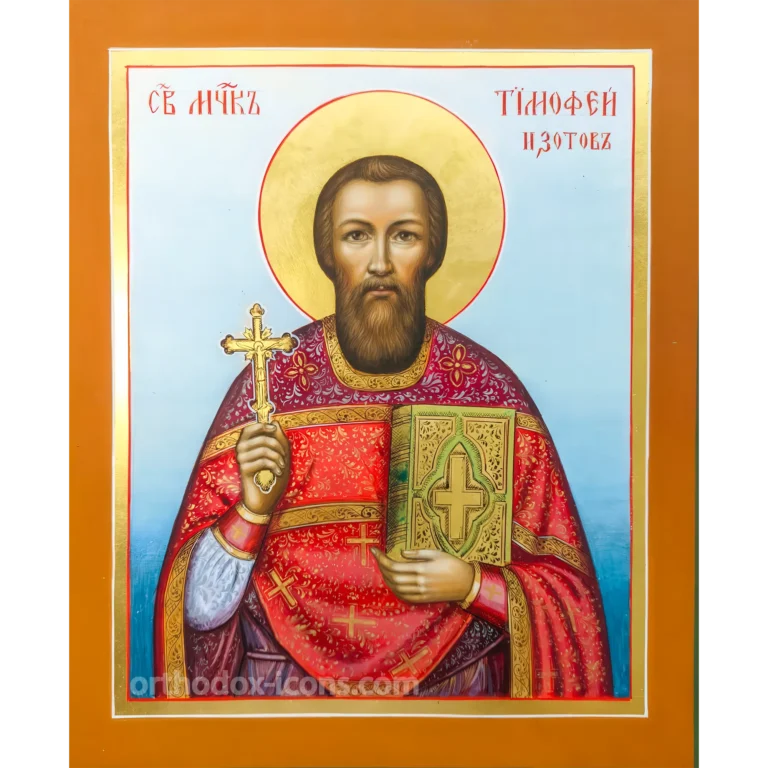
Hand-Painted Icon of Holy Martyr Timothy Isotov is an Orthodox icon of Hieromartyr Timothy Isotov, a priest and New Martyr of the Russian Church who suffered for the faith in Crimea in 1938. He is shown in priestly vestments, holding the cross of martyrdom and the Gospel.
Available sizes: 17×21 cm (6.7×8.3 in), 20×24 cm (7.9×9.4 in), 27×31 cm (10.6×12.2 in), 30×40 cm (11.8×15.7 in).
The icon is painted to order on a linden board with egg tempera, natural gesso, oak splines, 23K gold leaf (960 purity), and a protective finish. Free international shipping is included. Payment is made after you receive and approve the icon.
It is possible to paint an image in any size to order
Free shipping worldwide
Hand-Painted Icon of Holy Martyr Timothy Isotov is an Orthodox icon of Hieromartyr Timothy Isotov, one of the New Martyrs and Confessors of the Russian Church. He suffered for the faith during the persecutions of the twentieth century and accepted martyrdom in 1938. His icon carries not only the beauty of traditional hand-painted iconography, but also the memory of a priest who remained faithful to Christ and the Church in a time of severe trial.
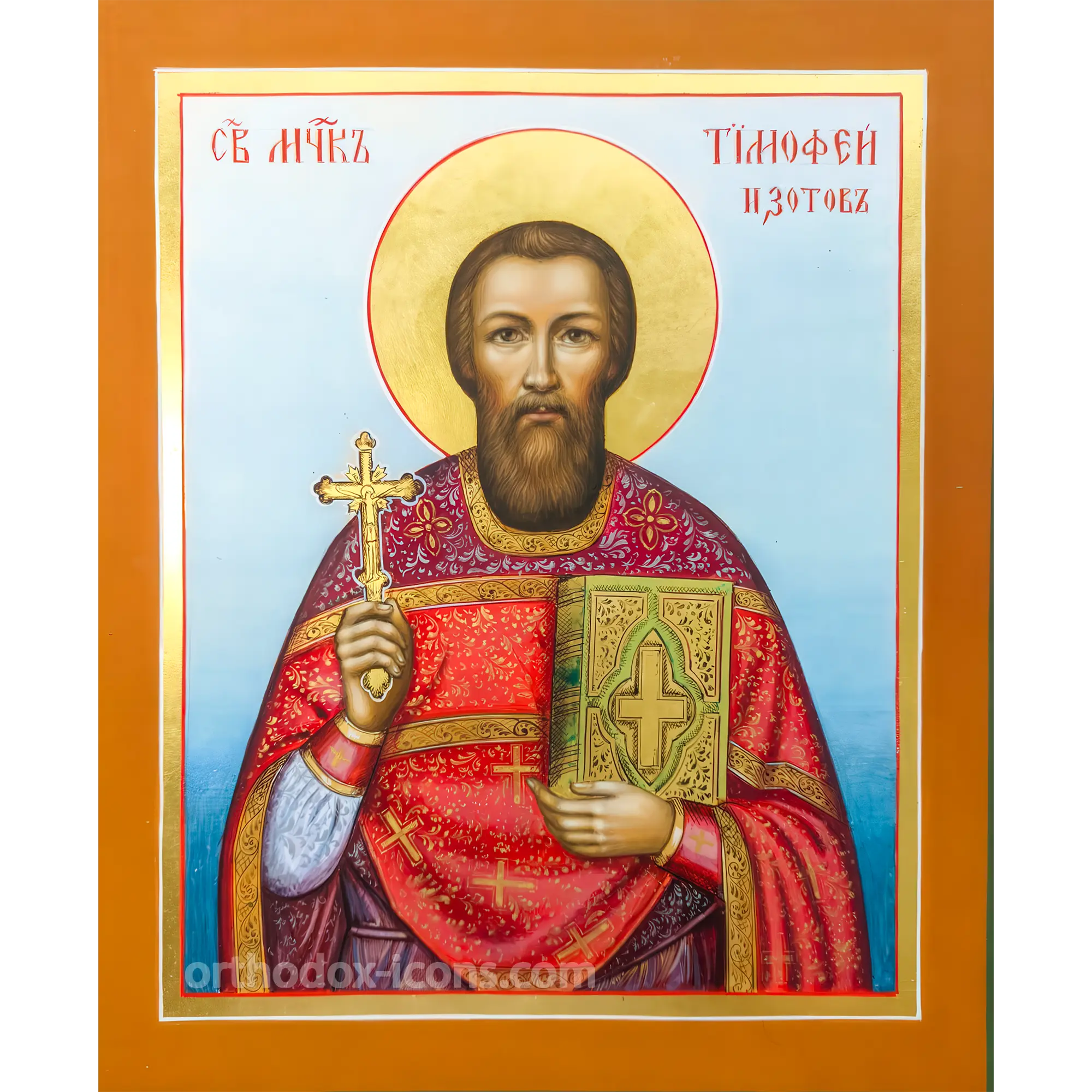
Saint Timothy Isotov is shown in priestly vestments. He wears a red phelonion with gold ornament and a light under-vestment, corresponding to his priestly rank. In one hand he holds the cross of martyrdom, and in the other the Gospel, which points to his service to the word of God. His face is painted with calmness and spiritual concentration, expressing the inward firmness of a man who remained faithful to his calling to the end.
The available sizes are 17×21 cm (6.7×8.3 in), 20×24 cm (7.9×9.4 in), 27×31 cm (10.6×12.2 in), and 30×40 cm (11.8×15.7 in). These formats are suitable for a home icon corner, personal prayer, a priest’s study, a church space, or a gift for someone named Timothy.
Icon Characteristics
| Name | Hand-Painted Icon of Holy Martyr Timothy Isotov |
| Saint | Hieromartyr Timothy Isotov, New Martyr of the Russian Church |
| Iconographic type | Priest-martyr in vestments with cross and Gospel |
| Commemoration | Among the New Martyrs and Confessors of the Russian Church; December 2, Crimean New Martyrs; December 28, Saints of Crimea |
| Visible features | Priestly vestments, martyr’s cross, Gospel, gilded halo, calm blue background, Church Slavonic inscription |
| Available sizes | 17×21 cm (6.7×8.3 in), 20×24 cm (7.9×9.4 in), 27×31 cm (10.6×12.2 in), 30×40 cm (11.8×15.7 in) |
Life of Hieromartyr Timothy Isotov
Hieromartyr Timothy Isotov was born in 1875 in Simferopol, in the Taurida Governorate, into the family of the gardener Spiridon Isotov. He received his education in a parish school and did not begin church service as a priest in youth. In 1909, at the age of thirty-four, he entered service as a psalm-reader at the cathedral in Simferopol, beginning his work in the Church from the lower ranks of church service.
For his blameless life and diligence, Timothy Spiridonovich was ordained a deacon in 1912 and continued serving at the cathedral. In 1916 he was appointed to the church in Autka near Yalta, and in 1921 he was transferred to the Church of All Saints in Simferopol. These were difficult years for the Church, when persecution of clergy had already begun.
In 1922, Deacon Timothy was first arrested during the campaign for seizure of church valuables. He was accused of participation in resistance to the seizure, but the case was closed for lack of evidence, and he was released. In 1928, despite the trials he had endured, he was ordained to the priesthood and sent to serve in the village of Novo-Pavlovka. In September 1936, Father Timothy was transferred to the church of the Great Martyr Theodore Stratelates in Alushta, where he would later receive the crown of martyrdom.
Martyrdom and Witness
In the winter of 1938, the authorities attempted to break apart the church community by persuading parishioners to leave the church. The community did not fall apart, and the church could not be closed in that way. On February 8, 1938, an order was issued for the arrest of Father Timothy. He was arrested that same day, and the investigation was carried out in only a few days, a sign of the lawlessness of that time.
During questioning, the priest was accused of counter-revolutionary activity because he baptized children in the home of the church elder, called parishioners to preserve the unity of the community, and served the Divine Liturgy on the day of elections to the Supreme Soviet. Father Timothy confessed his faith with courage. He did not renounce his priestly service and did not accept guilt for political crimes.
On February 15, 1938, an NKVD troika sentenced him to death. Priest Timothy Isotov was shot in Simferopol and buried in a common unknown grave together with other victims of repression. His earthly life ended in suffering, but his witness remained as part of the memory of the New Martyrs of the Russian Church.
Glorification and Commemoration
Hieromartyr Timothy Isotov was glorified by the Russian Orthodox Church among the saints as one of the New Martyrs and Confessors of the Russian Church. His memory is honored in the Synaxis of the New Martyrs and Confessors of the Russian Church, celebrated on the Sunday closest to January 25 / February 7.
He is also commemorated in the Synaxis of the New Martyrs and Confessors of the Crimean Metropolia on December 2, and in the Synaxis of the Saints of Crimea on December 28. These commemorations are especially meaningful for people connected with Crimea and for those who honor the witnesses of the Church during the persecutions of the twentieth century.
The glorification of the New Martyrs is an important testimony in the life of the Church. It shows that holiness did not disappear in the modern age, even during times of violence, fear, and pressure against the faithful.
Iconographic Features
In the icon, Hieromartyr Timothy Isotov is shown as a priest. His red phelonion with gold ornament and light under-vestment correspond to his rank as a presbyter. The cross in his right hand is the sign of Christian confession and martyrdom. The Gospel in his left hand points to his service to the word of God and the pastoral ministry entrusted to him.
The gilded halo around the saint’s head signifies his holiness and glorification in the Kingdom of Heaven. The color scheme is built on traditional tones. Red and gold in the priestly vestments speak of sacrificial love and divine glory, while the calm blue background creates an impression of heavenly peace.
The inscription at the top of the icon names the saint in Church Slavonic, following iconographic tradition. The image is not a secular portrait, but a prayerful church image of a priest who remained faithful to Christ and became a witness to the truth.
Spiritual Meaning of the Icon
Hieromartyr Timothy Isotov is venerated as an intercessor for those who suffer for truth and faith, and as a patron of clergy and faithful laypeople in difficult times. People turn to his icon with prayers for courage in confessing the faith, protection from persecution and slander, and steadfastness during trials.
This saint is especially dear to those connected with Crimea, the land where he served and accepted martyrdom. His life shows that a person without high position or public power can become a saint through faithfulness to Christ, humility, and readiness to suffer for Him.
The icon reminds modern Orthodox Christians that faith is not only words or cultural memory. It is tested in difficult circumstances. The New Martyrs witnessed that even in dark times the light of Christ cannot be extinguished by human cruelty.
Prayer Before Hieromartyr Timothy Isotov
Before the icon of Hieromartyr Timothy, Orthodox Christians may read prayers to the New Martyrs, general prayers to the saints, and personal petitions for help in difficulties. His intercession is especially sought in matters connected with courage, truth, faithful service, and endurance under unjust pressure.
Prayer before this icon may include requests for:
- courage in confessing the Orthodox faith;
- steadfastness during trials, pressure, or slander;
- protection for clergy, church workers, and faithful laypeople;
- help for those wrongly accused or treated unjustly;
- strength to preserve church unity and peace;
- faithfulness to Christ and the Church in difficult times;
- patience, humility, and freedom from fear;
- remembrance of the New Martyrs and the history of the Church.
The icon can become a center of home prayer for those who suffer for truth, for priests and their families, for parish communities, and for all who need an example of Christian courage.
Who This Icon Is For
The icon of Hieromartyr Timothy Isotov is especially suitable for men named Timothy or Timotheus. It may be given for baptism, name day, birthday, ordination, entrance into church service, or another important spiritual date. It is a meaningful named saint icon because it presents a modern witness of faithfulness, not a distant or abstract example.
The icon is also suitable for clergy, parish communities, people connected with Crimea, those who study the history of the Russian Church in the twentieth century, and anyone who venerates the New Martyrs and Confessors. It may be given to a priest, seminarian, church worker, historian of the Church, or a person going through unjust pressure and needing spiritual support.
For a church or chapel, the icon can be ordered in a larger format. It may be placed among icons of the New Martyrs, local saints of Crimea, priest-martyrs, or saints connected with faithful pastoral service.
Materials and Mstyora Icon Painting Technique
Each icon of Hieromartyr Timothy Isotov is painted according to traditional iconographic technique. The base is a selected linden board, strengthened with oak splines. The front is prepared with cloth and natural chalk gesso, creating a smooth and durable surface for painting.
The image is painted in egg tempera with mineral pigments. Special attention is given to the face, because icons of the New Martyrs require historical and spiritual accuracy. Their iconography is comparatively recent and is often based on photographs, documents, and testimony of contemporaries.
The halo and decorative details are made with 23K gold leaf (960 purity). A protective finish is applied to help preserve the icon. For an individual order, the size, color scheme, inscriptions, dedication on the reverse side, protective case, or additional decorative treatment can be discussed.
Sizes and Custom Options
The icon is available in 17×21 cm (6.7×8.3 in), 20×24 cm (7.9×9.4 in), 27×31 cm (10.6×12.2 in), and 30×40 cm (11.8×15.7 in). For a home icon corner, 20×24 cm (7.9×9.4 in) or 27×31 cm (10.6×12.2 in) are especially convenient, because they allow the face, vestments, cross, Gospel, and inscription to remain readable.
For church use, larger icons may be painted for an analogion, icon case, chapel, or iconostasis. The format can be chosen according to the place of prayer, viewing distance, lighting, and neighboring icons.
Because the icon is painted to order, it can be personalized. A dedication may be added on the back, the color harmony can be discussed, and the level of gilding or decorative detail can be chosen before work begins. Production time depends on the size and complexity and is usually agreed individually.
Blessing and Care
The icon may be blessed in an Orthodox church after it is received, or brought to your parish for blessing. A blessed icon is treated as a sacred image for prayer and for turning to God through the intercession of the saint.
A hand-painted icon should be placed away from direct sunlight, heat sources, excessive humidity, and sudden temperature changes. Do not wipe the surface with wet cloths, alcohol, household chemicals, or abrasive materials.
Dust should be removed gently with a dry soft brush or dry cloth without pressure. The best protection is a good wooden glazed icon case, especially if the icon will be kept in a church, near candles, or in a place where dust and humidity may vary.
Questions and Answers
Who is shown on the icon of Holy Martyr Timothy Isotov?
The icon shows Hieromartyr Timothy Isotov, a priest and New Martyr of the Russian Church who suffered for the Orthodox faith in Crimea in 1938.
Why is Timothy Isotov called a hieromartyr?
He was a priest who accepted martyrdom for faithfulness to Christ and the Church. In Orthodox usage, a priest-martyr is called a hieromartyr.
What is Saint Timothy Isotov holding in the icon?
He is shown in priestly vestments with a cross, the sign of martyrdom, and the Gospel, pointing to his priestly service and preaching of the word of God.
When is Hieromartyr Timothy Isotov commemorated?
He is commemorated among the New Martyrs and Confessors of the Russian Church, in the Synaxis of the Crimean New Martyrs on December 2, and in the Synaxis of the Saints of Crimea on December 28.
What do Orthodox Christians pray for before this icon?
People pray for courage in confessing the faith, steadfastness during trials, protection from slander and injustice, help for clergy, and faithfulness to the Church.
Who is this hand-painted icon suitable for?
It is suitable for men named Timothy or Timotheus, clergy, people connected with Crimea, those who venerate the New Martyrs, and anyone seeking an example of Christian courage.
What sizes are available for this icon?
The available sizes are 17×21 cm (6.7×8.3 in), 20×24 cm (7.9×9.4 in), 27×31 cm (10.6×12.2 in), and 30×40 cm (11.8×15.7 in).
What materials are used for the icon?
The icon is painted on a linden board with oak splines, cloth, natural chalk gesso, egg tempera, mineral pigments, 23K gold leaf (960 purity), and a protective finish.
What is special about icons of the New Martyrs?
Icons of the New Martyrs are based on church tradition, historical documents, and often photographs or contemporary testimony, so they require careful historical and iconographic accuracy.
How should a hand-painted icon of Timothy Isotov be cared for?
Keep the icon away from direct sunlight, moisture, heat, and sudden temperature changes. Dust it gently with a dry soft brush or cloth, without water, alcohol, or household cleaners.
| Dimensions | 17x21cm (6.7×8.3 in), 20x24cm (7.9×9.4 in), 27x31cm (10.6×12.2 in), 30x40cm (11.8×15.7 in) |
|---|---|
| Name | Timotheus, Timothy |