Saint Wenceslaus Orthodox Icon
$750
Available size: 13×25 cm (5.1×9.8 in)
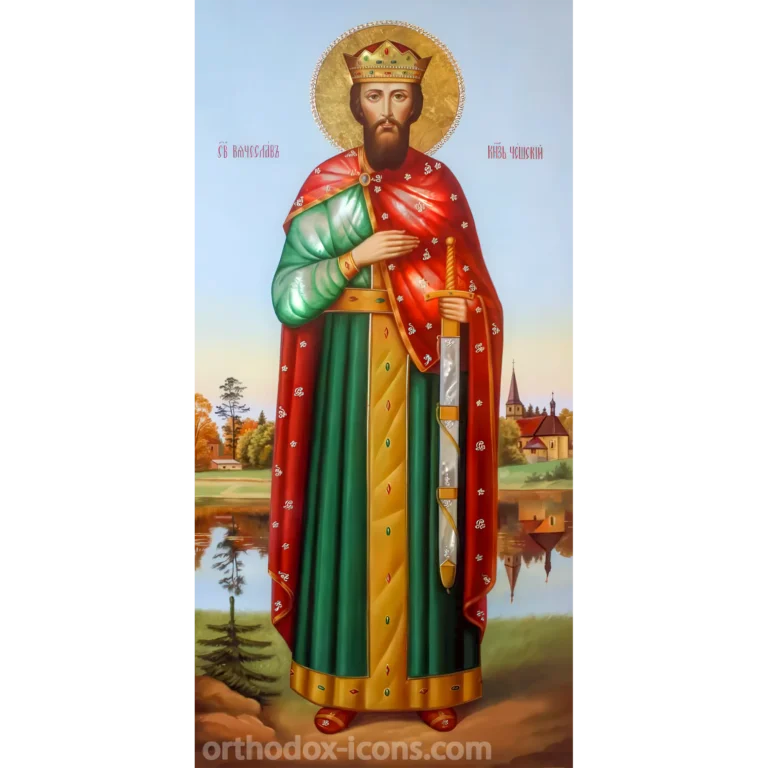
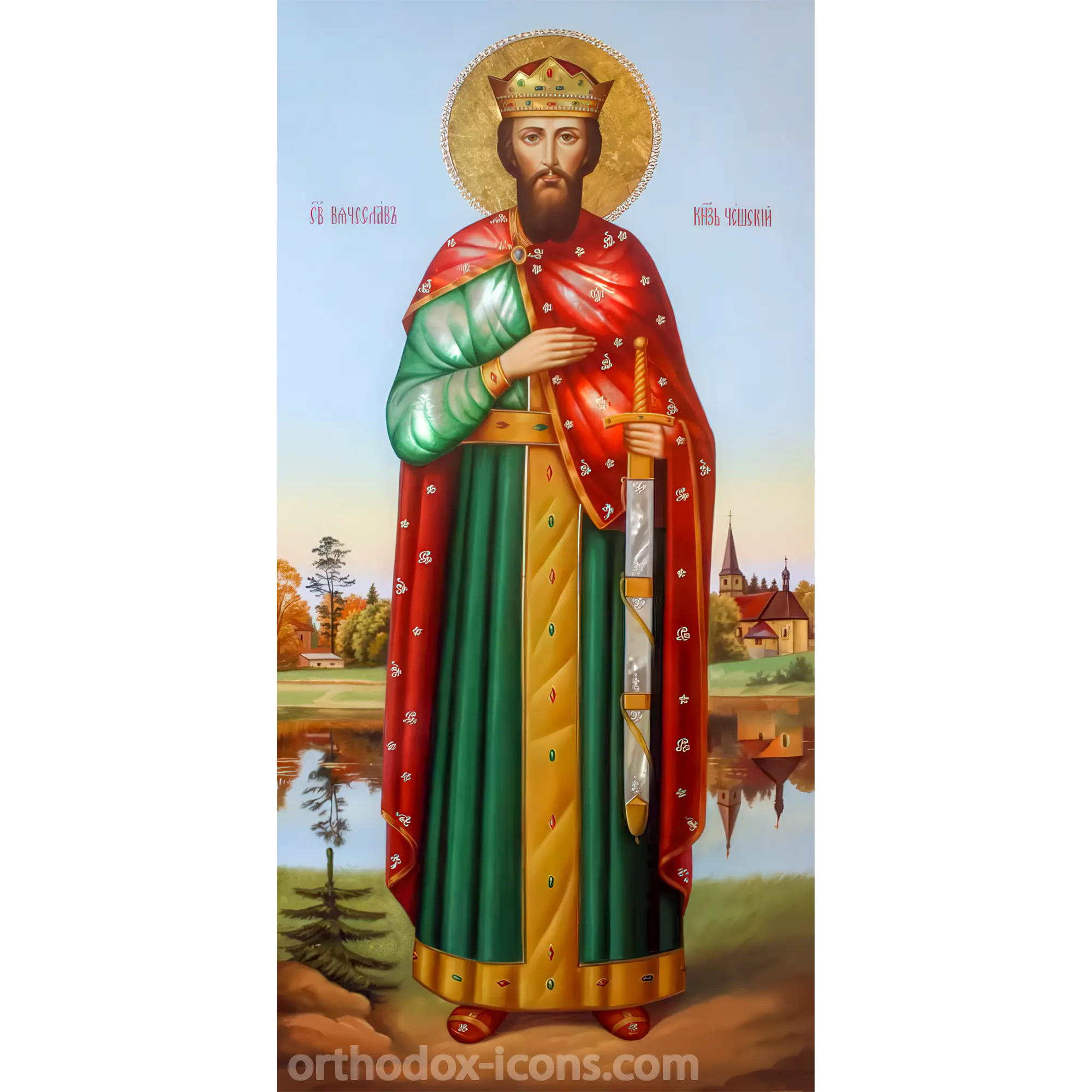
Saint Wenceslaus Orthodox Icon is a hand-painted full-length image of the holy right-believing Prince Wenceslaus of Bohemia, a Slavic ruler, enlightener, and martyr of the tenth century. He is shown in princely vestments, with a green tunic, rich red cloak, golden crown, and a sword lowered in a white scabbard.
The right hand of the prince is pressed to his chest in a gesture of heartfelt prayer. The lowered sword points to his duty to defend his people, while also recalling his peaceful spirit and martyrdom. A detailed landscape background with a quiet lake, an old church, and autumn trees gives this icon a calm, contemplative character.
This icon is especially suitable as a patron saint icon for men and boys named Wenceslaus or Vyacheslav, and as a meaningful Orthodox gift for leaders, public servants, soldiers, and those whose work involves responsibility and protection of others. Free international shipping is included. Payment is made after you receive and approve the icon.
It is possible to paint an image in any size to order
Free shipping worldwide
Saint Wenceslaus Orthodox Icon is a hand-painted full-length image of the holy right-believing Prince Wenceslaus of Bohemia, known in the Slavic tradition as Vyacheslav. He is venerated as a wise ruler, enlightener of his people, peacemaker, and martyr who accepted death through betrayal. This icon presents him not as a distant historical figure, but as a Christian prince whose authority was joined to prayer, responsibility, and service.
The icon is painted in the tradition of the Mstyora school. Its most distinctive feature is the detailed landscape background, which is harmoniously joined to the strict standing figure of the saint. A quiet lake, an old church, and an autumn forest create an atmosphere of peace and spiritual order. The landscape does not distract from the saint; it helps reveal the fruits associated with his rule: peace, church building, and the Christian enlightenment of the Czech land.
The available size is 13×25 cm (5.1×9.8 in). This compact vertical format suits the full-length image of Saint Wenceslaus and preserves the main details: the princely crown, red cloak, lowered sword, prayerful gesture, halo, and painted background. Larger and church formats may be discussed individually when a more detailed rendering of the landscape and vestments is required.
Iconography and Symbolism of the Image
Saint Wenceslaus is shown standing full-length, in the dignity of his princely calling. His iconography is deeply symbolic and reveals the meaning of his earthly service. The golden crown on his head, decorated with jewel-like ornament, points to lawful authority and noble origin. Yet in the icon this authority is not worldly display; it is shown as a responsibility before God.
The saint wears an emerald-green tunic edged with gold and a wide red princely cloak fastened with a golden clasp. The red cloak is a sign of princely or royal dignity. In icon painting, red can also point to sacrifice, martyrdom, and fervent love for God. This color is especially fitting for Saint Wenceslaus, whose royal service ended in martyrdom.
The position of the hands reveals the inner life of the saint. His right hand is reverently pressed to his chest, a gesture of sincere prayer and devotion to the will of God. His left hand holds a sword lowered downward and enclosed in a white scabbard. This is not an aggressive weapon raised for attack. It signifies the duty of a ruler to defend his people, while also showing his peaceful spirit and unwillingness to shed brotherly blood.
The sword also recalls the martyrdom of Saint Wenceslaus, who was killed by conspirators. In this icon, therefore, the sword has a double meaning: princely responsibility and sacrificial witness. It belongs to a ruler who was ready to protect his people, but whose deeper strength was meekness, prayer, and faithfulness to Christ.
The painted landscape is one of the most valuable features of the icon. Instead of a plain gold field, the iconographer has created a calm panorama with a lake, a stone church, and autumn trees reflected in the water. This background symbolizes peace, church beauty, and the Christian order associated with the saint’s rule.
Who This Icon Is For
The icon of the right-believing Prince Wenceslaus is a meaningful and carefully chosen spiritual gift. It is especially appropriate as a patron saint icon for boys and men named Wenceslaus or Vyacheslav. Given for baptism, nameday, graduation, or another important stage of life, it reminds the person of his heavenly patron and of the virtues connected with this saint: courage, nobility, honesty, prayer, and responsibility.
Because Prince Wenceslaus was a ruler and defender of his people, his icon may also be given to leaders, public servants, officers, soldiers, and people who carry responsibility for others. It is a strong image for a study, office, home icon corner, or family prayer space. The icon reminds us that authority is given not for self-importance, but for service, mercy, justice, and preservation of peace.
For a family, this icon can become a patronal image connected with the name Vyacheslav or Wenceslaus. For a child, it can stand near the bed or in the family icon corner. For an adult man, it can serve as a quiet reminder that strength is not measured only by power, but also by restraint, prayer, and the ability to choose peace when conflict is possible.
Prayers Before Saint Wenceslaus
During his earthly life, Saint Wenceslaus was remembered for peace, justice, and care for ordinary people. For this reason, Orthodox Christians may pray before his icon for help in many difficult situations connected with responsibility, conflict, family peace, and the protection of others.
Saint Wenceslaus is asked for prayerful help in preserving peace and resolving conflicts; finding compromise and avoiding violence; wisdom for rulers, leaders, and those who make serious decisions; protection for soldiers and those in dangerous service; guidance for people who have lost their way; and help for children and students in learning and growth.
Prayer before his icon should not be understood as a promise of automatic outward success. The life of Saint Wenceslaus teaches that Christian leadership begins with repentance, mercy, justice, and the willingness to serve. His icon calls a person to seek peace without cowardice, courage without cruelty, and authority without pride.
Brief Life of Saint Wenceslaus
Saint Wenceslaus, or Vaclav, was born around the year 907. He was the grandson of the holy martyr Ludmila of Bohemia, who raised him in the Christian faith. After the death of his father, he came to the princely throne in a difficult time, when part of the Czech nobility still followed pagan customs and harsh ways of life.
Prince Wenceslaus ruled with wisdom and mercy. He cared for the poor, widows, and orphans, built churches, including the famous church of Saint Vitus in Prague, and supported the Christian education of his people. Church tradition remembers him as a ruler who personally took part in works of mercy and desired peace rather than senseless war.
His Christian mercy and peaceful policy brought hostility from pagan-minded nobles. The conspirators gathered around his younger brother Boleslav. In 935, according to some accounts in 929, Wenceslaus was invited by his brother and then murdered by him and his companions as he was going to church. The people deeply venerated the murdered prince, and he was soon honored among the holy right-believing princes and passion-bearers.
The memory of Saint Wenceslaus of Bohemia is celebrated on October 11, corresponding to September 28 in the old calendar, and also on March 17, corresponding to March 4 in the old calendar, the day associated with the translation of his relics.
Materials and Mstyora Painting Technique
This icon is a hand-painted work of church art made according to traditional methods. The panel is made from solid linden wood. To help prevent warping, oak splines are set into the back of the board. The surface is prepared with chalk gesso, a traditional ground made for icon painting, and polished until it becomes smooth enough for fine tempera work.
The painting is made in egg tempera with natural mineral pigments. This technique allows the iconographer to render the face, hands, princely garments, ornaments, sword, halo, and landscape background with clarity and depth. The halo and ornamental details are gilded with 23K gold leaf (960 purity), giving the icon a restrained solemn brightness.
After completion, the icon receives a protective finish. This helps preserve the painted surface and gives depth to the colors. The value of such an icon is not only in decorative richness, but in the combination of prayerful image, careful drawing, traditional materials, and the living hand of the icon painter.
Size and Individual Order
The listed size for this icon is 13×25 cm (5.1×9.8 in). This compact format is suitable for a small home icon corner, personal prayer shelf, study, or office. It keeps the full-length figure and the main landscape details readable while remaining easy to place in a home setting.
Because the icon includes a full-length saint and a detailed landscape background, larger formats may be discussed individually. A larger board gives more space for the church spire, the lake, the autumn trees, the ornament on the cloak, and the facial features of the saint. Such a format can be appropriate for a larger home icon corner, chapel, parish gift, or church space.
Individual orders may also include a more restrained gold background instead of the landscape, different proportions, a kiot, or additional family patron saints on the borders. Timing depends on size and complexity. Free international shipping is included, and payment is made after you receive and approve the icon.
Blessing and Care
The icon may be blessed in an Orthodox church after it is received. A blessed icon is intended for prayer, thanksgiving, and turning to God through the intercession of Saint Wenceslaus.
A hand-painted icon should be treated carefully. Wood, egg tempera, mineral pigments, and gilding should be protected from dampness, direct sunlight, heaters, soot, and sudden changes of temperature. The surface should not be wiped with wet sponges, alcohol, furniture cleaners, or household chemicals.
Dust is best removed gently with a dry soft brush, without pressure. For long-term preservation, especially if the icon will become a family holy image, a wooden glazed kiot is recommended. It protects the icon from dust, accidental touch, mechanical damage, and changes in the surrounding environment.
Questions and Answers
Why is Saint Wenceslaus called a right-believing prince?
In Orthodox usage, right-believing princes are rulers whose authority was joined to Christian faith, justice, mercy, and care for their people. Saint Wenceslaus used his position for service rather than personal power.
Why does Saint Wenceslaus hold a sword if he was a peacemaker?
The sword in its scabbard points to princely authority and the duty to protect the people. Because it is lowered rather than raised, it also emphasizes his peaceful spirit and recalls his martyrdom.
What does the red cloak of Saint Wenceslaus signify?
The red cloak is a sign of princely dignity. In icon painting, red can also point to sacrifice, martyrdom, and fervent love for God.
What is shown in the background of this icon?
The background shows a Czech or Western European landscape with a calm lake, autumn trees, and a stone church. It reflects peace, church beauty, and the Christian enlightenment associated with Saint Wenceslaus.
Is this icon suitable for a soldier or officer?
Yes. Saint Wenceslaus is venerated as a holy prince and protector. This icon may be given to soldiers, officers, and those who carry responsibility for the safety of others, with prayer for courage, wisdom, and peace.
How is this icon different from an icon with a plain gold background?
This icon has a painted landscape background, which gives the composition depth and a quiet historical atmosphere. A plain gold background would look stricter and more liturgical; both options may be appropriate depending on the purpose.
Can this icon be given for a child’s baptism?
Yes, especially if the child is baptized with the name Wenceslaus or Vyacheslav. It can become a personal patron saint icon for the child and remain a family holy image for many years.
What are oak splines and why are they used?
Oak splines are strong wooden supports inserted into the back of the linden panel. They help the icon board remain stable as wood responds to humidity and temperature changes.
Why are natural mineral pigments valued in icon painting?
Natural mineral pigments mixed with egg tempera are valued for their depth, clarity, and durability. This traditional technique has been used for centuries in hand-painted Orthodox icons.
Where can this icon be placed at home?
The icon may be placed in a home icon corner, on a prayer shelf, in a study, or in a child’s room if the child bears the name Wenceslaus or Vyacheslav.
| Dimensions | 13x25cm (5.1×9.8 in) |
|---|---|
| Name | Wenceslaus |