Photina the Samaritan Orthodox Icon
Price range: $600 through $1600
Available sizes: 13×25 cm (5.1×9.8 in), 18×31 cm (7.1×12.2 in), 30×50 cm (11.8×19.7 in)
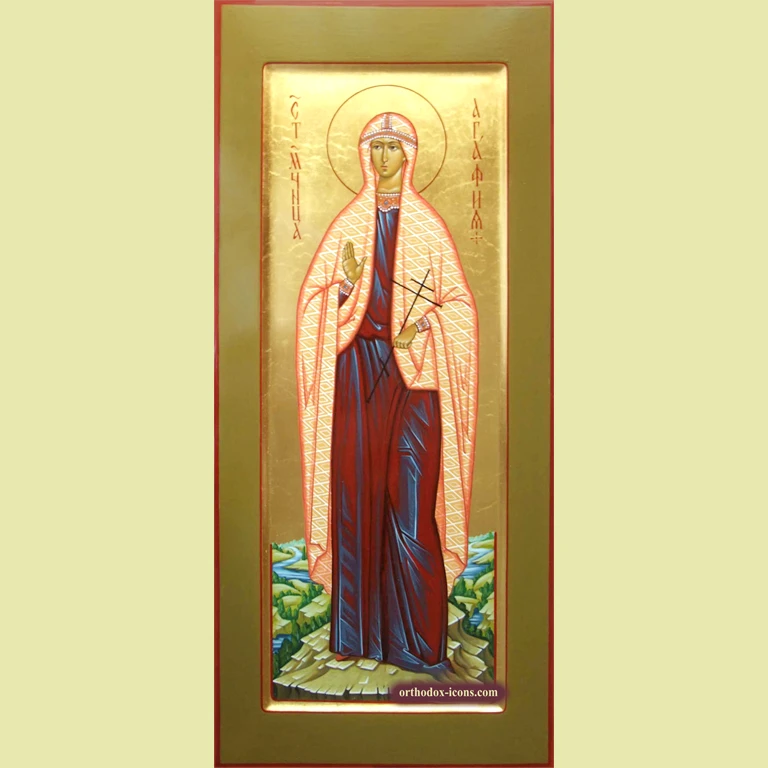
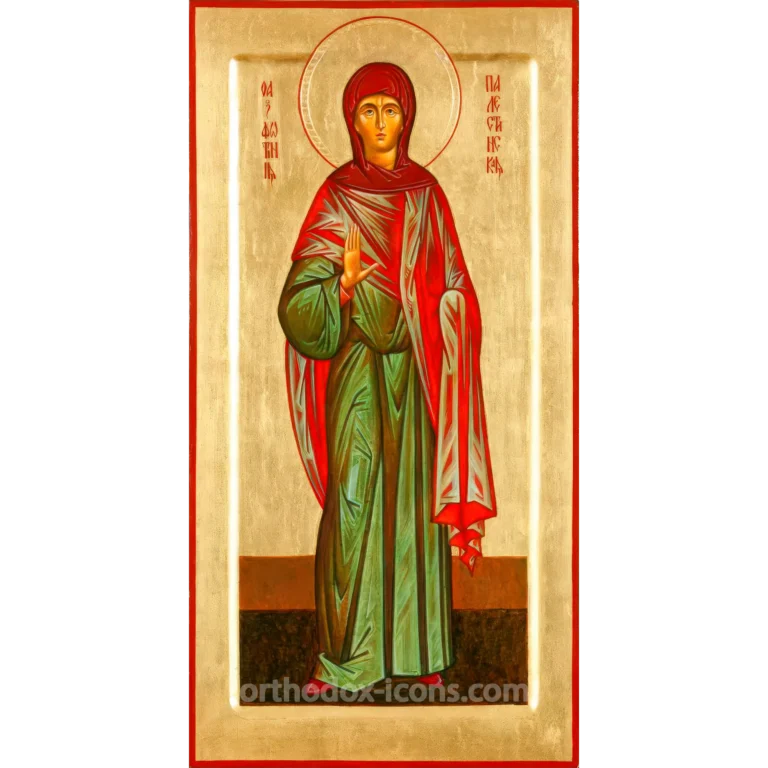
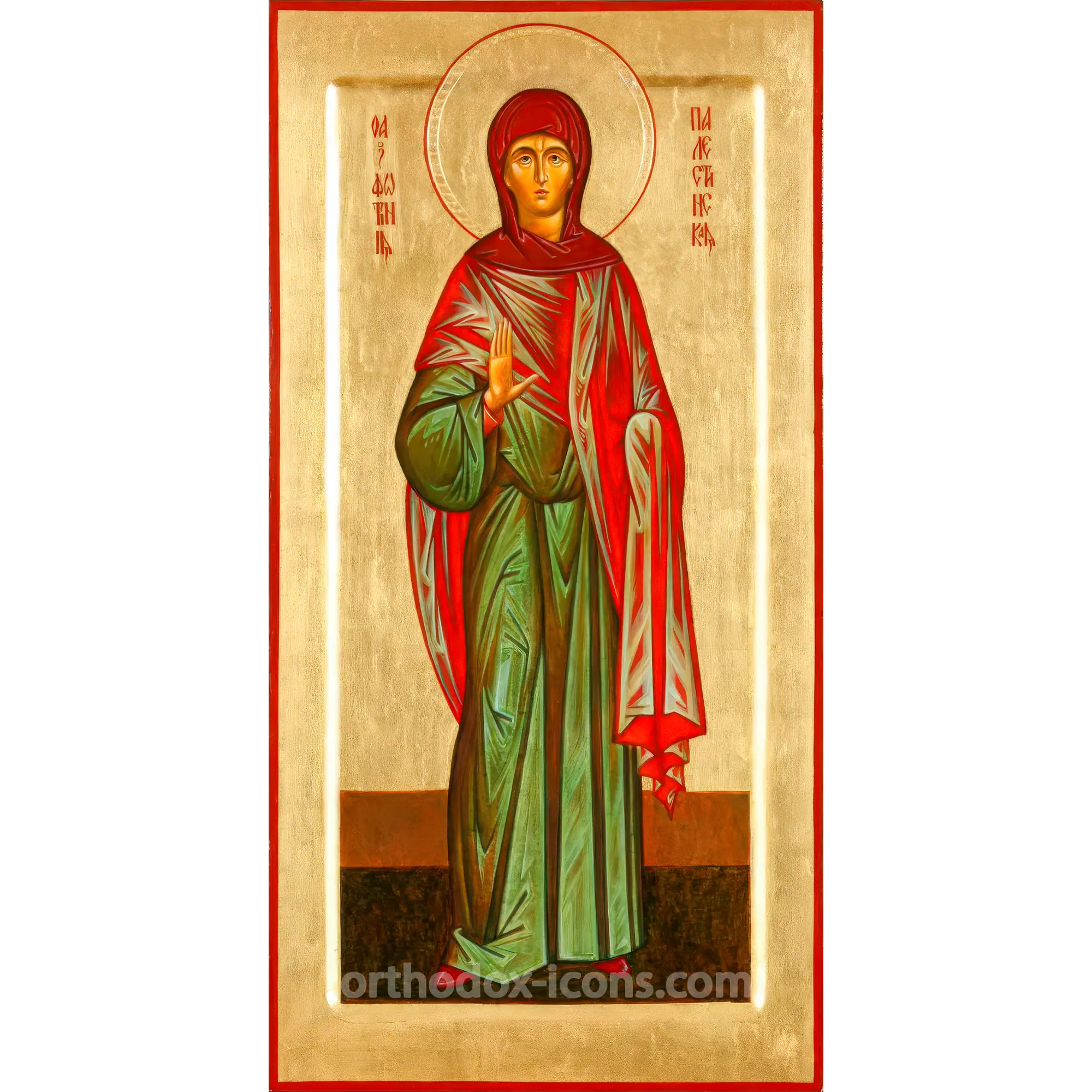
Venerable Photina, also venerated in the Russian tradition as Saint Svetlana, is shown in a full-length vertical composition on a gilded background. The saint is painted in a green tunic and red maphorion, with her head covered, one hand raised in a restrained blessing or prayerful gesture, and a calm ascetic face turned toward the person praying.
This hand-painted Orthodox icon is suitable as a patron saint icon for women and girls named Svetlana, Photina, or Photinia. It may be ordered for baptism, nameday, birthday, monastic gift, home prayer, a chapel, or a parish space.
The icon is painted on a linden wood panel with oak splines, natural chalk gesso, egg tempera, 23K gold leaf (960 purity), and a protective finish. Free international shipping is included. Payment is made after you receive and approve the icon.
It is possible to paint an image in any size to order
Free shipping worldwide
The hand-painted icon of Venerable Photina, also known in the Russian tradition as Saint Svetlana, presents a full-length image of the holy ascetic of Palestine. Her life is associated with solitude, prayer, chastity, and complete trust in God. On this icon, the saint is shown standing in a strict vertical composition, wearing a green tunic and red maphorion, with her head covered and one hand raised in a restrained gesture of blessing or prayerful witness.
The gilded background, elongated format, and quiet composition help express the main mood of the image: silence, inner collectedness, and prayerful standing before God. The icon is not overloaded with secondary details. The viewer’s attention remains on the saint herself: her face, hand gesture, slender figure, and the color harmony of red, green, and gold.
This icon is especially suitable as a patron saint icon for women and girls named Svetlana. In the Orthodox tradition, the name Svetlana is often connected with the names Photina or Photinia, from a Greek root associated with light. For this reason, the full church identification of the saint is important: Venerable Photina, or Photinia, of Palestine. The icon may be ordered for baptism, nameday, birthday, a spiritual milestone, a home icon corner, monastic cell, chapel, or parish church.
The available sizes are 13×25 cm (5.1×9.8 in), 18×31 cm (7.1×12.2 in), and 30×50 cm (11.8×19.7 in). These tall formats suit the full-length iconography of the saint: they preserve the proportions of the figure and allow the image to remain expressive even in a smaller size.
Features of the Presented Icon
On this icon, Venerable Photina, or Saint Svetlana, is shown frontally and full-length. The composition is strict and calm: the figure of the saint stands along the central axis, while the gilded background creates a space of light around her. The borders have a warm golden tone and a red outer edge, giving the image a complete and festive appearance.
The saint is painted in a green tunic with a red maphorion over it. In icon painting, green is often associated with life, spiritual renewal, and inner growth. The red maphorion may be understood as a sign of fervent love for God, resolve, and ascetic struggle. This color combination makes the image both restrained and warm: there is no outward drama, but there is a sense of living inner strength.
The head of the saint is covered with a red veil. Her face is calm, without sharp emotional expression: the gaze meets the viewer, yet remains focused and prayerful. The raised right hand forms a gesture of blessing or prayerful standing, while the left hand holds the edge of the veil. At the bottom of the composition, the ground line completes the full-length silhouette and points to the earthly path that led the saint toward heavenly glorification.
Church Slavonic inscriptions identify the saint. They are placed near the halo and do not overload the image. The halo is painted against the gold background and outlined with a fine red line, making the face the compositional center of the icon.
Who This Icon of Svetlana and Photina Is For
The icon of Venerable Svetlana, or Photina, is first of all appropriate as a patron saint icon for women and girls baptized with the name Svetlana, Photina, or Photinia. It may be given for baptism, nameday, birthday, graduation, the beginning of adult life, marriage, monastic life, or another important spiritual stage.
For a young girl, this icon can become the first personal image of her heavenly patroness. For an adult woman, it can be a prayerful support, reminding her of purity of heart, patience, inner light, and the ability to remain faithful to God in circumstances where a person may feel loneliness, uncertainty, or trial.
The image of Venerable Photina of Palestine is also fitting for those who are drawn to the theme of hidden prayer. Her life is connected not with outward service in the world, but with an inward ascetic path: prayer, restraint, humility, and the willing acceptance of difficult conditions. For this reason, it is natural to pray before her icon for spiritual collectedness, patience, chastity, deliverance from despondency, and faithfulness to one’s chosen path.
In a church or monastic setting, the icon may be made in a larger or iconostasis format. The full-length image of the saint is suitable for a row of holy women, a side kiot, a chapel, a monastic cell, or a separate prayer space.
Prayers Before the Icon of Venerable Svetlana
Before the icon of Venerable Svetlana, or Photina of Palestine, Orthodox Christians pray for purity of soul, strengthening of faith, patience in trials, and preservation of inner peace. Her ascetic life reminds us that a person can keep gratitude to God even in loneliness, hardship, and uncertainty.
Saint Photina is asked for prayerful help with spiritual steadiness and strengthening of faith; purity of heart, chastity, and sobriety of mind; patience in loneliness, sorrow, and difficult circumstances; help in choosing one’s path in life; overcoming despondency, anxiety, and inner confusion; preservation of prayer and gratitude; blessing for women and girls named Svetlana, Photina, or Photinia; and protection of family and loved ones through the saint’s intercession.
Prayer before the icon should not be understood as an expectation of an instant outward solution to every circumstance. The life of the saint teaches something deeper: even in severe conditions, a person can find spiritual freedom by trusting God, preserving prayer, and not allowing fear to destroy the heart.
Brief Life of Venerable Photina of Palestine
Venerable Photina, or Photinia, of Palestine is honored as a holy ascetic whose life is connected with Venerable Martinian and Venerable Zoe. According to the traditional account, after a shipwreck Photina came to a rock where Venerable Martinian had previously lived in ascetic struggle. He helped her survive and, caring for the purity of his own ascetic path, left that place, while Photina remained there in solitude.
Her life on the island became a path of prayer and patience. She did not seek comfort or return to her former way of life, but accepted the circumstances as a road toward God. The saint spent her days in prayer, restraint, and thanksgiving. Her life shows that ascetic struggle does not always begin with a path chosen in advance: sometimes the Lord opens a way of salvation through an unexpected trial.
After several years of solitary life, Venerable Photina peacefully departed to the Lord. Her memory is preserved in Church tradition as an example of women’s ascetic life, purity, trust in God, and prayerful steadfastness. In the Russian tradition, she is often venerated under the name Svetlana, which gives her icon special meaning for those who bear this name.
There is no external heroic scene in the image of Venerable Svetlana, but there is deep spiritual meaning. It is the holiness of silence, faithfulness, and inner light. The icon reminds us that Christian ascetic labor may be fulfilled not only in great outward deeds, but also in the patient guarding of the heart before God.
Feast Day and Patron Saint Meaning
The memory of Venerable Photina, or Photinia, of Palestine is commemorated on February 26 according to the modern calendar used in the Russian tradition. This date is especially meaningful for women and girls named Svetlana, Photina, or Photinia. If the icon is needed for a nameday, it is best to order it in advance, especially when a large size, individual gilding, kiot, or church format is required.
A patron saint icon is not merely a memorable gift. It helps a person remember her heavenly patroness, turn to her in prayer, and receive her own name as a spiritual reminder. For the name Svetlana this is especially expressive: the theme of light is echoed by the gold background of the icon, by the inner light of prayer, and by the name Photina itself.
Such an icon can become a family holy image. It may be given as a blessing to a daughter, granddaughter, goddaughter, or wife. In a smaller size it is suitable for personal prayer, while a larger format can take a visible place in a home icon corner, chapel, or parish space.
Iconography: Clothing, Gesture, and Gilded Background
The full-length iconography of Venerable Svetlana allows the saint to be shown as a whole person, not only as a fragmentary portrait. The vertical figure emphasizes prayerful standing, and the calm placement of the hands and feet communicates inner stability.
The green garment of the saint recalls life, spiritual renewal, and hope. The red maphorion strengthens the image of ascetic struggle, fervent faith, and resolve. The covered head points to chastity, humility, and monastic or ascetic restraint. The whole composition becomes an image of feminine holiness in which outward modesty is joined to great inner strength.
The raised hand of the saint is turned toward the person praying with an open gesture. It may be understood as a sign of prayerful standing, blessing, and spiritual witness. This gesture makes the image more immediate: the saint is not shown as distant, but as if she meets the person in prayer and reminds her to preserve peace in the heart.
The gilded background has not only decorative but theological meaning. In Orthodox icon painting, gold is connected with the image of uncreated light, the Kingdom of Heaven, and the glorification of the saint. Against this background, the red and green garments, halo, face, and inscriptions remain especially clear.
Materials, Gilding, and Custom Options
The icon of Venerable Svetlana, or Photina, is painted on a wooden panel. For these full-length images, a linden board strengthened with oak splines is used. The panel is prepared for painting with natural chalk gesso, which is polished to a smooth surface and allows the egg tempera painting to appear clear and deep.
The image is painted in egg tempera. This technique is well suited for the restrained face, fine lines of the hands, folds of the green tunic, red maphorion, halo, ground line, and Church Slavonic inscriptions. In the presented version, 23K gold leaf (960 purity) plays an important role: it is used on the background and around the halo, creating a warm radiance around the figure of the saint.
For an individual order, the size, border tone, degree of gilding, style of inscriptions, kiot, home icon corner format, or larger church version may be discussed. Iconostasis sizes are selected separately, taking into account the height of the row, lighting, neighboring icons, distance from the viewer, and the overall color solution of the space.
Choosing the Size of the Icon
The 13×25 cm (5.1×9.8 in) size is suitable for a small prayer shelf, personal space, monastic cell, or compact home icon corner. In this format, the full-length silhouette, halo, gold background, and general color composition remain clear.
The 18×31 cm (7.1×12.2 in) size gives more space for the face, hands, folds of the garments, and inscriptions. This format is often chosen as a patron saint icon for baptism, nameday, or birthday.
The 30×50 cm (11.8×19.7 in) size reveals the image more fully. In a larger format, the gilding, depth of color, subtle transitions in the garments, calmness of the face, and strict vertical composition become more expressive. Such an icon is appropriate for a spacious home icon corner, chapel, monastic space, or parish church.
Iconostasis formats are made by individual agreement. For a church row, the proportions, placement of inscriptions, degree of gilding, presence of a kiot, and the style of neighboring icons should be determined in advance.
Blessing and Care for a Hand-Painted Icon
The icon of Venerable Svetlana, or Photina, may be blessed in an Orthodox church after it is received. Once blessed, the image is intended for prayer, thanksgiving, and turning to God through the intercession of the saint.
A hand-painted icon should be placed away from direct sunlight, heaters, dampness, soot, and sudden temperature changes. The surface should not be wiped with wet tissues, alcohol, household chemicals, or rough cloth. The gilded background, halo, face, hands, and inscriptions require especially careful handling.
Dust is best removed with a dry soft brush or dry soft cloth, without pressure. For additional protection, a wooden glazed kiot may be ordered. It helps protect the icon from dust, accidental touch, mechanical damage, and environmental exposure.
Questions and Answers
Who is shown on this icon of Venerable Photina?
The icon shows Venerable Photina, or Photinia, of Palestine, who is often venerated in the Russian tradition as Saint Svetlana.
Why are the names Svetlana and Photina connected?
In the Russian Orthodox tradition, the name Svetlana is often associated with the church names Photina or Photinia. For a patron saint icon, both names help identify the saint clearly.
What do Orthodox Christians pray for before Saint Photina’s icon?
Before this icon, people pray for purity of heart, strengthening of faith, patience, chastity, spiritual attentiveness, help in loneliness, and preservation of inner peace.
When is the feast day of Venerable Photina of Palestine?
The memory of Venerable Photina, or Photinia, of Palestine is commemorated on February 26 according to the modern calendar used in the Russian tradition.
Is this icon suitable for someone named Svetlana?
Yes. This is an appropriate patron saint icon for women and girls named Svetlana, as well as for those baptized with the name Photina or Photinia.
What sizes are available for this icon?
The available sizes are 13×25 cm, 18×31 cm, and 30×50 cm. These tall formats suit the full-length image of the saint, and iconostasis sizes may be discussed separately.
Does this icon have gilding?
Yes. In the presented version, 23K gold leaf (960 purity) is used on the background and around the halo, giving the image a solemn liturgical brightness.
Can this icon be ordered for a church or chapel?
Yes. The icon may be made in a larger or iconostasis format for a church, chapel, monastic space, or prayer corner. Size, inscriptions, gilding, and kiot can be discussed individually.
How should a hand-painted icon be cared for?
Keep the icon away from moisture, direct sunlight, overheating, soot, and mechanical damage. Dust should be removed only with a dry soft brush or dry soft cloth, without pressure.
Should the icon be blessed after receiving it?
The icon may be blessed in an Orthodox church after delivery. Once blessed, it is used for home, cell, or church prayer.
| Dimensions | 13x25cm (5.1×9.8 in), 18x31cm (7.1×12.2 in), 30x50cm (11.8×19.7 in) |
|---|---|
| Name | Photina |