Saint Nikita Orthodox Icon
Price range: $950 through $2250
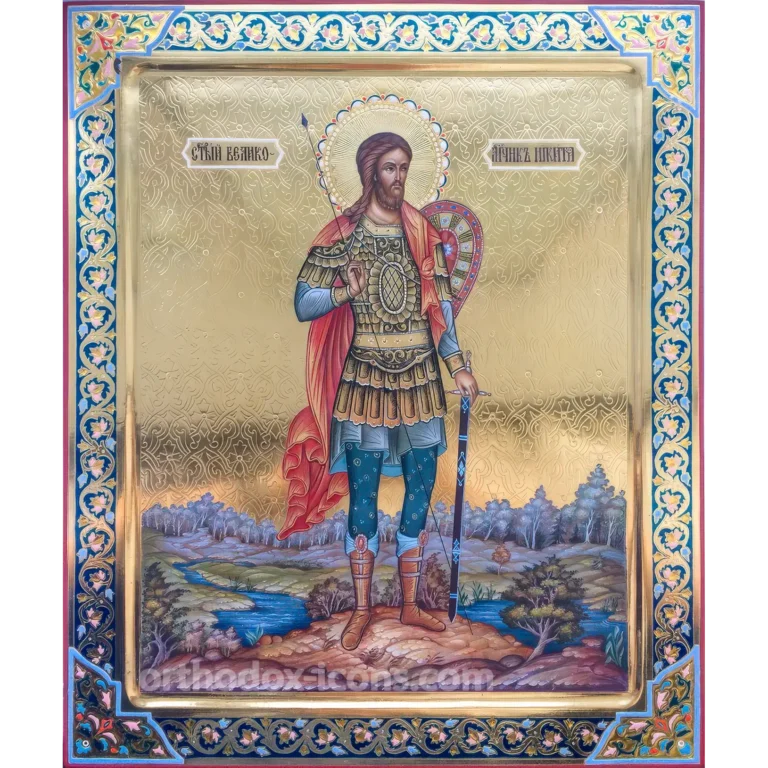
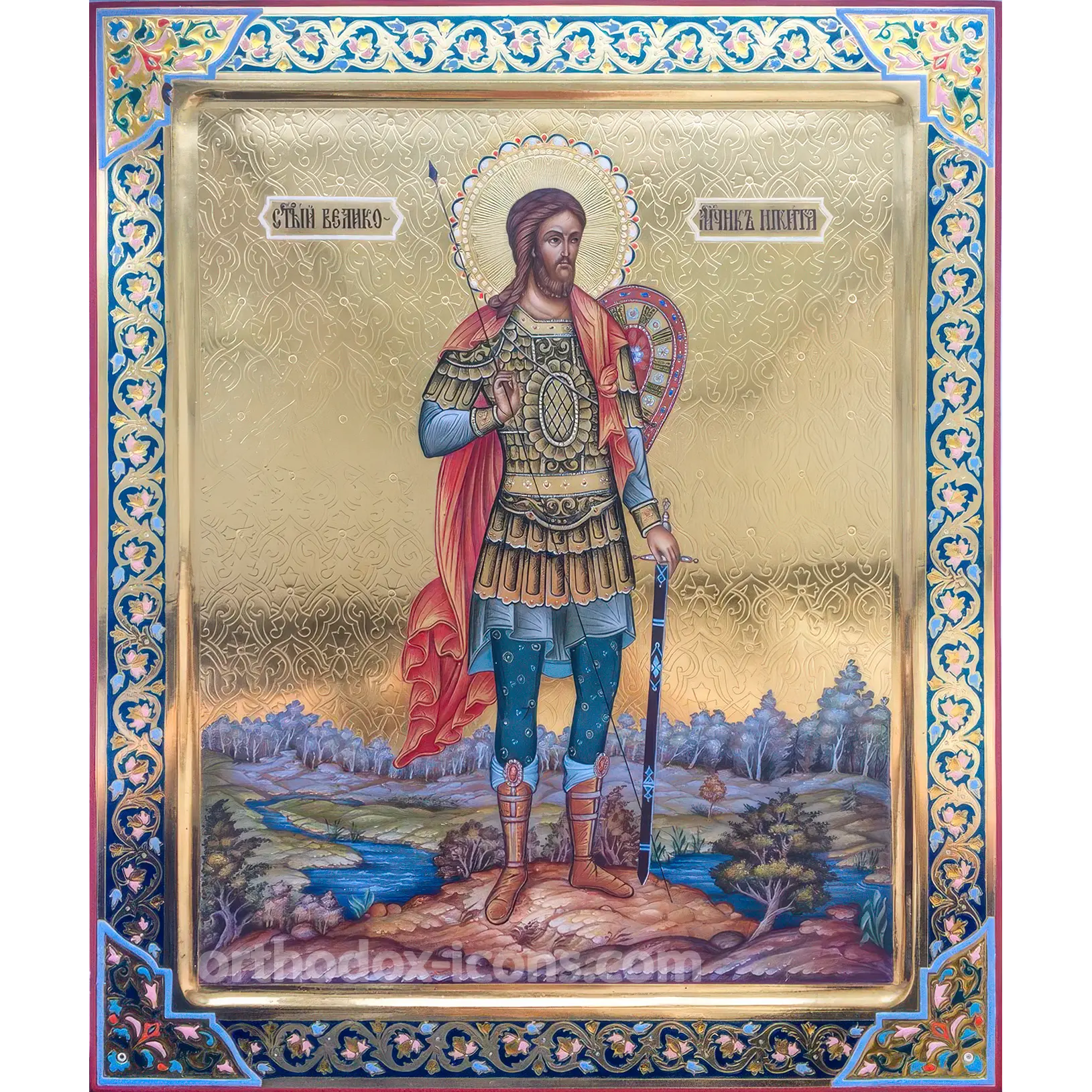
Saint Nikita Orthodox Icon is a hand-painted icon of the Holy Great Martyr Nikita the Goth, an early Christian warrior saint and confessor of Christ. He is shown full-length in armor, with a red martyr’s cloak, a cross in one hand, and a drawn sword in the other, standing before a landscape with river and trees.
Available sizes: 20×24 cm (7.9×9.4 in), 27×31 cm (10.6×12.2 in), 30×40 cm (11.8×15.7 in). Larger church and iconostasis sizes can be made by individual agreement. Linden board, natural gesso, mineral egg tempera, 23K gold leaf (960 purity), hand-tooled gold ornament, enamel-style painted borders, and protective lacquer. Free international shipping is included, with payment after you receive and approve the icon.
It is possible to paint an image in any size to order
Free shipping worldwide
Saint Nikita Orthodox Icon is a hand-painted icon of the Holy Great Martyr Nikita the Goth, also known in Slavic Orthodox tradition as Nikita Besogon. The icon presents a solemn image of an early Christian warrior saint whose faith remained unbroken before pagan persecution, torture, and death.
Saint Nikita is shown full-length against a painted landscape with river and trees. He wears the armor of a Roman warrior: mail, blue trousers, and high leather boots. Over the armor falls a crimson-red cloak, the traditional sign of martyrdom. In one hand he holds a slender cross, confessing Christ, and with the other he rests on a drawn sword, the symbol of spiritual warfare and readiness to defend the truth.
The icon is richly decorated. The sky behind the saint and the wide borders of the icon are covered with natural 23K gold leaf (960 purity). Over the gold, the master has made a continuous hand-tooled relief ornament, so the surface catches the light with a living play of depth and brightness. The broad borders are painted with multicolored floral motifs in blue, pink, and green, imitating the appearance of old cloisonne enamel.
The Witness of Saint Nikita the Goth
The life of the Holy Great Martyr Nikita takes us to the fourth century, to the lands of the Goths near the Danube. Nikita was born into a noble Gothic family and accepted Christianity in his youth. According to tradition, he was baptized by Bishop Theophilus, who took part in the First Ecumenical Council.
At that time the Gothic people were divided. Some, led by Fritigern, accepted Christianity, while others followed the pagan ruler Athanaric. Because of his noble origin, education, and authority among his people, Nikita became one of the important witnesses of the Gospel among the Goths. Through his personal example, piety, and preaching, many were strengthened in the Christian faith.
After Athanaric came to power, a fierce persecution of Christians began. Pagan idols were carried through the settlements, and people were forced to worship them. Those who refused were put to death. Saint Nikita openly rejected this idolatry and rebuked the cruelty and blindness of the persecutor, calling the faithful not to fear death for the sake of eternal life in Christ.
The ruler subjected Nikita to cruel torments, but the saint did not renounce Christ. A traditional account says that while Nikita was in prison, the devil appeared to him disguised as an angel and tried to persuade him to sacrifice to idols in order to save his life. The saint recognized the deception and overcame the evil one. This episode became the basis for the popular name Nikita Besogon, by which he is remembered as a protector against dark spiritual forces.
When the persecutors could not break his will, they cast him into a great fire. Saint Nikita gave his soul to the Lord in the flames in the year 372. His relics were later venerated, and many healings were associated with them.
Technique: Gold, Hand-Tooled Ornament, and Tempera
This icon is made in the tradition of Russian hand-painted icons, with careful attention to both the sacred image and the decorative work. The painted figure of the saint, the gold background, the relief ornament, and the enamel-style borders are all created by hand.
| Wooden base | Carefully dried solid linden board with inserted oak support battens on the reverse side to help protect the board from warping. |
| Ground | Linen cloth and multiple layers of natural chalk gesso, polished to a smooth surface for painting and gilding. |
| Painting | Traditional mineral egg tempera made from natural pigments, used for the saint’s face, armor, garments, hands, cross, sword, and landscape. |
| Gold and hand tooling | The background and borders are covered with 23K gold leaf (960 purity). A hand-tooled relief ornament is made over the gold, giving the surface depth and brightness. |
| Border painting | The wide borders are decorated with floral ornament painted over gold, imitating the visual character of old cloisonne enamel. |
| Available sizes | 20×24 cm (7.9×9.4 in), 27×31 cm (10.6×12.2 in), 30×40 cm (11.8×15.7 in), with larger church and iconostasis sizes by agreement. |
Theological Symbolism of the Image
The full-length image of Saint Nikita is deeply symbolic. His armor and sword do not only refer to his earthly status as a warrior. They also show him as a warrior of the Heavenly King, standing in spiritual battle against evil, falsehood, and fear. The sword points to the word of God and to the unyielding defense of the truth.
The crimson cloak over the armor is the color of martyrdom. It recalls the blood shed for Christ, but also the victory of life over death. In Orthodox iconography, such red garments do not glorify violence; they witness to sacrificial love, courage, and faithfulness unto death.
The cross in the saint’s hand reveals the true meaning of his victory. Saint Nikita does not conquer by earthly strength alone, but by confession of Christ. The cross is the sign of voluntary witness and the source of courage before persecution.
The landscape with river, hills, and trees gives historical depth to the icon. It recalls the lands near the Danube where the martyr’s earthly witness took place. The union of earthly landscape with shining gold sky points to the passage from the visible world into the eternal light of the Kingdom of God.
What People Pray For Before Saint Nikita’s Icon
Saint Nikita the Great Martyr is venerated in the Orthodox Church as a protector in spiritual struggle and as a patron of courage. People pray before his icon for defense from visible and invisible enemies, protection in danger, strengthening of faith, and victory over temptations.
Parents often ask Saint Nikita to protect sons who serve in the military or face dangerous circumstances. The saint is asked for courage, endurance, sober judgment, and firmness in critical situations.
Because of the tradition connected with Nikita Besogon, the saint is also invoked for spiritual protection, for help against fear, despondency, destructive influences, and dark temptations. Families may pray for children to be protected from harmful company, addictions, and loss of faith.
People also ask Saint Nikita for help in serious illness, especially when suffering is joined with anxiety, spiritual distress, or inner turmoil. As with all Orthodox prayer before icons, the help is sought from God through the intercession of the saint, not from the image as an object.
Gift Meaning
This icon is especially suitable as a patron saint icon for a boy or man named Nikita, Nicetas, or Niketas. It may be given for baptism, a name day, birthday, coming of age, military service, or a significant life milestone.
The icon is also a meaningful gift for military men, protectors, and Orthodox faithful who need spiritual steadiness, courage, and support in difficult circumstances. In a larger format, it can be painted for a chapel, church, military prayer room, or iconostasis.
Placement and Care
An icon with gold leaf, hand-tooled ornament, and painted borders should be placed in a clean and stable part of the home icon corner, away from direct sunlight, heaters, high humidity, and sudden temperature changes. The gold and painted surface should be treated carefully, even when protected by a finish.
Dust may be removed with a soft dry cloth or a very soft brush without pressure. Do not use chemical cleaners, abrasive materials, household sprays, or rough cloth. For long-term protection, especially in a home with changing humidity, a glazed wooden kiot is recommended.
Ordering and Shipping
The icon can be painted in the available sizes 20×24 cm (7.9×9.4 in), 27×31 cm (10.6×12.2 in), and 30×40 cm (11.8×15.7 in). Larger church and iconostasis formats can be made by individual agreement. Free international shipping is included, and payment is made after you receive and approve the icon.
Questions and Answers
Who was Saint Nikita the Goth?
Saint Nikita the Goth was a noble Gothic warrior of the fourth century who accepted Christianity, preached the Gospel among his people, and suffered martyrdom in 372 after refusing to worship pagan idols.
Why is Saint Nikita sometimes called Nikita Besogon?
This name is connected with a traditional account in which the devil appeared to Nikita in prison disguised as an angel. The saint recognized the deception, overcame the evil one, and is therefore venerated as a strong protector against dark spiritual forces.
What does the sword in Saint Nikita’s hand symbolize?
The sword points both to his earthly status as a warrior and to spiritual warfare. It recalls the biblical image of the sword of the Spirit, the Word of God, and the saint’s struggle against sin and falsehood.
What is the main artistic feature of this icon?
The icon has a richly decorated gold background and borders. The surface is covered with 23K gold leaf (960 purity), worked by hand with raised ornament, and the wide borders are painted with floral designs imitating old cloisonne enamel.
Will the colors on the icon fade over time?
The icon is painted in mineral egg tempera made with natural pigments. With proper care and protection from direct sunlight and humidity, these colors remain stable for many years.
Who is this icon suitable for as a gift?
It is especially suitable for a boy or man named Nikita or Nicetas, and also for military men, protectors, and anyone who needs courage, spiritual strength, and steadfastness in faith.
How should an icon with gold and hand-tooled ornament be cared for?
The icon should be dusted gently with a soft dry cloth or very soft brush. Do not use chemical cleaners, abrasive materials, or strong pressure. A glazed kiot is recommended for long-term protection.
Why is Saint Nikita shown before a landscape?
The landscape with river, hills, and trees recalls the historical setting of his martyrdom near the Danube and connects his earthly witness with the golden heavenly background.
What does the red cloak over the armor mean?
In martyr icons, red or crimson garments point to blood shed for Christ. The cloak also suggests victory over death and the saint’s inheritance of the Kingdom of Heaven.
Can this icon be painted in larger church sizes?
Yes. In addition to the available sizes 20×24 cm, 27×31 cm, and 30×40 cm, the icon can be painted in larger church or iconostasis formats by individual agreement.
| Dimensions | 20x24cm (7.9×9.4 in), 27x31cm (10.6×12.2 in), 30x40cm (11.8×15.7 in) |
|---|---|
| Name | Nikita, Nicetas |