Saint Alexius the Man of God Icon
Price range: $700 through $2250
Available sizes: 17×21 cm (6.7×8.3 in), 20×24 cm (7.9×9.4 in), 27×31 cm (10.6×12.2 in), 30×40 cm (11.8×15.7 in). Custom iconostasis sizes can be discussed before painting.
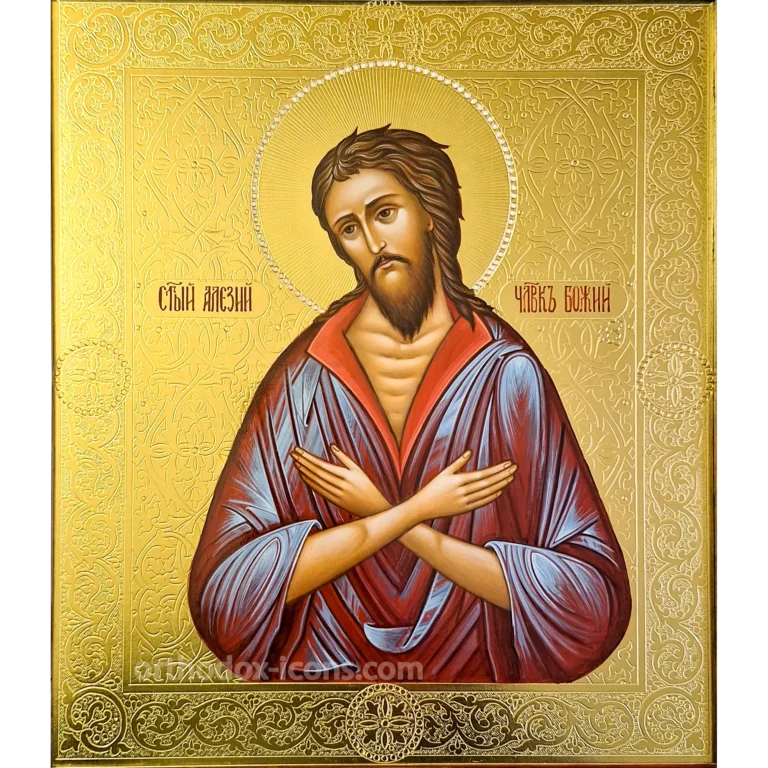
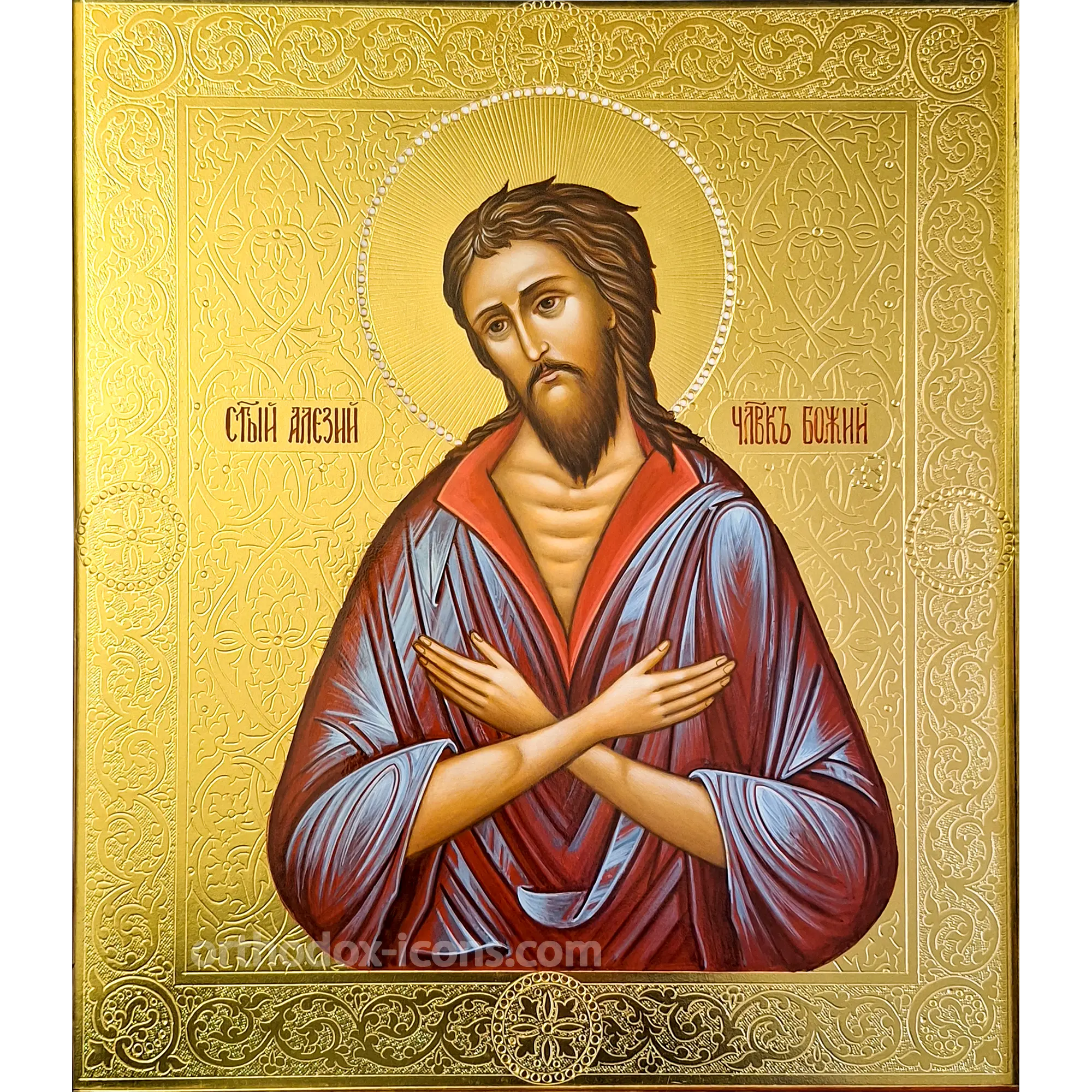
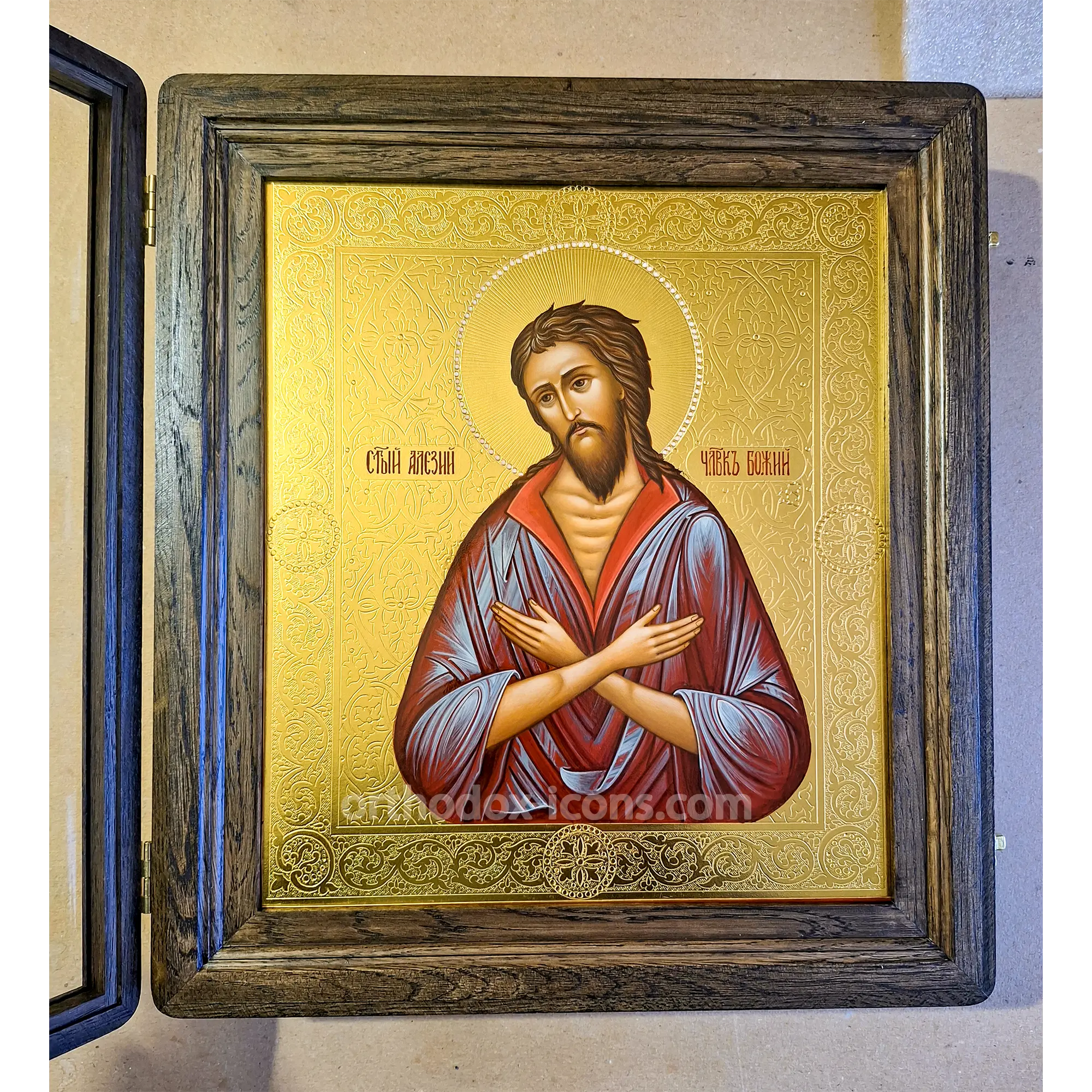
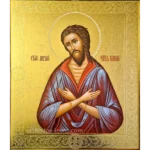
Saint Alexius the Man of God Icon is a hand-painted Orthodox icon of a saint who renounced earthly honor, wealth, and recognition for the sake of hidden service to Christ. Saint Alexius is shown half-length, with his hands crossed on his chest, against a gilded ornamental background.
- Prayer focus: humility, patience, strengthening of faith, wise life choices, overcoming pride, family peace, spiritual sobriety, and endurance during trials.
- Materials: linden board, oak splines, chalk gesso, egg tempera, mineral pigments, gold leaf, tooled ornamental background, and protective finish.
- For whom it is suitable: men and boys named Alexius, Alexis, or Alexey; baptism, name day, birthday, home icon corner, church, or a meaningful spiritual gift.
- Iconographic features: half-length image, hands crossed on the chest, large gilded halo, tooled gold ornament, and rich gilded framing.
It is possible to paint an image in any size to order
Free shipping worldwide
Hand-painted Saint Alexius the Man of God Icon presents a holy ascetic whose life is one of the most striking examples of voluntary humility, hidden spiritual labor, and complete trust in God. Saint Alexius was born into a noble Roman family, yet for the sake of Christ he left wealth, honor, and ordinary earthly comfort. His life shows that true spiritual greatness can remain unseen by people and still be fully known to God.
In this icon, Saint Alexius is shown half-length against a solemn gilded background with rich ornamental decoration. His hands are crossed on his chest, a deeply expressive gesture of humility, repentance, inner prayer, and surrender to the will of God. The face of the saint is calm and meek: there is no outward severity, but there is the quiet strength of a man who has passed through self-denial and hidden endurance.
Available sizes are 17×21 cm (6.7×8.3 in), 20×24 cm (7.9×9.4 in), 27×31 cm (10.6×12.2 in), and 30×40 cm (11.8×15.7 in). The icon is suitable for a home icon corner, a church, a personal patron saint icon, and as a baptism, name day, or birthday gift for someone named Alexius, Alexis, or Alexey.
Features of This Icon
The main feature of this icon is the meeting of a strict ascetic image with a festive gilded setting. Saint Alexius is not shown in royal clothing or with signs of worldly dignity. He appears in simple garments, with his chest and hands visible, the hands folded in the form of a cross. Around him, however, is a rich gold background, showing that humility and voluntary poverty before God become true spiritual glory.
The crossed hands are one of the most important details of the composition. The gesture can be read as prayerful self-abasement and as an inward cross accepted freely. Saint Alexius did not become known through authority, public teaching, or military courage. His holiness was revealed through hidden life, silence, patience, and the willingness to remain unnoticed by people.
The face is painted with soft sorrowful concentration. His gaze is turned not toward outward action, but inward toward prayer. This is essential to the image: Saint Alexius teaches by silent example. The icon invites a person to pause, step back from noise and vanity, and ask what the heart is truly serving.
The garments are painted in deep red-blue and cool gray-blue tones, creating a strong contrast with the gilded background. The red tones suggest spiritual zeal and love for Christ, while the cooler highlights bring restraint and depth. The gilded halo, ray-like ornament, and tooled plant patterns make the icon solemn without weakening its ascetic meaning.
Iconography of Saint Alexius the Man of God
In Orthodox iconography, Saint Alexius the Man of God is often shown as a humble ascetic who renounced wealth and social rank for a hidden life before God. His image is not based on visible office or public honor. His holiness is expressed through poverty, patience, prayer, and the concealment of his spiritual labor from human praise.
The half-length composition helps concentrate attention on the face, the hands, and the inner state of the saint. There are no unnecessary narrative details. The viewer immediately sees the meek face, the crossed hands, the gilded halo, and the inscription that identifies him as Alexius, the Man of God.
The title “Man of God” has a deep meaning. It does not describe outward status, but belonging to God with the whole heart. Alexius lived in such a way that his true dignity was hidden from people, yet open to heaven. This makes his icon especially meaningful today: it reminds us that spiritual life is not always visible, not always praised, and not always understood by others.
The gold background reveals the heavenly outcome of the saint’s earthly humility. Alexius outwardly gave up wealth, but received spiritual treasure. The gilding therefore does not contradict the ascetic image; it explains it. Poverty for Christ becomes heavenly richness, and hidden labor becomes glory in God.
Prayer Before the Icon of Saint Alexius
Orthodox Christians pray before the icon of Saint Alexius the Man of God for humility, patience, strengthening of faith, help in difficult choices, and freedom from the desire for human praise. He is especially close to those who face inner struggle, misunderstanding, family or personal trials, and the need to accept God’s will without bitterness.
People ask Saint Alexius for meekness, spiritual sobriety, endurance, help in overcoming pride and vanity, protection from despondency, strength for those who feel lonely or misunderstood, and peace in the family. Men and boys named Alexius, Alexis, or Alexey may also pray to him as their heavenly patron.
The icon reminds us that not every spiritual labor is seen by others. Sometimes a person must endure quietly, without defending himself loudly or demanding recognition. Saint Alexius shows another path: interior freedom, where a person is no longer ruled by praise, status, money, or opinion, because faithfulness to Christ becomes the center of life.
Who This Icon Is For
This icon is especially appropriate as a patron saint icon for a man or boy named Alexius, Alexis, or Alexey. It can be given for baptism, name day, birthday, the beginning of studies, a new stage of life, a move, an important decision, or another meaningful family occasion.
The icon also belongs naturally in a home icon corner, a personal prayer place, a study, a family chapel, or a church. It is suitable for people who value ascetic saints and who seek a quieter, more inward, and more attentive spiritual life. The image helps set the heart toward prayer for humility, patience, purity of heart, and freedom from vanity.
For a family, the icon can become a reminder that peace in the home is built not only by outward comfort, but by humility, forgiveness, self-restraint, and the willingness not always to insist on one’s own way. Saint Alexius left wealth and honor, but in the spiritual sense he became rich because he remained faithful to God until the end.
Short Life of Saint Alexius
Saint Alexius was born in Rome into a devout and noble family. His parents were wealthy and respected, but for many years they had no children and prayed earnestly for a child. When their son was born, they raised him in faith and piety. From youth, Alexius desired God and did not want to bind his heart to earthly glory, though his birth could have given him a life of comfort and honor.
According to his life, Alexius entered marriage at the will of his parents, but on the day of the wedding he secretly left home, giving part of his possessions to the poor. He traveled far away and lived for many years as a poor wanderer, spending his life in prayer, fasting, and humility. In Edessa, near a church of the Most Holy Theotokos, he hid his noble origin and accepted voluntary poverty for Christ.
When people began to recognize his holiness, Alexius left again to escape fame. By the providence of God, he returned to Rome but did not reveal himself to his parents. In his father’s house he lived as a poor stranger, enduring humiliation, need, and complete non-recognition by those closest to him. Only after his death was his identity revealed through a written account found in his hands.
The life of Saint Alexius is striking not because of outward triumph, but because of the depth of self-renunciation. He gave up not only wealth, but also the human desire to be understood, praised, and justified during life. For this reason, his witness is powerful: he chose to be known by God alone.
The memory of Saint Alexius the Man of God is celebrated on March 30 according to the civil calendar.
Materials, Gilding, and Ornament
The icon is painted on a linden board prepared with traditional icon gesso. Oak splines may be used to help stabilize the board. The face, hands, garments, inscriptions, and painted details are made in egg tempera with mineral pigments.
The gilded ornament is especially expressive in this image. The background, halo, and borders are decorated so that the surface appears as a precious luminous field. The tooled plant ornament gives solemnity to the icon, while the radiant halo and decorative contour draw attention back to the saint’s face.
Gold in Orthodox icon painting is connected with divine light and heavenly glory. In the icon of Saint Alexius, this meaning is especially important: the saint gave up visible earthly wealth, yet received imperishable spiritual treasure. The gold here is not merely external richness; it reveals the theological meaning of humility glorified by God.
Choosing the Size
The 17×21 cm size is suitable for a small home prayer place or a personal patron saint icon. The 20×24 cm format gives the image a stronger presence and works well as a baptism, name day, or birthday gift. The 27×31 cm size allows the face, crossed hands, garment folds, inscriptions, and ornamental background to be seen more clearly. The 30×40 cm format makes the icon especially solemn and reveals the gilded decoration more fully.
Custom iconostasis sizes can be discussed individually. In that case, the place of installation, lighting, neighboring icons, height, and viewing distance should be considered so that the face, crossed hands, halo, inscription, and gold ornament remain clear.
Placement, Blessing, and Care
The icon of Saint Alexius the Man of God can be placed in a home icon corner near icons of Christ, the Mother of God, Saint Nicholas, the Guardian Angel, and family patron saints. It is also appropriate in a personal prayer place for someone named Alexius, Alexis, or Alexey, or in a church row of venerable saints and ascetics.
The icon can be blessed in an Orthodox church before shipping. Free international shipping is included. Payment is made after you receive and approve the icon.
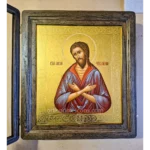
A hand-painted icon should be protected from direct sunlight, dampness, overheating, soot, and sudden temperature changes. Do not wipe the painted or gilded surface with wet cloths, alcohol, household chemicals, or rough fabric. Dust should be removed gently with a soft dry brush. A glazed wooden kiot is recommended for long-term protection, especially for larger icons with detailed gold ornament.
Questions and Answers
Who was Saint Alexius the Man of God?
Saint Alexius the Man of God was an ascetic saint who renounced wealth, social honor, and earthly comfort for a hidden life of humility in Christ.
Why is he called the Man of God?
This title shows that his whole life belonged to God. His spiritual labor was hidden from people, but it was known and glorified by the Lord.
What do Orthodox Christians pray for before his icon?
They pray for humility, patience, strengthening of faith, help in difficult choices, freedom from pride and vanity, and endurance during spiritual and personal trials.
For whom is this icon especially suitable?
It is especially suitable for men and boys named Alexius, Alexis, or Alexey, and for anyone who honors Saint Alexius and seeks spiritual steadiness.
Can this icon be given for baptism?
Yes. It is an appropriate patron saint icon for a boy or man named Alexius, Alexis, or Alexey, especially when Saint Alexius is chosen as his heavenly patron.
What do the crossed hands on the chest mean?
The crossed hands express humility, repentance, inner prayer, and the voluntary acceptance of a hidden spiritual path before God.
When is the feast day of Saint Alexius the Man of God?
His memory is celebrated on March 30 according to the civil calendar.
What sizes are available?
Available sizes are 17×21 cm, 20×24 cm, 27×31 cm, and 30×40 cm. Custom iconostasis sizes can also be discussed before painting.
What does the gilded background mean?
The gold background points to divine light and heavenly glory. In this icon it emphasizes the spiritual glory of a saint who chose humility over earthly recognition.
How should a hand-painted icon be cared for?
Keep the icon away from moisture, direct sunlight, overheating, and mechanical damage. Dust should be removed with a soft dry brush; a glazed kiot is recommended.
| Dimensions | 17x21cm (6.7×8.3 in), 20x24cm (7.9×9.4 in), 27x31cm (10.6×12.2 in), 30x40cm (11.8×15.7 in) |
|---|---|
| Name | Alexis, Alexey |