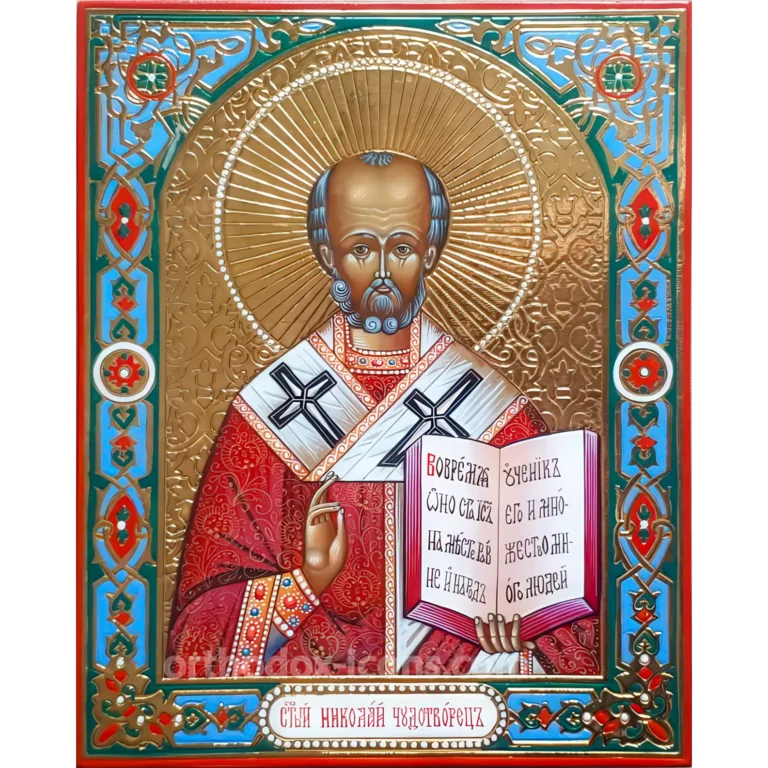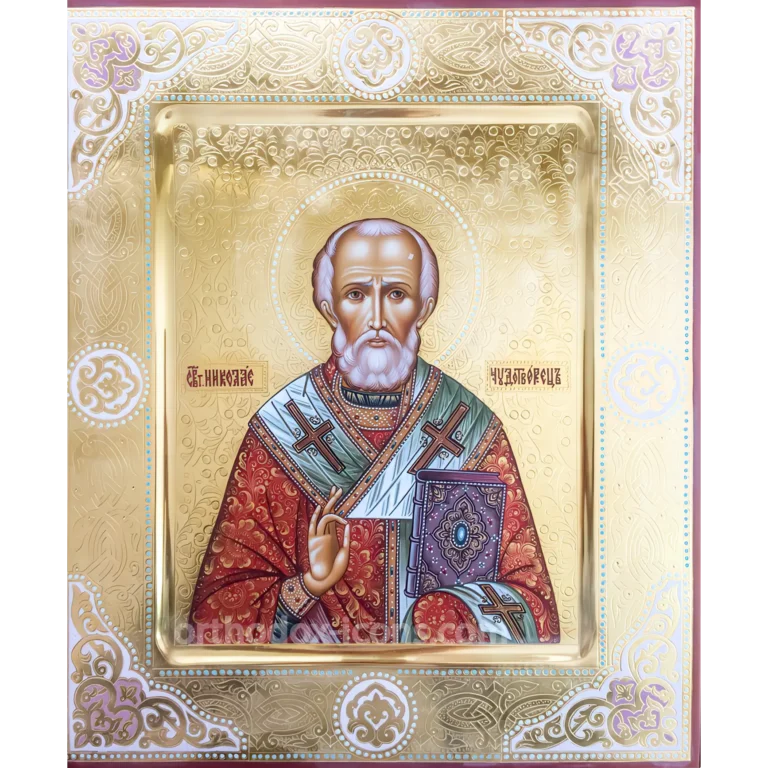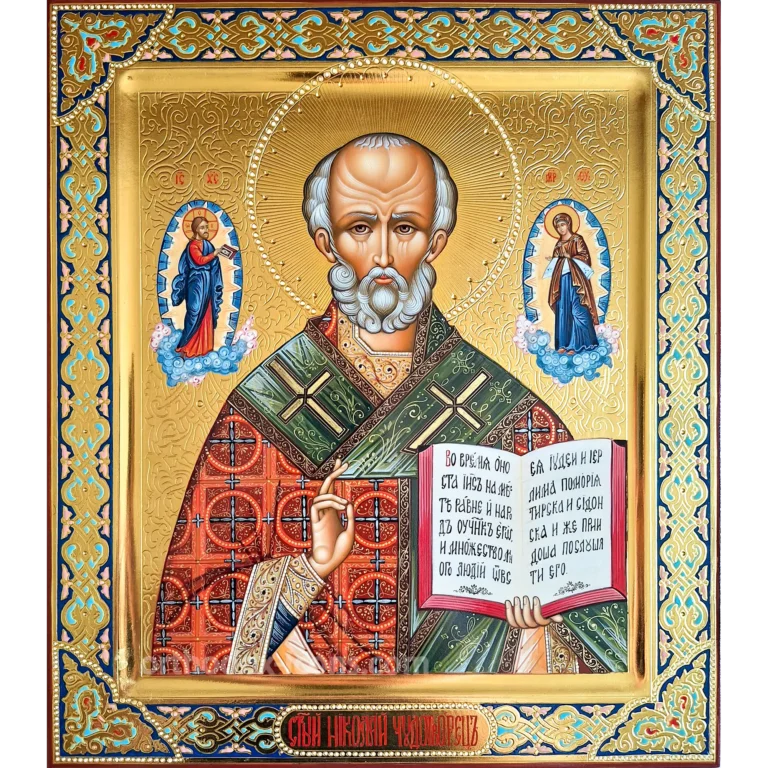
Nicholas the Wonderworker Icon
Price range: $500 through $1600
Available sizes: 17×21 cm (6.7×8.3 in), 20×24 cm (7.9×9.4 in), 27×31 cm (10.6×12.2 in), 30×40 cm (11.8×15.7 in), with larger church and iconostasis sizes available by agreement.
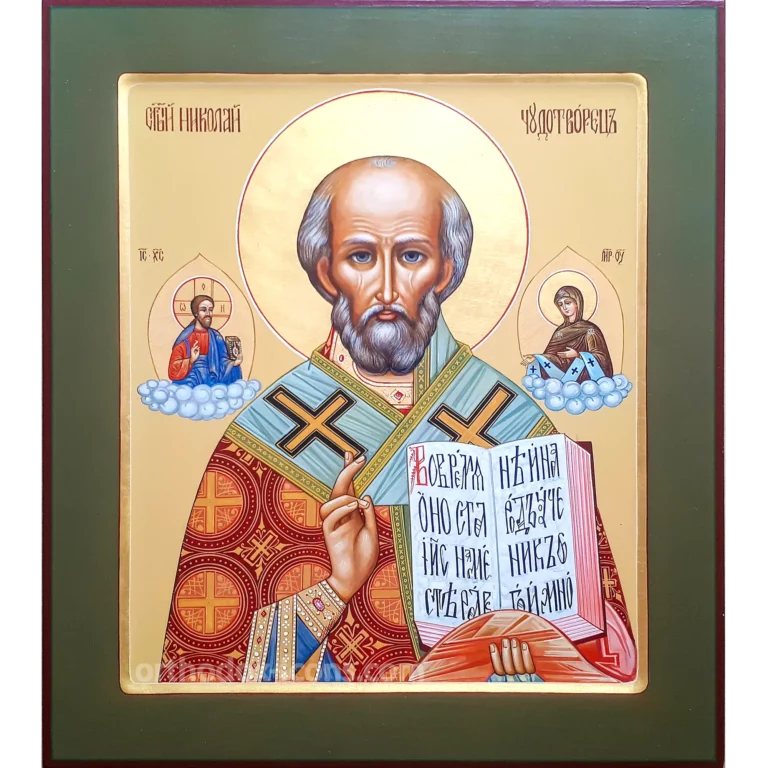
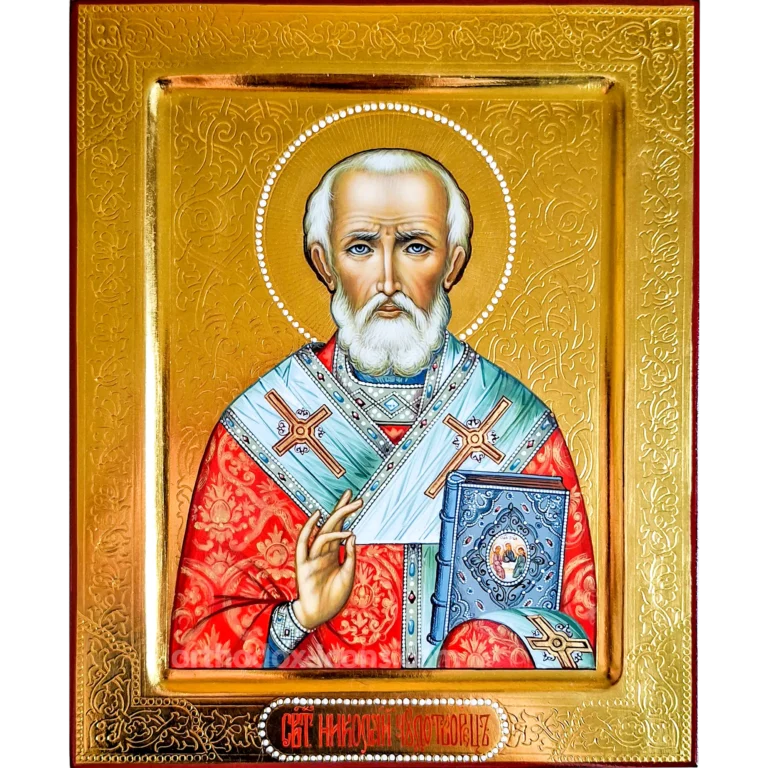
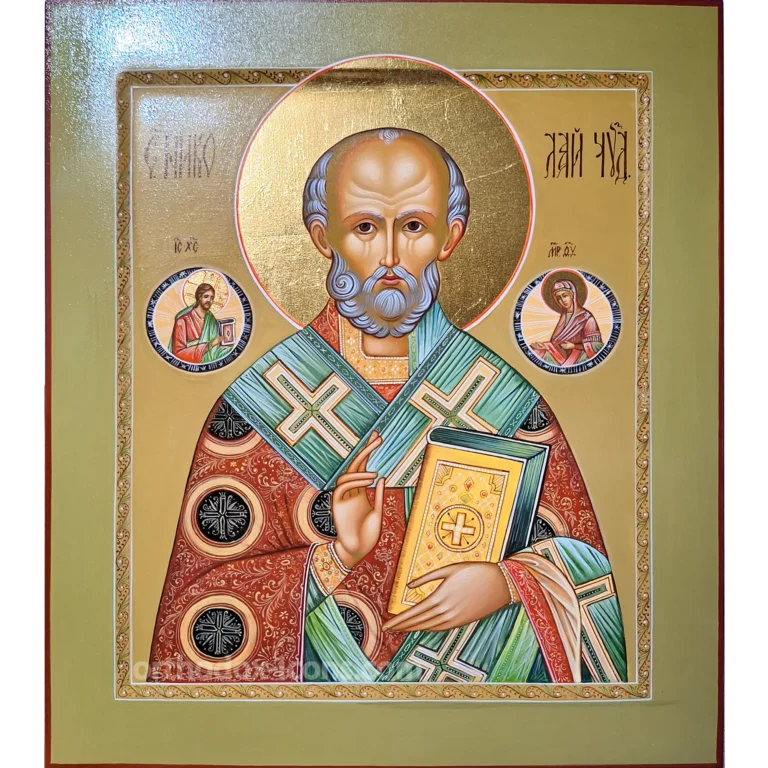
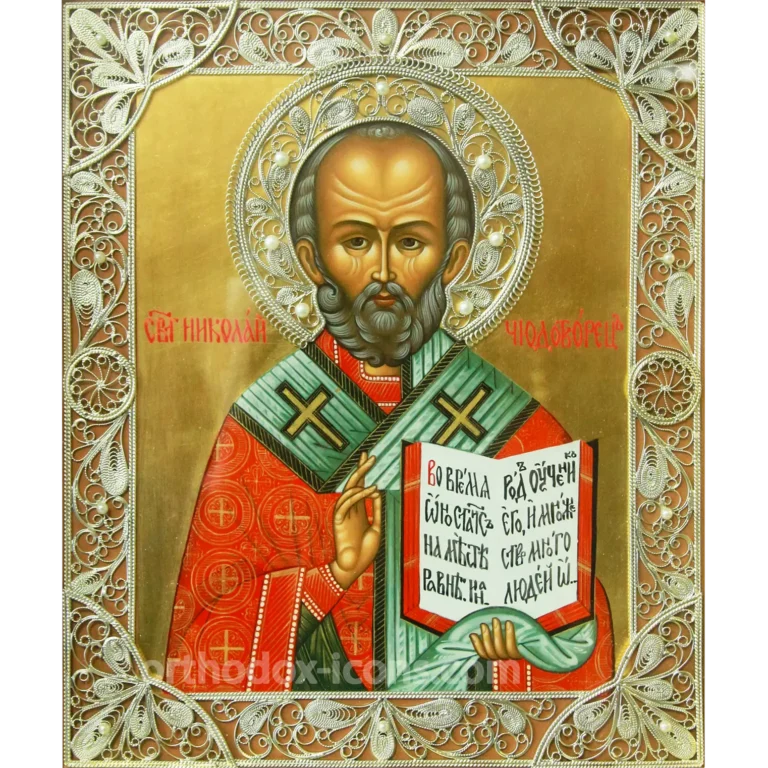
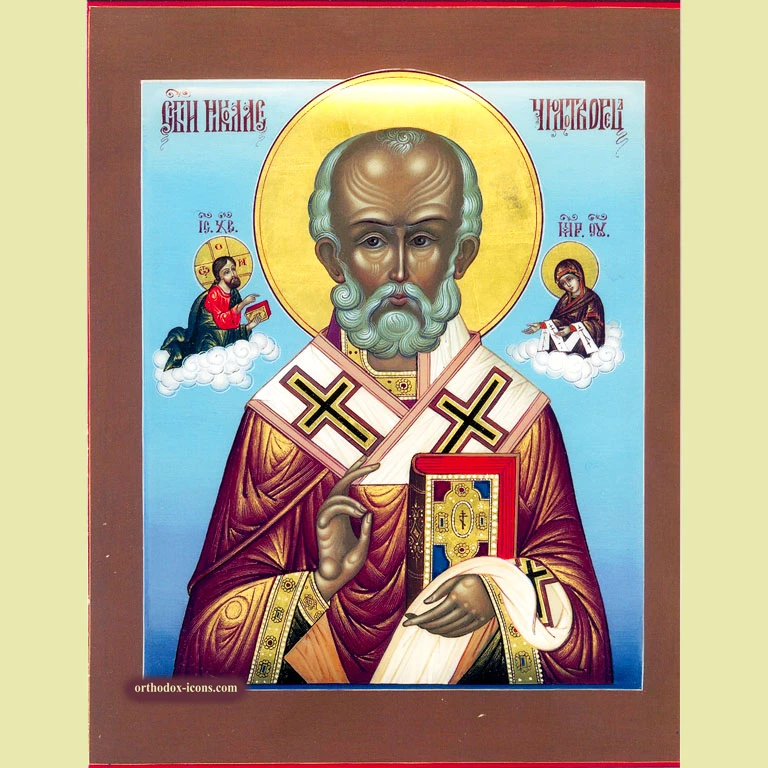
The Nicholas the Wonderworker Icon is a hand-painted Orthodox icon in a realistic academic style. Saint Nicholas is shown with the Gospel, while Christ and the Mother of God appear above him in the clouds, recalling the Miracle of Nicaea. The calm blue background, brown borders, and gold leaf halos keep attention on the saint’s compassionate face and episcopal dignity.
Prayer focus: protection from injustice and slander, help in travel, healing in illness, support in financial hardship, peace in the family, and the intercession of Saint Nicholas in difficult circumstances.
Materials: solid linden board, oak support splines, cloth, chalk gesso, oil paints or tempera, 23K gold leaf (960 purity) on the halos, and protective varnish.
Free international shipping is included, and payment is made after you receive and approve the icon.
It is possible to paint an image in any size to order
Free shipping worldwide
The Nicholas the Wonderworker Icon presents one of the most beloved saints of the Orthodox Church in a warm, realistic academic style. Saint Nicholas is shown as a bishop, holding the Gospel, with Christ and the Mother of God appearing above him in the clouds. The composition is not only a portrait of a saint; it is a visual confession of faith, mercy, and divine justice.
This hand-painted icon is especially expressive because it combines a familiar Orthodox subject with the painterly language of nineteenth-century church art. The face of Saint Nicholas is soft, deep, and attentive. The blue background and restrained brown borders avoid decorative excess, so the viewer’s attention remains on the saint himself and on the sacred event represented around him.
Nicholas the Wonderworker Icon and the Miracle of Nicaea
The most important feature of this icon is the scene placed in the upper part of the composition. On one side, the Lord Jesus Christ offers Saint Nicholas the Gospel. On the other side, the Most Holy Theotokos gives him the bishop’s omophorion. This iconographic detail refers to the Miracle of Nicaea, connected with the First Ecumenical Council in 325.
According to Orthodox tradition, Saint Nicholas could not bear the blasphemous teaching of Arius, who denied the true divinity of Christ. Because of his zeal, Nicholas was deprived of his episcopal dignity and placed in prison. During the night, Christ and the Mother of God appeared and restored to him the Gospel and the omophorion, showing that his defense of the true faith was pleasing to God. The bishops then released him and restored his rank.
For this reason, the icon speaks not only of personal devotion to Saint Nicholas, but also of the triumph of truth over falsehood. It is a powerful image for prayer in times of slander, injustice, confusion, and moral pressure.
Academic Church Painting
This image is painted in an academic, realistic manner. That style became widespread in Russian church art in the eighteenth and nineteenth centuries and can be seen in many major cathedrals. It differs from stricter Byzantine or Old Russian icon painting by using softer modeling, natural proportions, light and shadow, and a more painterly treatment of the face and garments.
In this icon, the face of Saint Nicholas is rendered with particular care. The eyes are living and compassionate, the gray beard is written with fine transitions, and the folds of the red phelonion have a sense of volume. The result is solemn, but also close and humanly understandable, which makes the image especially suitable for those who respond to realistic church painting.
The icon is not overloaded with gold ornament, enamel-style decoration, or tooled patterns. Gold leaf is used on the halos of Saint Nicholas, Christ, and the Mother of God, while the background remains a clear sky-blue field. This restraint gives the icon a calm prayerful character.
The Life and Help of Saint Nicholas
Saint Nicholas lived in the third and fourth centuries in Lycia, in Asia Minor. From youth he was known for his faith, mercy, and love for the poor. As Archbishop of Myra, he became a defender of Orthodoxy, but also a father to those in distress.
During his earthly life, he secretly helped the poor, rescued the innocent from unjust punishment, protected travelers and sailors, and answered many desperate needs through prayer. After his repose, his intercession did not cease. His relics, now in Bari, became a source of healing, and countless Orthodox Christians continue to turn to him as a quick helper.
This icon is therefore appropriate not only as a named icon for someone called Nicholas, but also as a devotional image for a family, a traveler, a person facing court or workplace injustice, or anyone seeking the help of a merciful saint.
What People Pray for Before This Icon
Orthodox Christians pray before Saint Nicholas for protection during travel, for sailors, drivers, pilots, and all who spend time on the road or at sea. He is also asked for help in illness, financial trouble, family difficulties, and urgent need.
Because this icon includes the Miracle of Nicaea, it has a particular connection with the defense of truth. It is fitting to pray before it for protection from slander, false accusations, unfair judgment, and difficult legal or personal conflicts. The icon reminds the faithful that truth is not merely an argument, but something guarded by God.
Materials and Hand-Painted Execution
The icon is made on a solid linden board, a traditional and reliable material for icon painting. Oak support splines are set into the back of the board to help resist warping as humidity changes. The surface is covered with cloth and several layers of chalk gesso, then carefully polished before painting begins.
The image is painted in oil paints or tempera, depending on the artistic technique used for this academic style. The halos are gilded with 23K gold leaf (960 purity). After the painting is complete, the surface is protected with varnish, giving depth to the colors and helping preserve the icon from dust, moisture, and fading.
Who This Icon Is For
The Nicholas the Wonderworker Icon is a meaningful gift for a birthday, name day, baptism, wedding, anniversary, or house blessing. It is especially suitable for a person named Nicholas and for those whose life or work is connected with travel, responsibility, justice, leadership, or service to others.
Because the painting is realistic and emotionally accessible, it may also be a good choice for someone who is beginning to build a home icon corner. The image is reverent and churchly, while the painterly style makes the saint’s face especially readable and warm.
Icon Characteristics
| Icon name | Nicholas the Wonderworker Icon |
| Saint | Saint Nicholas, Archbishop of Myra in Lycia |
| Iconographic subject | Saint Nicholas with Christ, the Mother of God, the Gospel, and the omophorion; the Miracle of Nicaea |
| Painting style | Academic, realistic church painting |
| Materials | Solid linden board, oak support splines, cloth, chalk gesso, oil paints or tempera |
| Gold | 23K gold leaf (960 purity) on the halos |
| Available sizes | 17×21 cm (6.7×8.3 in), 20×24 cm (7.9×9.4 in), 27×31 cm (10.6×12.2 in), 30×40 cm (11.8×15.7 in); larger church and iconostasis sizes by agreement |
| Use | Home icon corner, chapel, parish gift, named icon, devotional gift |
Choosing the Size
Available sizes are 17×21 cm (6.7×8.3 in), 20×24 cm (7.9×9.4 in), 27×31 cm (10.6×12.2 in), and 30×40 cm (11.8×15.7 in). The smaller formats work well for a home prayer corner or a personal devotional space. The larger formats give more room for the facial modeling, the Gospel, the vestments, and the small figures of Christ and the Mother of God above the saint.
For a church, chapel, or iconostasis, larger formats may be discussed individually before painting. A protective kiot can also be ordered or selected separately, especially if the icon will be placed near candles or in a room where humidity changes.
Free international shipping is included, and payment is made after you receive and approve the icon.
Questions and Answers
What does the presence of Christ and the Mother of God mean on this icon?
It refers to the Miracle of Nicaea. According to Orthodox tradition, after Saint Nicholas was punished at the First Ecumenical Council, Christ and the Mother of God restored to him the Gospel and the episcopal omophorion, confirming his zeal for the true faith.
How is this icon different from stricter Byzantine-style icons?
This icon is painted in an academic, realistic manner. The face, beard, vestments, and folds are modeled with soft light and shadow, while the overall composition remains suitable for Orthodox prayer and veneration.
Is real gold leaf used on the icon?
Yes. The halos of Saint Nicholas, Christ, and the Mother of God are gilded with 23K gold leaf (960 purity), while the main background is painted in a quiet sky-blue tone.
Why does this icon not have rich ornament or tooling?
The restrained decoration is part of the character of this image. The smooth background and simple borders allow the viewer to concentrate on the face of Saint Nicholas and on the theological meaning of the Nicaea scene.
Can this academic-style icon be placed with traditional Orthodox icons?
Yes. Academic church painting has long been used in Orthodox churches, especially from the eighteenth and nineteenth centuries onward. In a home icon corner, it can also be placed in a separate kiot or on its own shelf for visual harmony.
Is the icon durable for long-term use?
Yes. The icon is made on a solid linden board with oak support splines, cloth, and chalk gesso. The painted layer is protected with varnish, so the icon is made for long-term devotional use.
Is this icon appropriate for Orthodox prayer?
Yes. The composition, subject, and materials are made for Orthodox veneration. The academic style changes the painterly language, but the image remains a traditional Orthodox icon of Saint Nicholas.
What do Orthodox Christians pray for before Saint Nicholas?
Saint Nicholas is asked for help in travel, sickness, family troubles, poverty, debt, unjust accusations, and many urgent needs. He is especially loved as a quick helper and merciful intercessor.
What are iconostasis sizes?
Iconostasis sizes are larger formats made for a church, chapel, or large standing kiot. Such sizes are discussed individually before the icon is painted.
Is a kiot recommended for this icon?
A kiot is not mandatory, but it is recommended. It protects the painted surface from dust, candle soot, changes in humidity, and accidental damage.
| Dimensions | 17x21cm (6.7×8.3 in), 20x24cm (7.9×9.4 in), 27x31cm (10.6×12.2 in), 30x40cm (11.8×15.7 in) |
|---|---|
| Name | Nicholas |