Icon of Grand Duchess Elizabeth Feodorovna
Price range: $500 through $1350
Available sizes: 13×25 cm (5.1×9.8 in), 18×31 cm (7.1×12.2 in), 30×50 cm (11.8×19.7 in); larger iconostasis sizes can be made by individual request.
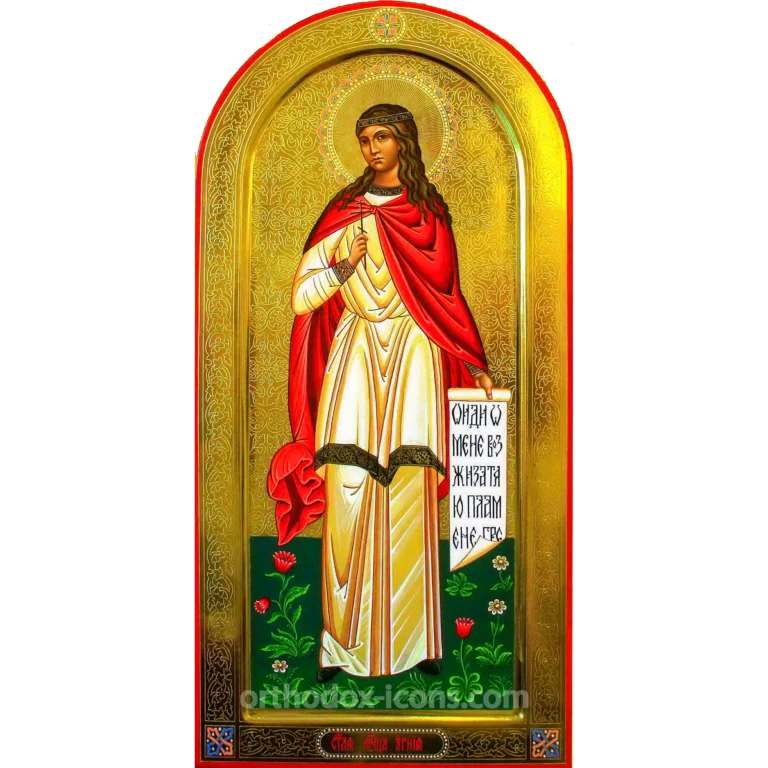
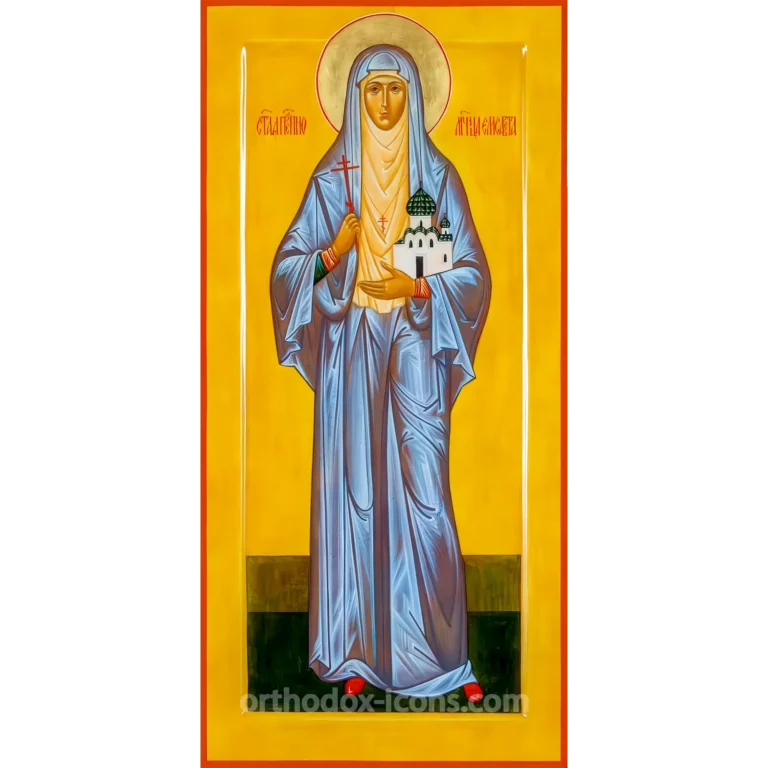
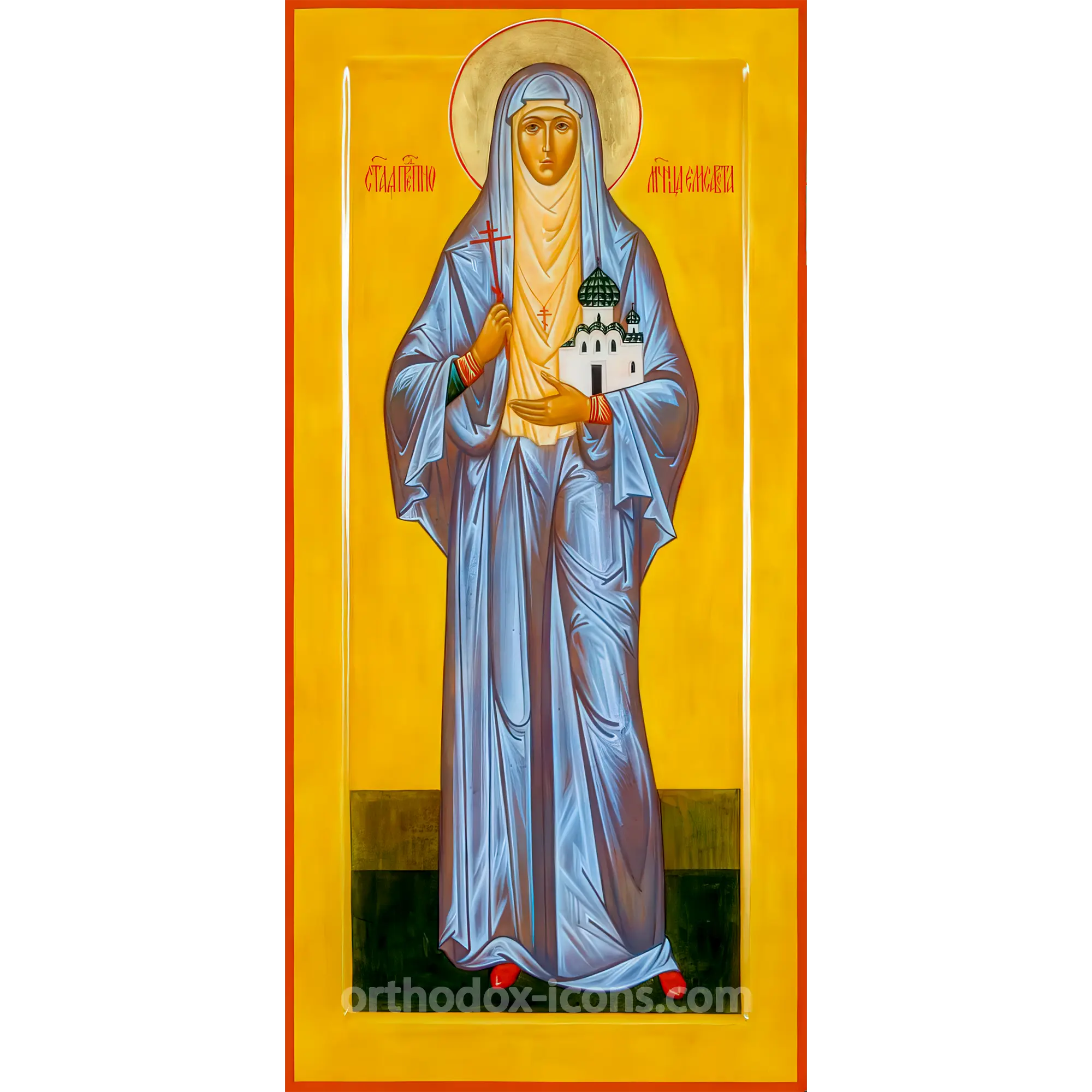
Icon of Grand Duchess Elizabeth Feodorovna is a hand-painted full-length Orthodox icon of the Holy New Martyr and Grand Duchess, remembered for her life of mercy and her faithful witness to Christ. She is shown in the gray-blue garment of a sister of mercy and a white apostolnik with a cross.
In her right hand Saint Elizabeth holds a red martyr’s cross; in her left hand she holds a white-stone church, symbolizing the Martha and Mary Convent of Mercy that she founded in Moscow. The image is painted on a flat board without a kovcheg, with a warm golden-yellow field and a strict red outline along the edges.
Prayer focus: healing and strength in serious illness, patience in suffering, works of mercy, family peace, and support for doctors, nurses, caregivers, and volunteers.
Materials: wooden icon board, oak support slats, pavoloka, natural chalk gesso, egg tempera, gold leaf according to the selected finish, and protective coating.
It is possible to paint an image in any size to order
Free shipping worldwide
Icon of Grand Duchess Elizabeth Feodorovna is a hand-painted Orthodox icon of the Holy Venerable Martyr Elizabeth Feodorovna Romanova, a deeply loved saint of the twentieth century. Her life revealed a rare union of noble dignity, humility, active mercy, and faithful endurance for Christ. In this icon she is shown as the abbess and sister of mercy of the Martha and Mary Convent, holding a martyr’s cross and a church in her hands.
This image is especially meaningful as a patron saint icon for women and girls named Elizabeth. It is also a strong spiritual gift for doctors, nurses, caregivers, social workers, volunteers, and all who serve the sick, the lonely, and the poor. The icon speaks not through external luxury, but through restraint: the calm figure, the gray-blue garment, the white apostolnik, the red cross, and the model of the church all point to a life given to mercy and to Christ.
Icon Characteristics
| Full name | Icon of Grand Duchess Elizabeth Feodorovna |
| Saint depicted | Holy Venerable Martyr Grand Duchess Elizabeth Feodorovna Romanova |
| Iconographic type | Full-length figure with a martyr’s cross and a model of a church |
| Board | Wooden icon board without a kovcheg, oak support slats, pavoloka, natural chalk gesso |
| Painting technique | Egg tempera |
| Gilding | Gold leaf according to the selected finish; in the shown example the halo is gilded, while the background is painted in a warm golden-yellow color |
| Fields | Smooth fields in the color of the background, with a thin red outline along the edge of the board |
| Available sizes | 13×25 cm (5.1×9.8 in), 18×31 cm (7.1×12.2 in), 30×50 cm (11.8×19.7 in); iconostasis sizes by request |
Who This Icon Is For
This hand-painted icon is often chosen for a home prayer corner or as a serious Orthodox gift. First of all, it is a personal patron saint icon for women and girls who received the name Elizabeth in holy baptism. It may be given for a patron saint day, name day, baptism, birthday, jubilee, or another important family occasion.
The image also has special meaning for people whose lives are connected with medicine and social care. Saint Elizabeth founded a convent of mercy and personally cared for the gravely ill. For this reason her icon is often given to physicians, surgeons, nurses, caregivers, hospice workers, social workers, and volunteers. Prayer before this icon can help those who meet human suffering every day to remember compassion, patience, and inner strength.
For a family, parish, hospital chapel, or charitable institution, this icon becomes a quiet reminder that mercy is not an abstract idea. In the life of Saint Elizabeth it was expressed in concrete service: tending the sick, helping the poor, comforting the grieving, and remaining faithful after personal tragedy.
Prayer Before Saint Elizabeth Feodorovna
Orthodox Christians turn to Saint Elizabeth Feodorovna in times of physical and spiritual trial. She is asked to intercede before God for strength in illness, patience in suffering, consolation in grief, and the renewal of mercy toward one’s neighbor. Her own life makes her especially close to those who care for the sick and to those who endure long and difficult burdens.
Common prayer intentions before this icon include:
- healing, endurance, and spiritual strength in serious illness;
- patience, humility, and consolation in sorrow;
- support for doctors, nurses, caregivers, and everyone who helps the sick;
- strengthening in works of charity and mercy;
- peace, fidelity, and mutual care in family life;
- sincere love for one’s neighbor and firmness in the Orthodox faith.
An icon is not a charm and does not replace medical care or responsible action. Prayer before Saint Elizabeth is a turning to God through the intercession of a saint whose life was filled with mercy, sacrifice, and faithfulness. The icon helps the person praying gather attention and remember that Christian love must become active compassion.
Brief Life of Grand Duchess Elizabeth
Princess Elisabeth of Hesse and by Rhine was born in Germany and was raised in a Protestant tradition. In 1884 she came to Russia to become the wife of Grand Duke Sergei Alexandrovich Romanov. Through her husband’s deep faith and her own encounter with Russian spiritual life, she came to love Orthodoxy and later consciously entered the Orthodox Church, receiving the name Elizabeth.
Her life changed dramatically in 1905, when her husband was killed by a terrorist bomb. Elizabeth Feodorovna showed extraordinary Christian mercy: she visited the murderer in prison, brought him the Gospel, and asked the emperor to pardon him. After this tragedy she sold her jewels and possessions, using the proceeds to found the Martha and Mary Convent of Mercy in Moscow.
As abbess of the convent, Grand Duchess Elizabeth lived a strict ascetic life. She slept simply, fasted, and spent nights beside the beds of the most seriously ill patients. Under her guidance the convent offered free medical and spiritual help to the poor, the orphaned, and the disabled. Her service joined prayer, nursing, charity, and the careful organization of practical help.
After the Russian Revolution of 1917, Elizabeth Feodorovna refused to leave Russia, choosing to share the fate of the people she had served. In the spring of 1918 she was arrested. On the night of July 18, together with the nun Barbara and other members of the imperial family, she was thrown alive into a mine shaft near Alapaevsk. Even while dying from her wounds, she helped bind the injuries of others and sang hymns. In 1992 the Russian Orthodox Church glorified her among the holy new martyrs.
Commemoration Days
The Orthodox Church commemorates the Holy Venerable Martyr Elizabeth Feodorovna on July 18, the day of her martyrdom with the Alapaevsk martyrs. She is also remembered on the Sunday after February 7, in the Synaxis of the New Martyrs and Confessors of the Russian Church.
These dates may be considered when choosing the icon as a patron saint gift for a woman named Elizabeth, or as a spiritual gift for someone whose work is connected with healing, mercy, social service, or care for the vulnerable.
Features of the Presented Icon
This hand-painted icon is marked by clarity, restraint, and spiritual nobility. Unlike traditional boards with a recessed kovcheg, this image is painted on a smooth flat board. The background and fields are finished in an even warm golden-yellow tone, suggesting spiritual light. The smooth field does not distract from the saint’s figure, making her image direct and prayerfully close.
The ground beneath the saint’s feet is painted as a broad band of muted green. The halo is highlighted with smooth gold leaf and outlined with a thin red line. A strict cinnabar-red outline runs along the edges of the board, visually completing the composition. The calligraphic inscription with the saint’s name is written in red at shoulder level.
The figure itself is full-length and calm. Saint Elizabeth does not appear in imperial splendor, but in the modest clothing of a sister of mercy. This is essential to the meaning of the image: the saint is shown not as a worldly princess, but as one who freely chose service, renunciation, and compassionate love.
Iconography: Garment, Church, and Cross
Saint Elizabeth Feodorovna is depicted in a long gray-blue garment, close to a steel-blue tone. This color gives the icon a quiet, collected character and points to humility and heavenly service. On her head and chest is a white apostolnik, the veil worn by the sisters of the convent. A small red cross is shown on her chest.
In her right hand the saint holds a thin red eight-pointed cross. In Orthodox iconography this is the sign of martyrs: those who accepted death for Christ and bore witness to Him with their lives. The red color recalls both sacrifice and love for Christ.
In her left hand the venerable martyr carefully holds a small white-stone church with green domes. This is a symbolic image of the Protection Cathedral of the Martha and Mary Convent of Mercy, founded through her labor. The church in her hands identifies her as a founder and builder, and also reminds the viewer that her mercy was rooted in worship, prayer, and the life of the Church.
Materials, Gilding, and Finish
The icon is made according to traditional Russian icon-painting methods. The base is a smooth wooden icon board. Oak support slats are inserted into the back of the board to give stability and help protect it from warping during natural changes in humidity.
The front surface is covered with pavoloka and layers of natural chalk gesso, which are polished to a smooth ground. The image is painted in egg tempera, a classical technique that makes it possible to render the cool gray-blue tones of the saint’s clothing, the white apostolnik, the fine features of the face, the red cross, the church in her hands, and the clear inscriptions.
Gold leaf is used according to the selected level of finish. In the shown example, the saint’s halo is gilded with natural gold leaf, while the background is painted in a warm golden-yellow shade. A protective varnish or natural drying oil is applied to preserve the painted surface and protect the finished work.
How to Choose the Size
The 13×25 cm (5.1×9.8 in) format is an elongated compact size, well suited to a full-length saint. It fits easily into a home icon corner on a smaller shelf and can serve as a personal patron saint icon.
The 18×31 cm (7.1×12.2 in) size is a classic and popular home format. It gives the iconographer more room to paint the folds of the apostolnik, the architecture of the church in the saint’s hand, and the fine features of the face. It is a strong choice for a spiritual gift.
The 30×50 cm (11.8×19.7 in) format is more solemn and can be chosen for a central place in a home prayer corner, for a hospital chapel, a parish space, or another place connected with prayer and works of mercy. Larger iconostasis sizes can be made by individual request for church interiors.
Blessing and Care
After receiving the hand-painted icon, it may be brought to an Orthodox church for blessing. A blessed icon is not treated as decoration, but as a holy image for prayer, thanksgiving, repentance, and remembrance of the saint’s intercession before God.
To preserve the brightness of the tempera painting and the stability of the board, the icon should not be placed in direct sunlight, above heating radiators, near humidifiers, or in places with sudden changes in humidity. The painted surface must not be washed with water, wiped with a damp cloth, or cleaned with detergents. Dust should be removed very gently with a dry microfiber cloth or a soft natural brush. For protection from candle soot and accidental damage, the icon may be placed in a glazed wooden kiot.
Free international shipping is included. Payment is made after you receive and approve the icon.
Questions and Answers
Why is Saint Elizabeth shown in gray-blue clothing rather than princely dress?
She is shown in the clothing of a sister of mercy, associated with the Martha and Mary Convent that she founded. This emphasizes humility, service, and care for the suffering.
What church does Saint Elizabeth hold in her left hand?
The church symbolizes the Protection Cathedral of the Martha and Mary Convent of Mercy in Moscow, the center of her charitable and spiritual work.
Who is this icon especially suitable for?
It is a meaningful patron saint icon for women named Elizabeth, and also a fitting gift for doctors, nurses, social workers, caregivers, and volunteers.
Is Grand Duchess Elizabeth Feodorovna the same saint as Righteous Elizabeth?
No. Righteous Elizabeth, the mother of Saint John the Baptist, lived in the first century. Elizabeth Feodorovna Romanova is a twentieth-century Orthodox new martyr.
Why is Saint Elizabeth called a venerable martyr?
This title points to her ascetic, convent-centered life of service and to her martyrdom for Christ after the Russian Revolution.
What do Orthodox Christians pray for before this icon?
People pray for strength in illness, patience in sorrow, mercy toward others, family peace, and help for those who care for the sick and vulnerable.
Is gold leaf used on this icon?
Yes. According to the traditional finish, the saint’s halo may be gilded with natural gold leaf, while the background is painted in a warm golden-yellow tone.
Why does this icon have no kovcheg?
This version is painted on a smooth flat board. The flat surface gives the composition a restrained, clear character and brings the figure visually closer to prayer.
How should this hand-painted icon be cared for?
Keep it away from direct sunlight, moisture, heaters, and sudden temperature changes. Dust it only with a dry soft brush or dry cloth.
Will the ordered icon exactly copy the photograph?
Each icon is painted by hand, so small differences in color tones, folds, and details are natural and show the individual work of the iconographer.
| Dimensions | 13x25cm (5.1×9.8 in), 18x31cm (7.1×12.2 in), 30x50cm (11.8×19.7 in) |
|---|---|
| Name | Elizabeth |