Alexander of Svir Icon
Price range: $500 through $1350
Available sizes: 13×25 cm (5.1×9.8 in), 18×31 cm (7.1×12.2 in), 30×50 cm (11.8×19.7 in); larger iconostasis sizes can be made by individual request.
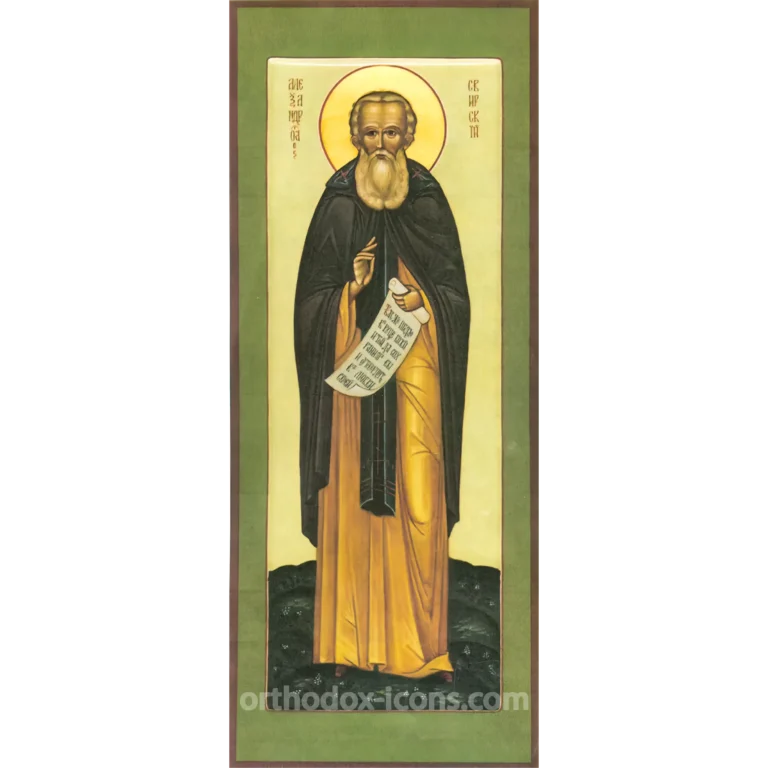
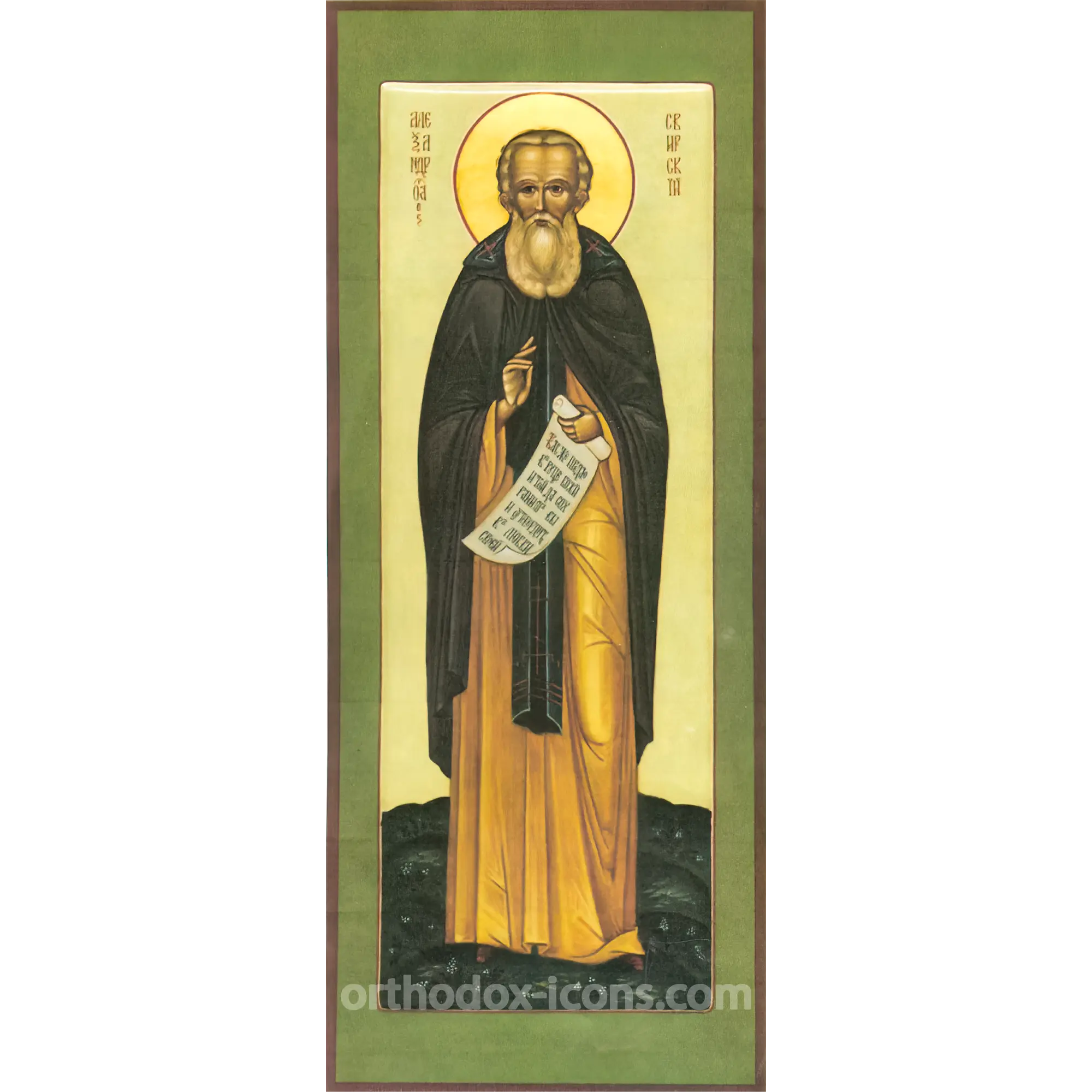
Alexander of Svir Icon is a hand-painted full-length icon of Venerable Alexander of Svir, a great Russian saint and visionary of the Holy Trinity. He is shown in a dark monastic mantle and light ocher inner robe. His right hand blesses the viewer, while his left hand holds an open scroll with spiritual instruction.
The icon is painted in a recessed kovcheg on a warm cream background with contrasting olive-green fields. Its restrained palette, dark mantle, green ground, and quiet composition reflect the ascetic character of Saint Alexander’s life.
Prayer focus: strengthening of faith, spiritual healing, consolation in serious illness, help for childless couples, deliverance from inner turmoil, and support in monastic or spiritual struggle.
Materials: wooden board with kovcheg, oak support slats, chalk gesso, egg tempera with natural mineral pigments, and protective oil or varnish.
It is possible to paint an image in any size to order
Free shipping worldwide
Alexander of Svir Icon is a hand-painted Orthodox icon of Venerable Alexander of Svir, one of the most remarkable saints of the Russian land. In Orthodox tradition he is especially remembered as a seer of the Holy Trinity, to whom the Trinity was revealed visibly, as once to the patriarch Abraham in the Old Testament. This full-length icon is painted in a strict and restrained palette, without a golden background, which quietly emphasizes the saint’s asceticism, humility, and life of prayer.
Saint Alexander is shown standing full-length in monastic garments. His right hand is raised in blessing, and his left hand holds an open scroll with spiritual instruction. The warm cream background, olive-green fields, dark monastic mantle, light ocher robe, and hilly green ground create a clear, sober, and deeply prayerful composition. This icon is intended not for decorative luxury, but for spiritual concentration, consolation, and remembrance of a life wholly given to God.
Icon Characteristics
| Full name | Alexander of Svir Icon |
| Saint depicted | Venerable Alexander of Svir, Wonderworker |
| Iconographic type | Full-length monastic saint with blessing hand and open scroll |
| Board | Wooden icon board with kovcheg, oak support slats, pavoloka, chalk gesso |
| Painting technique | Egg tempera with natural mineral pigments |
| Color palette | Warm cream background, ocher halo, dark monastic mantle, light ocher robe, olive-green fields |
| Available sizes | 13×25 cm (5.1×9.8 in), 18×31 cm (7.1×12.2 in), 30×50 cm (11.8×19.7 in); iconostasis sizes by request |
Who This Icon Is For
The icon of Alexander of Svir holds a special place in Orthodox devotion as an image of a saint to whom people turn in very difficult circumstances. It is often chosen for those who are seriously ill, for families asking for children, for people seeking spiritual strengthening, and for those who need consolation in long trials.
The icon is also a meaningful patron saint image for men and boys named Alexander. It may be given for baptism, name day, patron saint day, birthday, monastic tonsure, or another important spiritual occasion. Because Saint Alexander of Svir was a great monastic elder, his icon is also appropriate as a gift for monks, clergy, seminarians, and people who have chosen a life of prayer or church service.
For a home icon corner, hospital room, monastery cell, chapel, or church, this image speaks with a quiet and ascetic strength. It does not rely on external splendor. Instead, it directs attention to prayer, repentance, patience, and the hope of God’s mercy.
Prayer Before the Icon of Alexander of Svir
During his life and after his repose, Venerable Alexander of Svir became known for many instances of prayerful help. Orthodox Christians ask his intercession in illness, childlessness, spiritual confusion, inner turmoil, and the struggle to remain faithful to God. Such prayer should be understood with humility: healing and help come from God, while the saint intercedes before Him.
Common prayer intentions before this icon include:
- consolation and strength in serious bodily illness;
- help for childless couples and prayer for the gift of children;
- spiritual healing, peace of mind, and deliverance from inner turmoil;
- support in monastic life and spiritual struggle;
- help in choosing the right path in life;
- strengthening of weak faith, patience, and hope.
An Orthodox icon is not a charm or a replacement for responsible care. Prayer before the icon of Saint Alexander of Svir is a turning to God through the intercession of a venerable saint whose life was marked by silence, ascetic labor, prayer, and trust in divine mercy.
Brief Life of Venerable Alexander of Svir
Saint Alexander, whose birth name was Amos, was born in 1448 in the Novgorod region into a pious peasant family after the long prayers of his parents for a child. From youth he was gentle, loved prayer, and avoided noisy amusements. When he learned that his parents wished him to marry, he secretly left home and went to Valaam, where he received monastic tonsure at the age of twenty-six with the name Alexander.
After thirteen years of strict ascetic life on Valaam, Alexander withdrew by divine revelation into the remote forests near Lake Roshchinskoye, not far from the River Svir. There he built a small cell and lived in solitude. According to his life, for seven years he remained alone, eating only forest herbs and berries. Because of such severe fasting he became gravely ill, but an angel appeared to him and healed him.
Word of the holy hermit spread through the surrounding area, and monks began to gather around him. In 1508, in the twenty-third year of his desert life, Alexander of Svir was granted a wondrous vision: the Holy Trinity appeared to him in the form of Three Men in radiant garments. The Trinity commanded him to build a church and establish a monastery, which he faithfully did, becoming its first abbot.
Even as abbot, Alexander remained an example of extreme humility. He wore patched clothing, slept on the bare floor, chopped wood, carried water, and prepared food for the brethren. He reposed peacefully in the Lord in 1533. In 1641 his relics were found incorrupt, and to this day they are venerated in the Alexander-Svirsky Monastery as a great wonder of Orthodox tradition.
Commemoration Days
The Orthodox Church commemorates Venerable Alexander of Svir on September 12, the day of his repose, and on April 30, the day of the finding of his incorrupt relics. These dates may be considered when choosing a patron saint icon for a man named Alexander, or when preparing a gift for a monastery, church, chapel, or Orthodox family.
Features of the Presented Icon
This icon is painted in the restrained spirit associated with northern Russian iconography. It has no richly gilded background or excessive decorative elements. This restraint helps the person praying focus not on outward beauty, but on the inner spiritual meaning of the image.
The saint is shown inside a recessed kovcheg, painted in a soft cream shade like ivory. The warm background suggests quiet spiritual light and peace. The full-length figure rises against broad olive-green fields. The contrast between the dark monastic garment, light background, and green fields makes the composition clear and readable. The halo around the saint’s head is warm ocher and may be gilded according to the selected finish.
Iconography: Monastic Garments and Scroll
Venerable Alexander is shown full-length. His face, painted according to the canons of tempera iconography, conveys the features of a deep elder: a high forehead, hollow cheeks, a strict gaze, and a long gray beard narrowing downward. The ascetic appearance reflects decades of fasting, prayer, solitude, and spiritual labor.
The saint is clothed in traditional monastic garments. He wears a dark, almost black, broad mantle falling in heavy folds to his feet. Small red crosses are shown on the collar. Beneath the mantle appears a light ocher robe, and a dark epitrachelion descends from the neck. His head is uncovered, a feature often found in icons of Russian saints, emphasizing his direct prayerful standing before God.
The right hand of Alexander of Svir is formed in a blessing gesture addressed to the viewer. In his left hand he holds an open white scroll. The text on the scroll traditionally contains the elder’s spiritual instruction to his monastic brethren, calling them to purity of soul and body, humility, and sincere love. Beneath his feet is a stylized green ground with small light strokes, symbolizing transformed earth and the path of spiritual ascent.
Materials and Icon-Painting Technique
The creation of this icon is a careful manual process rooted in the traditions of Russian icon painting. The base is a solid wooden board, usually linden, with a carved kovcheg on the front. Oak support slats are inserted into the back to help protect the board from warping.
The surface is covered with pavoloka and layers of chalk gesso made with animal glue. The gesso is carefully sanded to create a smooth ground. The image is painted in egg tempera, using natural mineral pigments such as ocher, umber, glauconite, and cinnabar. This technique gives the colors density, depth, and long life.
After the painting is complete, the icon is covered with natural linseed drying oil or a restoration-grade protective varnish. This deepens the colors and helps protect the painted surface from moisture and dust.
How to Choose the Size
The 13×25 cm (5.1×9.8 in) size is a narrow full-length format. It is suitable for a small prayer space, personal cell, bedside icon, or for bringing the icon to a hospital room when spiritual support is needed.
The 18×31 cm (7.1×12.2 in) size is a classic and popular format. It gives the iconographer enough space to paint the saint’s face, the folds of the mantle, and the text on the scroll clearly. It is a strong option for a home icon corner.
The 30×50 cm (11.8×19.7 in) format is a large full-length size. On such a board the figure of the saint appears especially monumental. It is appropriate for a church, chapel, monastery, or as a donation to a parish. Iconostasis sizes are painted by individual measurements.
Care for a Hand-Painted Icon
An egg tempera icon requires careful treatment. The wooden board should not be placed above radiators, near fireplaces, or on a wall exposed to direct sunlight. Sharp changes in temperature and humidity can damage the board and painted surface.
The icon must not be washed with water, wiped with damp cloths, or cleaned with chemicals. Dust should be removed only with a dry very soft brush. The best way to protect the icon is to keep it in a glazed wooden kiot.
Free international shipping is included. Payment is made after you receive and approve the icon.
Questions and Answers
Why does this icon not have a gold background?
The restrained cream and olive palette emphasizes the ascetic humility of Venerable Alexander of Svir, who avoided worldly luxury.
What is written on the scroll?
The scroll traditionally contains spiritual instruction to the monastic brethren, calling them to purity, humility, and sincere love.
Are the relics of Saint Alexander of Svir incorrupt?
Yes. In Orthodox tradition, his relics are venerated as incorrupt and are considered one of the great wonders connected with the saint.
What is special about the vision of the Holy Trinity?
Saint Alexander of Svir is known in Orthodox tradition as a New Testament saint who was granted a visible vision of the Holy Trinity in the form of Three Men in light.
Do Orthodox Christians pray to Saint Alexander of Svir about infertility?
Yes. Many faithful ask his intercession for the gift of children, remembering that Saint Alexander himself was born after his parents’ long prayers.
What do the red crosses on the mantle mean?
The red crosses on the monastic garment signify bearing the cross of monastic life and enduring sorrows for Christ.
Why is the saint shown thin and ascetic?
The icon reflects his life of severe fasting, solitude, prayer, and spiritual struggle. The open forehead and strict face point to eldership and wisdom.
Can this icon be given to laypeople?
Yes. It is suitable not only for monks, but also for Orthodox families, people named Alexander, and those seeking prayerful support in difficult circumstances.
What is the green ground under the saint’s feet?
The stylized ground, or pozem, symbolizes the transformed earth and the difficult path of spiritual ascent.
Does egg tempera fade over time?
Properly cared for, egg tempera made with natural pigments is very durable and can preserve its depth and color for many generations.
| Dimensions | 13x25cm (5.1×9.8 in), 18x31cm (7.1×12.2 in), 30x50cm (11.8×19.7 in) |
|---|---|
| Name | Alexander |