Orthodox Icon of the Merciful Christ
$900
17×21 cm (approx. 6.7 x 8.3 inches)
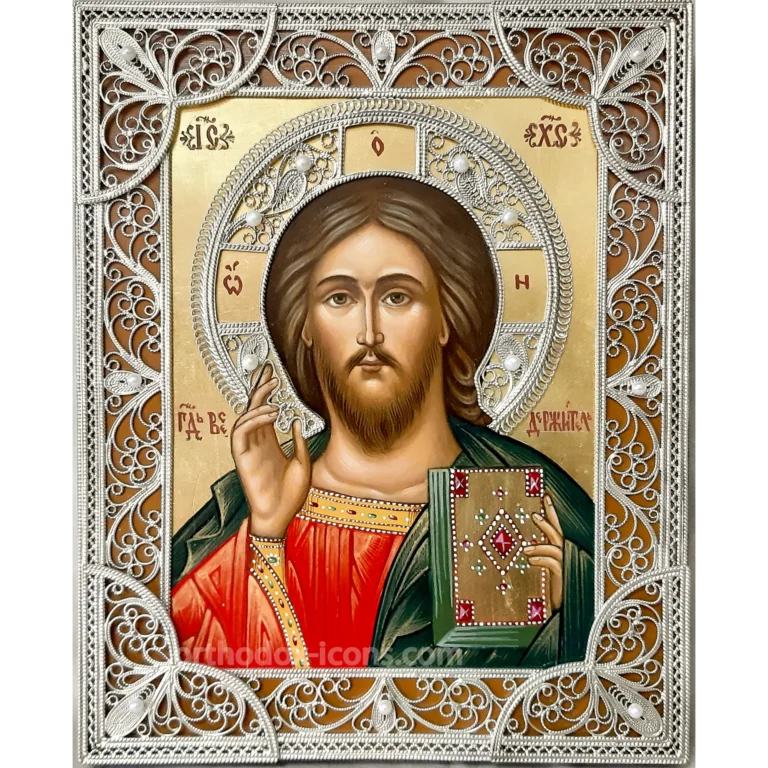
The Icon of the Savior in a skan (filigree) oklad is a solemn image of Christ Pantocrator (The Almighty), executed in a combination of traditional iconography and an elegant filigree oklad made of cupronickel. Such an image is chosen for a home iconostasis, daily prayer, a church gift, and for a larger church space. The icon is created on a natural linden wood board with oak splines and a kovcheg (recess), on chalk levkas (gesso), using mineral egg tempera, and is gilded with 23-karat (960 standard) gold leaf. The decorative cupronickel filigree oklad gives the image special solemnity and nobility. The openwork silvery filigree, pearl inserts, gold background, red-ochre garments of the Savior, and dark green himation create a rare combination of spiritual strictness, festivity, and artistic expressiveness.
Production time for a filigree (skan) icon: 2 months.
It is possible to paint an image in any size to order
Free shipping worldwide
The Icon of the Savior in a filigree (skan) oklad is one of the most solemn and spiritually significant images for an Orthodox home, uniting the canonical iconography of Christ Pantocrator, traditional hand-painted techniques, and exquisite decorative framing. Before such an image, a believer turns to Christ as the Lord, Teacher, Merciful Savior, and Source of truth. The icon is particularly appropriate for a home iconostasis, for constant personal prayer, for a family blessing, and as a worthy church gift for a baptism, housewarming, anniversary, or other important spiritual event. The cupronickel filigree oklad makes the image especially festive and noble, emphasizing its church solemnity and turning the icon into a genuine family heirloom.
Briefly About the Icon
- Name: Icon of the Savior in a Filigree (Skan) Oklad
- Iconographic Meaning: Christ as the Lord Almighty (Pantocrator), Teacher of truth, Merciful Savior, and Judge
- Framing Feature: Skan (filigree) oklad made of cupronickel
- Purpose: For the home, daily prayer, family iconostasis, gifts, churches, and iconostases
- Available Sizes: 17×21 cm (6.7×8.3″) and larger, up to custom iconostasis sizes
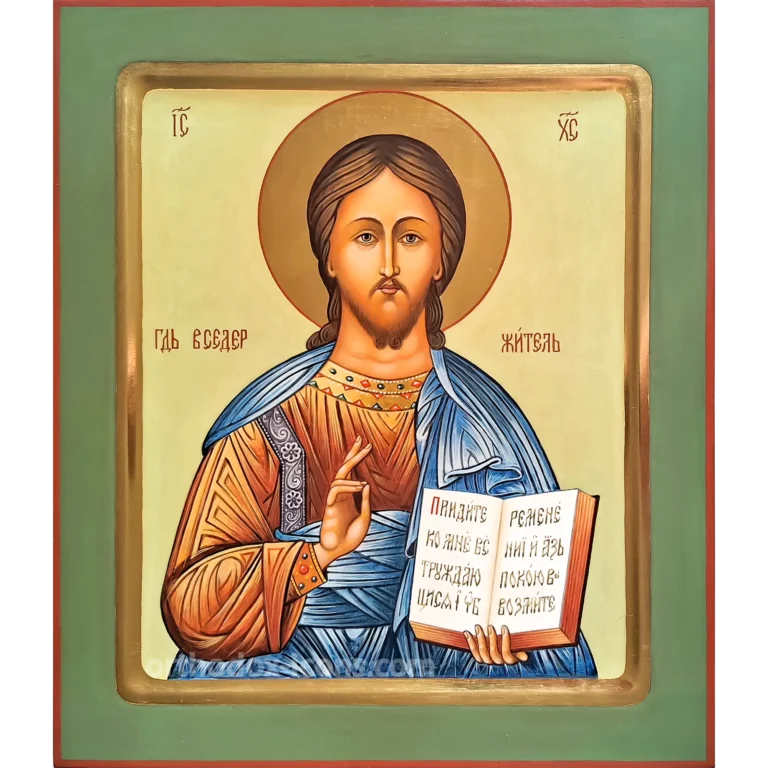
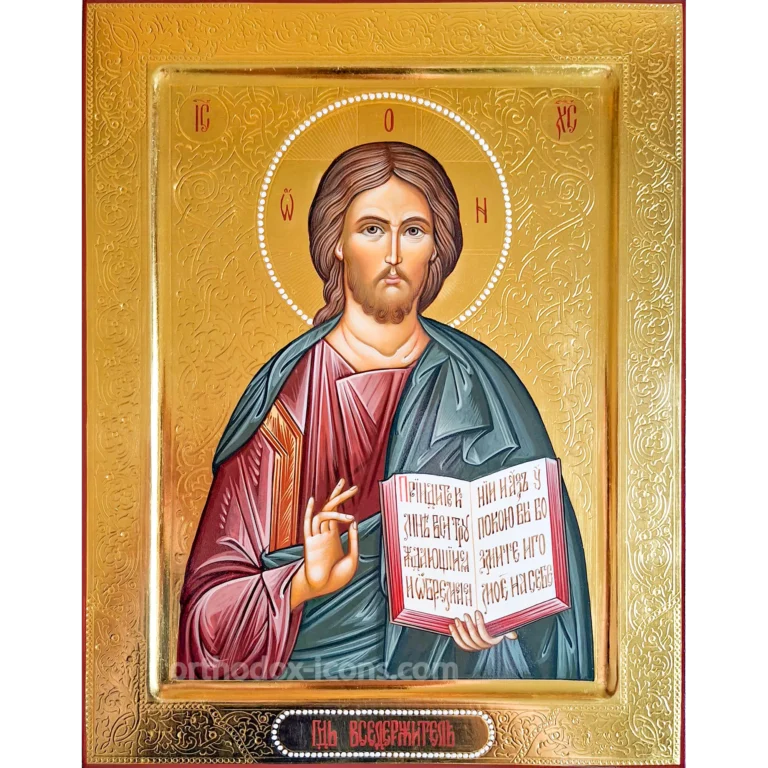
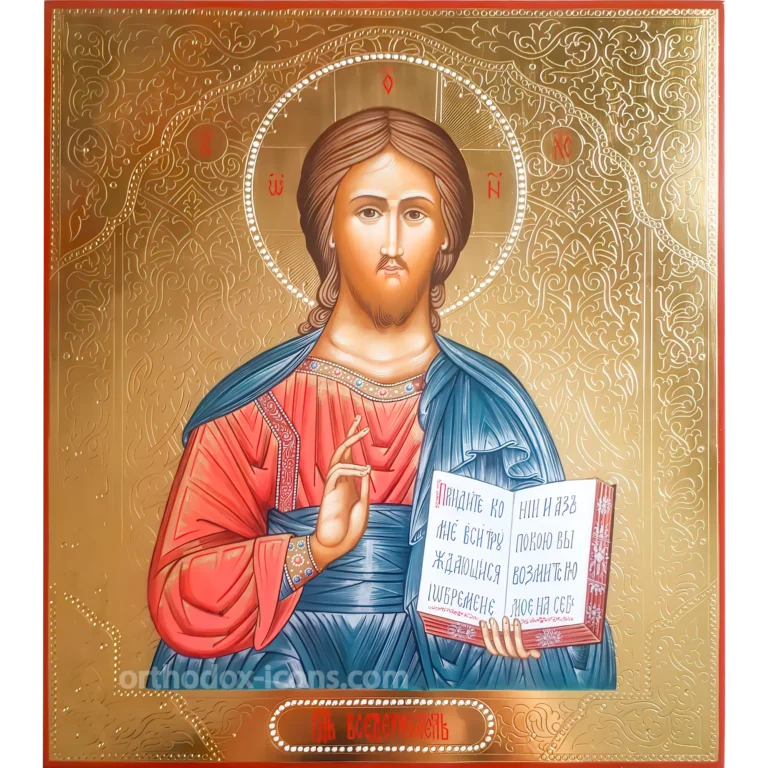
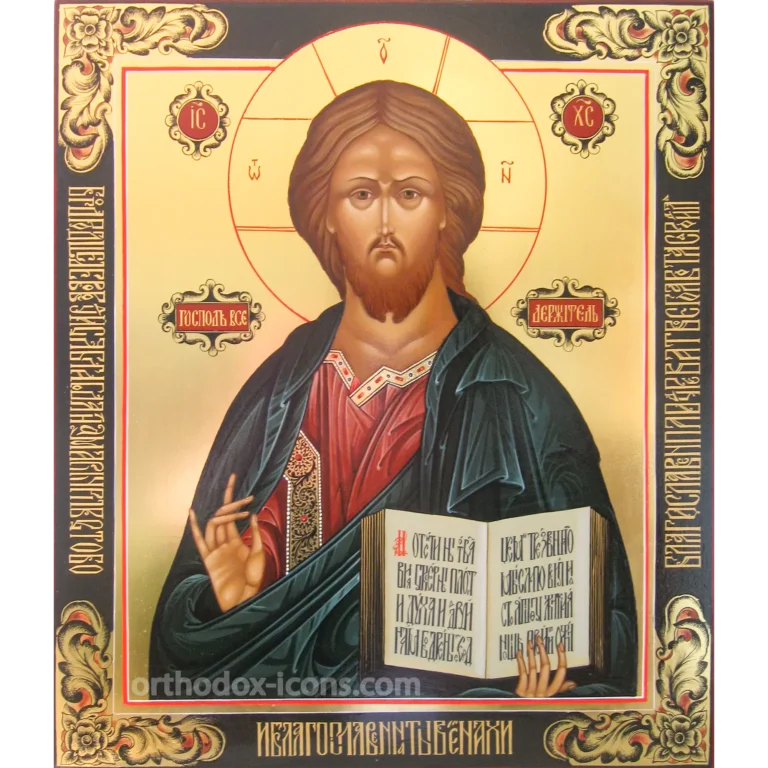
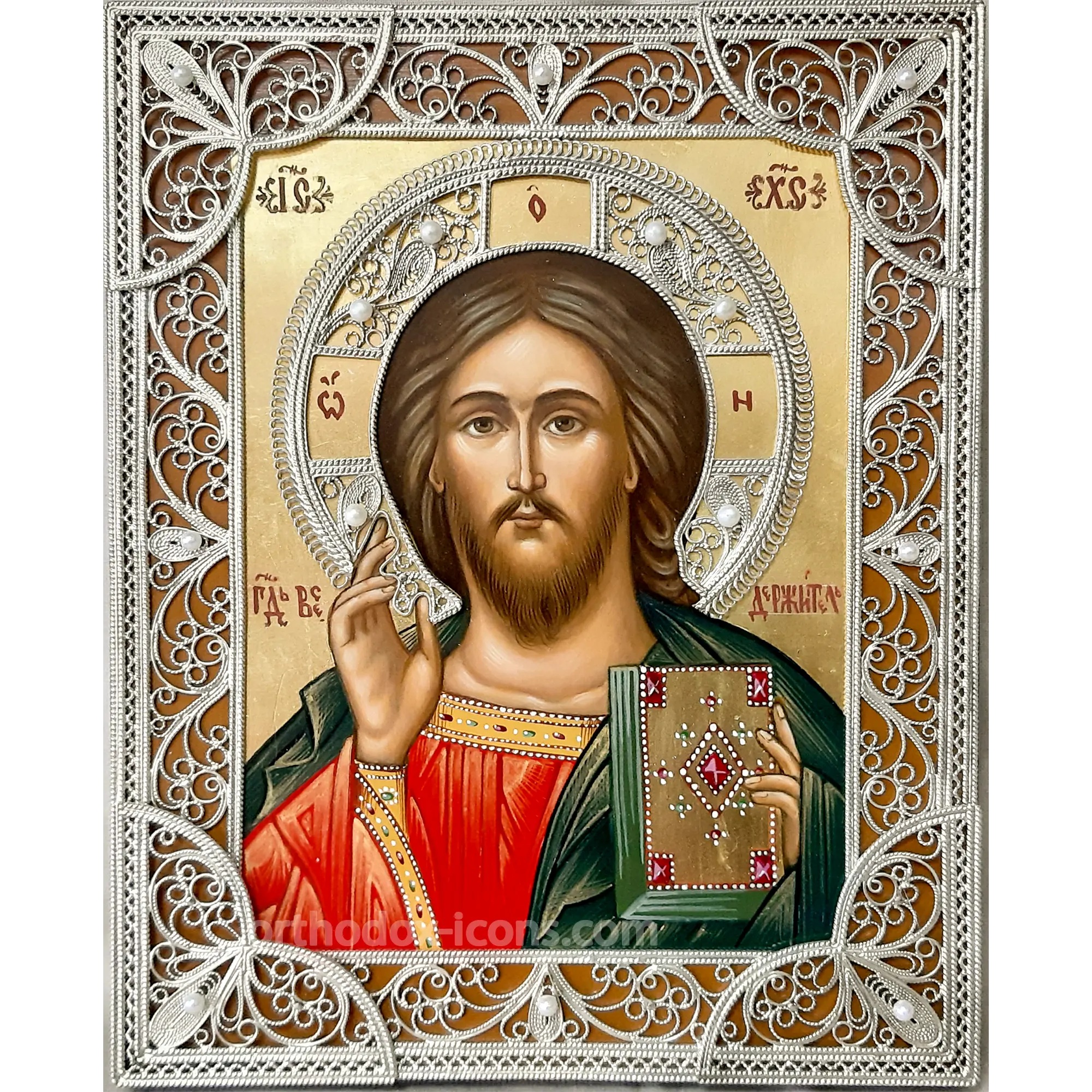
The presented image immediately attracts attention with its rare combination of strict canonical clarity and decorative solemnity. The central face of Christ is painted softly and nobly, with a direct, attentive gaze that is perceived simultaneously as peaceful, merciful, and spiritually demanding. With His right hand, the Savior gives a blessing, while in His left, He holds a closed Gospel in a precious binding, emphasizing His dignity as the Heavenly Teacher and Lord of the world. The face is surrounded by a bright golden halo, around which an especially expressive cupronickel filigree crown with delicate openwork and pearl inserts is placed, enhancing the festive resonance of the image.
The external filigree oklad deserves special attention. Its silvery openwork pattern is built on fine scrolls, interlacings, floral motifs, and ornamental arcs that create an impression of airiness and precious manual labor. Pearl inserts are placed in the corners and along the perimeter of the oklad, thanks to which the image acquires an even more solemn and majestic character. Against the background of the warm golden field, the red-ochre chiton of the Savior and the dark green himation are revealed particularly vividly, and the combination of gold, silvery filigree, and rich color accents makes the icon truly festive and deeply ecclesiastical.
Such an icon is suitable not only for personal prayer but also for those cases when the image is intended to become the visible center of a home iconostasis. The cupronickel filigree oklad gives the icon a special nobility and makes it noticeable even in a large space. At the same time, the artistic expressiveness does not distract from what is most important: before us is not a decorative object, but the holy image of Christ, before whom people pray for peace of heart, help in difficulties, forgiveness, the protection of the home, and fidelity to the Gospel.
History of the Image of the Savior in the Orthodox Tradition
The image of the Savior has occupied a central place in Orthodox iconography since ancient times. This is connected with the very foundation of the Christian faith: the Son of God became incarnate, became a man, lived among people, preached, suffered, resurrected, and opened the path to salvation. That is why the Orthodox icon of Christ is not just a pious depiction, but a testimony to the reality of the Incarnation. If the Lord truly became a visible man, it means His holy image can be conveyed in iconography and venerated by believers.
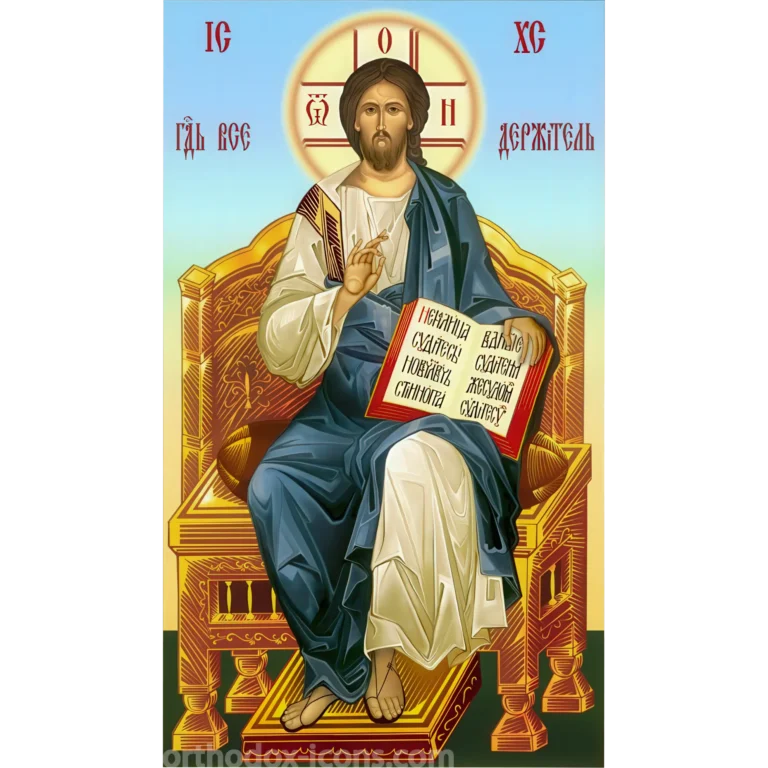
In the Byzantine tradition, the main iconographic types of the Savior gradually took shape: Pantocrator (The Almighty), the Savior Enthroned, the Image Not-Made-By-Hands (Mandylion), and full-length or half-length depictions of Christ. All these variants express different aspects of a single truth. Christ is the Lord of the world, Judge, Teacher, and Source of mercy and spiritual truth. In the Russian icon-painting school, the image of the Savior received special development and became the mandatory center of both church and home iconostases.
In Russia, people prayed before the image of the Savior daily: in the morning and evening, before a journey, before an important task, in illness, in sorrow, and in thanksgiving. It was considered the main image of the “beautiful corner” (Krasny Ugol) because the entire life of an Orthodox person should be oriented toward Christ. Even when the home iconostasis was very small, the image of the Savior was almost always present in it as the spiritual center. That is why today, the icon of Christ remains one of the most necessary and highly venerated in an Orthodox home.
Why the Image of the Savior is Especially Important
- It is the central image of the home and church iconostasis;
- It reminds us of Christ as the Source of truth, mercy, and salvation;
- People pray before it in the most important life circumstances;
- It helps to build spiritual life in the light of the Gospel.
Theological Meaning of the Icon of the Savior in a Filigree Oklad
The main theological meaning of this icon lies in the manifestation of Christ as the Lord Almighty, Teacher, and Savior of the world. Before us is the image not just of a righteous mentor, but of the God-Man Himself, Who came for the sake of humanity’s salvation. The blessing gesture of the right hand indicates that Christ grants mercy, peace, and grace-filled help. He blesses not merely externally, but genuinely participates in a person’s life if they turn to Him with faith.
The closed Gospel in the Savior’s hand emphasizes His dignity as the Bearer of Divine teaching and the guardian of truth. This is a sign of the law of love, wisdom, spiritual guidance, and judgment according to truth. Christ judges the world not by human caprice, but by the truth of the Gospel. That is why the image of the Savior always reminds us of both mercy and humanity’s inner responsibility before God.
The filigree oklad itself also holds special theological significance. In the Orthodox tradition, the oklad does not replace the icon and is not an external decoration for the sake of luxury. It emphasizes the holiness of the image, the reverence for it, and the church’s understanding of the icon as a precious shrine. The silvery filigree, crafted from cupronickel, and the pearl inserts around the face and along the edges of the image do not distract from Christ, but heighten the sense of solemnly standing before Him. Combined with the gold background and the painted face, this creates an impression of glory, light, and spiritual significance.
Thus, the icon of the Savior in a filigree oklad unites several important meanings: Christ as the center of spiritual life, the Gospel as truth, the blessing as a sign of God’s mercy, and the oklad as an expression of the church’s veneration of the holy image. Therefore, such an icon is especially valuable for those who want to have in their home not just a traditional image, but a truly solemn and spiritually saturated shrine.
What to Pray for Before the Icon of the Savior
Before the icon of the Savior in a filigree oklad, people pray for peace of heart, guidance, help in life’s trials, family blessings, protection of the home, the health of loved ones, repentance, and spiritual steadfastness. This is one of the most universal and deeply personal images for daily prayer. Before it, one can offer thanksgiving, requests for help, and share their most intimate experiences.
Most often, believers turn to the image of the Savior with prayers:
- For guidance and wisdom in difficult circumstances;
- For peace of heart and deliverance from anxiety;
- For the forgiveness of sins and correction of life;
- For the protection of the home, family, and loved ones;
- For a blessing upon labor, travel, and important undertakings;
- For help in illnesses, sorrows, and spiritual trials;
- For fidelity to Christ and the Gospel in everyday life.
Such an icon is especially appropriate in a family iconostasis because it not only adorns the prayer corner but also gives it an inner center. People pray before it morning and evening, before a journey, before a serious conversation, on days of anxiety, and on days of gratitude. The image of Christ reminds the whole family that true peace in the home begins with a living connection to the Savior.
When it is Especially Appropriate to Choose this Icon
- For a home iconostasis and daily prayer;
- As a gift for a baptism, housewarming, anniversary, Name Day, or other spiritual event;
- For family prayer and the blessing of the home;
- For a chapel, church, and iconostasis in a larger size;
- As a solemn image of the Savior with noble filigree framing.
Artistic Features of the Presented Image
The presented icon is distinguished by a particularly expressive combination of a painted image and decorative filigree. The central face of the Savior is painted softly and nobly: the warm tones of the face, the calm direct gaze, and the delicate modeling of the hair and beard create a sense of peace, strength, and inner composure. The red-ochre chiton with golden trim and the dark green himation give the figure solemnity and depth, while the closed Gospel in Christ’s hand emphasizes the teaching and authoritative character of the image.
The silvery cupronickel filigree oklad plays a special artistic role here. The openwork scrolls and interlacings framing the image resemble the finest jewelry lace. The corners of the oklad are resolved especially beautifully, where large floral motifs and smooth arcs create a sense of richness and festive lightness. The round crown around the halo with pearl inserts makes the face of the Savior even more focused and solemn.
The gold background and warm ochre areas of the painting harmonize very well with the cool luster of the cupronickel filigree. Thanks to this, a rare artistic balance arises: the icon looks festive and elegant but does not lose its strictness and depth. Visually, this is an image that is equally well-perceived in a home iconostasis and in a more solemn church space.
Technology of Icon Creation
The base of the icon is created from a natural linden wood board. Linden is traditionally considered one of the best materials for iconography due to its smooth structure, stability, and ability to securely hold the primer and paint layers. To reinforce the board, oak splines are used, which help maintain the geometry of the piece and reduce the risk of deformation over time. In the central part, a kovcheg (recess) is formed—a traditional depression that highlights the sacred space of the image.
After preparing the base, levkas (gesso) is applied—a multi-layered primer that creates a strong, even, and bright surface for painting. Next, the icon is painted using mineral egg tempera. This iconography technique allows for achieving noble color, delicate chiaroscuro, clarity of lines, and the longevity of the image. For gilding, 23-karat (960 standard) gold leaf is used. In this image, gold is especially important, as it forms the background and helps reveal the solemn spiritual resonance of the icon.
A special feature of this icon is the filigree (skan) oklad, which is made of cupronickel. Skan represents delicate openwork crafted from decoratively laid metal elements resembling exquisite lace. Combined with pearl inserts and a gold background, such an oklad makes the icon particularly elegant, festive, and representative. At the same time, the oklad does not replace the painting but emphasizes and enhances the veneration of the holy image. That is why the icon of the Savior in a filigree oklad is especially valued as a solemn and enduring shrine.
Icon Characteristics Table
| Parameter | Description |
|---|---|
| Name | Icon of the Savior in a Filigree (Skan) Oklad |
| Iconographic Meaning | Christ as the Lord Almighty, Teacher, Merciful Savior, and Judge |
| Framing Feature | Skan (filigree) oklad made of cupronickel |
| Main Spiritual Focus | Prayer to Christ, living according to the Gospel, blessing, and peace of heart |
| Base | Natural linden wood board |
| Board Reinforcement | Oak splines |
| Construction | Kovcheg (recess) |
| Primer | Chalk levkas (gesso) |
| Painting | Mineral egg tempera |
| Gilding | 23-karat (960 standard) gold leaf |
| Oklad | Skan (filigree) made of cupronickel |
| Sizes | 17×21 cm and larger, up to custom iconostasis sizes |
| Purpose | For the home, family, gift, chapel, church, and iconostasis |
Why This Image is Especially Significant for the Home and Family
The icon of the Savior in a filigree oklad is especially important for the home because it combines two levels of value. On the one hand, it is the main image of Christ for daily prayer, for asking for help, for repentance, and for thanksgiving. On the other hand, thanks to the cupronickel filigree oklad and its solemn execution, it becomes a particularly noticeable shrine that can take the central place in the family iconostasis.
The size of 17×21 cm and larger makes the icon suitable for both a small home “beautiful corner” and a larger prayer space. The possibility of execution in iconostasis sizes allows this image to be used in a church interior as well. Such an icon can become not only a personal prayer image but a true family heirloom, passed down from generation to generation as a sign of faith, blessing, and spiritual continuity.
Advantages of the Choice
- One of the main images of the Savior for a home iconostasis;
- Solemn decoration with a filigree oklad made of cupronickel;
- Openwork silvery filigree and pearl inserts enhance the festivity of the image;
- Suitable for daily prayer, a gift, the home, a church, and an iconostasis;
- Traditional technology: linden wood, oak splines, kovcheg, levkas, tempera, gold leaf;
- Availability of sizes from 17×21 cm and larger, including iconostasis formats.
Frequently Asked Questions (FAQ)
1. What does the icon of the Savior in a filigree oklad mean?
This is the image of Christ as the Lord Almighty, Teacher, Merciful Savior, and Judge, framed by a solemn filigree (skan) oklad.
2. What do people pray for before the icon of the Savior?
Before it, people pray for guidance, peace of heart, forgiveness of sins, protection of the family, help in difficult circumstances, and the strengthening of faith.
3. Is such an icon suitable for a home iconostasis?
Yes, this is one of the main and most appropriate images for a home iconostasis and daily prayer.
4. What is the filigree oklad made of?
The filigree (skan) oklad is made of cupronickel (melchior).
5. What does the oklad add to the icon in a spiritual and artistic sense?
It emphasizes solemnity, reverent veneration of the image, and makes the icon especially festive and expressive.
6. What makes the presented image stand out visually?
It stands out with its openwork silvery filigree, pearl inserts, gold background, the red-ochre garments of the Savior, and the dark green himation.
7. What is the base of the icon made of?
The base is made of a natural linden wood board, reinforced with oak splines, and features a traditional kovcheg (recess).
8. What materials are used to paint the image?
The icon is created on levkas using mineral egg tempera, and the gilding is executed with genuine 23-karat (960 standard) gold leaf.
9. What sizes are available for order?
Sizes starting from 17×21 cm and larger are available, as well as monumental iconostasis sizes.
10. What spaces is this icon suitable for?
It is suitable for the home, a family iconostasis, a chapel, a church, an iconostasis, and as a highly significant church gift.
| Dimensions | 17x21cm (6.7×8.3 in) |
|---|---|
| Name | Jesus |