Filigree Icon of Tikhon
$950
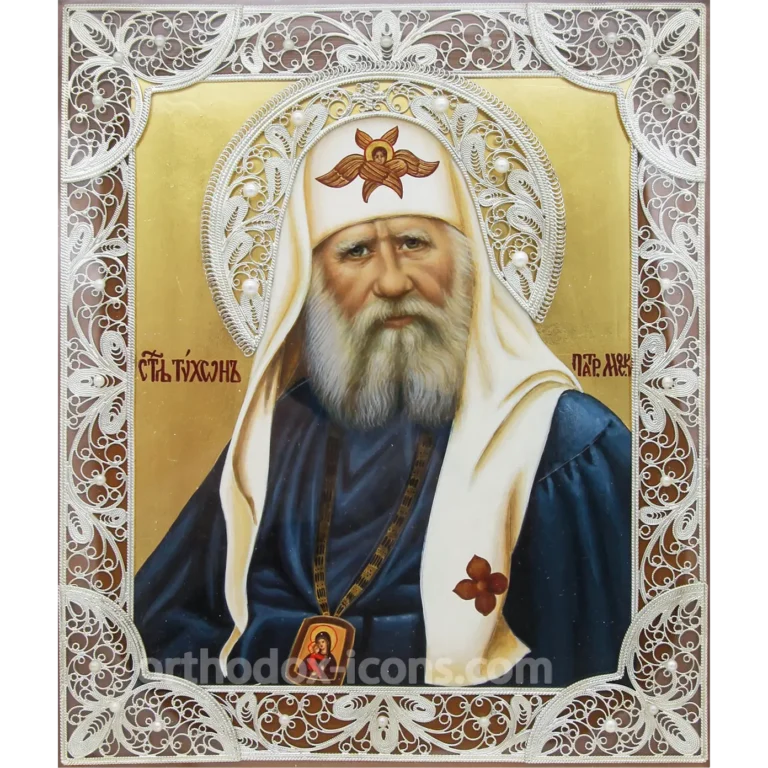
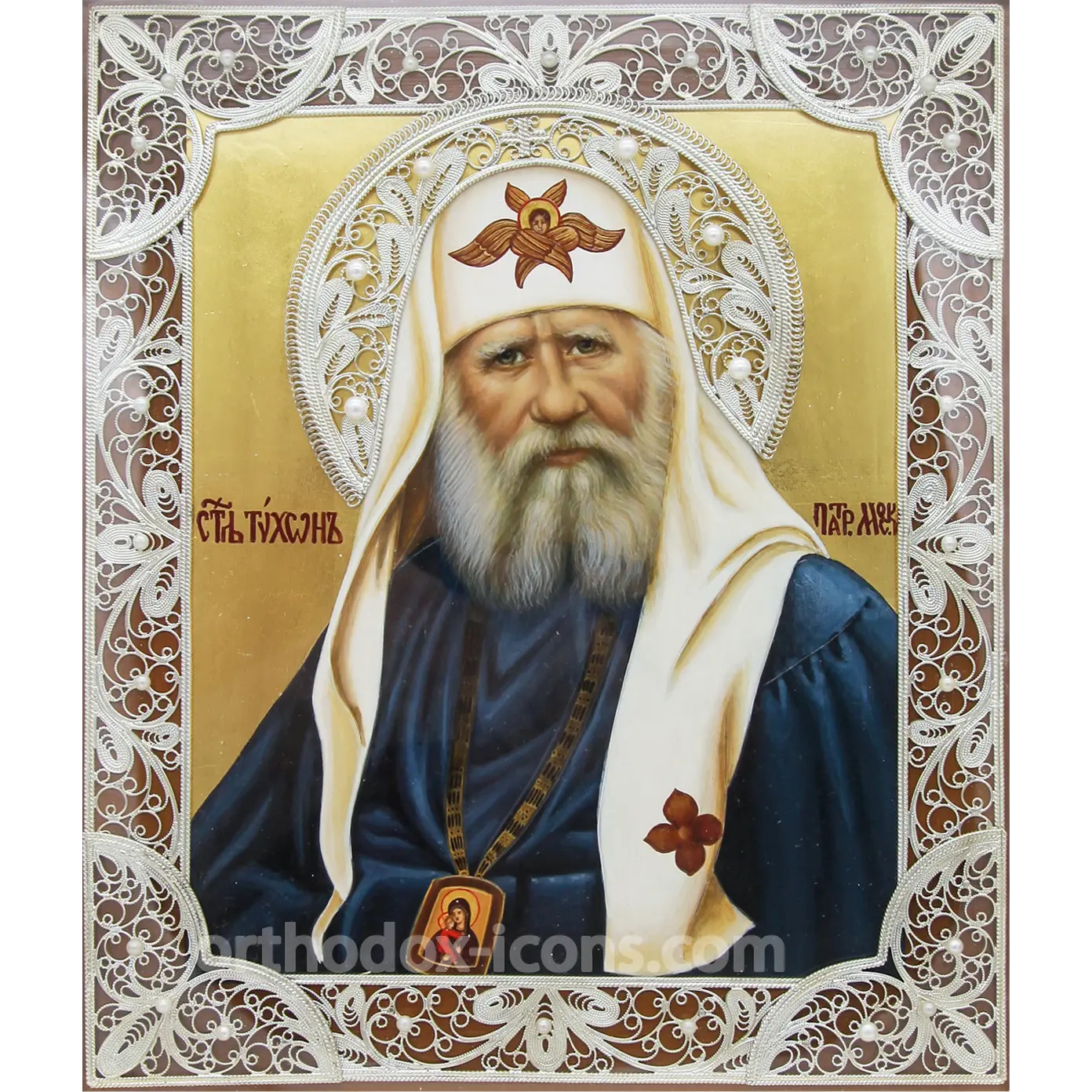
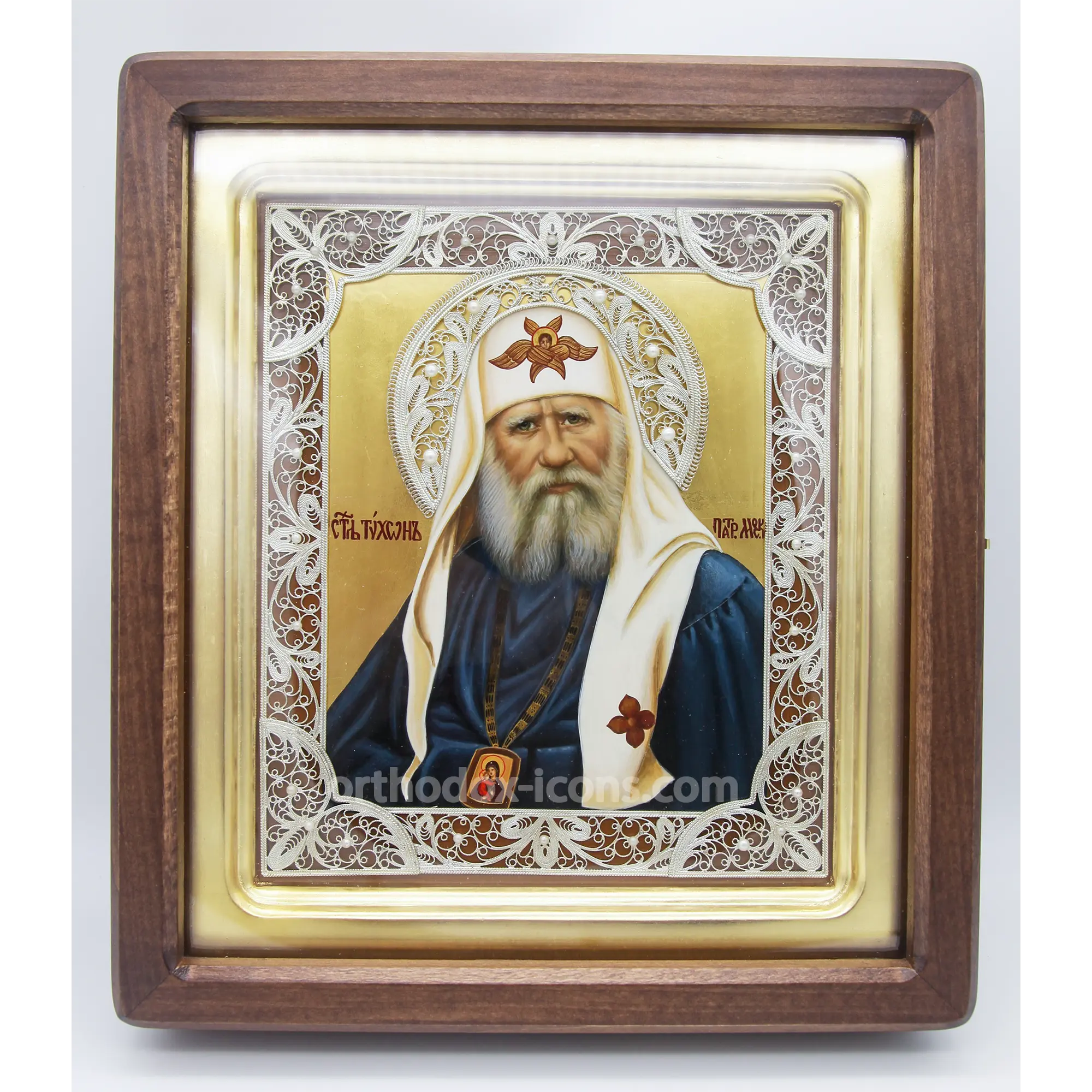
Filigree Icon of Tikhon is a hand-painted icon of Saint Tikhon, Patriarch of Moscow and All Russia, in a metal filigree revetment. The saint is shown waist-length in a white patriarchal koukoulion, dark vestments, and panagia, with a gold background and delicate filigree ornament around the fields and halo.
Available size: 17×21 cm (6.7×8.3 in). Larger and iconostasis sizes can be made by agreement.
The icon is painted on a linden board with egg tempera, natural gesso, 23K gold leaf (960 purity), metal filigree, pearl-like decorative inserts, and a protective finish. Production time for a filigree icon is about 2 months. Free international shipping is included. Payment is made after you receive and approve the icon.
It is possible to paint an image in any size to order
Free shipping worldwide
Filigree Icon of Tikhon is a hand-painted icon of Saint Tikhon, Patriarch of Moscow and All Russia, in a metal filigree revetment. Saint Tikhon’s ministry fell during one of the most difficult periods in the history of the Russian Orthodox Church. He is venerated as a wise primate, confessor of the faith, pastor, intercessor, and hierarch who remained faithful to Christ and the Church in years of turmoil, persecution, public upheaval, and spiritual trial.
In this icon, Saint Tikhon is shown waist-length in patriarchal vestments. His face is painted softly and attentively. The gaze is turned toward the person praying, yet it is not externally severe; it conveys inward pain, spiritual maturity, pastoral care, and quiet dignity formed through suffering. The white patriarchal koukoulion, dark vestments, panagia with the image of the Mother of God, and gold background emphasize his high church rank, while the filigree revetment gives the icon a solemn and commemorative character.
The filigree revetment is an important part of the artistic design of this icon. Openwork metal filigree frames the fields, corners, and halo area, creating a light, lace-like ornament. White decorative inserts resemble pearls and strengthen the festive character of the image. At the same time, the revetment does not cover the painted face or distract from the prayerful center; it works as a precious frame, honoring the saint and the sacred image.
The available size is 17×21 cm (6.7×8.3 in). This format suits a waist-length image of Saint Tikhon well: the face, koukoulion, panagia, inscriptions, gold background, filigree halo, and border remain readable. Larger and iconostasis sizes can be made by agreement.
Icon Characteristics
| Name | Filigree Icon of Tikhon |
| Saint | Saint Tikhon, Patriarch of Moscow and All Russia |
| Iconographic type | Waist-length icon of a hierarch in patriarchal koukoulion, with panagia and filigree revetment |
| Commemoration days | April 7, October 9, and among the New Martyrs and Confessors of the Russian Church |
| Visible features | Patriarchal koukoulion, panagia, gold background, filigree revetment, filigree halo, pearl-like decorative inserts, Church Slavonic inscriptions |
| Available size | 17×21 cm (6.7×8.3 in); larger and iconostasis sizes by agreement |
Who This Icon of Saint Tikhon Is For
The icon of Saint Tikhon in a filigree revetment is suitable for a home icon corner, parish room, church, priest’s office, theological school, or a memorable Orthodox gift. The image is especially meaningful for those who carry responsibility for others: pastors, leaders, mentors, teachers, elders in the family, and people who must make difficult decisions in complicated circumstances.
Saint Tikhon is a heavenly patron for men named Tikhon. A named saint icon may be given for baptism, name day, birthday, ordination, anniversary, entrance into theological studies, or an important stage of life. For someone bearing this name, the icon becomes a personal sacred image before which he may pray for faithfulness to Christ, wisdom, patience, and spiritual firmness.
The filigree revetment makes this icon especially fitting as a solemn gift. The openwork metal decoration is perceived as a sign of reverence for the holy image and gives the icon a festive, churchly character. It may be presented to a church, priest, rector, parish community, family that especially venerates the New Martyrs and Confessors of Russia, or to a person seeking prayerful support in a time of trial.
For a church setting, the icon of Saint Tikhon can be made in a larger or iconostasis format. The image fits naturally among Russian hierarchs, patriarchs, confessors, new martyrs, and pastors of the twentieth century. In a larger execution, the filigree halo, fields, panagia, white koukoulion, and noble restraint of the face can be shown with greater expressiveness.
Prayer Before Saint Tikhon
Before the icon of Saint Tikhon, Orthodox Christians pray for stronger faith, preservation of peace, wisdom, patience, church unity, and firmness during trials. His earthly ministry was not connected with outward calm, but with severe historical circumstances in which a pastor needed courage, discernment, prayer, and deep faithfulness to the Church.
Prayer before Saint Tikhon may include requests for:
- strengthening of faith in difficult times;
- peace in the family, parish, community, and church life;
- wisdom for pastors, mentors, and leaders;
- steadfastness under pressure, fear, and injustice;
- help for clergy and church workers;
- protection from despondency, confusion, and spiritual coldness;
- faithfulness to Christ during external trials;
- discernment, patience, and the ability to make responsible decisions.
The prayerful meaning of Saint Tikhon’s icon is especially important for those living through change and uncertainty. Saint Tikhon reminds the faithful that Christian firmness is not the same as harshness, and spiritual authority should never become external pressure. His image speaks of pastoral love, patience, the ability to preserve peace, and the courage not to yield in what is essential: faithfulness to Christ and His Church.
Life of Saint Tikhon, Patriarch of Moscow
Saint Tikhon, born Vasily Ivanovich Bellavin, was born in the nineteenth century in the family of a priest. From youth he was connected with church life, received theological education, and entered monastic life with the name Tikhon. His service took place in different settings: he was a pastor, bishop, missionary, church leader, and a man who had to unite personal prayerfulness with great administrative responsibility.
His ministry in North America was especially important. There, Saint Tikhon cared for Orthodox parishes, supported church organization, encouraged missionary work, and strengthened community life. Later he continued episcopal service in Russia, and after the restoration of the patriarchate he was elected Patriarch of Moscow and All Russia.
Saint Tikhon’s patriarchal ministry fell during years of revolution, civil conflict, social division, and persecution of the Church. He sought to preserve church peace, protect holy places, support clergy and faithful people, and call all to repentance, mercy, and an end to violence. His word was the word of a shepherd who did not seek earthly triumph, but bore the cross of responsibility for the Church in an extremely difficult time.
Saint Tikhon endured pressure, isolation, accusations, and grief, yet he remained faithful to his patriarchal service. His witness is the witness of confession: he was not outwardly militant, but he was firm where faith, dignity, and the Church’s testimony had to be preserved. After his repose, Saint Tikhon became one of the central spiritual figures of the Russian Church in the twentieth century.
Commemoration Days of Saint Tikhon
Saint Tikhon, Patriarch of Moscow and All Russia, is commemorated on April 7, the day of his repose. October 9 is also observed as the day of his glorification among the saints. In addition, Saint Tikhon is honored in the Synaxis of the New Martyrs and Confessors of the Russian Church.
These dates are especially important for men named Tikhon, clergy, parishes, churches, and Orthodox families who venerate the saint as an intercessor for the Church and the Russian people. The icon may be ordered for a name day, ordination, parish feast, priest’s anniversary, blessing of a parish room, or a memorable date connected with church life.
If the icon is needed for a particular day, it is best to agree in advance on the size, filigree revetment, decorative treatment, icon case, and possible church format. A filigree revetment requires careful handwork, so timing and details should be discussed early, especially for a larger or iconostasis-size icon.
Features of This Hand-Painted Filigree Icon
In the presented icon, Saint Tikhon is shown waist-length in a white patriarchal koukoulion and dark vestments. The saint’s face occupies the central place. It is painted gently, with an attentive gaze and deep inward concentration. The strength of the image is not outward ceremony, but spiritual quietness, pastoral dignity, and confessional truth.
On the saint’s chest is a panagia with the image of the Mother of God. This detail points to episcopal and patriarchal service, and to the special prayerful standing of a pastor on behalf of the Church entrusted to him. The white koukoulion with the seraphim and cross emphasizes the patriarchal rank, while the dark blue vestment creates a restrained and deep background for the light figure of the saint.
The gold background gives the icon church solemnity. Against it, the white and silver-toned lines of the filigree revetment are especially expressive. Openwork filigree frames the icon around the perimeter, forming a complex floral and scroll ornament. A separate filigree treatment surrounds the halo, making the saint’s face the main prayerful center.
Pearl-like decorative inserts are placed on the fields and around the halo. They strengthen the beauty of the image without overloading the composition. Filigree has a sense of lightness: even with rich decoration, it leaves space, air, and brightness. As a result, the icon looks solemn but not heavy, preserving clarity for prayer.
Iconography: Patriarchal Koukoulion, Panagia, and Filigree Revetment
The patriarchal koukoulion is one of the main details of this icon. The white covering with the seraphim and cross points to the primatial service of Saint Tikhon. The white color is connected with purity, church dignity, and the special responsibility of the patriarch before God and the Church.
The panagia on the saint’s chest reminds the faithful that episcopal service is carried out under the protection of the Mother of God. For Patriarch Tikhon, this detail is especially meaningful because his life and ministry were bound to constant prayerful intercession for the Church during years of trial.
The filigree revetment in this icon is not merely decoration. The openwork metal ornament creates the image of a precious church frame expressing reverence for the saint. Unlike a closed revetment, filigree leaves the painted image visible and gives the icon lightness. Fine scrolls, floral elements, framing details, and pearl-like inserts form a space of beauty around the saint.
The gold background in icon painting is not simply a color choice. It points to the light of the Kingdom of Heaven and to the fact that the saint is shown not as a historical portrait, but as a glorified servant of God. Together with the white koukoulion, panagia, and filigree revetment, the gold background strengthens the solemn, confessional, and prayerful meaning of the image.
Materials, Filigree, and Custom Options
The icon of Saint Tikhon is painted on a solid linden board with oak splines. Linden is well suited to hand-painted icons because it allows a smooth surface to be prepared, supports delicate painting of the face, and holds a complex composition with gold background, halo, patriarchal vestments, and filigree decoration. Oak splines strengthen the board and help it keep its shape during natural changes in humidity and temperature.
The painting surface is prepared with natural chalk gesso. The image is painted in egg tempera, a traditional technique that allows the iconographer to convey the softness of the face, gray beard, white patriarchal koukoulion, dark vestment, panagia, Church Slavonic inscriptions, and fine color transitions. This execution uses a gold background, metal filigree on the fields and around the halo, and pearl-like decorative inserts.
The filigree revetment is the main artistic feature of this icon. It is made as openwork decorative framing from fine metal scrolls, floral motifs, border elements, and inserts. This type of revetment is already readable in the 17×21 cm (6.7×8.3 in) size; in a larger format, the complexity of the pattern, width of the fields, and solemnity of the halo can be developed more fully.
For an individual order, the size, character of the filigree revetment, icon case, background treatment, degree of decoration, inscriptions, and larger church execution can be discussed. Iconostasis sizes are selected separately according to placement, row height, lighting, neighboring icons, and the overall artistic order.
How to Choose the Size
The 17×21 cm (6.7×8.3 in) size is suitable for a home icon corner, office, personal prayer space, or compact named saint icon. In this format, the face of Saint Tikhon, white koukoulion, panagia, gold background, and overall pattern of the filigree revetment remain clear.
Larger sizes allow the artistic features to be shown in greater detail: the complex openwork revetment, filigree halo, pearl-like decorative inserts, softness of the face, texture of the white vestment, and inscriptions. Such an icon is appropriate for a spacious home, church, chapel, parish room, theological school, or memorial gift to a clergyman.
An iconostasis format is agreed individually. For church placement, the proportions of the row, distance from the faithful, lighting, neighboring icons, and overall iconostasis style should be considered. The icon of Saint Tikhon in a filigree revetment can be included among Russian hierarchs, patriarchs, confessors, and new martyrs.
Blessing and Care for a Filigree Icon
The icon of Saint Tikhon may be blessed in an Orthodox church after it is received, or brought to your parish for blessing. A blessed icon becomes a sacred image for prayer, thanksgiving, and turning to God through the intercession of the saint.
An icon with a filigree revetment requires especially careful handling. It should be kept away from direct sunlight, heaters, dampness, soot, and sudden temperature changes. Do not wipe the painted surface or filigree with wet cloths, alcohol, household chemicals, or abrasive materials.
Dust should be removed with a dry soft brush without pressure. Take special care around the openwork filigree, pearl-like inserts, gold background, face, panagia, and inscriptions. For additional protection, a wooden glazed icon case can be used. It helps protect the icon from dust, accidental touch, mechanical damage, and environmental influence, especially if the icon is intended for a church or a large home icon corner.
Questions and Answers
Who is shown on the Filigree Icon of Tikhon?
The icon shows Saint Tikhon, Patriarch of Moscow and All Russia, a confessor of the faith and one of the most venerated Russian hierarchs of the twentieth century.
Why is Saint Tikhon shown in a white patriarchal koukoulion?
The white patriarchal koukoulion identifies him as Patriarch of Moscow and All Russia and points to his primatial service and responsibility before God and the Church.
What does the panagia on Saint Tikhon’s chest mean?
The panagia is a sign of episcopal dignity. It recalls the bishop’s prayerful service and his standing before God under the protection of the Mother of God.
What is a filigree revetment?
A filigree revetment is an openwork metal ornament made from fine decorative elements. It frames the fields and halo while leaving the painted face and central image visible.
What do Orthodox Christians pray for before Saint Tikhon’s icon?
People pray for stronger faith, peace in the Church and family, wisdom, patience, courage under pressure, and help for pastors, mentors, and those responsible for others.
Who is this hand-painted icon suitable for?
It is suitable for men named Tikhon, clergy, churches, parish communities, Orthodox families, and those who venerate Saint Tikhon as a confessor and intercessor for the Church.
When is Saint Tikhon commemorated?
Saint Tikhon is commemorated on April 7, the day of his repose, and on October 9, the day of his glorification. He is also honored among the New Martyrs and Confessors of the Russian Church.
What are the visible features of this icon?
The icon has a gold background, Saint Tikhon in patriarchal vestments, a panagia, white koukoulion, filigree border, filigree halo, and pearl-like decorative inserts.
What size is available for this icon?
The available size is 17×21 cm (6.7×8.3 in). Larger and iconostasis sizes can be discussed individually.
How should a filigree icon of Saint Tikhon be cared for?
Keep the icon away from moisture, direct sunlight, strong heat, and sudden temperature changes. Dust it gently with a dry soft brush, especially around the filigree and gilded areas.
| Dimensions | 17x21cm (6.7×8.3 in) |
|---|---|
| Name | Tikhon |