St. Stephen of Perm Icon
$1750
Available size: 27×31 cm (10.6×12.2 in) and larger sizes, with church and iconostasis formats available by individual order.
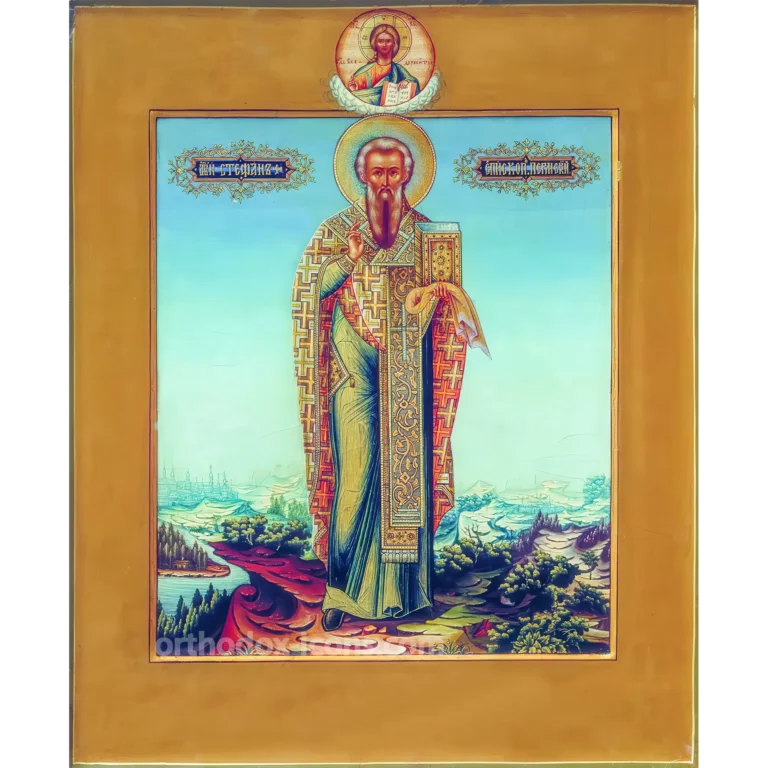
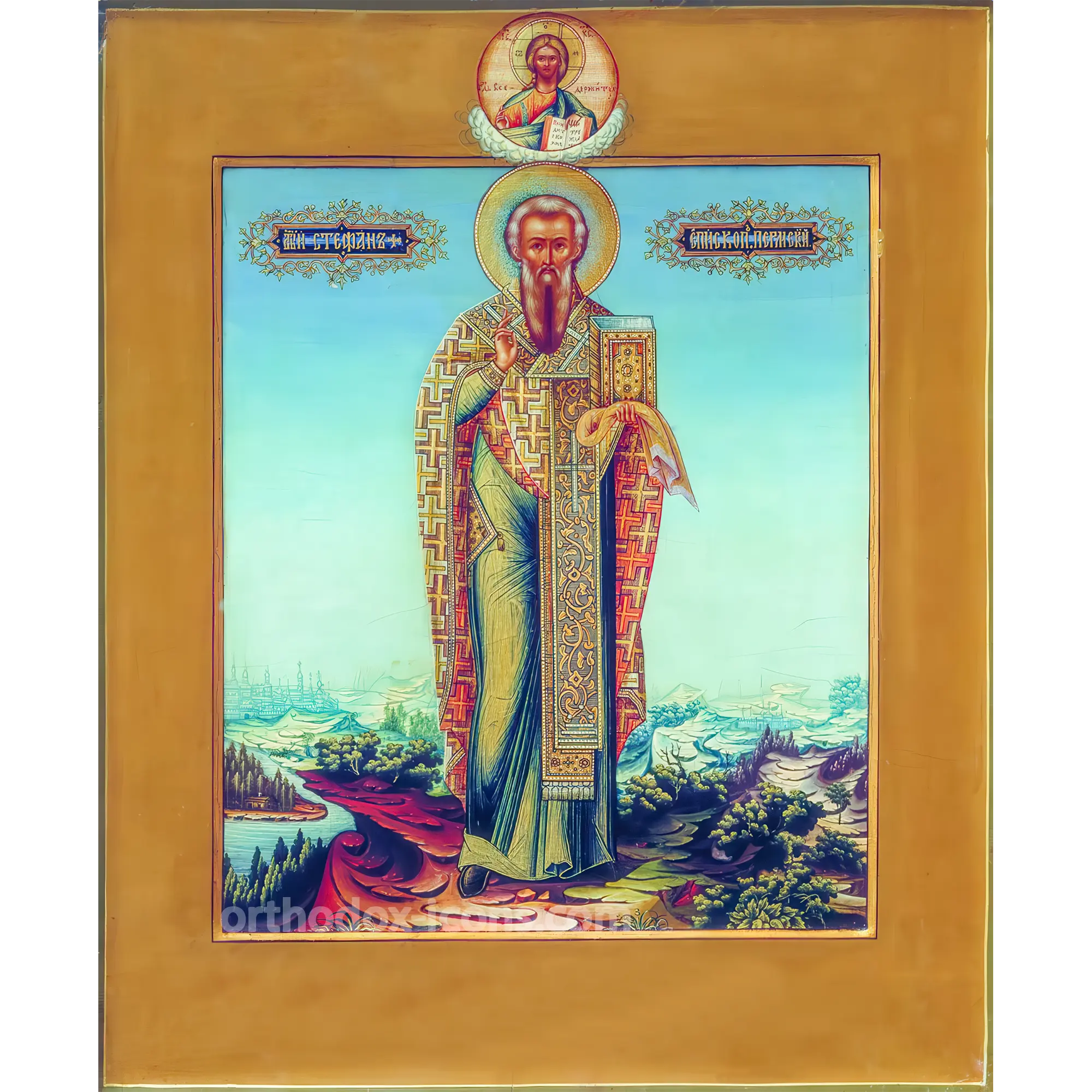
St. Stephen of Perm Icon is a hand-painted full-length icon of Saint Stephen, Bishop of Perm, enlightener of the Perm land, missionary, teacher, and creator of a written alphabet for the Komi-Zyryan people. He is shown in episcopal vestments, with the Gospel and a blessing gesture.
Prayer focus: enlightenment of the mind, help in study, missionary service, strengthening of faith, wise speech, patient teaching, peaceful guidance of people, and support in spiritual labor.
Materials: linden wood board, oak splines, natural chalk gesso, egg tempera, 23K gold leaf (960 purity) on the halo and borders, and protective finish.
Distinctive features: full-length figure of the saint, Gospel, blessing hand, image of Christ the Savior above, landscape of the Perm land below, inscription cartouches, and a large readable format from 27×31 cm.
It is possible to paint an image in any size to order
Free shipping worldwide
The St. Stephen of Perm Icon is a hand-painted image of one of the outstanding Russian saints of the fourteenth century: Saint Stephen, Bishop of Perm, enlightener of the Perm land, missionary, and spiritual teacher of the Komi-Zyryan people. He is venerated as an apostle of the north-eastern lands of Rus, because he not only preached the Gospel among pagan peoples, but also created writing for them, translated liturgical texts, and helped establish church life in the native language of the people he served.
In the presented icon Saint Stephen is shown full-length, in episcopal vestments, with the Gospel and a blessing gesture. The image reveals him as a bishop, preacher, teacher of faith, and intercessor for people. A distinctive feature of the composition is the broad landscape background: behind and below the saint opens the Perm land, with rivers, hills, forests, and distant church or town silhouettes.
In the upper part of the icon Christ the Savior is shown blessing Saint Stephen for his apostolic labor. This creates the vertical meaning of the image: from Christ to the saint, and from the saint to the land and people being enlightened by the Gospel.
Icon Characteristics
| Name | Hand-painted St. Stephen of Perm Icon |
| Saint | Saint Stephen, Bishop of Perm, enlightener of the Perm land |
| Iconographic type | Full-length image of the bishop in episcopal vestments, with the Gospel and blessing gesture |
| Feast day | May 9 / April 26 according to the old calendar |
| Visible features | Episcopal vestments, Gospel, blessing hand, Christ the Savior above, Perm land landscape, inscription cartouches |
| Available size | 27×31 cm (10.6×12.2 in) and larger sizes, with church and iconostasis formats by individual order |
Who This Icon Is For
The icon of Saint Stephen of Perm is especially suitable for men baptized with the name Stephen or Stepan. It can be given for baptism, nameday, birthday, anniversary, ordination, the beginning of a school year, or an important professional date. For a person named Stephen, it becomes a personal prayer icon before which he can ask his patron saint for help, understanding, and spiritual firmness.
This image is also close to people connected with education and the work of the word: teachers, professors, mentors, students, researchers, translators, philologists, linguists, editors, writers, and anyone whose work involves language and the passing on of knowledge. Saint Stephen did not merely preach; he sought to make Christian teaching understandable to the people to whom he was sent.
The icon is also appropriate for clergy, missionaries, catechists, Sunday school teachers, and those who carry church obedience. Saint Stephen of Perm is an example of attentive and self-sacrificing service rather than harsh pressure. His image reminds us that true enlightenment requires love, labor, knowledge of language, respect for culture, and personal faithfulness to Christ.
Prayer Before Saint Stephen of Perm
Before the icon of Saint Stephen of Perm, Orthodox Christians pray for enlightenment of the mind, strengthening of faith, help in study, wise speech, missionary service, patience in teaching, and the ability to speak about important things clearly, gently, and convincingly.
His image is especially meaningful for those who feel responsible for others: parents, teachers, priests, mentors, leaders, translators, and people working with texts, language, and culture. They ask for diligence in study, wisdom in teaching, calm explanation without irritation, support in missionary and educational work, peace between people of different cultures and languages, and patience in long labor when results do not come quickly.
Prayer before this icon is not only a request for success in school or work. It points to the deeper meaning of knowledge: the word should serve truth, peace, enlightenment, and the salvation of the person. Saint Stephen shows that Christian teaching requires not only education, but humility, sacrifice, love for people, and readiness to go where service is difficult.
Life of Saint Stephen of Perm
Saint Stephen of Perm was born in the fourteenth century in Ustyug. From his youth he loved books, prayer, and church life. After receiving an education and becoming a monk, he dedicated himself to a rare and difficult work: preaching among the Zyryans, the people of the Perm land.
For this ministry it was not enough simply to know theology. Saint Stephen needed to understand the language, way of life, worldview, and spiritual needs of the people to whom he went. One of his great labors was the creation of writing for the Komi-Zyryans. He composed an alphabet and translated liturgical and Christian texts so that the word of God could be heard not only through a foreign language, but through the native speech of the people.
Saint Stephen faced resistance, distrust, danger, and difficult living conditions. Yet his preaching was not based on force, but on personal faith, patience, and convincing speech. He answered pagan beliefs not with crude power, but with the light of Christian teaching, prayer, and the example of his own life.
Later Saint Stephen was consecrated Bishop of Perm. In this ministry he continued his work of enlightenment: he built churches, instructed the newly baptized, cared for the spiritual ordering of the region, and strengthened church life. His labor was not a brief impulse, but a long service that required learning, courage, humility, and genuine love for people.
Feast Day of Saint Stephen of Perm
Saint Stephen of Perm is commemorated on May 9 according to the civil calendar, or April 26 according to the old calendar. This day is especially meaningful for people named Stephen and for those who venerate him as a patron of education, missionary service, church teaching, translation, and preaching.
The icon can be chosen for a nameday, birthday, entrance into school or university, graduation, the beginning of teaching work, ordination, church obedience, the opening of a Sunday school, parish library, or educational project. If the icon is needed for a certain date, a larger size or iconostasis format should be discussed in advance.
Features of This St. Stephen of Perm Icon
In the presented icon, Saint Stephen of Perm is shown full-length and frontal, in episcopal vestments. His right hand is raised in blessing, and in his left hand he holds the Gospel. The saint’s figure occupies the central place, but the composition is not limited to a portrait: around him opens the wide space of the northern land he enlightened.
The background is built as a landscape narrative. In the lower part there are rivers, hills, forests, distant buildings, and church silhouettes. This connects the saint not only with his personal ascetic labor, but also with the concrete place of his service, the Perm land. The landscape is not random decoration; it helps the viewer see Saint Stephen as a pastor who came to a people, a land, and a culture in need of Gospel enlightenment.
The image of Christ the Savior in the upper part of the icon emphasizes that Saint Stephen’s service was not performed for personal glory, but by God’s blessing. Christ is shown above the saint as the source of preaching, strength, and truth.
The inscriptions are placed in decorative cartouches beside the halo, identifying Saint Stephen as Bishop of Perm. The ornamental details around the inscriptions support the solemn character of the image without overloading the composition. Wide golden fields create a calm frame and strengthen the sense of wholeness and significance.
Iconography: Vestments, Gospel, and Perm Landscape
The episcopal vestments point to Saint Stephen’s service as a bishop. He was not only a preacher and translator, but also a pastor of the Church, responsible for the spiritual ordering of people who had received the Christian faith. The richly ornamented vestments on the icon emphasize not personal luxury, but the dignity of the episcopal office and the solemnity of church service.
The Gospel in Saint Stephen’s hand is one of the central elements of meaning. He brought the word of Christ to the Perm land and made that word accessible through language, writing, and liturgical tradition. The book therefore speaks not only of episcopal dignity, but also of teaching, translation, preaching, and the passing of faith from heart to heart.
The blessing gesture reveals the saint as an intercessor and pastor. Together with the Gospel, it reminds us that true enlightenment is never cold knowledge alone. It joins word, prayer, kindness, personal example, and responsibility before God.
The landscape of the Perm land is especially important. In icons of missionary saints, the place of service often becomes part of the iconographic story. Here the rivers, hills, distant settlements, and churches recall the northern land where Saint Stephen carried out his apostolic ministry.
Materials, Gold Leaf, and Custom Options
The icon of Saint Stephen of Perm is painted on a solid linden wood board with oak splines. Linden is well suited for hand-painted icons because it allows careful preparation under the gesso and preserves the clarity of the painting. Oak splines strengthen the board and help it keep its form through natural changes of humidity and temperature.
A natural chalk gesso is applied under the painting. The image is written in egg tempera, a traditional technique that allows the iconographer to render the saint’s face, episcopal vestments, ornament, Gospel, blessing hand, image of Christ, landscape details, and inscriptions with clarity.
In this version, 23K gold leaf (960 purity) is used on the halo and wide borders, together with fine decorative painting that supports the solemn character of the icon. Because the image has a complex composition with a full-length figure, Christ above, inscription cartouches, and the landscape of the Perm land, it is especially readable in 27×31 cm (10.6×12.2 in) and larger formats.
For an individual order, the size, degree of gilding, ornament style, color of the borders, inscriptions, kiot, church format, or iconostasis placement can be discussed. Free international shipping is included. Payment is made after you receive and approve the icon.
How to Choose the Size
The 27×31 cm (10.6×12.2 in) size is suitable for a home iconostasis, study, educational space, or a gift for an important date. In this format the full-length figure of the saint, Gospel, blessing hand, upper image of Christ, and main landscape elements are already clear and readable.
Larger formats allow the icon to open more fully. They make the details of the episcopal vestments, ornaments, inscription cartouches, distant church silhouettes, and the landscape of the Perm land more visible. If the icon is intended for a spacious prayer corner, parish space, Sunday school, library, or priest’s study, a larger size will feel more whole and solemn.
Iconostasis sizes are chosen individually, taking into account the height of the row, viewing distance, neighboring icons, lighting, and overall artistic order. For church placement, the decorative work, figure scale, border color, and kiot can be adapted to the interior.
Blessing and Care
The icon of Saint Stephen of Perm may be blessed in an Orthodox church after it is received, or brought to your parish for blessing. A blessed icon is treated as a holy image for prayer, thanksgiving, and turning to God through the intercession of the saint.
A hand-painted icon should be cared for gently. It should be placed away from direct sunlight, heating devices, dampness, and sudden changes in temperature. Do not wipe the surface with a wet cloth, alcohol wipes, household chemicals, or abrasive materials. Dust should be removed with a dry soft brush or dry cloth without pressure.
Special care should be taken around gilded areas, inscriptions, fine lines of the episcopal vestments, landscape details, and the image of Christ in the upper part of the composition. A wooden glazed kiot can provide additional protection from dust, candle smoke, accidental touch, and mechanical damage, especially if the icon is made in a large or church format.
Questions and Answers
Who is depicted on the St. Stephen of Perm Icon?
The icon depicts Saint Stephen, Bishop of Perm, enlightener of the Perm land, missionary, and creator of a written alphabet for the Komi-Zyryan people.
Why is Saint Stephen shown with the Gospel?
The Gospel points to his episcopal and missionary service. Saint Stephen brought the Christian faith to the Perm land and made the word of faith accessible through the people’s own language and writing.
What does the image of Christ above the saint mean?
The image of Christ the Savior shows that Saint Stephen’s ministry was carried out by God’s blessing. Christ is the source of preaching, truth, and spiritual strength.
What do Orthodox Christians pray for before this icon?
They pray for enlightenment of the mind, help in study, strengthening of faith, wise speech, patience, missionary service, and the ability to guide others peacefully and clearly.
Who is this icon suitable for?
It is suitable for people named Stephen, teachers, students, clergy, missionaries, translators, philologists, mentors, and anyone connected with education, language, and spiritual teaching.
When is the feast day of Saint Stephen of Perm?
Saint Stephen of Perm is commemorated on May 9 in the civil calendar, corresponding to April 26 in the old calendar.
Why is the landscape of the Perm land shown on the icon?
The landscape recalls the place of Saint Stephen’s apostolic service. He preached among the Zyryans, created writing for them, and helped establish church life in the Perm land.
What sizes are available for this icon?
The listed size is 27×31 cm (10.6×12.2 in) and larger sizes can be discussed. Church and iconostasis formats are available by individual order.
Can this icon be ordered for a church?
Yes. The icon can be painted in a church or iconostasis size, with proportions, gilding, inscriptions, and decorative details discussed according to the place of installation.
How should a hand-painted icon of Saint Stephen be cared for?
Keep the icon away from moisture, direct sunlight, strong heat, and sudden temperature changes. Dust it gently with a dry soft brush or cloth, without water, alcohol, or household cleaners.
| Dimensions | 27x31cm (10.6×12.2 in) |
|---|---|
| Name | Stephen |