St. John the Baptist Orthodox Icon
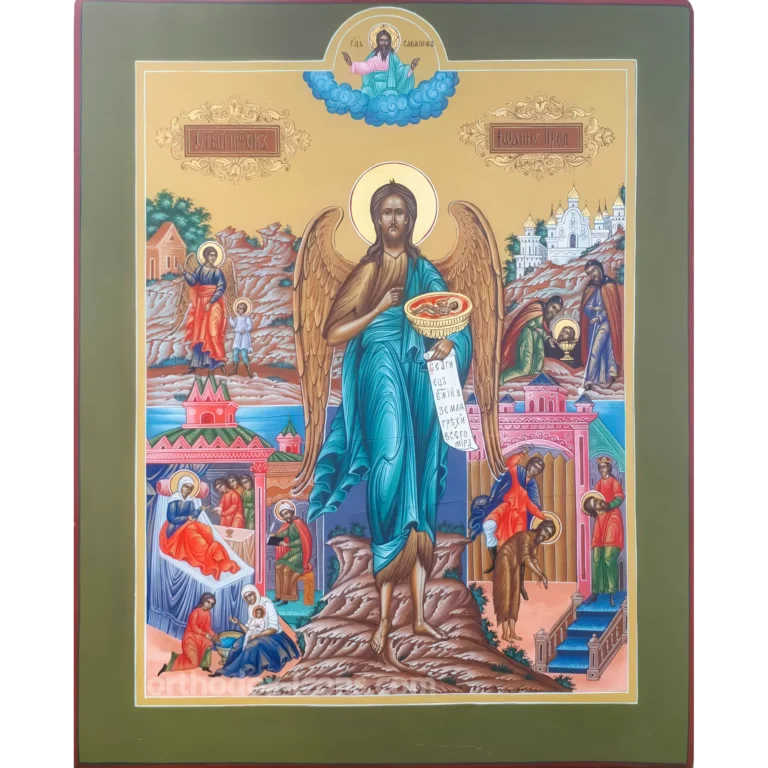
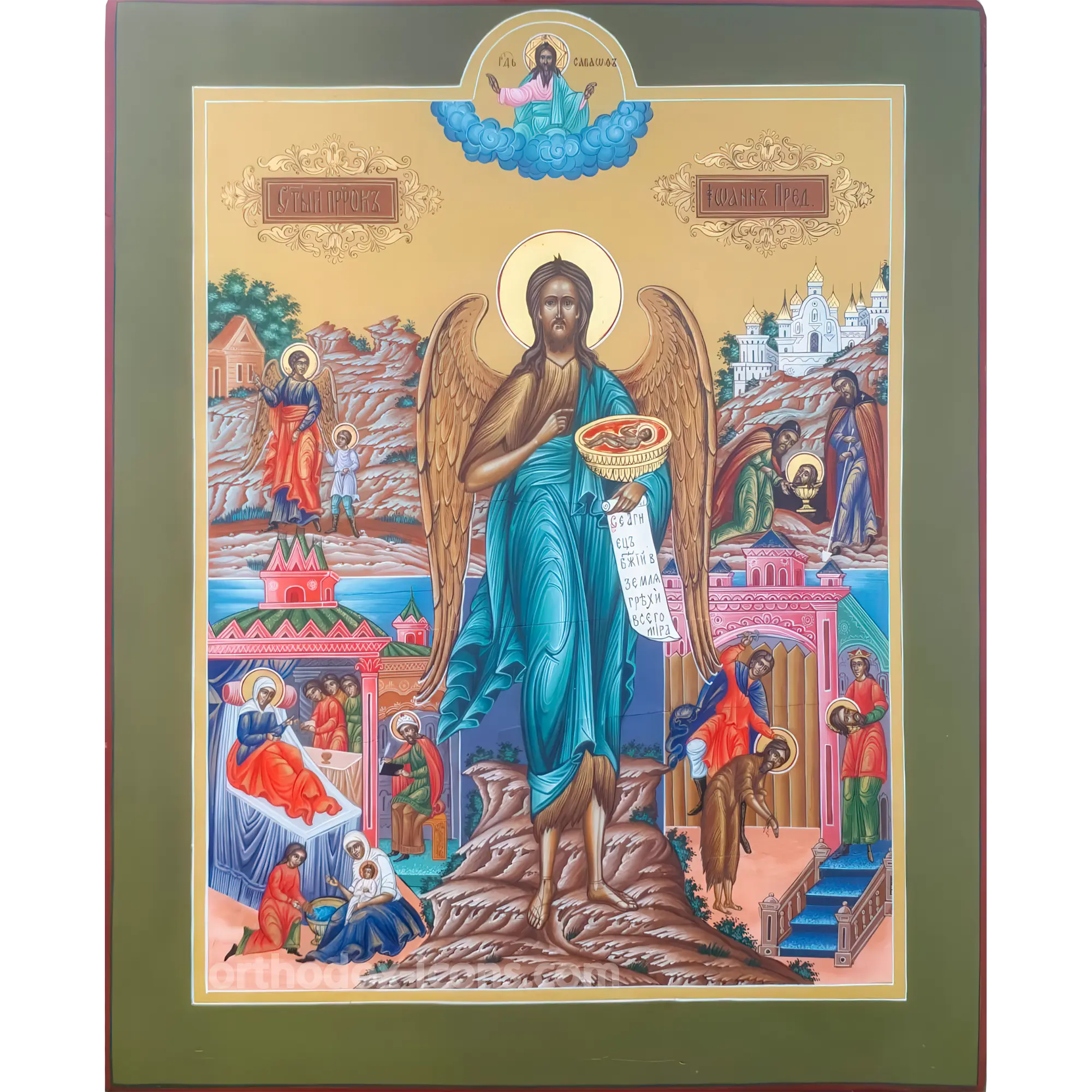
St. John the Baptist Orthodox Icon is a hand-painted multi-scene icon of Saint John the Forerunner as the Angel of the Desert. The central figure has great wings, holds the Eucharistic chalice with the Christ Child, and is surrounded by scenes from his life: his Nativity, departure into the wilderness, Beheading, and the Finding of his holy head.
Custom commission: the size, completion time, and price are calculated individually because this is a complex life-scenes icon with miniature painting. Larger church and iconostasis sizes may be commissioned by agreement.
The icon is painted on a solid linden board with inset oak splines, linen cloth, chalk gesso, mineral egg tempera, selected gold leaf details, and natural linseed oil. Free international shipping is included, and payment is made after you receive and approve the icon.
It is possible to paint an image in any size to order
Free shipping worldwide
St. John the Baptist Orthodox Icon is a hand-painted multi-scene icon of the holy Prophet, Forerunner, and Baptist of the Lord John, shown as the Angel of the Desert. This is a complex theological and narrative image: the central figure of the Baptist, with great angelic wings, is surrounded by scenes from his earthly life, all woven into one landscape. The icon is intended for serious prayer, a church space, a home chapel, or a person who seeks repentance, firmness of spirit, and a true spiritual guide.
Saint John the Forerunner is the greatest of the prophets, completing the history of the Old Testament and opening the age of the New. Christ Himself said of him that among those born of women none had arisen greater than John the Baptist. His birth was granted through the prayers of his elderly parents, the priest Zachariah and Righteous Elizabeth. Escaping death during the slaughter of the infants, John grew up in the harsh Judean wilderness, living in fasting and prayer, wearing a garment of camel’s hair and eating simply.
At about thirty years of age he came forth preaching repentance and calling the people to cleanse their hearts for the coming Messiah. He baptized the Lord Jesus Christ in the Jordan and first witnessed the manifestation of the Holy Trinity. Later, for fearlessly rebuking the sins of King Herod Antipas, he was imprisoned and accepted a martyr’s death by beheading.
St. John the Baptist Orthodox Icon – Angel of the Desert
The central image of this icon is deeply symbolic and is based on the prophecy of Malachi, applied by Christ to John: “Behold, I send My messenger, and he will prepare the way before Me.” In Greek, the word angelos means messenger. This is why Orthodox iconography can show John the Baptist with wings: not because he ceased to be human, but because he lived with angelic purity, ascetic strictness, and complete obedience to the will of God.
Behind Saint John are large golden-brown wings. They signify his equal-to-the-angels purity, chastity, ascetic life, and role as the greatest messenger of God. He is the voice crying in the wilderness, the one who points not to himself, but to Christ.
In his left hand the saint holds a golden chalice in which the Christ Child reclines. This is a profound Eucharistic symbol. John points to Him with his right hand, illustrating his chief words: “Behold the Lamb of God, who takes away the sin of the world.” The Child in the chalice signifies the future sacrifice of Christ on the Cross and the mystery of Holy Communion.
Together with the chalice, the prophet holds an open scroll with the call to repentance. Beneath the bright blue mantle he wears a hair shirt, the rough garment of camel’s wool that recalls his strict life in the wilderness. His bare feet stand firmly on the rocky ground of the desert.
At the very top of the icon, in a blue semicircular segment symbolizing the heavens, the Lord blesses His Forerunner. In this iconographic tradition the heavenly figure may be represented as the Ancient of Days or the Lord in glory, blessing the ministry of the prophet.
Life Scenes Around the Central Figure
This icon is not arranged like many traditional life-icons, where small scenes are placed in strict rectangular panels around the border. Here the scenes from the life of Saint John are organically woven into a single landscape around the central figure. A golden-ocher sky passes into the mountainous desert, and the landscape is joined with stylized old Russian architectural forms.
In the lower left is the Nativity of John the Forerunner. Righteous Elizabeth lies on her bed in richly painted chambers, while servants wash the newborn child in a basin. Nearby is the aged Zachariah, who writes the name of his son on a tablet. When he wrote, “His name is John,” his speech returned.
In the upper left, an angel leads the young John into the wilderness. This scene recalls the tradition that the Lord preserved the child from the sword of Herod and prepared him in the desert for his great prophetic ministry.
In the lower right is the dramatic scene of the Beheading. John bows in humility while a soldier raises the sword. Nearby stands Herodias or Salome with the dish prepared for the honorable head of the prophet. This scene reminds the believer that truth may lead to suffering, but it cannot be defeated by earthly violence.
In the right middle area is the Finding of the Head of John the Baptist, one of the miraculous discoveries of this great relic. Two believers find the golden vessel with the incorrupt head of the prophet hidden in the earth.
Prayer Before John the Forerunner
Saint John the Baptist is one of the greatest intercessors for the human race before the throne of God, second in liturgical honor only to the Mother of God. He was given great grace to lead people toward repentance. Before his icon, people pray when they have lost their way, become entangled in sins and passions, or seek strength for a deep change of life and sincere repentance.
Orthodox Christians also pray to the Forerunner for healing of illnesses of the head, including severe headaches, migraines, injuries, and other serious conditions. This tradition is connected with the martyrdom of the saint by beheading. Parents ask him for help in raising children in faith and purity. Those facing difficult, life-changing decisions ask for wisdom and fearlessness to follow the will of God despite worldly temptations.
The icon also brings comfort in deep sorrow, protection from visible and invisible enemies, and strengthening of spiritual courage. Its message is not abstract: it calls the believer to choose truth, repentance, and Christ.
Materials and Creation of a Complex Life-Scenes Icon
Writing a multi-scene life icon is among the most demanding forms of icon painting. It requires many months of careful work and a refined miniature brush. The iconographer must unite the large central figure with many small narrative scenes, keeping both theological clarity and visual harmony.
The base is a thick, well-dried solid linden board. Inset oak splines are placed on the back to protect the board from bending over time. Linen cloth is glued to the board, and up to fifteen layers of natural chalk gesso are applied and polished to a perfectly smooth surface.
The painting is made with classical mineral egg tempera. The colors are prepared by grinding mineral pigments and earth colors with egg yolk. The life scenes are painted with extremely fine brushes, allowing the master to work the smallest details of faces, garments, architecture, mountains, and sacred vessels.
Selected elements of gold leaf are used for the halos, chalice, and sacred accents. The finished icon is covered with natural linseed oil, which penetrates and protects the paint layer after drying.
| Icon name | St. John the Baptist Orthodox Icon |
|---|---|
| Full iconographic title | John the Forerunner, Angel of the Desert, with scenes from his life |
| Saint depicted | Saint John the Baptist, Prophet, Forerunner, and Baptist of the Lord |
| Central details | Angelic wings, Eucharistic chalice with the Christ Child, scroll, hair shirt, blue mantle |
| Life scenes | Nativity of John, departure into the wilderness, Beheading, and the Finding of his holy head |
| Board | Solid linden wood |
| Reinforcement | Inset oak splines |
| Ground | Linen cloth and natural chalk gesso |
| Painting | Mineral egg tempera with miniature life-scene painting |
| Gilding | Selected gold leaf elements |
| Price and size | Calculated individually according to size, detail, and amount of gilding |
Custom Commission and Price
This icon has an individually agreed price because it is a complex multi-scene work. The final cost and completion time depend on the selected size, level of miniature detail, amount of gilding, and the current workload of the icon painters. It may be commissioned as a smaller prayer icon, a large church icon, or an iconostasis image, but the miniature life scenes require enough surface area to remain clear and reverent.
Free international shipping is included, and payment is made after you receive and approve the icon.
Questions and Answers
Why is John the Baptist called the Forerunner?
Forerunner means the one who goes before and prepares the way. John was born before Christ and called the people to repentance before the Savior began His public ministry.
Why is he shown with wings if he was a man?
John was human, but the Church calls him the Angel of the Desert. The wings symbolize his angelic purity, ascetic life, and role as the messenger of God’s will.
What does the Christ Child in the chalice mean?
The Christ Child is shown as the Eucharistic Lamb. The chalice points to John’s words, ‘Behold the Lamb of God,’ and to the sacrifice of Christ and Holy Communion.
What is special about the life scenes in this icon?
Instead of being placed in strict rectangular border panels, the scenes from John’s life are woven into a single landscape around the central figure.
What do people pray for before this icon?
They pray for repentance, firmness of spirit, guidance in life choices, help in sorrow, protection from enemies, and, by tradition, healing of serious head illnesses.
Who is the elder writing on a tablet?
This is Righteous Zachariah, the father of John. After John’s birth he wrote, ‘His name is John,’ and his speech returned.
Who blesses John from heaven at the top of the icon?
The upper blue segment shows the Lord blessing the ministry of His prophet, often represented in this iconographic tradition as the Ancient of Days or the Lord in glory.
Can this icon be made in different sizes?
Yes. The icon can be commissioned in different formats, but the miniature life scenes require enough space for careful and readable painting.
Why is the price agreed individually?
A multi-scene life icon with miniature details is one of the most labor-intensive forms of icon painting, so the price depends on size, detail, and amount of gilding.
What are the main feasts of John the Baptist?
The main feasts include the Nativity of John the Baptist on July 7, the Beheading on September 11, and the Synaxis of John the Baptist on January 20.
| Name | Joannes, John |
|---|