John the Forerunner Orthodox Icon
$1350
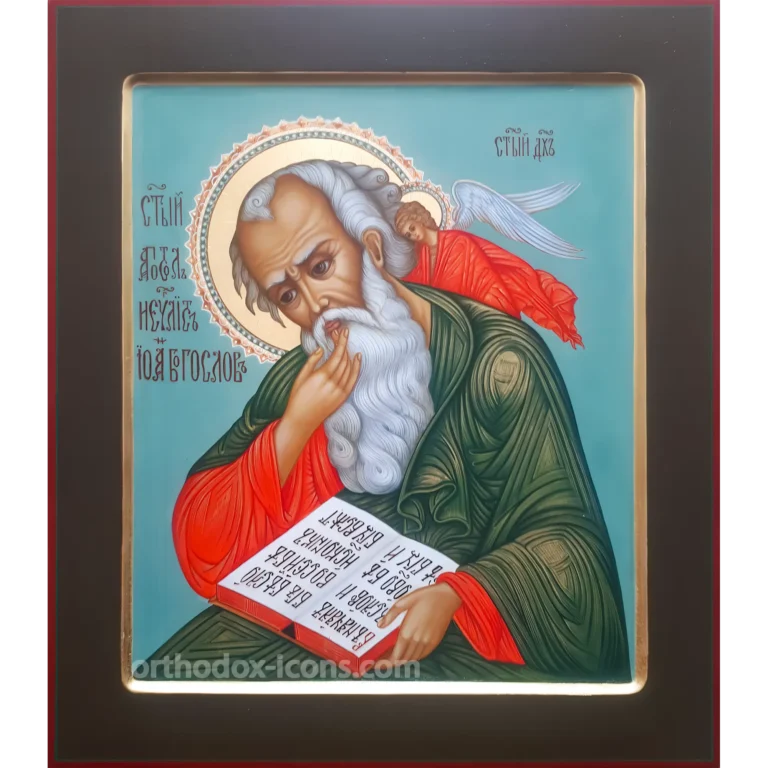
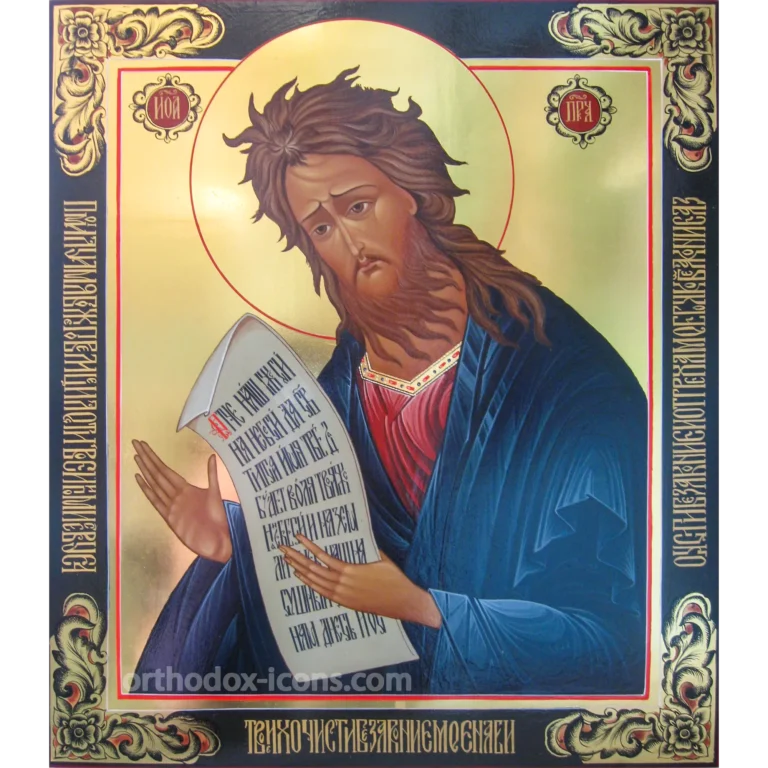
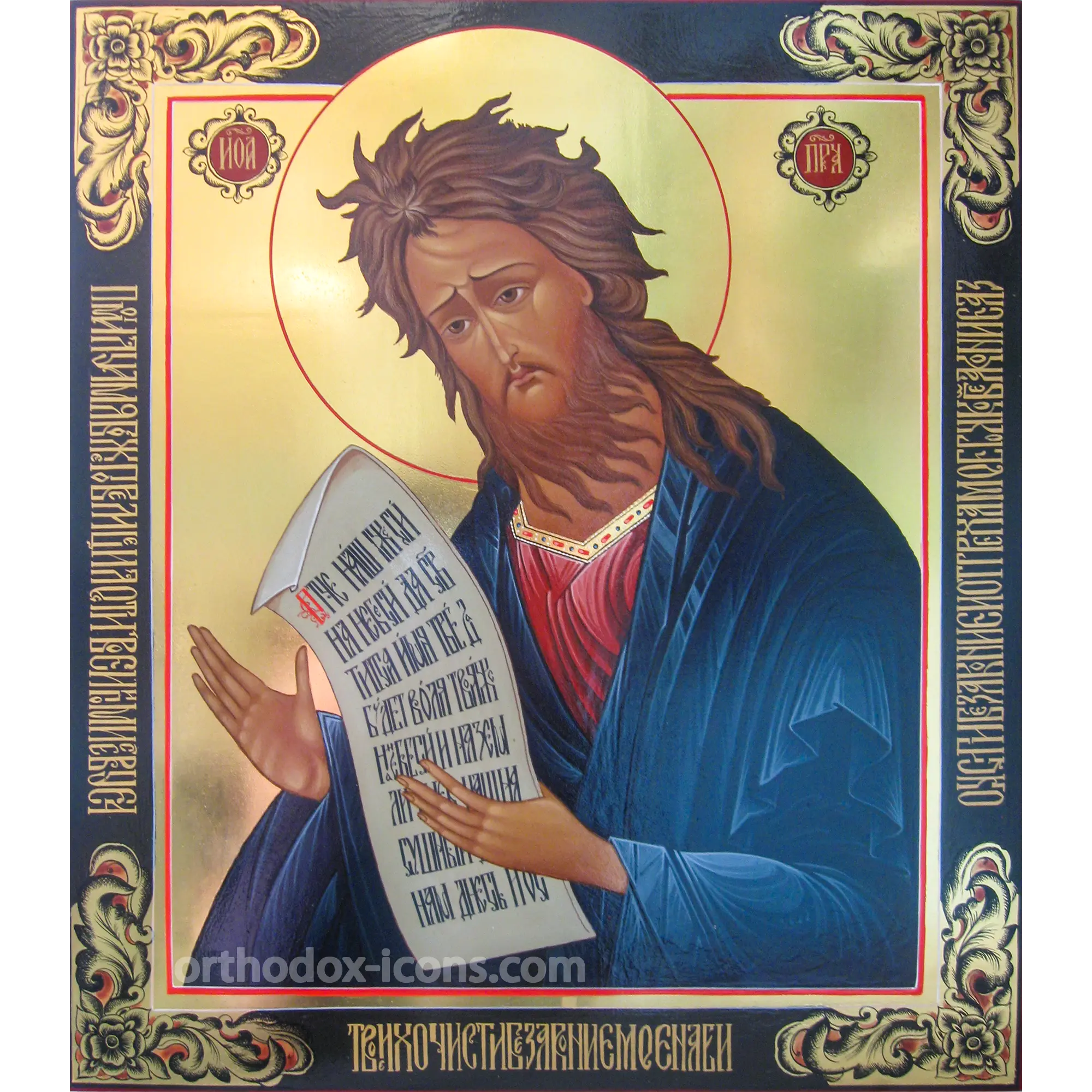
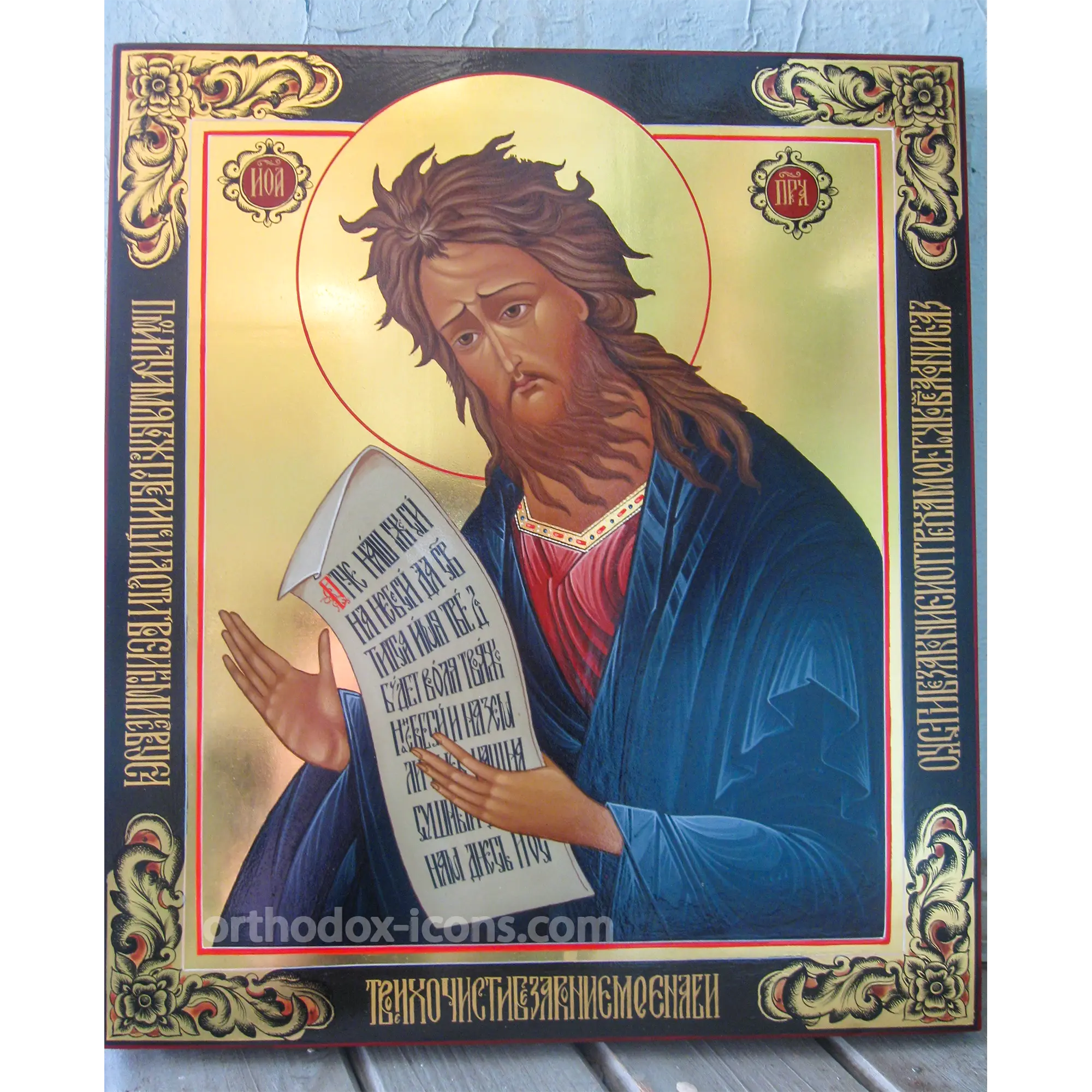
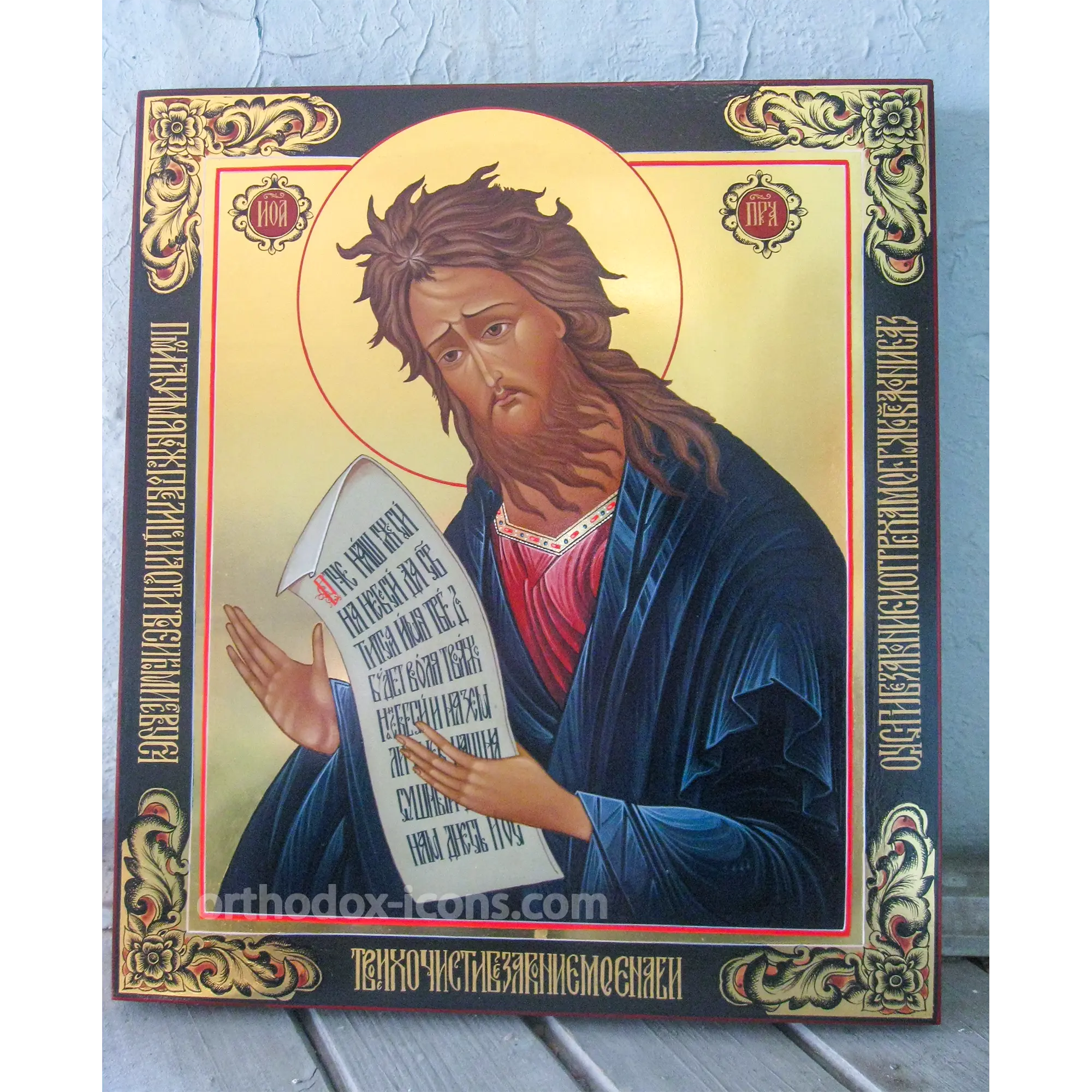
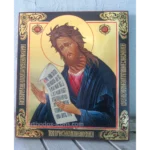
John the Forerunner Orthodox Icon is a hand-painted icon of the holy Prophet, Forerunner, and Baptist of the Lord. Saint John is shown half-length with an open scroll, a large gold halo, a red tunic, deep blue mantle, gold background, and dark ornamental borders with inscriptions.
Available size: 27×31 cm (10.6×12.2 in). Larger church and iconostasis sizes may be commissioned individually.
The icon is painted on a solid linden board with oak splines, natural chalk gesso, mineral egg tempera, and 23K gold leaf (960 purity). Free international shipping is included, and payment is made after you receive and approve the icon.
It is possible to paint an image in any size to order
Free shipping worldwide
John the Forerunner Orthodox Icon is a hand-painted Orthodox icon of the holy Prophet, Forerunner, and Baptist of the Lord. Saint John is the greatest of the prophets, the one who prepared people for the coming of the Savior, preached repentance, and baptized the Lord Jesus Christ in the Jordan. In this icon he is shown half-length, holding an open scroll, with a large gold halo, gold background, red tunic, deep blue mantle, and the ascetic features of a desert prophet.
John the Forerunner occupies a special place in Orthodox tradition. The Church honors him above all prophets because he not only foretold the coming of the Messiah, but personally pointed Him out to the people. His ministry addresses the heart directly: he calls the person to leave sin, cleanse the conscience, renounce self-deception, and prepare the soul to meet God. For this reason, his icon is especially close to those who seek repentance, spiritual renewal, inner focus, and strength in the struggle with passions.
John the Forerunner Orthodox Icon – Prophet, Baptist, and Witness
Saint John the Forerunner was the last and greatest prophet of the Old Testament. His birth was foretold from above, and his entire life became service to God. From youth he withdrew from worldly distractions, lived in the wilderness, wore rough clothing, and led a strict ascetic life. This strictness was not harshness for its own sake; it was the sign of complete freedom from earthly attachments.
The name Forerunner means the one who goes before. The Church calls Saint John by this name because he prepared the way of the Lord. His preaching was simple and powerful: a person must repent, correct his life, and turn to God not only with words, but also with deeds. This call is not a message of despair. Repentance opens the path to healing, freedom, and new life.
Saint John baptized people in the Jordan, calling them to purification and inner renewal. The central event of his ministry was the Baptism of the Lord Jesus Christ. John recognized Christ as the One who had come to save the world and humbly bore witness to Him. The scroll in his hands reminds us that he is not silent; he proclaims divine truth and calls the human person to spiritual awakening.
Spiritual Meaning of the Icon
The icon of John the Forerunner is an image of strict love. At first glance, the face of the saint may seem severe: his gaze is concentrated, his features are ascetic, and his expression is inwardly intense. Yet this strictness does not repel. It calls the believer to honesty before God. Saint John does not offer shallow comfort; he helps the person see that true joy begins with purification of the heart.
The open scroll in his hands is the main meaning-bearing detail of the icon. It signifies the prophetic word addressed to the people. John the Forerunner does not speak from himself; he announces the will of God and calls the person to repentance. In the icon, the scroll recalls the Gospel, the voice of conscience, and the spiritual law that cannot be replaced by outward success or beautiful words.
The garments of the saint also carry theological meaning. The red tunic may be understood as a sign of zeal, martyrdom, and spiritual fire. The deep blue mantle gives the image depth and points to the heavenly direction of his ministry and the inner mystery of prophecy. Long hair, beard, a slight inclination of the head, and an attentive gaze form the image of a man wholly given to God.
The gold background does not signify earthly luxury; it signifies divine light. Against this background, the figure of the Forerunner is perceived as a witness from spiritual reality, a prophet whose word does not grow old. The wide dark borders with floral ornament and inscriptions give the icon solemnity and decorative completeness. Unlike some other icons of John the Baptist, this image is not written in a recessed kovcheg; it is framed by the dark ornamental fields.
Prayer Before John the Forerunner
Before the icon of Saint John the Forerunner, Orthodox Christians pray for repentance, spiritual sobriety, strengthening of faith, and help in the struggle with passions. This image is especially important for a person who understands the need for inward change, wants to leave a sinful habit, return prayer to daily life, reconcile with loved ones, or come back to church life after a period of coldness.
People pray before John the Forerunner for the gift of repentance and cleansing of conscience, strengthening of faith and spiritual resolve, help against passions, addictions, and harmful habits, guidance of children and loved ones, return to prayer, confession, Communion, and church life, a right choice of life path, and protection of the family from quarrels, temptations, and spiritual coldness.
This icon may be a meaningful name icon for men and boys named John, Ivan, or Joannes, and for any person who needs spiritual support and inner firmness. It may be given for baptism, name day, birthday, wedding, house blessing, the beginning of independent life, a spiritual turning point, or an important family event. In a church or iconostasis size, the image is especially appropriate in the Deesis row, where John the Forerunner traditionally stands before Christ together with the Most Holy Theotokos.
Features of This Hand-Painted Icon
In this icon Saint John the Forerunner is shown half-length, holding an open scroll. His figure fills the central space, and the large gold halo marks him as a prophet of God and witness to Christ. The head is slightly inclined, and the gaze is directed toward the person praying, not with ordinary emotion, but with the seriousness of a prophet who sees the depth of the human soul and calls it to truth.
The face of John the Forerunner is written with special expressiveness. Elongated features, attentive eyes, long hair, and beard create the ascetic image of the desert prophet. He is not shown in outward action; his primary action is the word, the witness, the prophetic call. For this reason, the scroll is not merely an object in his hands, but an extension of his ministry.
The color scheme is built on the contrast of gold, deep blue, red, and dark borders. The blue mantle is painted in broad folds and occupies much of the composition, giving a sense of depth and inward stillness. The red tunic visible beneath it adds spiritual intensity. The gold background gives the image solemnity, while the dark border with floral ornament makes the icon richly framed and visually complete.
The borders are decorated with plant motifs and inscriptions that create the feeling of a traditional festive frame. Ornamental details appear in the corners, while vertical inscriptions at the sides emphasize the sacred character of the image. This composition is suitable for a home icon corner, and in a larger size it may also be used in a church space.
Materials and Creation of the Icon
The John the Forerunner Orthodox Icon is painted on a natural solid linden board. Linden is traditionally used in icon painting because of its even structure, stability, and ability to receive the ground well. Oak splines strengthen the board and help preserve its shape when humidity and temperature change.
After the wooden base is prepared, natural chalk gesso is applied in layers. This traditional ground creates a strong and even surface for painting. In the image of John the Forerunner, the quality of the gesso is especially important for the fine writing of the prophet’s face, long hair, beard, hands, garment folds, scroll, inscriptions, and decorative border.
The painting is made with mineral egg tempera, a technique valued for noble matte color, depth, and durability. The iconographer gradually reveals the image from the main color masses to highlights, from the overall silhouette to the details of face, hands, hair, clothing, and scroll. In an icon of John the Forerunner, it is especially important to keep the spiritual balance: the image must be strict, but not cold; a call to repentance, but not without hope.
23K gold leaf (960 purity) is used for the halo, background, and selected decorative elements. Gold emphasizes the heavenly dignity of the saint and helps create the prayerful space of the icon. In a larger or iconostasis version, the gilding can be especially expressive, and the details of the scroll, face, halo, and ornamental borders become more readable.
| Icon name | John the Forerunner Orthodox Icon |
|---|---|
| Full iconographic title | Hand-painted icon of the holy Prophet, Forerunner, and Baptist of the Lord John |
| Saint depicted | Saint John the Forerunner |
| Iconographic type | Half-length image of the saint with an open scroll |
| Decorative features | Gold halo, gold background, dark ornamental borders, vertical inscriptions, solemn frame |
| Board | Solid linden wood |
| Reinforcement | Oak splines |
| Ground | Natural chalk gesso |
| Painting | Mineral egg tempera |
| Gilding | 23K gold leaf (960 purity) |
| Available size | 27×31 cm (10.6×12.2 in); larger church and iconostasis sizes by commission |
Who This Icon Is Suitable For
The icon of Saint John the Forerunner is especially suitable as a name icon for men named John or Ivan. It may be given for baptism, name day, birthday, anniversary, wedding, house blessing, the beginning of independent life, or an important spiritual stage. Such a gift carries the prayerful protection of the saint who teaches honesty before God, repentance, and spiritual watchfulness.
This image is appropriate for families praying for children, for the overcoming of harmful habits, for reconciliation, for return to church, and for strengthening of spiritual life. John the Forerunner is a strict saint, but his strictness is saving: it helps a person stop excusing weakness and begin seeking correction.
Available size: 27×31 cm (10.6×12.2 in). Larger church and iconostasis sizes may be commissioned individually.
Free international shipping is included, and payment is made after you receive and approve the icon.
Questions and Answers
Who is shown on the John the Forerunner Orthodox Icon?
The icon shows Saint John, the Prophet, Forerunner, and Baptist of the Lord, the great prophet who prepared people for the coming of Christ.
Why is John called the Forerunner?
He is called the Forerunner because he came before the public ministry of Christ and prepared the way for the Lord through the preaching of repentance.
What do Orthodox Christians pray for before this icon?
They pray for repentance, spiritual sobriety, strengthening of faith, freedom from passions, guidance for loved ones, and return to church life.
Is this icon suitable as a name icon?
Yes. It is especially suitable as a name icon for men and boys named John, Ivan, or Joannes.
What does the scroll in his hands mean?
The scroll signifies the prophetic ministry of John the Forerunner and his call to repentance addressed to the people.
Why does the face of John the Forerunner look strict?
The strict expression conveys his prophetic ministry, his call to honesty before God, repentance, and correction of life.
Does this icon have a kovcheg?
No. In this icon the image is separated by a frame and wide ornamental borders rather than a recessed kovcheg.
Is this icon suitable for a home icon corner?
Yes. It is suitable for home prayer, a family icon corner, a church, a chapel, or an iconostasis row.
What materials are used for this icon?
The icon is painted on a linden board with oak splines, natural chalk gesso, mineral egg tempera, and 23K gold leaf (960 purity).
What size is available?
The listed size is 27×31 cm (10.6×12.2 in). Larger church and iconostasis sizes may be made by individual commission.
| Name | Joannes, John |
|---|---|
| Dimensions | 27x31cm (10.6×12.2 in) |