Sophia of Suzdal Orthodox Icon
Price range: $500 through $1350
Available sizes: 13×25 cm (5.1×9.8 in), 18×31 cm (7.1×12.2 in), 30×50 cm (11.8×19.7 in); iconostasis formats can be made by individual request.
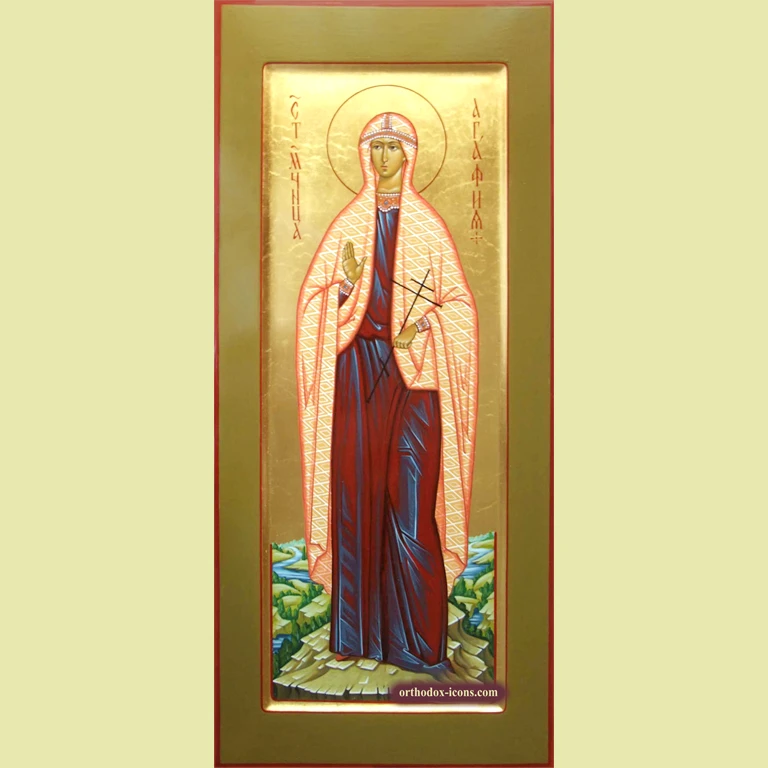
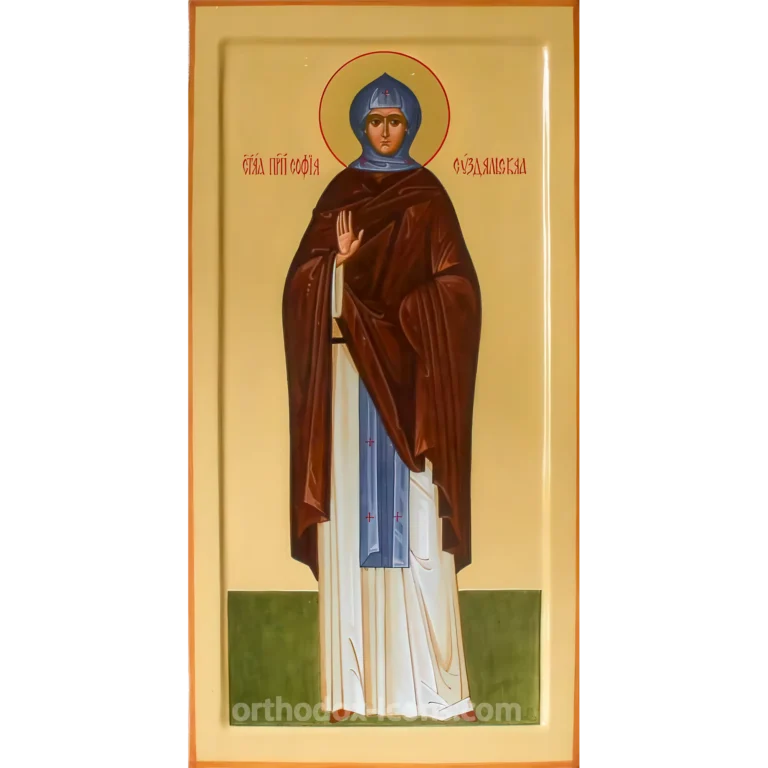
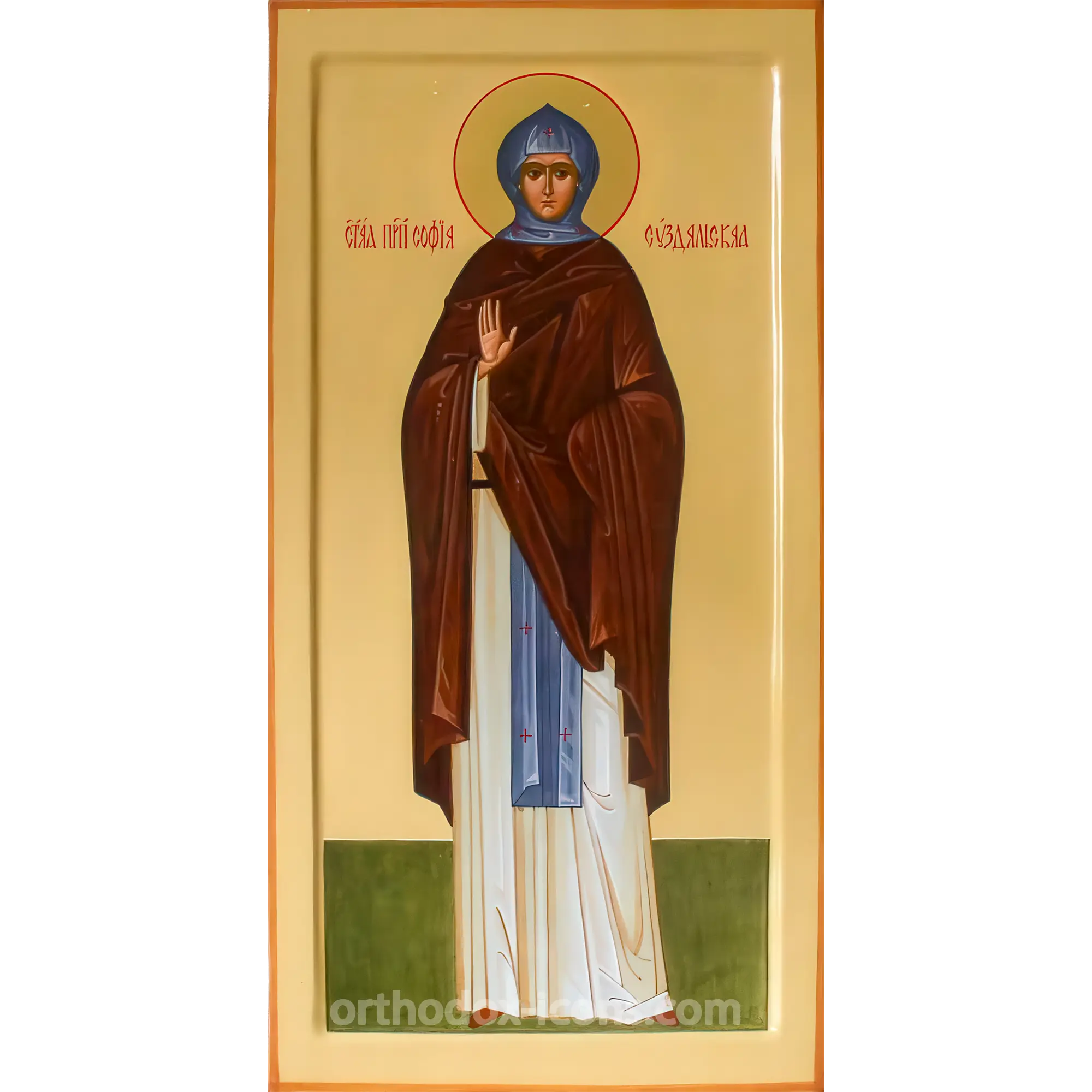
Sophia of Suzdal Orthodox Icon is a hand-painted full-length icon of the venerable princess and nun, known in the world as Solomonia Saburova, the first wife of Grand Prince Vasily III of Moscow. She is shown in monastic clothing, with a dark mantle, blue head covering, light inner garment, raised right hand, and gold halo.
The icon is painted in egg tempera on a linden wood panel with chalk levkas; gold leaf may be used according to the chosen version. Free international shipping is included. Payment is made after you receive and approve the icon.
It is possible to paint an image in any size to order
Free shipping worldwide
Sophia of Suzdal Orthodox Icon is a hand-painted Orthodox icon of the venerable princess and nun who was known in the world as Solomonia Saburova, the first wife of Grand Prince Vasily III of Moscow. Her life was marked by severe family trials, forced removal from her former position, and a monastic path in the Protection Convent in Suzdal. In the memory of the Church, Saint Sophia is venerated as an image of humility, patience, inner nobility, and faithfulness to God in circumstances that a person cannot always change outwardly, but can pass through with prayer and spiritual dignity.
In this icon Saint Sophia is shown full-length in monastic clothing. The strict vertical composition, calm golden background, dark mantle, blue head covering, and light inner garment create an image of quiet prayerful concentration. Her right hand is raised in a gesture of prayerful standing, while the left hand is hidden under the folds of her monastic garment. There is no outward splendor of princely rank here: the saint appears as a venerable nun who passed from earthly greatness to monastic humility.
The Sophia of Suzdal Orthodox Icon may be chosen as a named icon for a woman or girl named Sophia, as a prayerful image for a family, or as a gift for baptism, nameday, birthday, wedding anniversary, or a meaningful family date. The elongated format is especially suitable for a full-length image of the saint and preserves the slender figure, readable inscriptions, and quiet prayerful character of the icon.
Icon Characteristics
| Full name | Hand-painted icon of Venerable Sophia of Suzdal |
| Saint shown | Venerable Sophia of Suzdal, known in the world as Solomonia Saburova |
| Iconographic type | Full-length image of a venerable princess-nun in monastic clothing |
| Feast days | December 29 / December 16 Old Style; August 14 / August 1 Old Style; also in the Synaxis of the Saints of Vladimir |
| Visible details | Full-length figure, monastic mantle, blue head covering, gold halo, raised right hand, simple ground, elongated format |
| Available sizes | 13×25 cm (5.1×9.8 in), 18×31 cm (7.1×12.2 in), 30×50 cm (11.8×19.7 in), and iconostasis sizes by request |
Who May Choose an Icon of Sophia of Suzdal
An icon of Venerable Sophia of Suzdal is especially appropriate for women and girls baptized with the name Sophia. It is a named icon of a heavenly patroness and may be given for baptism, nameday, birthday, coming of age, marriage, or another important date. The name Sophia means wisdom, and in the image of the Suzdal saint this wisdom is revealed not as outward learning, but as the ability to preserve faith, dignity, and a prayerful heart in difficult circumstances.
This image is especially close to women who are passing through family hardship, inner pain, loneliness, unjust treatment, or a long period of waiting. The life of Saint Sophia was connected with a severe trial: she was removed from grand-princely life and sent to a convent, where she walked the path of deep humility. For this reason, prayer before her icon is not about earthly triumph over others, but about help to preserve the soul from bitterness, despondency, and despair.
The icon is also suitable for a family icon corner, an Orthodox women’s monastery, a church, a chapel, a prayer room, or as a gift for someone for whom the themes of patience, spiritual endurance, and trust in God are especially important. In a large format, the image of Sophia of Suzdal becomes particularly solemn and may be painted for an iconostasis row or a separate prayer space.
What People Pray for Before Sophia of Suzdal
Before an icon of Venerable Sophia of Suzdal, Orthodox Christians pray for patience in sorrows, strengthening of faith, humility, help in family trials, spiritual endurance, feminine wisdom, and peace of heart. Her image is especially meaningful for those who are passing through long circumstances that cannot be solved quickly: family conflict, separation, a sense of injustice, loneliness, anxiety about the future, or inward exhaustion.
- For patience and strengthening in difficult life circumstances.
- For preservation of faith, hope, and peace in the soul.
- For women and girls named Sophia.
- For help in family trials and difficult relationships.
- For humility without despair and inner firmness without bitterness.
- For support for women experiencing loneliness or sorrow.
- For a pious life, prayerful order, and purity of heart.
- For intercession for a city, family, monastery, or home.
An Orthodox icon is not an external charm or a way to automatically change circumstances. Prayer before Saint Sophia’s image is a turning to God through the intercession of a saint who herself passed through humiliation, sorrow, and monastic struggle. Her image helps a person not to collapse inwardly, but to seek support in prayer, repentance, patience, and trust in God’s providence.
Life of Venerable Sophia of Suzdal
Venerable Sophia of Suzdal bore the name Solomonia Saburova in the world. She came from a noble family and became the first wife of Grand Prince Vasily III. For a long time she lived at the grand-princely court, holding a high position, but her family life was overshadowed by childlessness. Later Solomonia was forcibly tonsured as a nun and sent to the Protection Convent in Suzdal.
From a human point of view, this was a heavy and unjust trial. Yet the Church remembers the later life of Sophia not only as tragedy, but as spiritual transformation. In the convent she received the name Sophia and gradually passed from earthly sorrow to monastic struggle. She devoted herself to prayer, abstinence, humility, and works of mercy. Her life became a witness that even forced circumstances can become a path of salvation when a person turns the heart toward God.
Venerable Sophia reposed in 1542 and was buried in the Protection Convent in Suzdal. Over time, healings and signs were associated with her tomb, and her veneration grew in the memory of the people and the Church. Sophia of Suzdal is honored as a venerable saint, a woman of prayer, a patroness of Suzdal, and an example of feminine patience, humility, and spiritual strength.
Feast Days of Venerable Sophia
The memory of Venerable Sophia of Suzdal is celebrated on December 29 according to the new calendar, or December 16 according to the old calendar. A second commemoration connected with the finding of her relics is celebrated on August 14 according to the new calendar, or August 1 according to the old calendar. She is also venerated in the Synaxis of the Saints of Vladimir.
These dates may be considered when choosing a named icon for a woman or girl named Sophia, a gift for a nameday, a family remembrance, an offering of thanksgiving, a church gift, or an icon for a monastery. If the image is needed for a specific date, the size, gilding, decoration, possible kiot, and timing should be discussed in advance.
Features of This Icon
In this icon Venerable Sophia of Suzdal is shown full-length. This format reveals not only the saint’s face, but the entire order of the monastic image: straight prayerful standing, long garments, calm position of the hands, gold halo, and simple ground below. The composition is not crowded with details, so the main attention remains on the spiritual bearing of the saint.
The face is painted strictly and with restraint. This is not coldness, but inward dignity. Sophia of Suzdal appears as a person who passed through pain without losing a prayerful inner order. Such an icon is especially meaningful for those who seek not decorative brightness, but quiet spiritual support.
The monastic clothing is painted in deep dark and blue tones. The dark mantle covers the saint’s figure with broad folds, recalling her monastic path, renunciation of former earthly glory, and concentration on the inner life. The blue head covering and light garment emphasize purity, quietness, and spiritual sobriety. Small crosses on the clothing point to monastic service and the acceptance of one’s life cross.
The gold halo around the saint’s head marks her glorification in the Church. The red inscriptions on the sides identify the image as Saint Venerable Sophia of Suzdal. The lower green ground gives the composition stability and completeness, while the elongated format strengthens the sense of slender prayerful standing.
Monastic Clothing, Gesture, and Ground
In the iconography of Sophia of Suzdal, her monastic appearance is especially important. Although she was a grand princess in the world, the icon shows her not in royal dress, but as a venerable nun. This helps to understand her Church veneration correctly: her holiness is revealed not through high earthly status, but through humble acceptance of the monastic path, prayer, and spiritual transformation in sorrow.
The raised right hand may be understood as a gesture of prayerful standing and spiritual address. It does not look authoritative or outwardly triumphant; rather, it emphasizes the peaceful, restrained character of the image. The saint stands before God and at the same time is turned toward the one who prays, as an intercessor close to human pain, women’s sorrows, and family trials.
The dark mantle and closed garments speak of monastic renunciation. The blue head covering adds depth and concentration. The light lower garment creates a gentle contrast and does not allow the composition to become gloomy: in Sophia of Suzdal’s image, sorrow does not close in on itself, but is illumined by hope. The simple ground does not become a separate narrative scene, but serves as a quiet support for the figure.
Materials, Gilding, and Custom Options
The icon of Sophia of Suzdal is painted on a solid linden wood panel with oak splines. Linden is well suited to hand-painted icons because of its even wood structure and the possibility of careful preparation for the ground. Oak splines help strengthen the board and preserve its shape through natural changes in humidity and temperature.
Natural chalk levkas is applied under the painting. The image is written in egg tempera, a traditional technique that allows the iconographer to convey the strict face of the saint, the folds of the dark mantle, the blue head covering, the light garment, inscriptions, halo, and ground. Depending on the chosen version, gold leaf may be used on the halo, background, fields, or individual decorative elements.
The sizes 13×25 cm (5.1×9.8 in), 18×31 cm (7.1×12.2 in), and 30×50 cm (11.8×19.7 in) are especially suitable for a full-length image of the saint. For an individual order, the size, degree of gilding, color solution of the fields, inscription style, kiot, or larger church format can be discussed.
How to Choose the Size
The 13×25 cm (5.1×9.8 in) size is a compact elongated format for a home icon corner, personal prayer, a small shelf, or a named gift. It preserves the full silhouette of the saint and is suitable for a more intimate placement.
The 18×31 cm (7.1×12.2 in) size is a more expressive home format. The face of the saint, the position of the hand, the folds of the monastic clothing, inscriptions, and gold halo are easier to read. This size is appropriate for a nameday, baptism, birthday, family date, or home prayer corner.
The 30×50 cm (11.8×19.7 in) size has a solemn presence and is suitable for a spacious home, church, chapel, monastery, or separate prayer space. In the larger format, the full-length composition, painterly restraint, color structure, and monastic character of the saint are revealed more fully.
Blessing and Care for the Icon
The icon of Venerable Sophia of Suzdal may be blessed in an Orthodox church after receiving it, or brought to your parish for blessing. A blessed icon becomes a holy image for prayer, thanksgiving, and turning to God through the intercession of the saint.
Keep the hand-painted icon away from direct sunlight, heaters, excessive humidity, and household chemicals. Dust should be removed with a soft dry cloth or brush. Do not use water, alcohol, wet wipes, or abrasive materials. A kiot with glass gives additional protection, especially for a church, chapel, monastery, or public prayer space.
Shipping and Payment
Free international shipping is included. The icon is packed carefully for safe transport. Payment is made after you receive and approve the icon.
Questions and Answers
Who is shown on this icon?
The icon shows Venerable Sophia of Suzdal, known in the world as Solomonia Saburova, the first wife of Grand Prince Vasily III.
Why is Sophia of Suzdal shown in monastic clothing?
Although she was a grand princess in the world, she is venerated as a nun who passed through sorrow, humility, and monastic struggle.
What do Orthodox Christians pray for before Sophia of Suzdal?
They pray for patience in sorrows, family trials, humility, strengthening of faith, feminine wisdom, spiritual endurance, and peace of heart.
Is this icon suitable for someone named Sophia?
Yes. It is a fitting named icon for a woman or girl named Sophia and may be given for baptism, nameday, birthday, or another family date.
What are the feast days of Venerable Sophia?
Her memory is celebrated on December 29 / December 16 Old Style and August 14 / August 1 Old Style; she is also honored in the Synaxis of the Saints of Vladimir.
What sizes are available?
The available sizes are 13×25 cm (5.1×9.8 in), 18×31 cm (7.1×12.2 in), and 30×50 cm (11.8×19.7 in), with iconostasis formats by request.
What materials are used?
The icon is painted on a linden wood panel with oak splines, chalk levkas, egg tempera, and optional gold leaf according to the chosen version.
Can this icon be made for a church or monastery?
Yes. Larger church, chapel, monastery, and iconostasis formats can be discussed individually.
How should the icon be cared for?
Keep it away from direct sun, heat, high humidity, and chemicals. Dust it gently with a soft dry cloth or brush.
How is the icon shipped and paid for?
Free international shipping is included, and payment is made after you receive and approve the icon.
| Dimensions | 13x25cm (5.1×9.8 in), 18x31cm (7.1×12.2 in), 30x50cm (11.8×19.7 in) |
|---|---|
| Name | Sophia |