Saint Dionysius of Valaam Icon
Price range: $500 through $1350
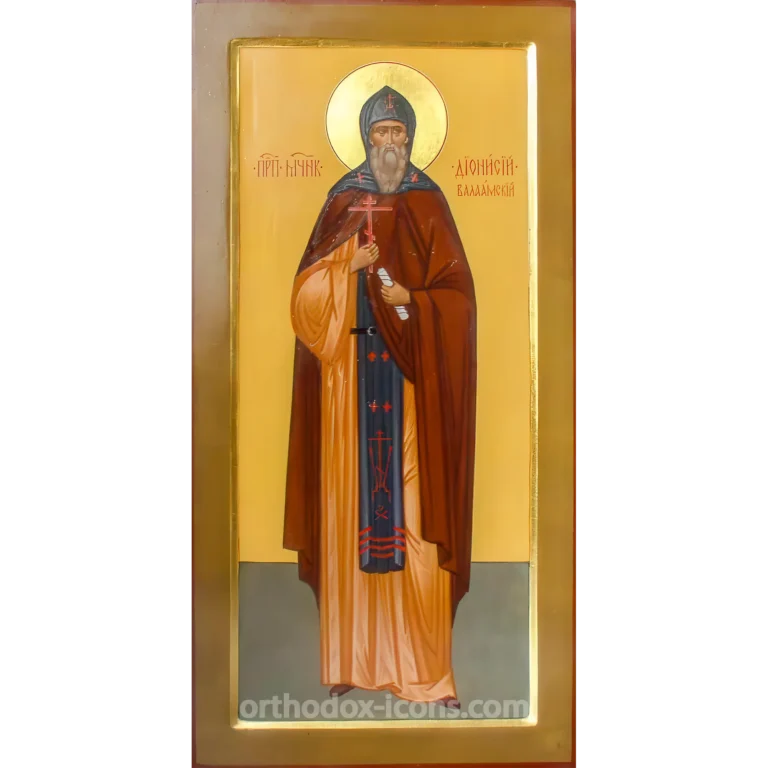
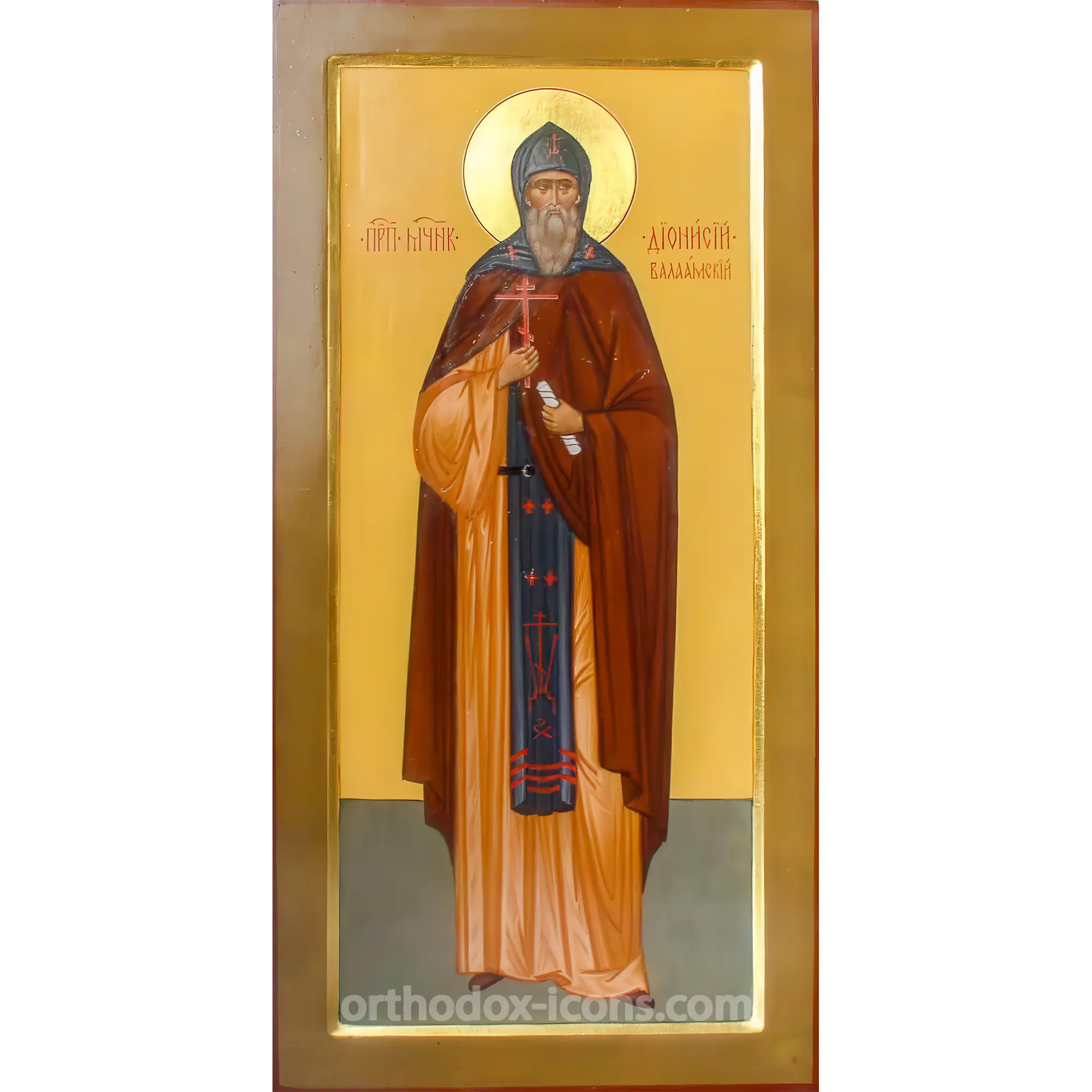
Saint Dionysius of Valaam Icon is a hand-painted full-length Orthodox icon of the Venerable Martyr Dionysius of Valaam, a monk connected with the spiritual history of Valaam Monastery. He is shown in monastic clothing, holding the martyr’s cross and a rolled scroll.
Available sizes: 13×25 cm (5.1×9.8 in), 18×31 cm (7.1×12.2 in), 30×50 cm (11.8×19.7 in). Iconostasis sizes can be made by agreement.
The icon is painted on a linden board with egg tempera, natural gesso, oak splines, 23K gold leaf (960 purity), and a protective finish. Free international shipping is included. Payment is made after you receive and approve the icon.
It is possible to paint an image in any size to order
Free shipping worldwide
Saint Dionysius of Valaam Icon is a hand-painted full-length icon of the Venerable Martyr Dionysius of Valaam, a holy monk connected with the spiritual history of Valaam Monastery. The saint is shown in monastic clothing, holding the martyr’s cross and a rolled scroll. His figure stands on a gilded background in a calm, vertical, and prayerful composition.
In this image, two important themes of Orthodox holiness are joined: monastic renunciation and martyr-like witness. The monastic garments speak of obedience, prayer, and inner labor, while the cross in the saint’s hand points to confessional faithfulness to Christ. The icon is not outwardly dramatic; its strength is in strict collectedness, a clear silhouette, and quiet prayerful depth.
The available sizes are 13×25 cm (5.1×9.8 in), 18×31 cm (7.1×12.2 in), and 30×50 cm (11.8×19.7 in). These vertical formats suit the full-length image of Saint Dionysius well. The smaller size is suitable for personal prayer, the middle size gives more space for the face, hands, garments, and inscriptions, and the larger size is appropriate for a spacious icon corner, chapel, or church row.
Icon Characteristics
| Name | Saint Dionysius of Valaam Icon |
| Saint | Venerable Martyr Dionysius of Valaam |
| Iconographic type | Full-length venerable martyr icon with cross and rolled scroll |
| Feast day | February 20; also venerated among the Valaam venerable martyrs |
| Visible features | Monastic clothing, cross in the hand, rolled scroll, gilded background, restrained vertical composition |
| Available sizes | 13×25 cm (5.1×9.8 in), 18×31 cm (7.1×12.2 in), 30×50 cm (11.8×19.7 in); iconostasis sizes by agreement |
Who This Icon of Dionysius of Valaam Is For
The icon of the Venerable Martyr Dionysius of Valaam is especially suitable for men baptized with the name Dionysius or Denis. It may be given for baptism, name day, birthday, monastic tonsure, a spiritual anniversary, or an important stage of life. A named saint icon helps a person remember his heavenly patron and turn to him in personal prayer.
The image of Saint Dionysius is also meaningful for those who venerate the saints of Valaam. In Orthodox tradition, Valaam is associated with strict prayer, monastic labor, northern silence, and spiritual endurance. For this reason, the icon is close to people for whom faithfulness, patience, obedience, inward collectedness, and grateful remembrance of the martyrs for Christ are important.
For a monastery, church, or chapel, this icon can be painted in a larger format. The full-length figure, gilded background, and clear vertical structure are well suited to an iconostasis or church space. The size can be adjusted for a specific row, icon case, wall, analogion, or prayer corner.
In a home icon corner, the icon of Dionysius of Valaam is suitable for those who seek a strict and prayerful image rather than an outwardly decorative one. It reminds the faithful of loyalty to God in circumstances of fear, pressure, loneliness, or doubt.
Prayer Before Saint Dionysius of Valaam
Before the icon of the Venerable Martyr Dionysius of Valaam, Orthodox Christians pray for strengthening of faith, patience in trials, and courage in difficult circumstances. His image reveals the meaning of Christian steadfastness: he is venerated as a monk who preserved faithfulness to Christ to the end.
Prayer before Saint Dionysius may include requests for:
- strengthening of faith and trust in God;
- patience in sorrows, illness, and life difficulties;
- courage before fear, pressure, and injustice;
- spiritual collectedness and sobriety;
- help for monastics and those carrying church obedience;
- protection of home, family, and loved ones from confusion and despondency;
- faithfulness to the Christian path in difficult times;
- remembrance and veneration of the saints of Valaam.
The martyr’s cross in the saint’s hand reminds the faithful that Christian victory is not always outward triumph. Sometimes it is shown in patience, quiet endurance, prayerful preservation of the heart, and the readiness not to deny the truth.
Life and Veneration of Saint Dionysius
The Venerable Martyr Dionysius of Valaam is connected with the history of Valaam Monastery, one of the well-known northern monasteries of the Russian Church. For centuries, Valaam was a place of strict monastic labor, prayer, solitude, and spiritual struggle. The monks of the monastery lived in difficult conditions, uniting work, liturgical life, prayer, and patience.
Saint Dionysius is venerated among the Valaam venerable martyrs who suffered during an attack on the monastery in the sixteenth century. Their witness is connected with faithfulness to Christ and to the monastic calling. For Orthodox memory, such saints are important because they did not necessarily leave behind famous writings or visible public works, but bore witness to faith by life and death.
Dionysius of Valaam is glorified as a venerable martyr. The word venerable points to his monastic path, while martyr points to his suffering for Christ. This combination gives his icon a strict and spiritually concentrated character. There is no outward militancy in the image, but there is inward firmness born of prayer and obedience.
The veneration of the Valaam venerable martyrs reminds the faithful of the cost of faith and of the meaning of monastic life. A monk does not pray only for himself, but for people, for the Church, and for the world. The icon of Dionysius of Valaam is therefore an image of quiet yet strong prayer.
Feast Day and Named Saint Meaning
The memory of the Venerable Martyr Dionysius of Valaam is connected with February 20 and with the common veneration of the Valaam venerable martyrs. For people named Dionysius, this date may become a day of prayer to their heavenly patron, thanksgiving, and spiritual attention to their own life.
The icon of Dionysius of Valaam may be chosen as a named saint icon for a man, young man, or monastic. The name Dionysius has ancient roots, but in Orthodox life its meaning is revealed through the concrete saint who bears it. For this reason, it is important that the full church name be clear in the description and inscription: Venerable Martyr Dionysius of Valaam.
This icon may be a meaningful gift for a name day, adult baptism, monastic tonsure, ordination, monastery anniversary, opening of a chapel, or addition to a church collection of icons. The elongated sizes 13×25 cm (5.1×9.8 in), 18×31 cm (7.1×12.2 in), and 30×50 cm (11.8×19.7 in) are especially well suited to the saint’s full-length image.
Features of This Hand-Painted Icon
In the presented icon, Saint Dionysius is shown full length. His figure is elongated vertically, so the image feels slender, calm, and prayerful. The gilded background surrounds the saint with warm light, while the quiet ground below keeps the composition from becoming overly decorative.
The saint is painted in monastic clothing. The dark head covering and upper mantle create a strict silhouette, while warm ochre-gold and brown-red tones in the garments give the image depth. Crosses are visible on the monastic clothing, emphasizing the saint’s spiritual path and belonging to monastic life.
In one hand, the Venerable Martyr holds the cross, the main sign of martyr-like witness. This is not merely a compositional detail, but a theological sign: the saint followed Christ and remained faithful to Him to the end. The rolled scroll in the other hand recalls spiritual instruction, monastic obedience, and inner wisdom that does not always express itself in many words.
The face of the saint is painted strictly and calmly. There is no outward emotionality; the gaze is concentrated and the features are held in prayerful restraint. This treatment is especially fitting for a venerable martyr, where the main meaning is not dramatic event, but inward faithfulness, silence, patience, and standing before God.
Iconography: Cross, Scroll, and Monastic Clothing
The cross in the hand of Saint Dionysius reveals him as a martyr. In Orthodox iconography, the martyr’s cross points to the victory of faith over fear and death. The saint does not hold a weapon and is not shown in battle. His victory is spiritual, and the cross becomes the main sign of confession of Christ.
The rolled scroll may be understood as a symbol of spiritual teaching, monastic rule, inner instruction, and the memory of obedience. It is not opened before the viewer, and this is meaningful. It recalls the hidden wisdom of monastic life, which is often expressed not in loud speech, but in prayer, humility, and faithfulness.
The monastic clothing with crosses emphasizes the venerable aspect of the saint. Dionysius of Valaam is honored not only as a martyr, but also as a monk who walked the path of monastic service. The dark and warm tones of the garments help preserve the strict northern character of the image, while the gilded background points to the saint’s heavenly glorification.
Materials, Gold Leaf, and Custom Options
The icon of Dionysius of Valaam is painted on a solid linden board with oak splines. Linden is well suited to hand-painted icons and a vertical full-length composition because it allows a smooth surface to be prepared, preserves clean lines, and supports the calm silhouette of the saint. Oak splines strengthen the board and help it keep its shape during natural changes in humidity and temperature.
The painting surface is prepared with natural chalk gesso. The icon is painted in egg tempera, a traditional technique that allows careful work on the saint’s face, gray beard, monastic clothing, crosses on the garment, martyr’s cross, rolled scroll, halo, Church Slavonic inscriptions, and quiet ground.
This version uses 23K gold leaf (960 purity) on the background and halo. The gilding gives the image solemnity without making it overly decorative. It emphasizes the holiness of the saint while keeping attention on the face, hands, and monastic silhouette. For an individual order, the size, field colors, degree of gilding, inscriptions, protective case, or larger church format can be discussed.
How to Choose the Size
The 13×25 cm (5.1×9.8 in) size is suitable for a small home prayer shelf, monastic cell, personal space, or named saint icon. In this format, the saint’s general silhouette, cross, scroll, halo, and gilded background remain clear.
The 18×31 cm (7.1×12.2 in) size gives more space for the face, beard, hands, folds of the monastic clothing, crosses on the garment, and inscriptions. This format is often chosen as a personal named saint icon or as a blessing for someone who venerates the saints of Valaam.
The 30×50 cm (11.8×19.7 in) size is suitable for a large home icon corner, chapel, monastery room, parish space, or church row. In this format, the full-length image of the Venerable Martyr Dionysius appears especially solemn, and the vertical figure, gilded background, and monastic clothing are perceived as a complete and expressive whole.
Iconostasis sizes are agreed individually. For church placement, the proportions of the row, distance from the faithful, lighting, color environment, and neighboring icons should be considered. The icon of Dionysius of Valaam can be painted as an independent church icon or as part of a row of Valaam saints.
Blessing and Care
The icon of the Venerable Martyr Dionysius of Valaam may be blessed in an Orthodox church after it is received, or brought to your parish for blessing. A blessed icon is treated as a sacred image for prayer, thanksgiving, and turning to God through the intercession of the saint.
A hand-painted icon should be kept away from direct sunlight, heaters, moisture, soot, and sudden temperature changes. Do not wipe the surface with wet cloths, alcohol wipes, household chemicals, or abrasive materials.
Dust should be removed gently with a dry soft brush or dry cloth without pressure. Special care should be taken around the gilded background, halo, face, hands, cross, scroll, and inscriptions. For additional protection, a wooden glazed icon case can be used to protect the icon from dust, accidental touch, mechanical damage, and environmental influence.
Questions and Answers
Who is shown on the Saint Dionysius of Valaam Icon?
The icon shows the Venerable Martyr Dionysius of Valaam, a holy monk connected with Valaam Monastery and venerated among the Valaam venerable martyrs.
Why is Saint Dionysius called a venerable martyr?
The word venerable points to his monastic life, while martyr points to his suffering for Christ. He is honored as a monk who remained faithful to God unto martyrdom.
What does the cross in Saint Dionysius’ hand mean?
The cross is the traditional sign of martyrdom. It points to confession of Christ, spiritual victory over fear, and faithfulness to God to the end.
What does the rolled scroll symbolize?
The rolled scroll recalls spiritual teaching, monastic obedience, inner instruction, and the hidden wisdom of prayerful life.
What do Orthodox Christians pray for before this icon?
People pray for stronger faith, patience during trials, courage, spiritual collectedness, help for monastics, and faithfulness to Christ in difficult circumstances.
Who is this hand-painted icon suitable for?
It is suitable for men named Dionysius or Denis, monastics, Orthodox families, churches, chapels, and those who venerate the saints of Valaam.
What sizes are available for this icon?
The available sizes are 13×25 cm (5.1×9.8 in), 18×31 cm (7.1×12.2 in), and 30×50 cm (11.8×19.7 in). Iconostasis sizes can be discussed individually.
Can this icon be ordered for a church or chapel?
Yes. The icon can be painted in a larger or iconostasis format, with size, inscriptions, gilding, and icon case agreed according to the place of prayer.
What materials are used for the icon?
The icon is painted on a linden board with oak splines, natural chalk gesso, egg tempera, 23K gold leaf (960 purity), and a protective finish.
How should a hand-painted Dionysius of Valaam icon be cared for?
Keep the icon away from moisture, direct sunlight, heat, soot, and sudden temperature changes. Dust it gently with a dry soft brush or cloth, without water, alcohol, or household cleaners.
| Dimensions | 13x25cm (5.1×9.8 in), 18x31cm (7.1×12.2 in), 30x50cm (11.8×19.7 in) |
|---|---|
| Name | Dionisius |