Pimen of Ugresh Orthodox Icon
Price range: $700 through $2250
Available sizes: 17×21 cm (6.7×8.3 in), 20×24 cm (7.9×9.4 in), 27×31 cm (10.6×12.2 in), 30×40 cm (11.8×15.7 in). Larger iconostasis sizes can be made by agreement.
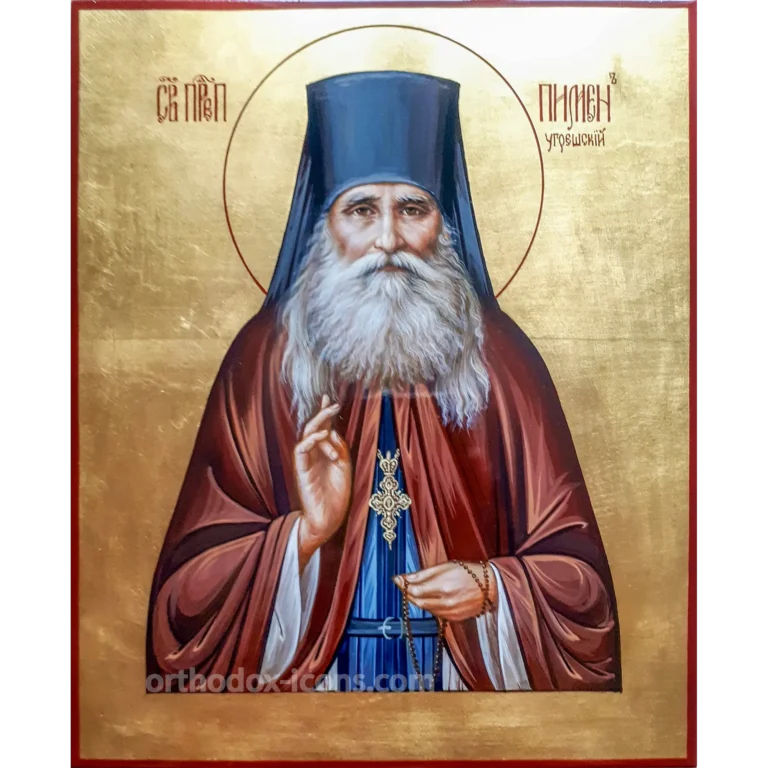
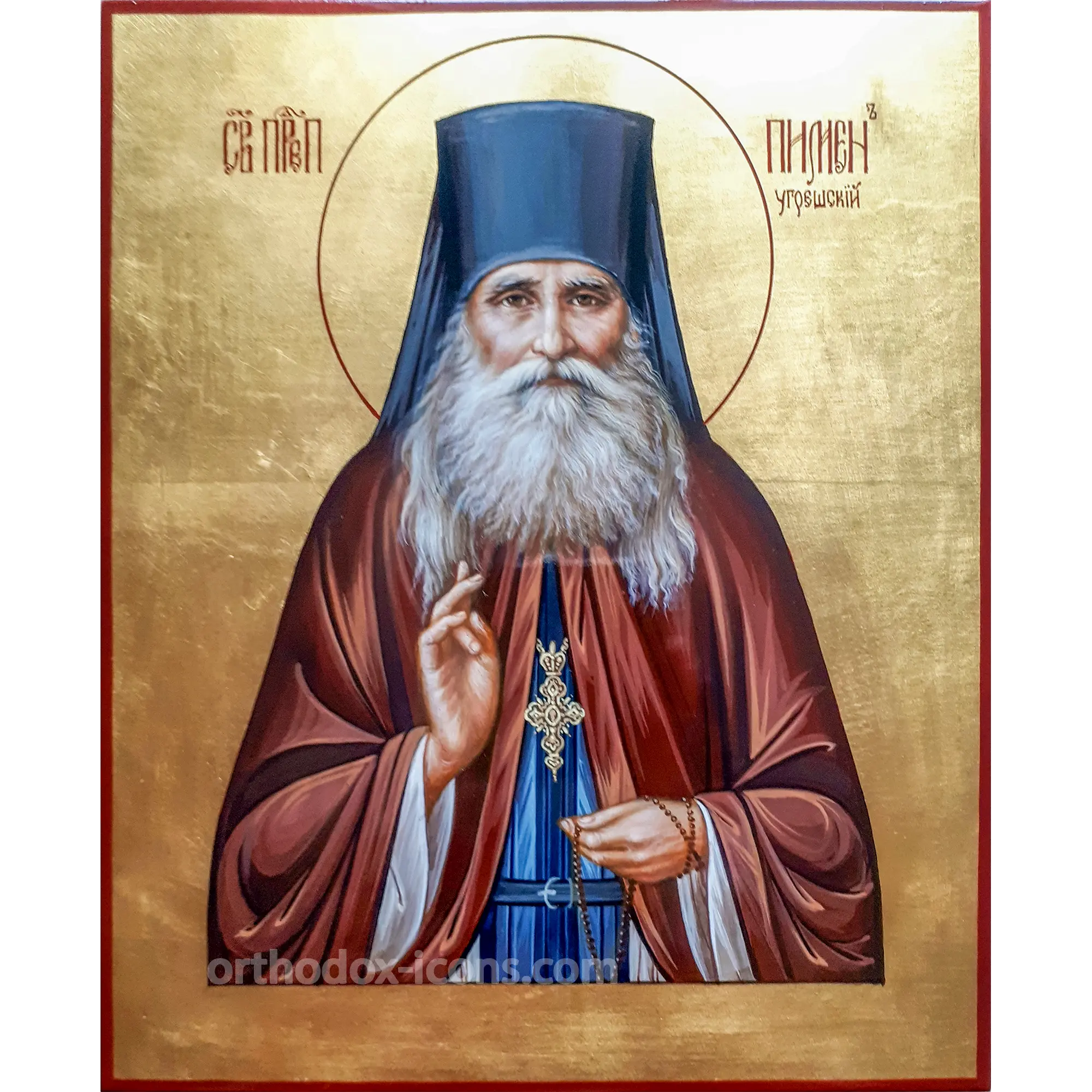
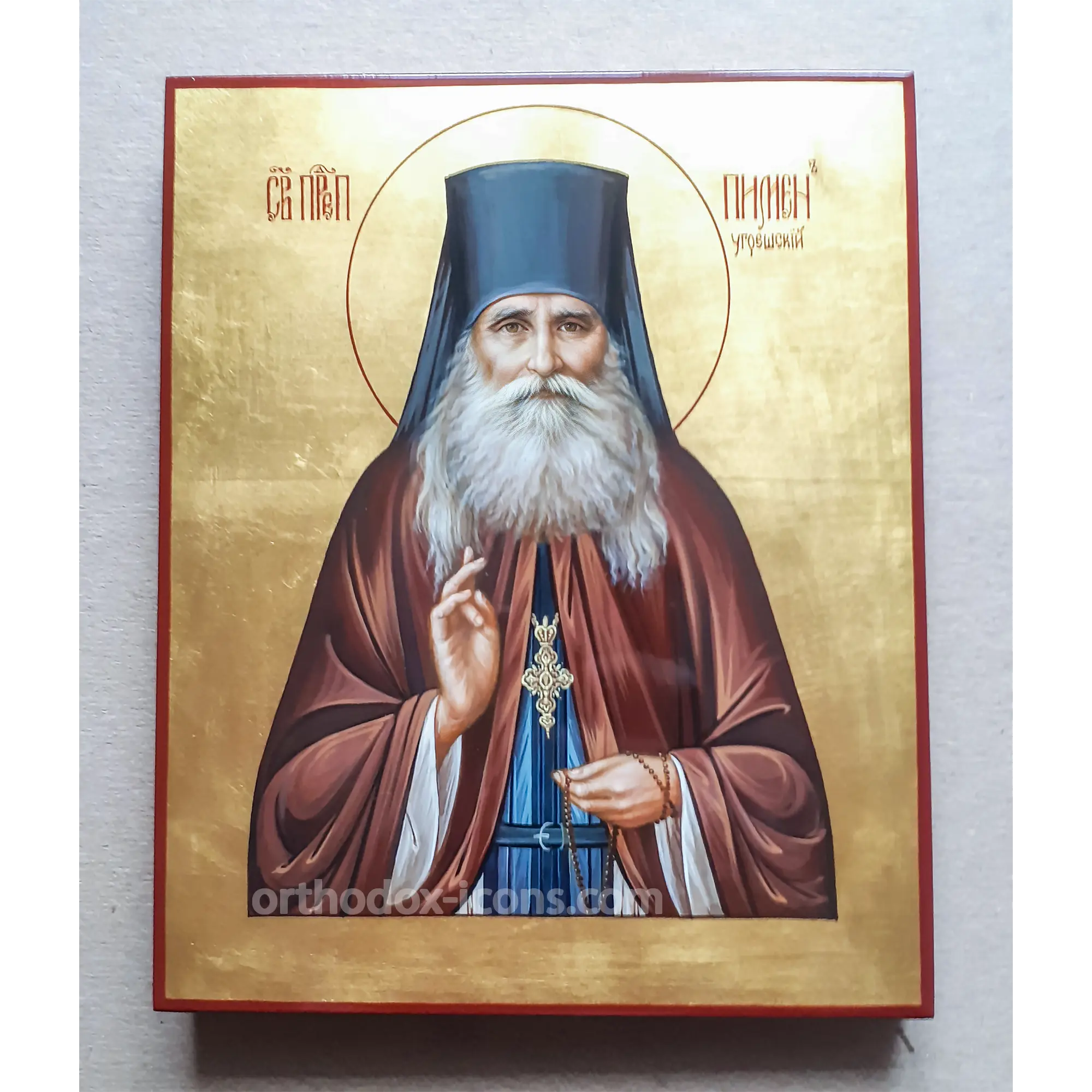
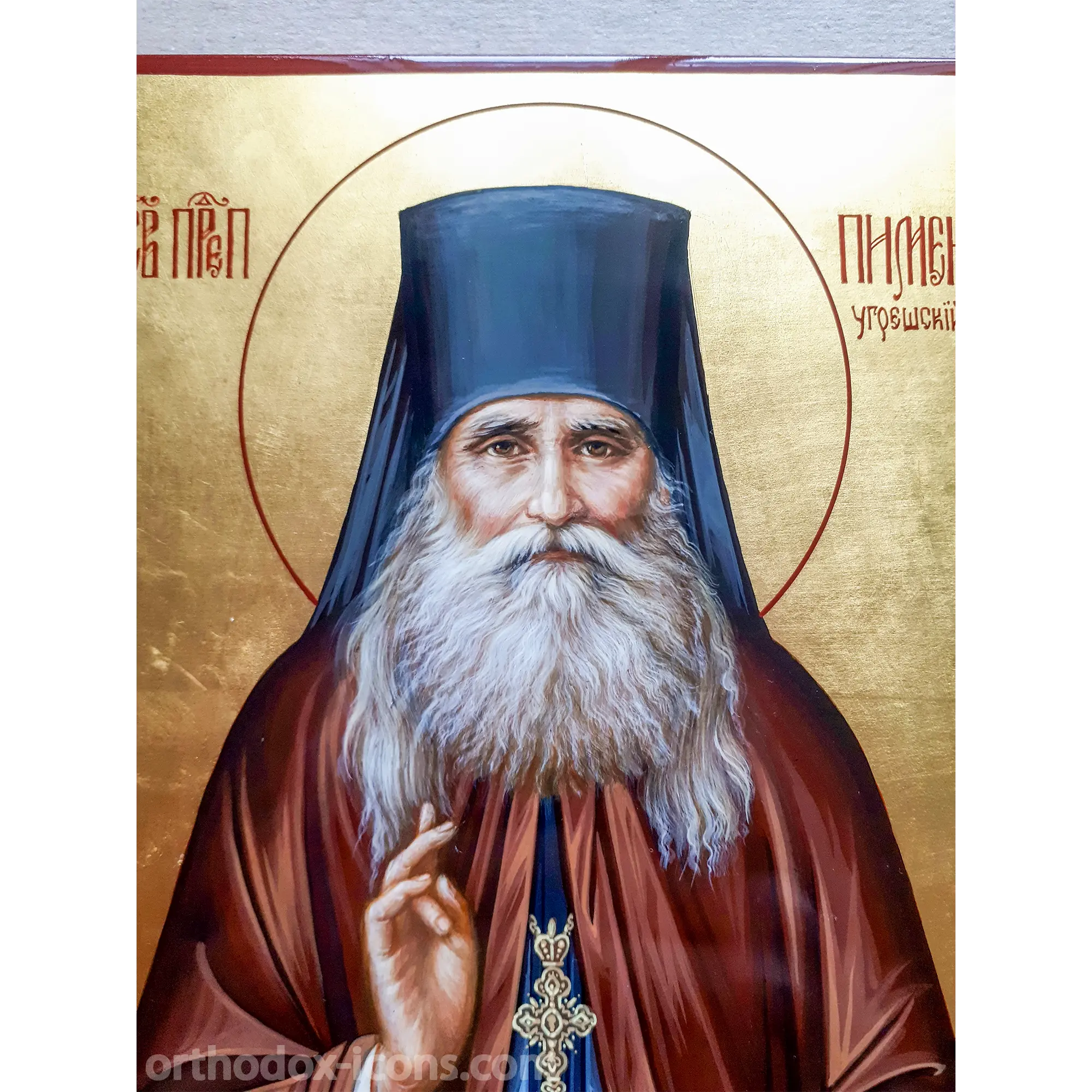
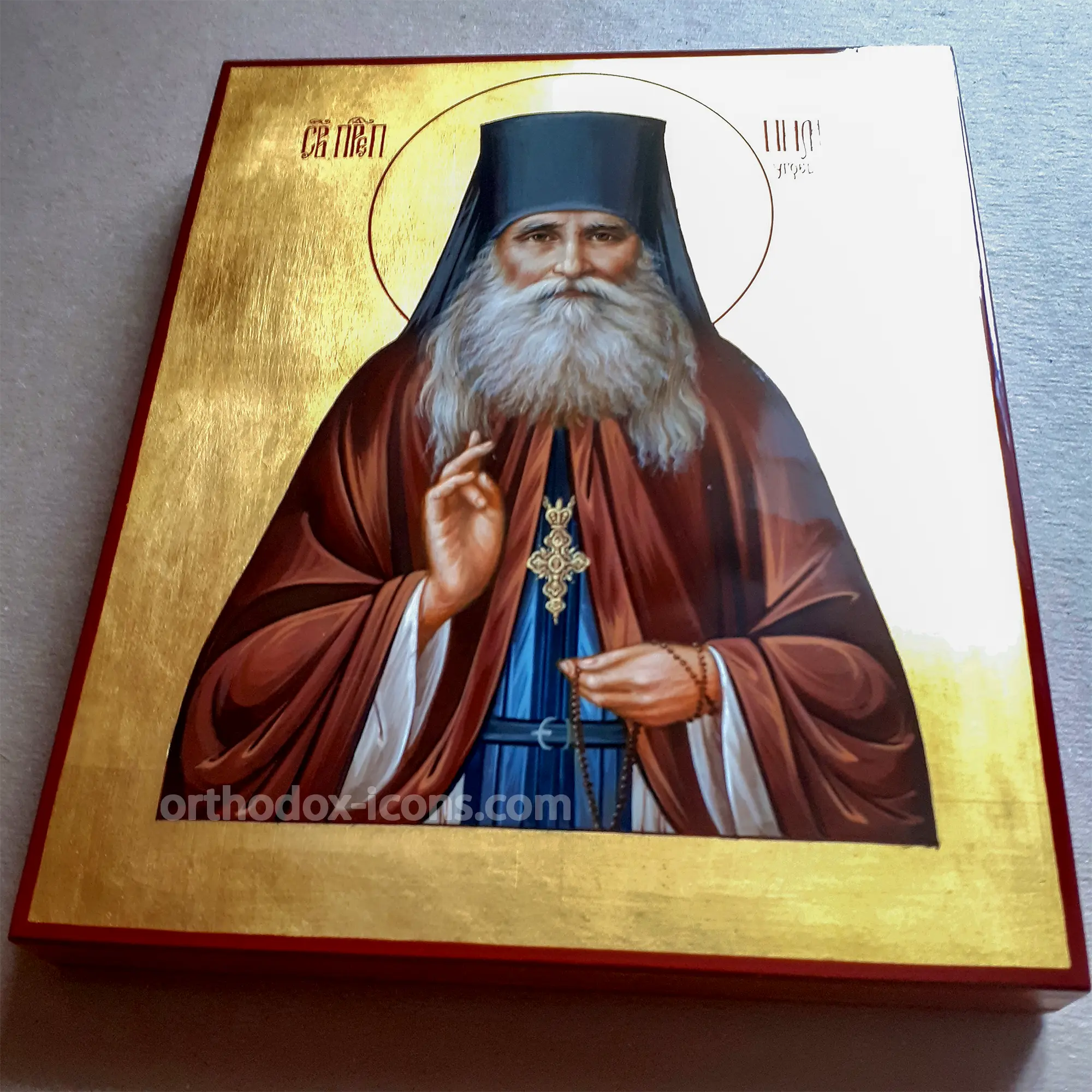
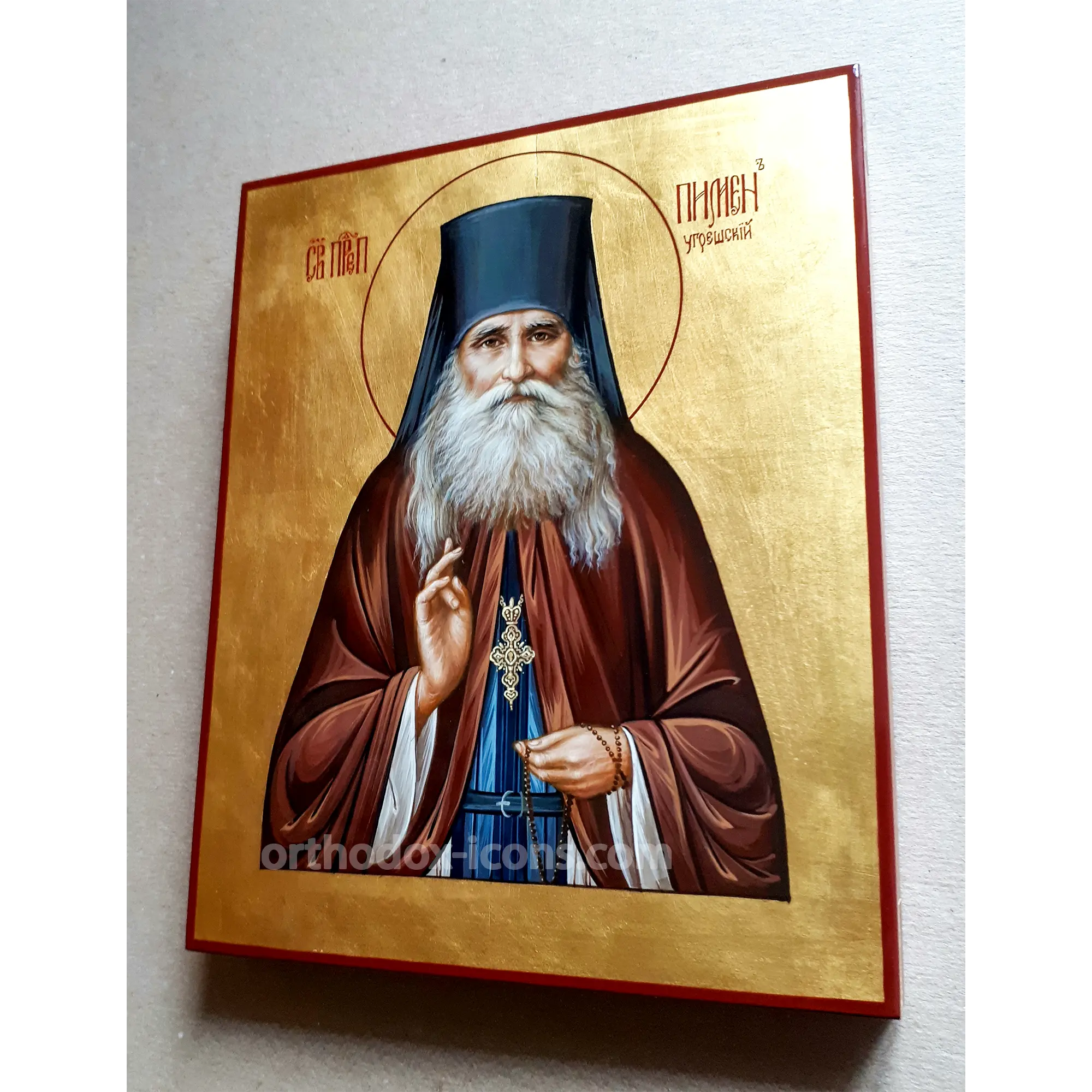
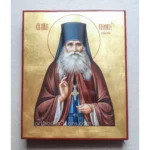
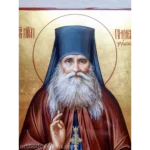
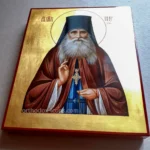
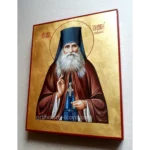
This hand-painted Pimen of Ugresh Orthodox Icon depicts Saint Pimen of Ugresh, archimandrite of the Nikolo-Ugresh Monastery, a nineteenth-century Russian venerable father, spiritual guide, and organizer of monastic life. He is shown half-length in monastic clothing, with a dark klobuk, blue inner garment, warm brown-red mantle, prayer rope in his left hand, pectoral cross, blessing right hand, gold halo, and calm gilded background.
Prayer before this icon is often connected with strengthening of faith, patience, spiritual discernment, help in monastic and Church service, raising children, comfort in inner sorrow, good ordering of work, and patron saint protection for people named Pimen. The icon is painted on a linden wood board with braces, pavoloka, chalk gesso, egg tempera, 23K gold leaf (960 purity), and a protective finish. Free international shipping is included. Payment is made after you receive and approve the icon.
It is possible to paint an image in any size to order
Free shipping worldwide
This hand-painted Pimen of Ugresh Orthodox Icon is a prayerful image of Saint Pimen of Ugresh, archimandrite of the Nikolo-Ugresh Monastery, a nineteenth-century Russian saint who joined monastic quiet, great diligence, pastoral discernment, and care for the spiritual order of a monastery. In the world he was Peter Dmitrievich Myasnikov. From youth he was drawn to church life, the reading of Holy Scripture, and monasticism. His path led through the Novoezersky Monastery, Optina Hermitage, and the Nikolo-Ugresh Monastery, where he became a cell attendant, monk, hieromonk, superior, and finally archimandrite. In this icon Saint Pimen is shown close to the one who prays: in monastic clothing, with a prayer rope, pectoral cross, and blessing hand.
The image of Saint Pimen of Ugresh is especially meaningful for those who value patient service. The saint did not seek outward fame, yet through daily labor, prayer, obedience, and care for the brethren, the Nikolo-Ugresh Monastery received new order and spiritual growth under him. His icon reminds the faithful that holiness is often revealed not in dramatic public acts, but in faithfulness to the work entrusted to a person: coming to church services, supporting another person, enduring a difficult period, not abandoning prayer, and preserving peace and order in the soul.
In this icon Saint Pimen is painted half-length against a gilded background. He wears a dark monastic klobuk, a blue inner garment, and a warm brown-red mantle. A pectoral cross is visible on his chest; in his left hand he holds a prayer rope, and his right hand is raised in blessing. The face is gentle and attentive, with quiet sadness and deep inner collectedness. There is no outward ceremonial splendor in this image. It works differently: quietly, warmly, and with the consoling tone of an elder.
Available sizes: 17×21 cm (6.7×8.3 in), 20×24 cm (7.9×9.4 in), 27×31 cm (10.6×12.2 in), and 30×40 cm (11.8×15.7 in). Larger iconostasis sizes can be made by agreement. The 17×21 cm and 20×24 cm formats are convenient for a small home prayer shelf, personal icon corner, study, or patron saint gift. The 27×31 cm size allows the face of the saint, the texture of the beard, the prayer rope, pectoral cross, folds of the mantle, and gold background to be seen more clearly. The 30×40 cm format is suitable for a spacious home iconostasis, monastic cell, parish church, chapel, or separate kiot.
The icon of Saint Pimen of Ugresh is especially appropriate as a name saint icon for a man or boy named Pimen. This is a rare name, so such an icon feels very personal and precise. It may be given for baptism, name day, birthday, monastic tonsure, ordination, beginning of studies, moving to a new home, or an important family occasion. The prayerful meaning is wider than name patronage alone: before this saint people pray for patience, spiritual discernment, help in raising children, strengthening in good work, comfort in inner sorrows, and good ordering of Church or family life.
Features of This Icon
The main feature of this icon is the intimate and very personal image of Saint Pimen. He is not shown in a complex scene from his Life and not against monastery buildings, but in prayerful presence. The half-length format helps the viewer focus on what matters most: the face, hands, prayer rope, and cross. The icon is well suited for home prayer because it does not overload the eye and fits naturally into a family icon corner beside icons of Christ, the Mother of God, Saint Nicholas, Saint Sergius of Radonezh, Saint Seraphim of Sarov, the Optina Elders, and other beloved saints.
The face of the venerable father is painted with soft elder-like expressiveness. Deep eyes, grey hair, a long white beard, and a calm gaze convey the experience of a man who spent many years in monastic obedience and knew the value of inner order. There is no sharp severity in this face. It invites trustful prayer. Before such an image one may ask not only for help with outward difficulties, but also for quiet of heart, patience, wisdom, and the ability not to fall apart from weariness.
The right hand of Saint Pimen is raised in blessing. This is an important detail for the image of a monastic guide and archimandrite. The gesture is not domineering; it is calm, open, and pastoral. The saint seems to address the one who prays with a quiet reminder: do not hurry, do not grow bitter, do not abandon prayer, and do your work before God. For Saint Pimen, who spent many years ordering a monastery, such a gesture is especially natural. It speaks of guidance without harshness, instruction without pressure, and spiritual support.
The prayer rope in the left hand emphasizes the saint’s monastic labor. It is not merely a recognizable attribute, but a sign of unceasing prayer, inner discipline, and remembrance of God. In the life of Saint Pimen, outward work was very great: monastery administration, building churches, care for the brethren, practical organization, and spiritual guidance. Yet none of this would have been fruitful without a foundation of prayer. The prayer rope helps show him not only as a capable organizer, but first of all as a man of prayer.
The pectoral cross on the saint’s chest recalls his priestly and archimandrite service. Saint Pimen was not simply a monk withdrawn from the world, but a pastor entrusted with people, a monastery, liturgical life, and spiritual care. The cross in the center of the composition gathers the whole image: his path was one of service, responsibility, and daily bearing of his cross without complaint.
The gilded background makes the icon bright and solemn. Gold here is not perceived as outward luxury; it helps separate the prayerful image from ordinary space and recalls the holiness to which a person comes through repentance, labor, and the grace of God. The fine red outline around the edges and halo gives the image a gathered quality, while the warm tones of the mantle make the icon living and domestic.
Iconography of Saint Pimen of Ugresh
In iconography Saint Pimen of Ugresh is shown as a monk and spiritual guide. In this icon his monastic dignity is especially clear: the klobuk, mantle, prayer rope, cross, and blessing hand. This type does not present the outer biography of the saint so much as the inner result of his life. Before us is a man who passed through obedience, labor, prayer, and pastoral responsibility.
The dark klobuk and monastic clothing speak of renunciation of vanity. For Saint Pimen this was not a form or outward status. Even in youth he sought monastic life, read Holy Scripture and the books of ascetics, and searched for his spiritual path. His entry into the monastery was a response to an inner calling, not a beautiful gesture. Therefore the monastic clothing in the icon is perceived as a sign of long and consistent faithfulness to the chosen path.
The blue inner garment and warm mantle create a beautiful color contrast. Blue gives the image depth and strictness, while the brown-red tones of the mantle recall earthly labor, humility, and pastoral warmth. The icon does not feel cold. Its color harmony is gentle and consoling: the gold background, white beard, dark klobuk, and warm folds of the garment create the image of an elder to whom one may turn with trust.
The half-length format makes the icon especially convenient for home veneration. Unlike a full-length image, it contains fewer details that might distract from prayer. Attention remains on the saint’s face, blessing hand, and prayer rope. This image is well suited for a person who wants not only a patron saint icon, but also a quiet reminder of spiritual collectedness, patience, and prayerful attention.
Prayer Before the Icon of Saint Pimen
Before the icon of Saint Pimen of Ugresh, Orthodox Christians may pray for strengthening of faith, patience, spiritual discernment, and help in daily work. His Life is especially close to those who bear responsibility for others: parents, mentors, clergy, teachers, leaders, elders in the family, and people involved in Church service. Saint Pimen shows that care for people requires not only a good heart, but also order, patience, prayer, and the ability not to fall into despair or irritation.
- for strengthening of faith and hope;
- for patience in long labors and family cares;
- for help in raising children and spiritual guidance;
- for support in monastic, priestly, and Church service;
- for wisdom for leaders, teachers, and mentors;
- for comfort in inner sorrow, despondency, and weariness;
- for good ordering of a home, community, parish, or monastery work;
- for preservation of prayer amid many responsibilities;
- for help in study, obedience, discipline, and good labor;
- for heavenly patronage for people named Pimen.
Prayer before the icon of Saint Pimen is not a request for an easy life without work. His own path was not easy. But he teaches how to pass through difficulties without complaint or inner collapse. Before this image one may ask God, through the saint’s prayers, for calmness, attention, endurance, good order in work, and help where much depends on daily faithfulness.
Brief Life of Saint Pimen
Saint Pimen of Ugresh, in the world Peter Dmitrievich Myasnikov, was born in Vologda in a pious merchant family. From childhood he loved the church, began reading Holy Scripture early, and gradually became firm in the desire to dedicate himself to monastic life. In youth he was deeply moved by spiritual books, especially ascetic writings, and the thought of renouncing the world became increasingly serious for him.
His path to monasticism was not a sudden impulse. He sought spiritual guidance, visited monasteries, and was formed by the tradition of Russian monastic life. The Novoezersky Monastery, Optina Hermitage, and later the Nikolo-Ugresh Monastery became important stages of his spiritual road. At Ugresh he bore various obediences and gradually became known for humility, order, diligence, and attention to people.
In the Nikolo-Ugresh Monastery Saint Pimen passed through the service of cell attendant, monk, hieromonk, superior, and archimandrite. His service was connected not only with prayer, but also with many practical labors. He cared for the brethren, the church services, construction, discipline, and the whole ordering of monastery life. Under him the monastery was strengthened outwardly and spiritually.
The saint did not separate prayer from work. He understood monastic life as a whole: church services, obedience, inner attention, care for people, and patient fulfillment of daily duties. This is why his image is close not only to monastics, but also to all who have many responsibilities and need help not to lose prayer and peace of heart.
Saint Pimen of Ugresh reposed in the nineteenth century and is honored as a venerable father connected with the Nikolo-Ugresh Monastery and the Moscow land. His memory has been preserved as the memory of a quiet and strong spiritual organizer, elder, and pastor whose holiness was revealed through faithful service rather than external fame.
Commemoration and Patron Saint Meaning
Saint Pimen of Ugresh is commemorated on August 30 according to the new calendar, corresponding to August 17 according to the old calendar. He is also remembered among the Moscow saints. For a person named Pimen, this date may be a name day if Saint Pimen of Ugresh is the heavenly patron chosen at baptism.
A patron saint icon of Saint Pimen is suitable as a gift for baptism, name day, birthday, monastic tonsure, ordination, beginning of study, a new home, or an important family event. The image is especially meaningful for people who need patience, order, prayerful attention, and quiet endurance in daily responsibilities.
The name Pimen is connected with other saints as well, so when choosing a patron saint icon it is important to know in honor of which heavenly patron the person was baptized. If the patron is Saint Pimen of Ugresh, this image is especially precise. In a home iconostasis it becomes a reminder of patience, spiritual discipline, good mentorship, and calm faithfulness to God.
Materials, Gold Leaf, and Custom Options
The icon of Saint Pimen of Ugresh is painted on a linden wood board. Applied or mortise braces are used for stability. Pavoloka and chalk gesso are applied to the board, and then the image is painted in egg tempera. This traditional icon-painting method makes it possible to render the saint’s face, grey beard, hands, prayer rope, cross, monastic clothing, and inscriptions with care.
In this version, 23K gold leaf (960 purity) plays an important role. The gilded background and halo create a warm prayerful space in which the figure of the venerable father appears especially collected. The gold does not overload the icon, but gently supports its spiritual meaning: the saint is shown not as an earthly administrator, but as a glorified ascetic to whom the faithful turn in prayer.
The color harmony is built on a calm combination of gold, dark blue, brown-red, and white. The blue garment and dark klobuk give the icon depth; the warm mantle softens the image; the white beard and hands create a living light accent. The fine red line around the halo and edges gathers the composition and makes it complete.
For an individual commission, the size, degree of gilding, background tone, inscription style, general color harmony, kiot, and format for a home, church, chapel, or iconostasis row can be discussed. In a larger version it is especially important to preserve the softness of the face, clarity of the blessing hand, readability of the prayer rope and cross, and the calm balance of the whole composition.
Choosing the Size
The 17×21 cm (6.7×8.3 in) size is suitable for a small home shelf, personal prayer place, study, or compact patron saint gift. In this format the main details remain readable: the saint’s face, halo, blessing hand, prayer rope, and pectoral cross.
The 20×24 cm (7.9×9.4 in) size remains convenient for home use, but gives more space for painting the face, beard, hands, folds of the mantle, and gilded background. This format is often chosen for a family iconostasis or as a gift for an adult.
The 27×31 cm (10.6×12.2 in) size reveals the painting and details more fully: soft transitions in the face, the grey beard, prayer rope, cross, folds of the vestment, and fine red outline become more visible. This is a good option for a spacious home icon corner, separate kiot, or prayer place.
The 30×40 cm (11.8×15.7 in) size is suitable for more solemn placement in a large home, prayer room, church, chapel, or iconostasis row. Iconostasis sizes are selected individually with attention to placement height, lighting, neighboring icons, and the whole rhythm of the church space.
Placement, Blessing, and Care
The icon of Saint Pimen of Ugresh may be placed in a home icon corner beside icons of Christ, the Mother of God, the Guardian Angel, Saint Nicholas the Wonderworker, Saint Sergius of Radonezh, Saint Seraphim of Sarov, the Optina Elders, and other saints close to the family. For a person named Pimen, this image may become a personal patron saint icon and a constant reminder of heavenly intercession.
After receiving the icon, it may be blessed in an Orthodox church. A blessed icon is intended for prayer, thanksgiving to God, and asking Saint Pimen for patience, wisdom, strengthening of faith, help in labor, raising children, comfort in inner sorrows, and good ordering of life.
A hand-painted icon should be protected from direct sunlight, moisture, overheating, smoke, soot, and sudden temperature changes. Do not wipe the surface with wet cloths, alcohol, household cleaners, or rough fabric. The face of the saint, gilded background, halo, hands, prayer rope, cross, and inscriptions require especially careful handling.
Dust should be removed gently with a soft dry brush and without pressure. For protection of the painting and gilding, a wooden glazed kiot is recommended. It helps preserve the icon from dust, humidity, and accidental damage, especially when the image is placed in an active home area, study, church, or intended for long-term use.
Questions and Answers
Who is depicted in the Pimen of Ugresh Orthodox Icon?
The icon depicts Saint Pimen of Ugresh, born Peter Dmitrievich Myasnikov, archimandrite of the Nikolo-Ugresh Monastery and a Russian venerable father of the nineteenth century.
Why is Saint Pimen shown in monastic clothing?
He was a monk, hieromonk, and archimandrite, so the icon shows him in monastic clothing, with a klobuk, mantle, prayer rope, and pectoral cross.
What does the prayer rope in Saint Pimen’s hand mean?
The prayer rope points to unceasing prayer, monastic collectedness, inner discipline, and the spiritual labor of the saint.
What does the blessing hand signify?
The blessing hand presents Saint Pimen as a spiritual guide and pastor who supports, instructs, and strengthens the faithful without harshness.
What do Orthodox Christians pray for before this icon?
Prayer before this icon is often connected with faith, patience, spiritual discernment, help in labor, raising children, comfort in inner sorrow, and good ordering of life.
Who may choose this icon as a patron saint icon?
This icon is especially suitable for a person named Pimen, and also for monastics, clergy, teachers, parents, mentors, and those who value patient service to God and people.
When is Saint Pimen of Ugresh commemorated?
Saint Pimen of Ugresh is commemorated on August 30 according to the new calendar, corresponding to August 17 according to the old calendar. He is also remembered among the Moscow saints.
Why is he called of Ugresh?
This name is connected with the Nikolo-Ugresh Monastery, where Saint Pimen served for many years as superior and archimandrite.
Where can this icon be placed?
The icon is suitable for a home icon corner, personal prayer place, study, monastic cell, church, chapel, or iconostasis row.
How should a hand-painted icon with gold leaf be cared for?
Keep the icon away from moisture, direct sunlight, heat, smoke, and mechanical damage. Dust it gently with a soft dry brush, and consider a glazed kiot for long-term protection.
| Dimensions | 17x21cm (6.7×8.3 in), 20x24cm (7.9×9.4 in), 27x31cm (10.6×12.2 in), 30x40cm (11.8×15.7 in) |
|---|---|
| Name | Poemen |