Orthodox Icon of Saint Elizabeth
Price range: $500 through $1350
Available sizes: 13×25 cm (5.1×9.8 in), 18×31 cm (7.1×12.2 in), 30×50 cm (11.8×19.7 in); larger iconostasis sizes can be made by individual request.
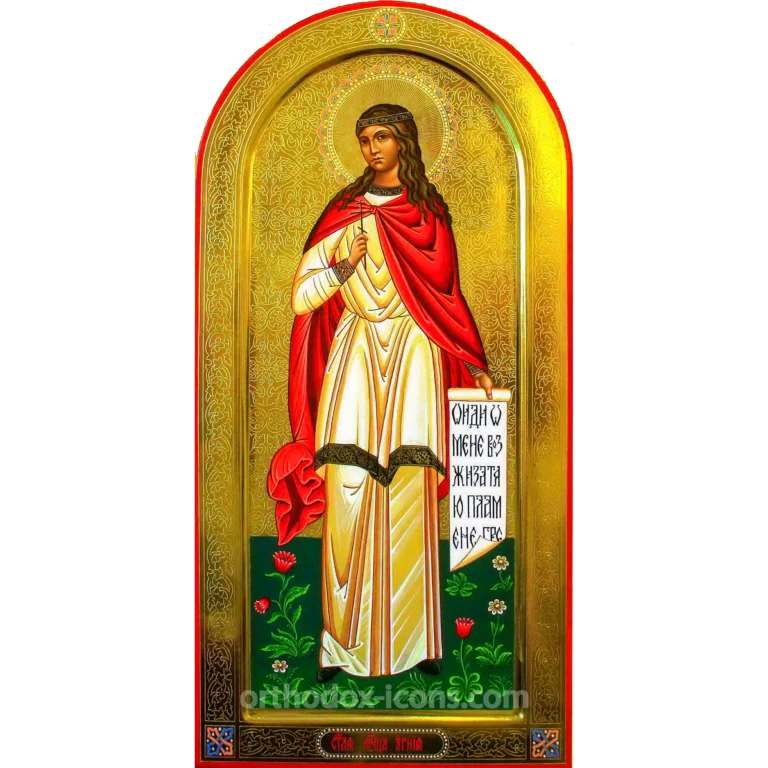
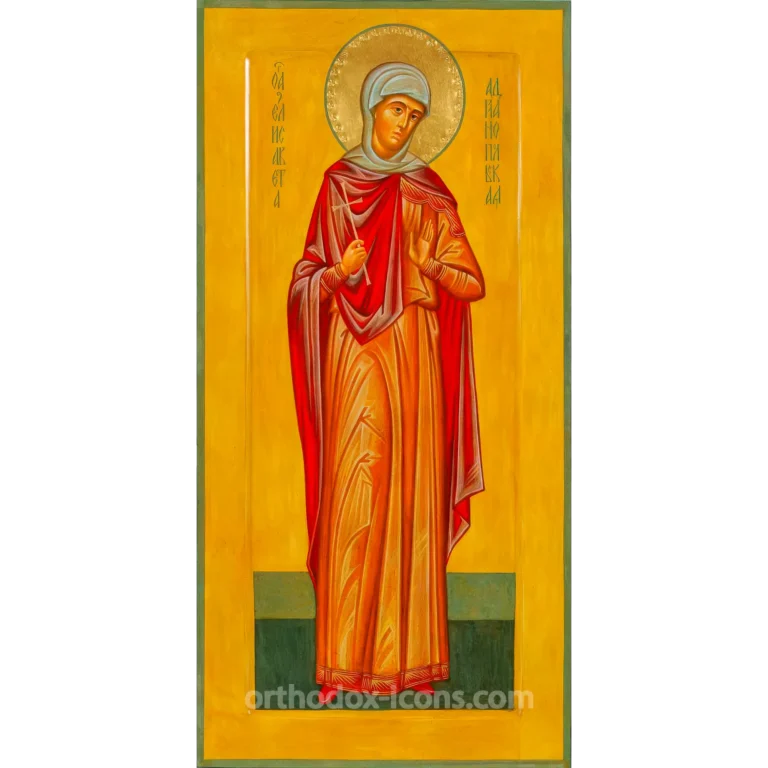
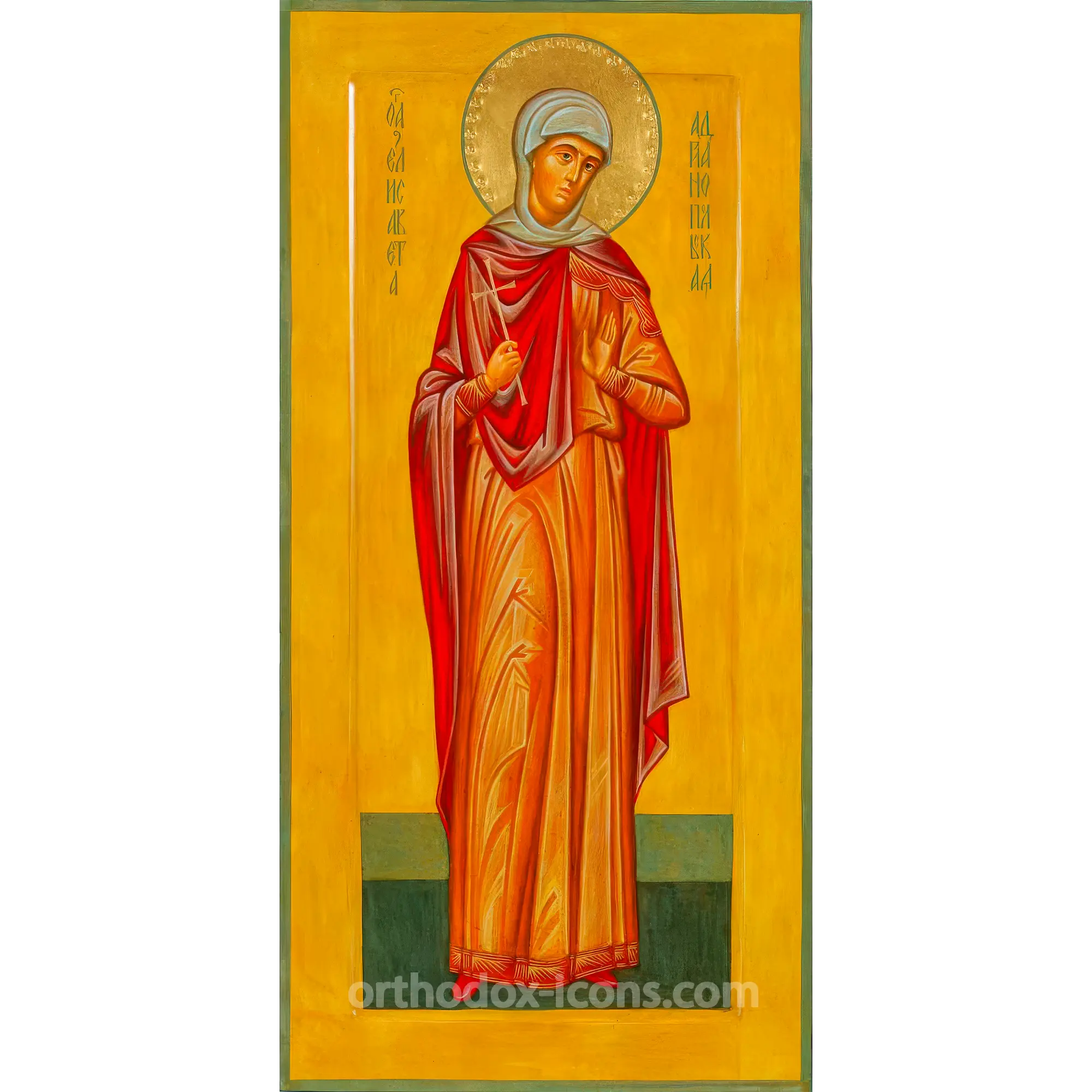
Orthodox Icon of Saint Elizabeth is a hand-painted full-length icon of the Holy Martyr Elizabeth of Adrianople, an early Christian saint who gave her life for faith in Christ. She is shown in a bright red maphorion, symbolizing martyrdom, and a golden-ocher tunic. In her right hand she holds a martyr’s cross, while her left hand is held to her chest in a gesture of sincere confession.
The icon is painted in a kovcheg on a warm yellow-ocher background, with a gold halo delicately decorated by pearl-like dotted engraving and a strict green ground.
Prayer focus: courage, spiritual endurance, strengthening of faith, consolation in trials, healing, protection from persecution, and help in building a faithful Christian family.
Materials: wooden board with kovcheg, oak support slats, chalk gesso, egg tempera with mineral pigments, gold leaf on the halo, and protective oil or varnish.
It is possible to paint an image in any size to order
Free shipping worldwide
Orthodox Icon of Saint Elizabeth is a hand-painted icon of the Holy Martyr Elizabeth of Adrianople, an early Christian saint whose steadfast faith and courage shine through the centuries. Having given her life for Christ in the third century, Saint Elizabeth became an example of spiritual strength, showing that true faith is stronger than earthly fear and bodily suffering.
The presented full-length icon is painted in warm, light tones with a restrained use of gold leaf. Saint Elizabeth is shown in a red maphorion and a golden-ocher tunic, holding the martyr’s cross. Her calm face, modest veil, sincere gesture, and simple upright posture make the image clear, prayerful, and deeply feminine without becoming decorative or sentimental.
Icon Characteristics
| Full name | Orthodox Icon of Saint Elizabeth |
| Saint depicted | Holy Martyr Elizabeth of Adrianople |
| Iconographic type | Full-length martyr with a cross in her hand |
| Board | Wooden icon board with kovcheg, oak support slats, pavoloka, chalk gesso |
| Painting technique | Egg tempera with natural mineral pigments |
| Gilding and decor | Gold leaf on the halo; pearl-like dotted engraving around the halo |
| Available sizes | 13×25 cm (5.1×9.8 in), 18×31 cm (7.1×12.2 in), 30×50 cm (11.8×19.7 in); iconostasis sizes by request |
Who This Icon Is For
The icon of the Martyr Elizabeth of Adrianople is first of all a patron saint icon for women and girls baptized with the name Elizabeth. It may be given for baptism, name day, patron saint day, coming of age, marriage, birthday, or another important spiritual occasion. A personal patron saint icon helps a person turn in prayer to her heavenly intercessor and remember the Christian meaning of her name.
This icon is also meaningful for any Christian passing through a difficult season. The image of a martyr is often chosen when a person needs spiritual strengthening, courage, patience, and protection from despair. Saint Elizabeth’s witness speaks quietly but firmly: faith can remain whole even when circumstances are painful and human strength feels small.
The icon may be placed in a home icon corner, child’s room, chapel, church, or family prayer space. Its full-length format and restrained warm palette make it suitable both as a personal gift and as a solemn Orthodox image for prayer.
Prayer Before the Icon of Saint Elizabeth
Orthodox Christians turn to the Holy Martyr Elizabeth of Adrianople with prayers for courage, spiritual endurance, patience in trials, strengthening of faith, protection from slander and persecution, healing, and help in creating a strong Christian family. Her example is especially close to people who seek to remain faithful to Christ under pressure.
- courage, spiritual endurance, and patience in hard circumstances;
- strengthening of weakened faith and deliverance from despair;
- protection from persecution, slander, unjust accusations, and oppression;
- help in building a strong and faithful Christian family;
- healing from bodily and spiritual illness;
- guidance for loved ones who have lost their way or fallen away from faith.
An Orthodox icon is not a charm or a guarantee of outward safety. Prayer before Saint Elizabeth is a turning to God through the intercession of a holy martyr. Her icon helps the person praying gather the heart, remember courage, and ask for the strength to remain faithful without bitterness.
Brief Life of the Martyr Elizabeth of Adrianople
Saint Elizabeth suffered for the confession of the Christian faith in the third century in the city of Adrianople in Thrace, in the territory of modern Turkey. At that time pagan rulers of the Roman Empire cruelly persecuted Christians. In Adrianople, Bishop Alexander zealously preached the Gospel and baptized many people despite threats and persecution.
When the regional ruler learned of his activity, he ordered the bishop to be seized. Alexander was tortured and forced to renounce Christ and sacrifice to idols, but he endured with patience. A pagan soldier named Heraclius witnessed these sufferings. Struck by the bishop’s endurance and the help of God, he believed in Christ and was immediately executed for his confession.
The witness of Bishop Alexander and the soldier Heraclius deeply moved four women in the crowd: Anna, Elizabeth, Theodotia, and Glyceria. Strengthened by the grace of the Holy Spirit, they stepped forward, confessed themselves Christians, and rebuked the ruler’s cruelty and the emptiness of idol worship.
The enraged governor ordered the women to be tortured, but neither persuasion nor suffering could break their faith. The holy martyrs, including Elizabeth, received the martyr’s crown and were beheaded, giving their souls into the hands of the Lord. Their shared witness became a bright sign of the triumph of Christian faith over pagan darkness.
Commemoration Day
The Orthodox Church commemorates the holy martyrs of Adrianople – Bishop Alexander, the soldier Heraclius, and the women Anna, Elizabeth, Theodotia, and Glyceria – on November 4 according to the new calendar, or October 22 according to the old calendar.
This date may be considered when choosing a patron saint icon for a woman or girl named Elizabeth, or when preparing a baptismal gift, name day gift, family icon, or church donation.
Features of the Presented Icon
The icon is painted in a strict and bright manner rooted in Russian icon painting. Although it is an icon of a martyr, the color palette is not heavy or dark. The full-length figure of Elizabeth is placed inside a rectangular kovcheg. The background and fields are painted in a warm yellow-ocher color. This tone suggests divine light, spiritual joy, and the eternity in which the saints abide.
Gold leaf is used with restraint so that attention remains on the saint’s face. Only the round halo is gilded. The outer edge of the halo is delicately decorated with a row of white pearl-like dots engraved over the gold. This gives the image a refined solemnity without excessive ornament. The outer edge of the board is marked by a thin olive-green line.
Iconography: Garments and Attributes
Saint Elizabeth of Adrianople is shown full-length. Her face is framed by a light blue-gray veil that covers the hair and expresses chastity and obedience to God. Her expression is peaceful, humble, and meek.
The saint’s garments are deeply symbolic. The upper garment, a broad maphorion, is painted in rich cinnabar red. In Orthodox iconography, red garments of martyrs signify the blood shed for Christ, burning faith, and victory over death. Beneath the maphorion is a long golden-ocher tunic reaching to the feet, symbolizing grace and heavenly light. Red shoes are visible beneath the hem.
In her right hand the martyr Elizabeth holds a small white, silver-toned eight-pointed cross. This is the principal attribute of holy martyrs, showing that she shared in the sufferings of Christ and entered the Kingdom of Heaven through faithfulness. Her left hand is reverently held to her chest, palm toward the viewer. This gesture expresses sincerity, heartfelt prayer, and readiness to accept the will of God.
Under her feet is a strict green ground, painted as a stepped rectangular base. It symbolizes the earth sanctified by the witness of the martyr and gives the standing figure a clear, stable foundation.
Materials and Icon-Painting Technique
The icon is painted by hand according to the traditional methods of Church art. The base is a solid linden wood board with a carved kovcheg. Oak support slats are inserted into the back to help protect the board from warping.
The wood is covered with linen pavoloka and natural chalk gesso made from chalk and animal glue. The ground is polished until smooth. The image is painted in egg tempera, using natural pigments such as cinnabar, ocher, and glauconite. This traditional paint can preserve its depth and color for many generations when the icon is properly cared for.
The halo is gilded with fine gold leaf. At the final stage the painted surface is protected with natural drying oil or restoration-grade varnish to guard against dust, moisture, and environmental changes.
How to Choose the Size
The 13×25 cm (5.1×9.8 in) size is a graceful narrow format. It is suitable for a smaller home, child’s room, personal prayer space, or a gift that can be kept close while traveling.
The 18×31 cm (7.1×12.2 in) size is a classic home icon format. Its proportions allow the iconographer to paint the face, garment folds, and the martyr’s cross with greater clarity.
The 30×50 cm (11.8×19.7 in) format is a large full-length size. The figure of the martyr appears especially solemn in this format. It is suitable as a central home icon or as a gift to a church. Iconostasis sizes can be made by individual request.
Care for the Icon
An egg tempera icon requires careful handling. The wooden board should not be placed above radiators, near fireplaces, under air conditioning, or in direct sunlight. Sudden changes in temperature and humidity can harm the board and paint layers.
The icon must never be wiped with damp cloths or cleaned with household products. Dust should be removed only with a dry very soft brush. To preserve the icon for future generations, a glazed wooden kiot is strongly recommended.
Free international shipping is included. Payment is made after you receive and approve the icon.
Questions and Answers
How is Elizabeth of Adrianople different from Righteous Elizabeth?
Righteous Elizabeth, mother of Saint John the Baptist, lived in the first century. Martyr Elizabeth of Adrianople lived in the third century and suffered for confessing Christ.
Why is Saint Elizabeth dressed in red?
The red maphorion signifies the martyr’s blood shed for Christ, as well as the fire of deep and unwavering faith.
What does the cross in Saint Elizabeth’s hand mean?
The eight-pointed cross is the sign of martyrdom. It shows that Saint Elizabeth accepted suffering for Christ and entered the Kingdom of Heaven through faithfulness.
Why is the background yellow rather than fully gilded?
The warm yellow-ocher background is a restrained alternative to full gilding and symbolizes divine light while keeping the icon calm for home prayer.
When is Saint Elizabeth of Adrianople commemorated?
Her commemoration is celebrated on November 4 according to the new calendar, together with the other martyrs of Adrianople.
Can this icon be given to a girl for baptism?
Yes. It is a fitting patron saint icon for a girl baptized with the name Elizabeth and can become her personal prayer image.
What does the left hand held to the chest mean?
The open hand at the chest expresses sincerity, heartfelt prayer, and firm confession of faith before God.
Why is the halo outlined with pearl-like dots?
The dotted engraving imitates a pearl border, a traditional decorative device that gives the halo delicate radiance without excessive ornament.
What is the green ground under the saint’s feet?
The green ground, or pozem, symbolizes life, hope, and spiritual flowering, showing the earth sanctified by the martyr’s witness.
How should one pray before this icon?
One may pray with the Church’s prayers to the martyrs of Adrianople or in one’s own words, with faith, repentance, and trust in God’s mercy.
| Dimensions | 13x25cm (5.1×9.8 in), 18x31cm (7.1×12.2 in), 30x50cm (11.8×19.7 in) |
|---|---|
| Name | Elizabeth |