Orthodox Icon of Luke of Simferopol
$3750
Available size: 30×50 cm (11.8×19.7 in). Larger church and iconostasis sizes can be made by individual commission.
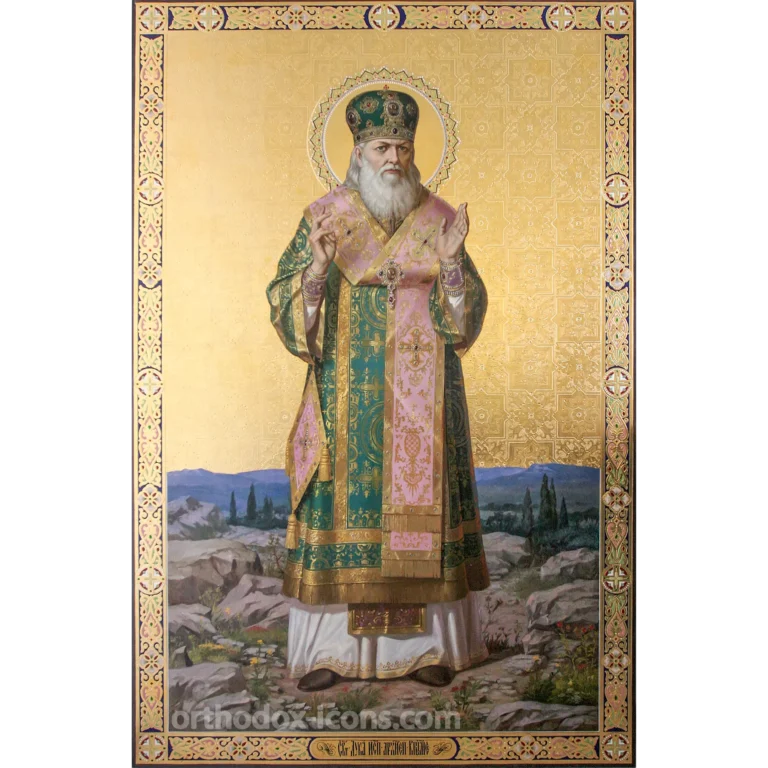
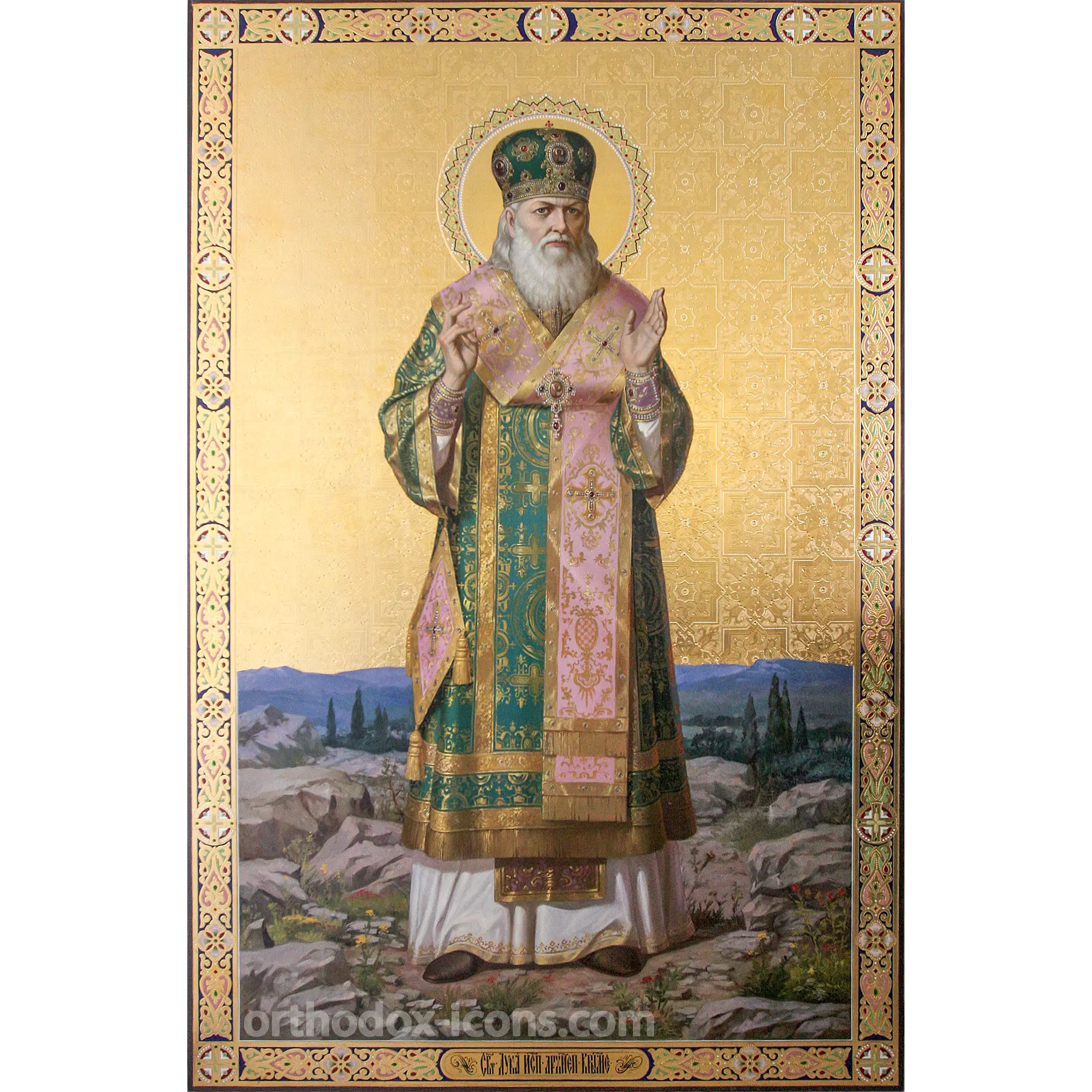
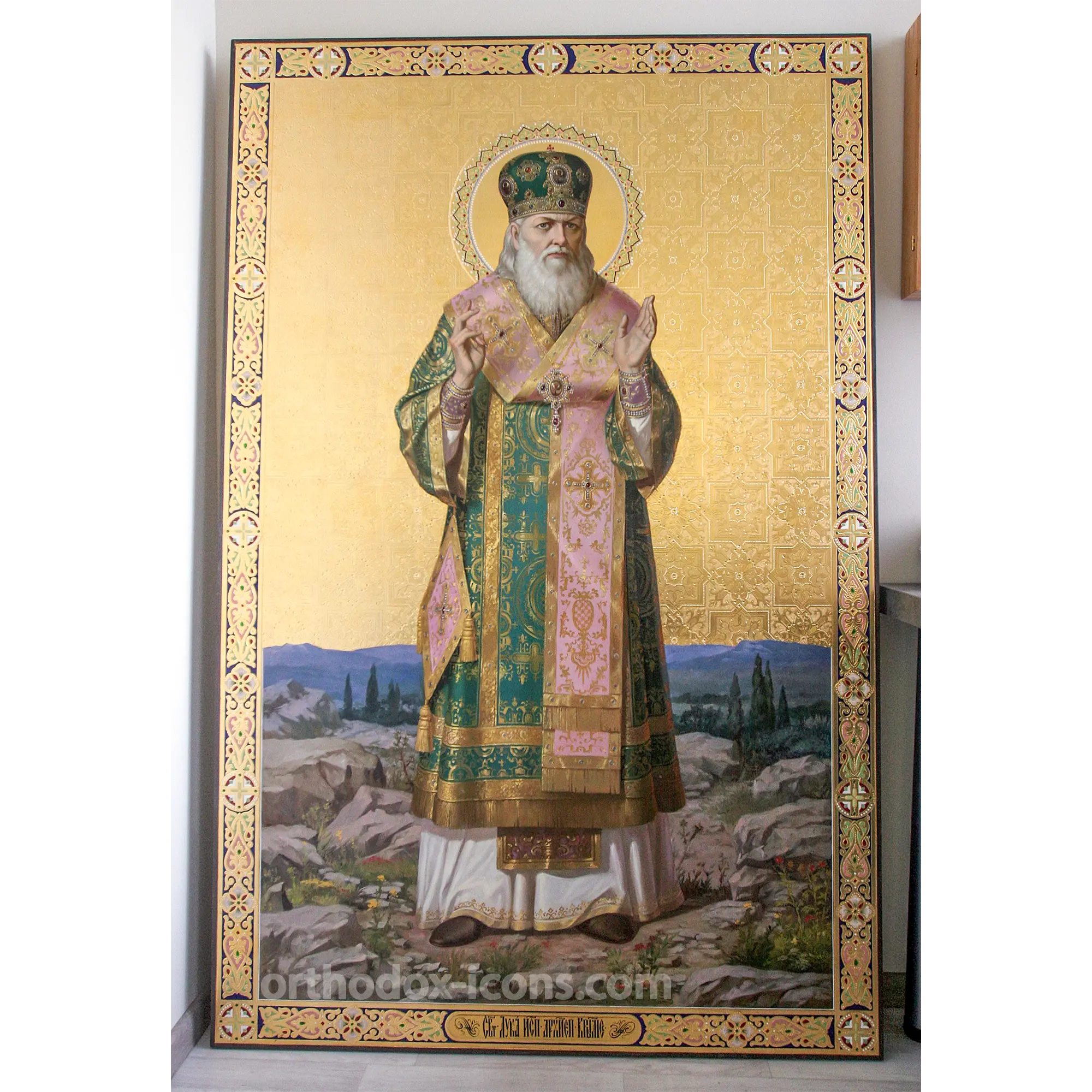
Orthodox Icon of Luke of Simferopol is a hand-painted full-length icon of Saint Luke of Crimea, Archbishop of Simferopol and Crimea, a holy physician, surgeon, confessor, and hierarch of the twentieth century. The saint is shown in episcopal vestments with raised blessing hands, a gold ornamental background, and a lower Crimean landscape with stones, mountains, and cypresses.
Materials: solid linden wood board, oak splines, natural chalk gesso, mineral egg tempera, and 23K gold leaf (960 purity). Free international shipping is included. Payment is made after you receive and approve the icon.
It is possible to paint an image in any size to order
Free shipping worldwide
Orthodox Icon of Luke of Simferopol is a hand-painted icon of Saint Luke of Crimea, Archbishop of Simferopol and Crimea. He is venerated as a holy physician, surgeon, scientist, hierarch, confessor of the faith, and intercessor for the sick. In this icon Saint Luke is shown full-length, in episcopal vestments, with both hands raised in a prayerful blessing gesture. His figure stands against a gold ornamental background, while the lower part of the composition includes a Crimean landscape with stony ground, distant mountains, and cypresses.
This icon is especially close to people who pray for health, help in medical treatment, a successful operation, wisdom for doctors, strength for patients, and support for the family of someone who is ill. Yet the meaning of the image is wider than the medical theme alone. Saint Luke unites the vocation of a physician with the ministry of an Orthodox bishop, exact scientific work with deep Christian faith, and service to suffering people with steadfast confession of Christ.
Orthodox Icon of Luke of Simferopol – Physician, Hierarch, and Confessor
Saint Luke of Crimea, in the world Valentin Felixovich Voyno-Yasenetsky, entered history as an outstanding surgeon, medical scholar, teacher, and Orthodox archpastor. He operated, taught, wrote on medicine, served the sick, and at the same time bore the responsibility of church ministry during years when open confession of the faith required exceptional courage.
His life is important for modern people because it shows that true knowledge and Orthodox faith are not enemies when a person serves truth, mercy, and the salvation of others. As a physician, Saint Luke knew bodily pain: wounds, illness, surgery, fear, and recovery. As a bishop, he also knew spiritual suffering: loneliness, confusion, grief, doubt, and pressure from hostile circumstances.
For this reason, Orthodox Christians pray before his icon not only for bodily healing, but also for patience, courage, clarity of mind, and spiritual endurance. His image is especially meaningful for doctors, surgeons, nurses, medical students, patients, families of the sick, hospital chapels, and parish communities that pray for those who suffer.
Spiritual Meaning of the Icon
Saint Luke is shown in episcopal vestments. This is essential to the meaning of the icon: he is not presented merely as a famous doctor, but as a bishop of the Church of Christ. His medical service and pastoral ministry are not separated. Both were forms of service to the human person before God.
The raised hands of the saint carry a blessing and prayerful meaning. In an icon of a holy physician, this detail is especially powerful. He does not hold a surgical instrument and is not shown in an ordinary medical scene. He stands as a hierarch who prays for the person and blesses them. This expresses the Orthodox understanding of healing: medical work is necessary and honorable, yet all true help is received before the face of God.
The gold background and large halo indicate sanctity and heavenly glory. In an Orthodox icon, gold is not simple decoration. It signifies divine light, the Kingdom of Heaven, and the spiritual reality in which the saint lives as an intercessor. The fine ornament on the background gives the image solemnity, while keeping attention on the face and figure of Saint Luke.
The lower landscape connects the icon with the earthly path of Saint Luke. Stones, mountains, dark cypresses, and the distant horizon evoke Crimea, the land of his archpastoral ministry, burial, and veneration. This detail makes the icon specific: it is not a general image of a bishop, but Saint Luke of Crimea, whose memory is deeply tied to Simferopol, medical service, and confession of the faith.
Prayer Before the Icon of Saint Luke of Crimea
Before the icon of Saint Luke of Crimea, Orthodox Christians pray for help in illness, healing, successful treatment, a good outcome of surgery, a correct diagnosis, wisdom for doctors, and strength for patients. People turn to him before an operation, during difficult treatment, after injury, in chronic illness, during recovery, and when a family needs patience and hope.
People often pray before this icon:
- for those who are sick, suffering, or undergoing treatment;
- for a successful operation and peaceful recovery;
- for wisdom and steadiness for doctors, surgeons, nurses, and medical staff;
- for a correct diagnosis and the right course of treatment;
- for patience, hope, and inner peace during illness;
- for the family and loved ones of a sick person;
- for medical students, physicians, scientists, and teachers;
- for the heavenly patronage of men named Luke.
Prayer before the icon does not replace medical care or responsible treatment. This is especially clear in devotion to Saint Luke himself, because he was a physician. Orthodox prayer to him naturally brings together trust in God, respect for medical knowledge, and compassion for the suffering person.
Feast Day of Saint Luke of Crimea
The main feast day of Saint Luke of Crimea is June 11. This date is often considered when choosing a name icon, preparing a gift for a name day, offering thanks to a doctor, or commissioning an icon for a church or medical chapel. If the icon is ordered in a large format, it is wise to allow enough time for preparation of the board, gilding, painting of the face, vestments, landscape, and decorative details.
An icon of Saint Luke may also be given for baptism, birthday, anniversary, a medical worker’s professional celebration, graduation from medical school, the beginning of medical practice, the opening of a clinic, or the dedication of a hospital chapel. Such a gift carries personal, prayerful, and professional meaning.
Features of This Hand-Painted Icon
In this icon Saint Luke of Crimea is painted full-length. This vertical format is especially expressive for an episcopal image because the viewer sees not only the face, but the entire figure: vestments, omophorion, mitre, blessing hands, landscape base, and decorative frame. The size 30×50 cm (11.8×19.7 in) and larger formats are well suited to this composition because they allow the details to remain readable.
The saint’s face is painted with attention to his characteristic appearance: gray beard, strict and deep gaze, inner concentration, and spiritual seriousness. The image is not sentimental. Saint Luke appears as a man of responsibility and experience, one who passed through suffering, service, confession, and spiritual struggle.
The episcopal vestments are painted in a rich but balanced color range: green, rose-violet, gold, and white details create a solemn liturgical tone. The mitre is ornamented, the vestments have fine decorative work, and the omophorion emphasizes the saint’s episcopal dignity. Yet the icon is not overloaded; the figure of the saint remains central, and the gold background works as a field of light.
The background is ornamented over gold. A decorative border with crosses and plant motifs gives the icon a festive, church-like appearance. The lower landscape with stones, mountains, and cypresses gives the image individuality and connects it with Saint Luke as the Crimean archpastor.
The central composition is painted on a flat board without a recessed kovcheg, with a decorative frame and gilded background.
Icon Characteristics
| Icon name | Orthodox Icon of Luke of Simferopol |
| Full title | Hand-painted icon of Saint Luke of Crimea, Archbishop of Simferopol and Crimea |
| Saint depicted | Saint Luke of Crimea |
| Iconographic type | Full-length image of the saint in episcopal vestments |
| Feast day | June 11 |
| Decorative features | Gold ornamental background, decorative frame, landscape with mountains and cypresses |
| Board | Solid linden wood with oak splines |
| Ground and painting | Natural chalk gesso and mineral egg tempera |
| Gilding | 23K gold leaf (960 purity) |
| Available size | 30×50 cm (11.8×19.7 in) and larger commission sizes |
Materials and Creation of the Icon
The icon of Saint Luke of Crimea is painted on a natural solid linden wood board. Linden is traditionally used in icon painting because of its even structure, stability, and ability to receive the prepared ground well. Oak splines help the board keep its shape and reduce the risk of deformation when humidity or temperature changes.
After the wooden base is prepared, natural chalk gesso is applied. This traditional multi-layer ground creates a firm and smooth surface for painting. In a full-length icon of Saint Luke, the quality of the ground is important because the painter must render the face, hands, mitre, episcopal vestments, ornamental details, gold background, and landscape with clarity.
The painting is done in mineral egg tempera on egg emulsion. This technique is valued for its noble matte surface, depth of color, and durability. The icon painter develops the image gradually, from the general silhouette to the details of the face, from broad color areas to highlights, from the shape of the vestments to the fine lines of ornament, folds, mountain landscape, and decorative frame.
The gilding uses 23K gold leaf (960 purity). Gold is applied to the background, halo, decorative accents, and ornamental parts of the image. In an Orthodox icon, gold signifies divine light and heavenly glory, not ordinary luxury. In the icon of Saint Luke, the gilding unites the seriousness of the holy physician-confessor with the solemn dignity of a hierarch.
In the size 30×50 cm (11.8×19.7 in) and larger formats, the full-length composition, landscape, ornamental field, and details of episcopal vestments can be seen especially well. For a church, chapel, hospital chapel, medical institution, or spacious home prayer area, a larger iconostasis size may be commissioned with more detailed work on the gilding, face, hands, mitre, and decorative elements.
Who This Icon Is Suitable For
This icon is especially suitable for doctors, surgeons, nurses, medical students, teachers of medicine, patients, and people undergoing treatment or preparing for surgery. It may be given to a physician in gratitude, to a medical worker on a professional occasion, to a medical student at the beginning or completion of studies, or to someone who needs prayerful support during illness.
As a name icon, it is suitable for men named Luke. Such a gift is appropriate for baptism, name day, birthday, anniversary, housewarming, or an important spiritual milestone. The image of Saint Luke carries a rare combination of personal patronage, medical meaning, episcopal holiness, and confessor’s steadfastness.
For the home, the icon may be placed in a prayer corner, family iconostasis, room of a sick person, doctor’s office, or any place where a family gathers for prayer. For church use, the icon is especially appropriate in hospital chapels, chapels attached to medical institutions, parishes where prayers for the sick are offered, and iconostasis rows with holy hierarchs and new martyrs.
Choosing the Size
Because this icon has a full-length vertical composition, sufficient size is important. The 30×50 cm (11.8×19.7 in) format allows the figure of Saint Luke, episcopal vestments, mitre, hand gesture, landscape, and gold ornamental background to be shown clearly. Larger sizes are suitable for a church, chapel, medical office, hospital space, or large home prayer room.
If the icon is chosen as a personal gift, the 30×50 cm format looks solemn and dignified. If it is intended for a church or iconostasis, it is better to discuss the height, proportions, placement, visibility of the face, and decorative details in relation to the surrounding space.
Blessing and Care of the Icon
The icon may be blessed in an Orthodox church before it is given, or after receiving it in one’s own parish. The blessing emphasizes that the icon is not merely a decorative painting, but a sacred image intended for prayer to God and veneration of the saint.
A hand-painted icon should be cared for gently. Dust is best removed with a soft dry brush or cloth, without pressure. The icon should not be wiped with a wet cloth, placed in direct sunlight, kept near a radiator or humidifier, or exposed to sudden changes in temperature. Gilded and ornamental areas should be treated with special care.
Free international shipping is included. Payment is made after you receive and approve the icon.
Questions and Answers
Who is depicted in the Orthodox Icon of Luke of Simferopol?
The icon depicts Saint Luke of Crimea, Archbishop of Simferopol and Crimea, an Orthodox hierarch, surgeon, scientist, confessor of the faith, and prayerful intercessor for the sick.
What do Orthodox Christians pray for before Saint Luke of Crimea?
They pray for help in illness, healing, successful treatment, a good outcome of surgery, wisdom for doctors, patience for patients, and strength for the family of the sick person.
Is this icon suitable for a doctor or medical worker?
Yes. Saint Luke is one of the most meaningful Orthodox saints for doctors, surgeons, nurses, medical students, and all who serve the sick.
Can one pray to Saint Luke before surgery?
Yes. Orthodox Christians often ask Saint Luke’s intercession before surgery, during treatment, and in recovery, while also following responsible medical care.
When is Saint Luke of Crimea commemorated?
The main feast day of Saint Luke of Crimea is June 11. This date is often considered when choosing a name-day gift, a thanksgiving gift for a doctor, or a church commission.
Is this icon suitable as a name icon?
Yes. It is suitable as a name icon for men named Luke, and also for doctors, patients, families of the sick, hospitals, chapels, and medical institutions.
Does this icon have a kovcheg?
No. This composition is painted on a flat board without a recessed kovcheg, with a decorative frame, gold background, and full-length image of the saint.
What size is available?
The listed size is 30×50 cm (11.8×19.7 in). Larger church and iconostasis sizes can be made by individual commission.
What materials are used for this hand-painted icon?
The icon is painted on a linden wood board with oak splines, natural chalk gesso, mineral egg tempera on egg emulsion, and 23K gold leaf (960 purity).
How should a hand-painted icon of Saint Luke be cared for?
Keep the icon away from moisture, direct sunlight, heat sources, and sudden temperature changes. Dust should be removed gently with a soft dry brush or cloth, without water, alcohol, or household chemicals.
| Name | Luke |
|---|---|
| Dimensions | 30x50cm (11.8×19.7 in) |