Orthodox Icon of Dmitry Donskoy
Custom size and price by agreement. This is a complex hand-painted icon with a mounted prince, multi-figure battle scene, city landscape, inscriptions, gilding, and ornamental decoration. The final size, production time, and cost are discussed individually before the icon is painted.
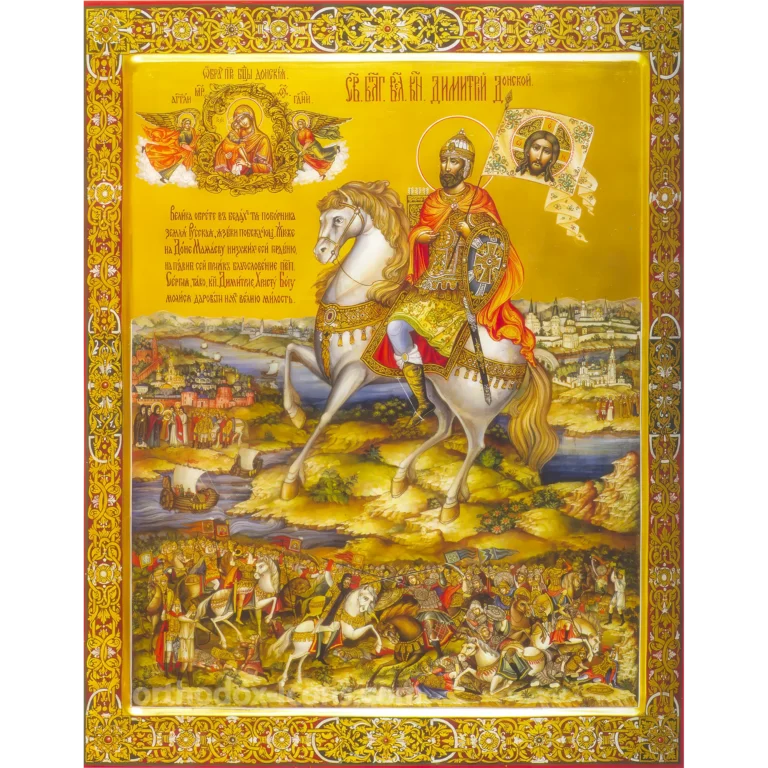
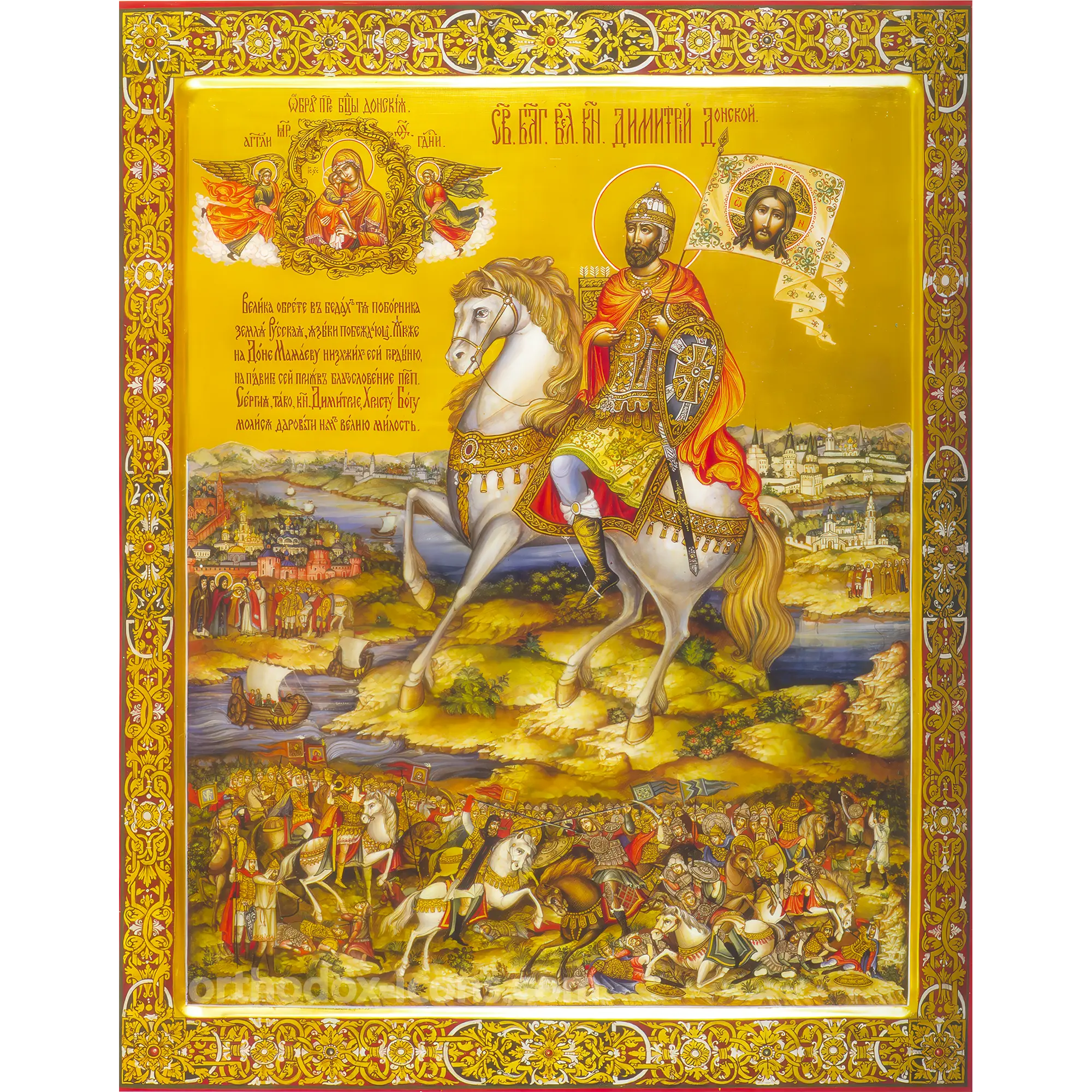
Orthodox Icon of Dmitry Donskoy is a solemn image of the holy right-believing Great Prince Dimitry Donskoy, warrior, defender of the Russian land, and victor at the Battle of Kulikovo. He is shown on a white horse, wearing princely armor and a red cloak, with a shield and a banner bearing the Face of Christ.
The composition also includes the Donskoy Icon of the Mother of God, angels, a prayer inscription, Russian cities, rivers, hills, troops, and the battle scene. The icon is suitable for men named Dmitry or Demetrius, soldiers, leaders, Orthodox families, churches, chapels, and memorial spaces. Free international shipping is included. Payment is made after you receive and approve the icon.
It is possible to paint an image in any size to order
Free shipping worldwide
Orthodox Icon of Dmitry Donskoy is a complex historical and iconographic image of the holy right-believing Great Prince Dimitry Donskoy, a Christian ruler, warrior, and defender of the Russian land. At the center of the composition, the saint is shown on a white horse, wearing a princely crown, richly detailed armor, and a red cloak. In his hands are a shield and a banner with the Face of Christ, showing that the military service of the holy prince is understood not as personal glory, but as service to God, homeland, and people.
The icon is built as a broad spiritual and historical composition. In addition to the central image of Dimitry Donskoy, it includes the Donskoy Icon of the Mother of God, angels, a prayer inscription, a panorama of Russian cities, river, hills, troops, and the Battle of Kulikovo. Such an icon requires extensive hand work: the icon painter must unite the face of the saint, the mounted figure, miniature figures, architecture, landscape, ornament, and gilding into one prayerful whole.
The price, size, and production time are calculated individually. They depend on the format, level of detail, number of figures, amount of gilding, ornament, battle scene complexity, need for a kiot, purpose of the icon, and current workshop schedule. This image may be made for a home icon corner, study, military chapel, church, memorial space, or as a significant patron saint gift.
Features of the Presented Image
The main figure of the icon is Saint Dimitry Donskoy on a white horse. The saint is painted in solemn princely attire: golden armor, red cloak, crown, shield, and banner underline his dignity as ruler and defender. At the same time, the image is not merely a historical portrait or military scene. In iconographic interpretation, the prince stands as a Christian ruler who accepts responsibility for people before God.
The white horse strengthens the victorious and noble character of the composition. It is not a random realistic detail, but part of the iconographic language. The movement of the horse directs the viewer’s eye toward spiritual overcoming, resolve, and defense. Dimitry Donskoy is not shown in outward confusion, but in collected and royal presence.
The banner with the Face of Christ has special importance. It shows that the prince’s deed is connected not only with military strength, but above all with faith. The Face of Christ above the prince and army reminds the viewer that earthly authority and military service must be placed under God’s truth. The shield with the cross reveals the theme of protection: the holy prince appears not as a conqueror, but as a guardian of faith, land, family, and people.
The upper part of the icon includes the Donskoy Icon of the Mother of God. Angels and a prayer inscription appear near it. This part helps interpret the entire image correctly: the victory of the holy prince is not presented as simple military triumph, but as an event understood through prayer, blessing, and the help of God.
The Battle of Kulikovo and Historical Meaning
The lower part of the icon is dedicated to the Battle of Kulikovo. It includes warriors, cavalry, banners, weapons, movement of battle, and the tension of a decisive historical moment. This makes the icon especially complex: the icon painter must show the scale of the event without turning the icon into an ordinary battle painting. All elements serve the main meaning: prayerful memory of the holy prince and his service to the Russian land.
The landscape with rivers, hills, Russian cities, churches, and distant architectural silhouettes reveals the theme of Rus as a spiritual and historical space. The icon shows not only the battle, but also the land that the holy prince defended. City panoramas, domes, troops, and natural landscape help the viewer see Dimitry Donskoy’s deed more broadly: not only military resistance, but responsibility for faith, people, and the future of the country.
A multi-figure composition requires a sufficiently large format. The larger the icon, the better the details can be developed: faces, horse harness, armor ornament, banner, Donskoy Icon of the Mother of God, Russian cities, prayer inscription, and the battle scene. For this reason, the format, intended placement, and desired level of detail should be discussed in advance.
Who This Icon of Dimitry Donskoy Is For
The icon of Saint Dimitry Donskoy is appropriate for men and young men named Dmitry, Dimitry, or Demetrius. It may be ordered as a patron saint icon for baptism, nameday, birthday, coming of age, entry into service, military oath, appointment to a responsible position, or another important life stage.
This image is especially meaningful for soldiers, officers, leaders, public servants, fathers, and all who carry responsibility for other people. Saint Dimitry Donskoy reminds us that courage must be joined to faith, prudence, humility, and willingness to serve not oneself, but others.
For a family, such an icon may become an image of male heavenly patronage, protection, responsibility, and faithfulness. Before it, people pray for peace in the home, help in difficult decisions, the upbringing of sons in honesty and courage, and preservation of faith and unity among loved ones.
In a church, chapel, or military institution, the icon of Dimitry Donskoy may be made in a large format. With its solemn composition, battle scene, image of the Mother of God, and rich ornament, it is suitable for a separate kiot, a commemorative gift to a church, or a space connected with prayer for defenders of the homeland.
Prayers Before Saint Dimitry Donskoy
Before the icon of Saint Dimitry Donskoy, Orthodox Christians pray for the protection of family, home, and homeland; help for soldiers; wisdom for leaders; courage, endurance, unity, and preservation of the Orthodox faith. His image is especially important in circumstances where a person must not only make a decision, but also preserve spiritual sobriety.
People ask Saint Dimitry’s intercession for protection of family and homeland, help in military and public service, courage before danger, wisdom for those making difficult decisions, preservation of faith, unity among people, overcoming division, upbringing of sons in responsibility and honesty, and heavenly patronage for men named Dmitry or Demetrius.
Prayer before this image is not reduced to asking for outward victory. Saint Dimitry Donskoy reminds the believer that true victory begins with inward faithfulness to God, overcoming fear, pride, cowardice, and division. The icon is especially close to those seeking spiritual strength in difficult service.
Brief Life of Saint Dimitry Donskoy
Saint Dimitry Donskoy lived in the fourteenth century, during a time of severe trial for the Russian land. He had to assume responsibility for rule at an early age, strengthen Moscow, unite Russian forces, and face external danger. His life unfolded amid political difficulty, military threat, and decisions that affected many people.
The main event connected with his name was the Battle of Kulikovo in 1380. According to Church tradition, before the battle the prince received the blessing of Saint Sergius of Radonezh. The victory on the Kulikovo Field became not only an important military event, but also a spiritual sign: Rus saw the possibility of unity, courage, and freedom from fear.
The sanctity of Dimitry Donskoy is not limited to his military talent. The Church honors him as a right-believing prince: a ruler who sought to serve God in his earthly calling. He defended people, strengthened the state, cared for the Orthodox faith, and left an image of responsible Christian leadership in which authority is not privilege, but difficult service.
The memory of the holy right-believing Prince Dimitry Donskoy is celebrated on June 1 according to the modern calendar. This date may be a nameday for men baptized with the name Dmitry or Demetrius if Saint Dimitry Donskoy is chosen as their heavenly patron.
Materials, Gilding, and Complexity of the Work
The icon of Dimitry Donskoy is painted on a wooden panel. Natural chalk gesso is applied beneath the painting, creating a strong and even surface for egg tempera. The image is painted in traditional egg tempera, a technique suitable for fine and durable icon painting.
In this image, gilding, decorative framing, and miniature painting are especially important. The gold background unites the composition, emphasizes the solemn character of the image, and creates a prayerful space around the central figure of the saint. The ornamental borders require separate hand work and strengthen the festive character of the icon.
The work includes several complex levels: the central figure of the prince on horseback, the saint’s face, horse harness, armor, shield, banner with the Face of Christ, the Donskoy Icon of the Mother of God, prayer inscription, landscape, architectural details, battle scene, and decorative frame. This is why the price is by agreement.
The individual calculation depends on size, amount of gilding, number of small figures, ornament complexity, degree of detail, need for a kiot, purpose of the icon, and production time. Timing is also affected by the icon painters’ current workload, board preparation, drying of layers, gilding, and final protective finishing.
Choosing the Format
For such a complex composition, a medium or large format is recommended. In a small size, the general image of the holy prince can be conveyed, but the battle scene, city panoramas, inscriptions, and small figures will be less detailed. A larger format allows the full composition to open: the saint’s face, horse, banner, shield, image of the Mother of God, Russian cities, and Battle of Kulikovo.
For a home icon corner, the format should be chosen according to the place where the icon will be placed. For a study, chapel, military institution, or church, a larger version is preferable, so that the image remains readable from a distance and the composition is perceived as a whole.
Iconostasis sizes are discussed separately. In that case, the height of the row, lighting, neighboring icons, viewing distance, overall style of the space, and desired level of detail are taken into account. For a multi-figure historical composition, the proportions should be determined in advance so that the central figure, inscriptions, and battle scene remain expressive.
Blessing and Care for a Hand-Painted Icon
The icon of Saint Dimitry Donskoy may be blessed in an Orthodox church after it is received. Once blessed, the image is intended for prayer, thanksgiving to God, and turning to Him through the intercession of the holy prince.
A hand-painted icon should be protected from direct sunlight, heaters, dampness, soot, and sudden temperature changes. The surface should not be wiped with wet tissues, alcohol, household chemicals, or rough cloth. The gilding, ornamental frame, miniature battle scenes, inscriptions, face of the saint, and banner with the Face of Christ require especially careful handling.
Dust is best removed with a dry soft brush or dry soft cloth, without pressure. For a complex icon with many fine details, a wooden glazed kiot is recommended. It helps protect the painting, gilding, and fine work from dust, accidental touch, moisture, and mechanical damage.
Questions and Answers
Who is shown on the Orthodox Icon of Dmitry Donskoy?
The icon shows Saint Dimitry Donskoy, the right-believing Great Prince, defender of the Russian land, and victor at the Battle of Kulikovo.
Why is Dimitry Donskoy shown on a white horse?
The mounted image emphasizes his princely and military service. The white horse strengthens the themes of victory, noble intention, and defense of the land.
What does the banner with the Face of Christ mean?
The banner with the Face of Christ shows that the prince’s service and defense of the homeland are placed under the sign of Orthodox faith, prayer, and God’s truth.
Why is the Donskoy Icon of the Mother of God included?
The image of the Mother of God in the upper part of the composition points to prayerful protection, blessing, and the spiritual understanding of the victory.
What do Orthodox Christians pray for before this icon?
People pray for protection of family and homeland, help for soldiers, wisdom for leaders, courage, unity, and preservation of the Orthodox faith.
Who is this icon suitable for?
It is suitable for men named Dmitry or Demetrius, soldiers, leaders, Orthodox families, churches, chapels, military institutions, and commemorative spaces.
Why is the price by agreement?
The price is calculated individually because the icon is complex: it includes a mounted central figure, the Donskoy Mother of God, landscape, cities, the Battle of Kulikovo, inscriptions, ornament, and extensive hand detailing.
What affects the production time?
Production time depends on size, gilding, the number of small figures, ornament complexity, kiot requirements, and the current workload of the icon painters.
When is the feast day of Saint Dimitry Donskoy?
The memory of the holy right-believing Prince Dimitry Donskoy is celebrated on June 1 according to the modern calendar.
How should such a complex hand-painted icon be cared for?
Keep the icon away from moisture, direct sun, overheating, soot, and mechanical damage. Dust should be removed with a dry soft brush, without pressure; a glazed kiot is recommended.
| Name | Demetrius, Dmitri |
|---|