Nine Martyrs of Cyzicus Icon
$1250
Available size: 27×31 cm (10.6×12.2 in). Larger and iconostasis sizes can be made by agreement.
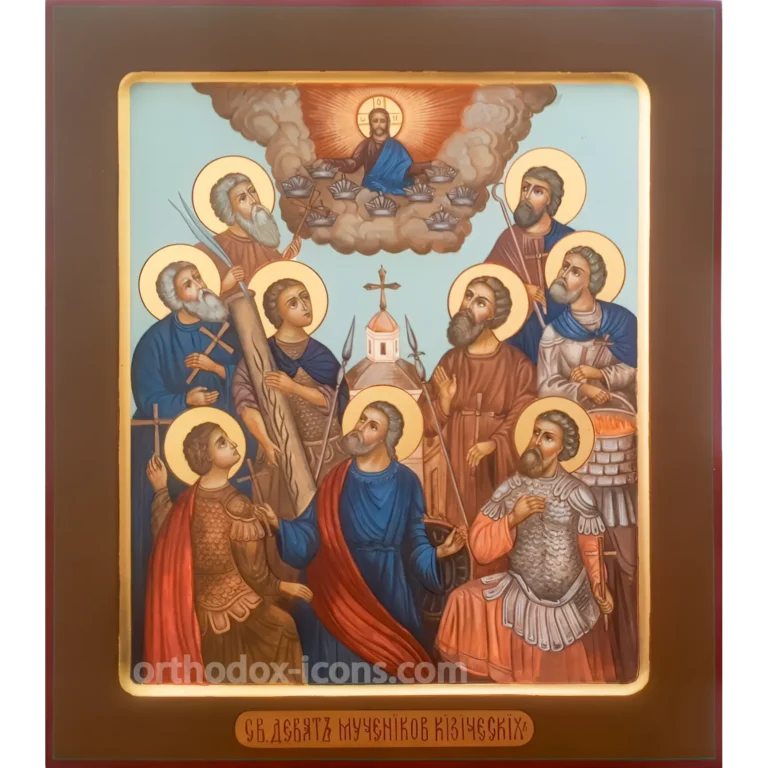
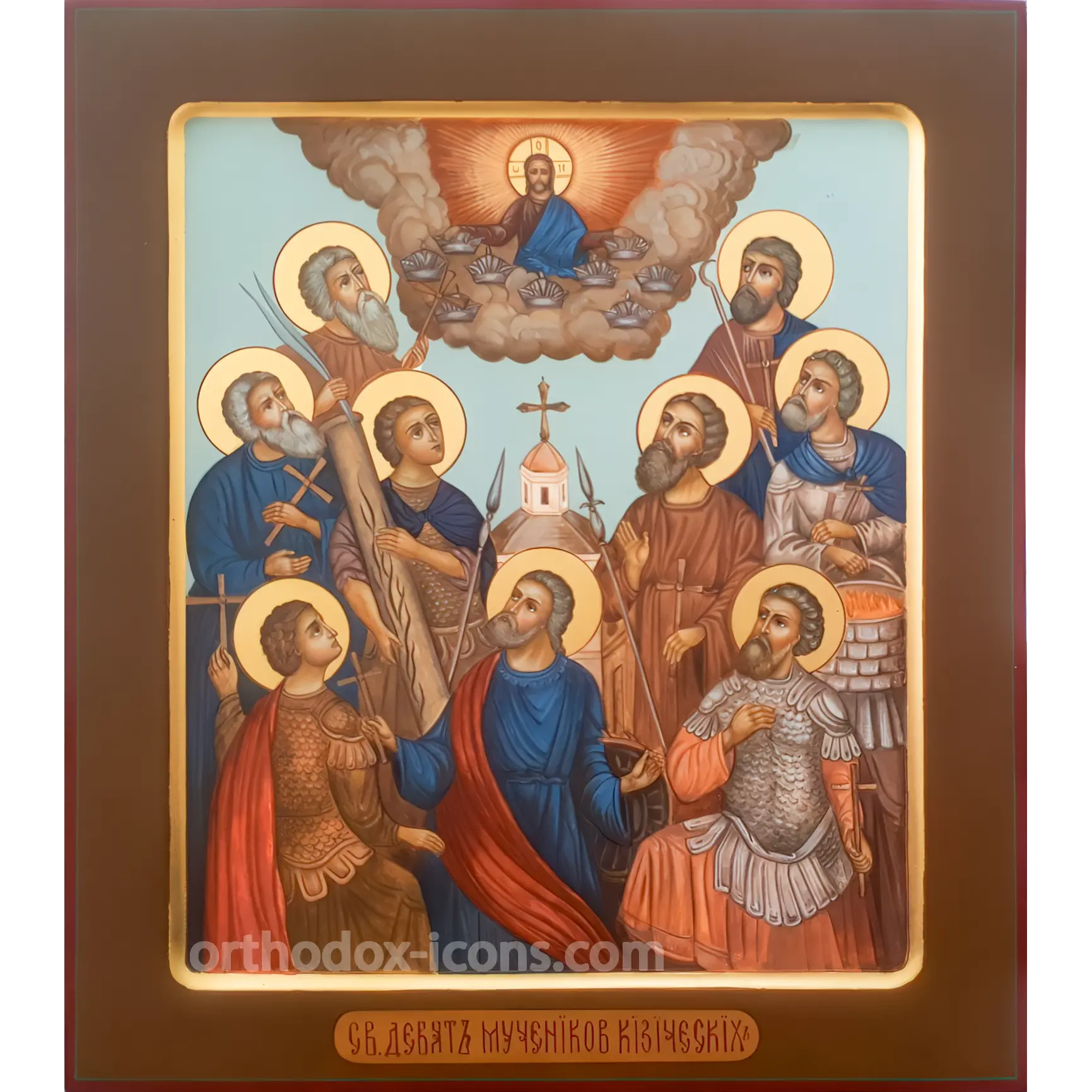
This hand-painted Nine Martyrs of Cyzicus Icon is a synaxis image of the ancient Christian martyrs Theognides, Rufus, Antipater, Theostichus, Artemas, Magnus, Theodotus, Thaumasius, and Philemon, who suffered for confessing Christ in the city of Cyzicus. The saints are shown around a church, with martyr crosses, instruments of martyrdom, and Christ blessing them from heavenly glory.
Prayer before this icon is often connected with healing from illness, strengthening of faith, help in sorrow, protection from despondency and fear, endurance in trials, support for the family, blessing in honest labor, and heavenly intercession in difficult circumstances. The icon is painted on a linden wood board with braces, pavoloka, chalk gesso, egg tempera, 23K gold leaf (960 purity), and a protective finish. Free international shipping is included. Payment is made after you receive and approve the icon.
It is possible to paint an image in any size to order
Free shipping worldwide
This hand-painted Nine Martyrs of Cyzicus Icon is a synaxis icon of Christian witnesses who suffered in the city of Cyzicus in Asia Minor. The Church honors them as martyrs who did not hide their confession before a pagan society, openly preached Christ, and accepted suffering for faithfulness to the Gospel. Their names are Theognides, Rufus, Antipater, Theostichus, Artemas, Magnus, Theodotus, Thaumasius, and Philemon. Each had his own life, position, and experience, yet they were united by one faith, one readiness to suffer for Christ, and one memory in the Church.
In this icon the nine martyrs are shown in a rich synaxis composition. A church stands in the center as a sign of the Church for whose faithfulness the saints accepted suffering. In the upper part, Christ is shown in cloud-like glory, blessing the martyrs and receiving their witness. Around Him are heavenly radiance and crowns, reminding the viewer of the martyr’s reward. The saints themselves are arranged in groups: some hold crosses, others hold instruments or signs of their suffering; their faces turn upward toward Christ, from whom strength, victory, and consolation come.
This image is especially expressive because it does not present only one saint, but a whole assembly of martyrs. The icon is perceived as a prayerful witness to the unity of the Church. The Nine Martyrs of Cyzicus are not shown as isolated heroes of personal achievement. They stand together like one army of Christ. Their different ages, garments, gestures, and positions in the composition show that people come to Christ from many lives, yet faithfulness to God makes them spiritually one.
Available size: 27×31 cm (10.6×12.2 in). Larger and iconostasis sizes can be made by agreement. The 27×31 cm format is suitable for a home iconostasis, separate kiot, prayer room, or gift for a person experiencing illness, sorrow, a difficult choice, or a period of spiritual trial. Larger sizes may be chosen for a church, chapel, hospital chapel, parish prayer room, church office, or iconostasis row. In a larger version the faces of the saints, central church building, blessing image of Christ, crowns, crosses, and details of the martyr composition can be shown with greater clarity.
In Orthodox tradition the Nine Martyrs of Cyzicus are often asked for help in healing from illnesses. Their veneration is especially connected with bodily afflictions, sorrows, anxiety, and difficult life circumstances. Prayer before the icon, however, is not an attempt to obtain instant fulfillment of a wish. The Christian asks God, through the prayers of the saints, for help, strengthening, patience, healing, peace of soul, a wise attitude toward illness, and hope that does not disappear in difficult times.
Features of This Icon
The main feature of this icon is its complex synaxis composition. Unlike a half-length or full-length image of a single saint, here the icon painter builds a whole prayerful narrative. The nine martyrs are placed around the central church building, and above them heavenly glory opens with the Savior. This arrangement immediately reveals the theological meaning of the image: martyrdom does not end in suffering, but leads to Christ, to the Kingdom of Heaven, and to the crown of faithfulness.
The central church building is no less important than the individual figures. It reminds us that the martyrs suffered not for private opinions or political dispute, but for faith in Christ and belonging to the Church. The church building is depicted as the spiritual center of the icon: the saints gather around it, heaven opens above it, and the composition receives its inner axis from it. This makes the image especially ecclesial and solemn.
In the upper part of the icon, Christ is shown in the clouds, in the radiance of glory. This fragment sets the central meaning: the martyrs are not turned toward earthly victory, but toward Christ. The crowns connected with the heavenly reward of the martyrs recall the apostolic image of the crown of life for those who remain faithful to the end. Visually, this upper part softens the drama of suffering: the martyrs are not abandoned, and their witness is accepted by God.
The figures of the saints are painted with different gestures and attributes. Some hold crosses as a sign of confession, others turn their faces toward the Savior, and others are shown with instruments of martyrdom. In the lower part of the composition there are soldiers and martyrs, with swords, spears, and fire nearby. These details do not make the icon cruel. Rather, they help reveal the cost of confession. The holy image does not hide the reality of suffering, but shows it in the light of Christ’s victory.
The color harmony is warm and gathered, with soft ocher, brown, blue, red, and golden tones. Golden borders and halos give the icon solemnity, while the dark outer frame helps the eye remain focused on the central scene. The lower inscription identifies the icon as the holy Nine Martyrs of Cyzicus and makes the image easy to recognize in a home or church setting.
Iconography of the Nine Martyrs of Cyzicus
The iconography of the Nine Martyrs of Cyzicus belongs to the group of synaxis martyr icons. It is important not only to list the saints by name, but to show their shared witness. In antiquity, Cyzicus was a city where Christianity was known, yet pagan surroundings and persecution forced many believers to hide or live cautiously. The nine martyrs openly confessed Christ, preached the faith, and accepted suffering without renouncing the Savior.
Their witness is revealed through several levels. The first is earthly: the saints stand near the church building and the instruments of martyrdom. The second is ecclesial: they are gathered together as one body of martyrs. The third is heavenly: Christ is shown above them, from whom blessing and reward come. This structure helps the one who prays see not only the historical memory of execution, but also the spiritual result: the martyrs conquered not by weapons, but by faithfulness to God.
The martyr crosses in the hands of the saints are among the main signs of the image. The cross is not merely an attribute, but a confession. It reminds us that the Christian path may include sorrow, misunderstanding, and trial, yet the cross becomes the road to resurrection. The Nine Martyrs of Cyzicus are especially close to those who experience illness or heavy circumstances. They teach not despair, but faith that holds fast to Christ even when outwardly everything is difficult.
The instruments of martyrdom and the fire reveal the theme of martyrdom. But the icon does not make pain the main meaning. Attention rises higher, toward the Savior, crowns, and light. This is a very important theological detail: Christian memory of the martyrs speaks not only about death, but about the victory of life in Christ. For this reason the icon can be especially consoling for the sick and sorrowful. It reminds us that suffering is not meaningless when a person passes through it with prayer and hope in God.
Prayer Before the Icon of the Nine Martyrs
Before the icon of the Nine Martyrs of Cyzicus, Orthodox Christians may pray for healing from illness, strengthening of faith, help in sorrow, and endurance in trials. In Church memory their veneration is especially connected with help in bodily afflictions, including illnesses, including those once associated with fever and chills. Today people pray before their image for health, relief of suffering, wise treatment, patience, and peace of soul.
- for healing from bodily illness and strengthening of physical strength;
- for help during difficult treatment or recovery;
- for freedom from fear, despondency, and confusion;
- for patience for the sick person and loved ones;
- for support of the family in sorrow and trial;
- for steadfastness in faith and faithfulness to Christ;
- for protection from slander, pressure, and injustice;
- for blessing in work and honest ordering of life;
- for help for those whose service is connected with care for the sick;
- for heavenly intercession in difficult circumstances.
Prayer before this icon is especially fitting when a person finds it hard to preserve hope. Illness, uncertainty, fatigue, family anxiety, long treatment, or care for a loved one can deeply exhaust the soul. The Nine Martyrs of Cyzicus remind the faithful that they are not alone. The Church prays with them, and the saints who passed through suffering become close intercessors before God.
Brief Life of the Holy Martyrs
The holy Nine Martyrs of Cyzicus lived at the end of the third century in the city of Cyzicus in Asia Minor. The city had known Christianity from early times, but pagan customs and persecutions remained strong. Many Christians were forced to hide their faith or leave the city.
Theognides, Rufus, Antipater, Theostichus, Artemas, Magnus, Theodotus, Thaumasius, and Philemon were among those Christians who refused to live secretly and silently. They openly confessed Christ, exposed pagan error, and called people to the true faith. Their preaching angered the pagan authorities because it challenged the old order and witnessed to the power of the Gospel.
The saints were seized, tortured, and commanded to renounce Christ. They remained firm. Each of them showed that faith is not merely a conviction for peaceful times, but a life for which a person is ready to answer to the end. After torture, the martyrs were beheaded. Thus they accepted death for Christ and entered Church memory as the Nine Martyrs of Cyzicus.
Later, the relics of the saints became a source of many healings. Their veneration spread far beyond Cyzicus, and they became especially known as intercessors for the sick. This does not mean that the saints replace medical care or human responsibility. Rather, the faithful ask God through their prayers for mercy, strengthening, and healing according to His will.
Commemoration and Patronage
The Nine Martyrs of Cyzicus are commemorated on May 12 according to the new calendar, corresponding to April 29 according to the old calendar. Their feast is connected in Orthodox memory with prayer for the sick, strengthening in sorrow, and hope in trials.
This icon is appropriate for a home where a family member is ill, for a person undergoing treatment, for a doctor or caregiver, for a church worker, or for anyone who needs strengthening of faith in a difficult season. It can also be placed in a hospital chapel, prayer room, church, or iconostasis row. The image reminds the faithful that bodily weakness does not separate a person from the love of God, and that trial can become a time of deeper turning toward Him.
Materials, Gold Leaf, and Custom Options
The icon of the Nine Martyrs of Cyzicus is painted on a linden wood board. Applied or mortise braces are used for stability. Pavoloka and chalk gesso are applied to the board, and then the image is painted in egg tempera. This traditional method allows the icon painter to render the complex multi-figure composition with care: the faces of the saints, halos, crosses, central church building, instruments of martyrdom, blessing image of Christ, clouds, crowns, inscriptions, and color transitions of the background.
In this version, gilding has an important role. 23K gold leaf (960 purity) is used in the halos, luminous accents, and decorative details, helping separate the holy image from ordinary space. For a synaxis martyr icon this is especially important. Gold does not merely decorate the composition; it speaks of the heavenly glory into which the saints enter after remaining faithful to Christ.
The color harmony is built on warm ocher, brown, red, blue, and golden tones. Red mantles and crosses recall martyrdom, the blue background opens the heavenly space, gold halos show holiness, and the dark outer frame gathers the composition and makes the central scene more expressive. Despite the number of figures, the icon remains clear: the eye moves from the martyrs to the church and then upward, toward Christ.
For an individual commission, the size, degree of gilding, background tone, inscription style, overall color harmony, kiot, and format for a home, church, chapel, or iconostasis row can be discussed. In a larger version it is especially important to preserve the readability of all nine figures, softness of the faces, clarity of the central church building, and expressiveness of the heavenly part of the composition.
Choosing the Size
The 27×31 cm (10.6×12.2 in) size is suitable for a home iconostasis, separate prayer shelf, study, hospital room, room of a sick person, or gift for a family passing through a difficult period. In this format the main elements remain readable: the nine martyrs, central church building, Christ in the clouds, crowns, crosses, and lower inscription.
A larger format is worth choosing if the icon will be placed in a spacious home, prayer room, church, chapel, or hospital chapel. In a larger size the multi-figure composition opens more fully: individual faces, gestures, instruments of martyrdom, details of the church building, clouds, and gold halos become more visible. For an iconostasis row, the size is selected individually so that the image harmonizes with neighboring icons in height, color, and overall structure.
If the icon is purchased as a gift for a sick person, the place of placement matters. For a small room, a moderate format may be better because it does not overload the space while remaining clearly visible for prayer. For a church or chapel where many believers can approach the icon, a larger version with stronger detail and a kiot is appropriate.
Placement, Blessing, and Care
The icon of the Nine Martyrs of Cyzicus may be placed in a home icon corner beside icons of Christ, the Mother of God, Saint Nicholas the Wonderworker, Great Martyr Panteleimon, Saint Luke of Crimea, venerable elders, and other saints to whom the family turns with prayer for health and help. This image is especially fitting in a home with a sick person, elderly parents, children, people undergoing treatment, or those who need spiritual strengthening.
After receiving the icon, it may be blessed in an Orthodox church. A blessed icon is intended for prayer, thanksgiving to God, and asking the holy martyrs for health, patience, strengthening of faith, help in sorrow, protection from despondency, and a good passage through life’s trials.
A hand-painted icon should be protected from direct sunlight, moisture, overheating, smoke, soot, and sudden temperature changes. Do not wipe the surface with wet cloths, alcohol, household cleaners, or rough fabric. The faces of the saints, gilded halos, central church building, image of Christ, inscriptions, and fine details of the multi-figure composition require especially careful handling.
Dust should be removed gently with a soft dry brush and without pressure. For protection of the painting and gilding, a wooden glazed kiot is recommended. It helps preserve the icon from dust, humidity, and accidental damage, especially when the image is placed in an active home area, hospital room, church, or intended for long-term prayerful use.
Questions and Answers
Who is depicted in the Nine Martyrs of Cyzicus Icon?
The icon depicts the holy martyrs Theognides, Rufus, Antipater, Theostichus, Artemas, Magnus, Theodotus, Thaumasius, and Philemon, who suffered for Christ in Cyzicus.
Why are they called the Martyrs of Cyzicus?
They are called the Martyrs of Cyzicus because their confession and martyrdom took place in the ancient city of Cyzicus in Asia Minor.
What do Orthodox Christians pray for before this icon?
Prayer before this icon is often connected with healing from illness, strengthening of faith, help in sorrow, patience, freedom from despondency, and support in difficult circumstances.
Why is this icon especially close to the sick?
In Church tradition the Nine Martyrs of Cyzicus are venerated as helpers in sickness and bodily affliction, so people often turn to them with prayer for health and strength.
What does Christ in the upper part of the icon mean?
Christ in heavenly glory shows that the martyrs’ suffering was accepted by God and ended not in defeat, but in the victory of faithfulness to Christ.
What do the crowns on the icon symbolize?
The crowns point to the martyr’s reward and the heavenly glory of the saints who remained faithful to Christ to the end.
Who may receive this icon as a gift?
The icon is suitable for a sick person, a family in a difficult period, a doctor, a church worker, someone who needs strengthening of faith, and also for a church or chapel.
What size is available?
The available size is 27×31 cm. Larger and iconostasis sizes can be made by agreement.
When are the Nine Martyrs of Cyzicus commemorated?
The Nine Martyrs of Cyzicus are commemorated on May 12 according to the new calendar, corresponding to April 29 according to the old calendar.
How should a hand-painted icon with gold leaf be cared for?
Keep the icon away from moisture, direct sunlight, heat, smoke, and mechanical damage. Dust it gently with a soft dry brush, and consider a glazed kiot for long-term protection.
| Dimensions | 27x31cm (10.6×12.2 in) |
|---|