The Protection of the Holy Virgin
$950
Available size: 17×21 cm (6.7×8.3 in).
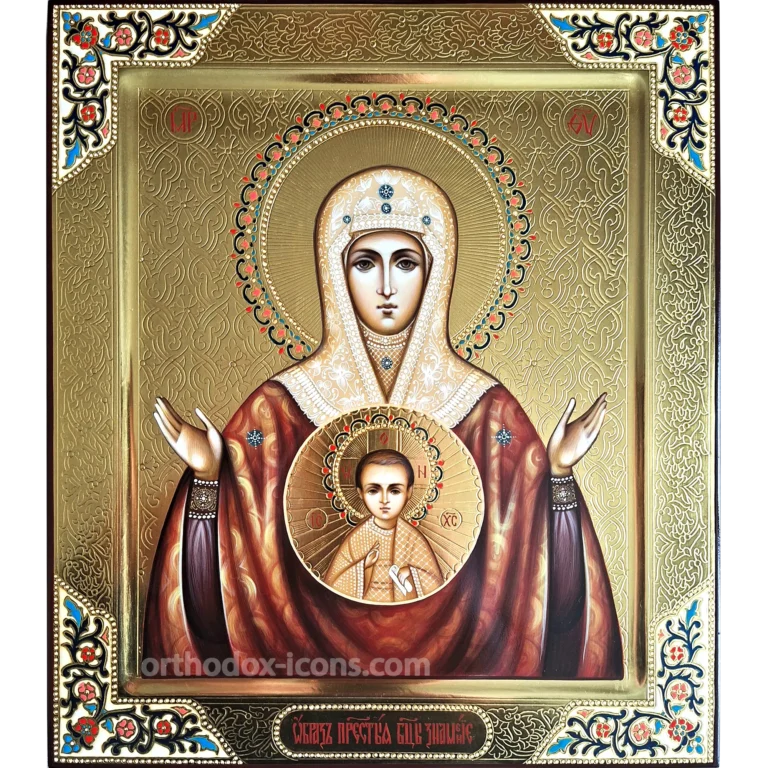
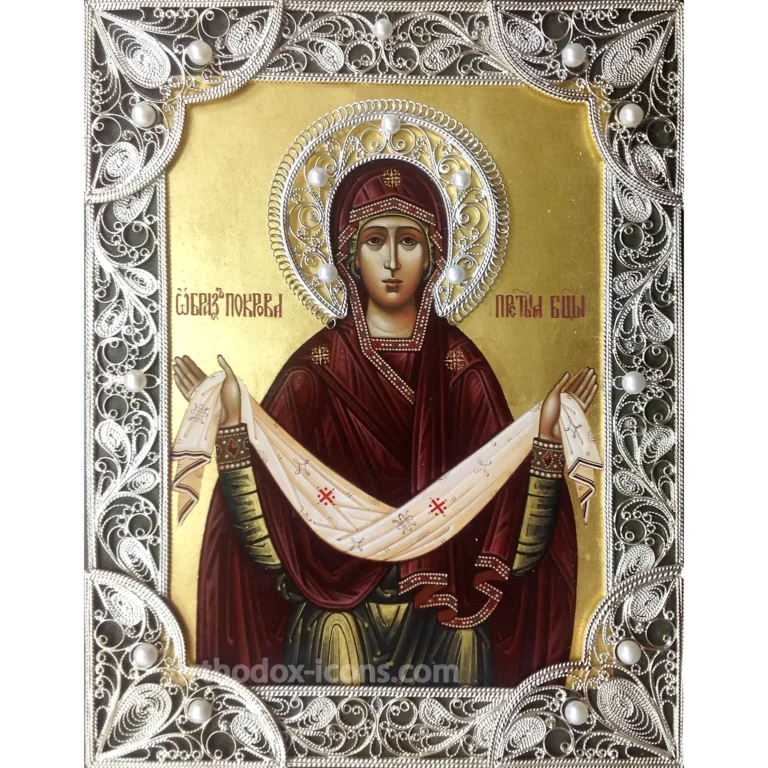
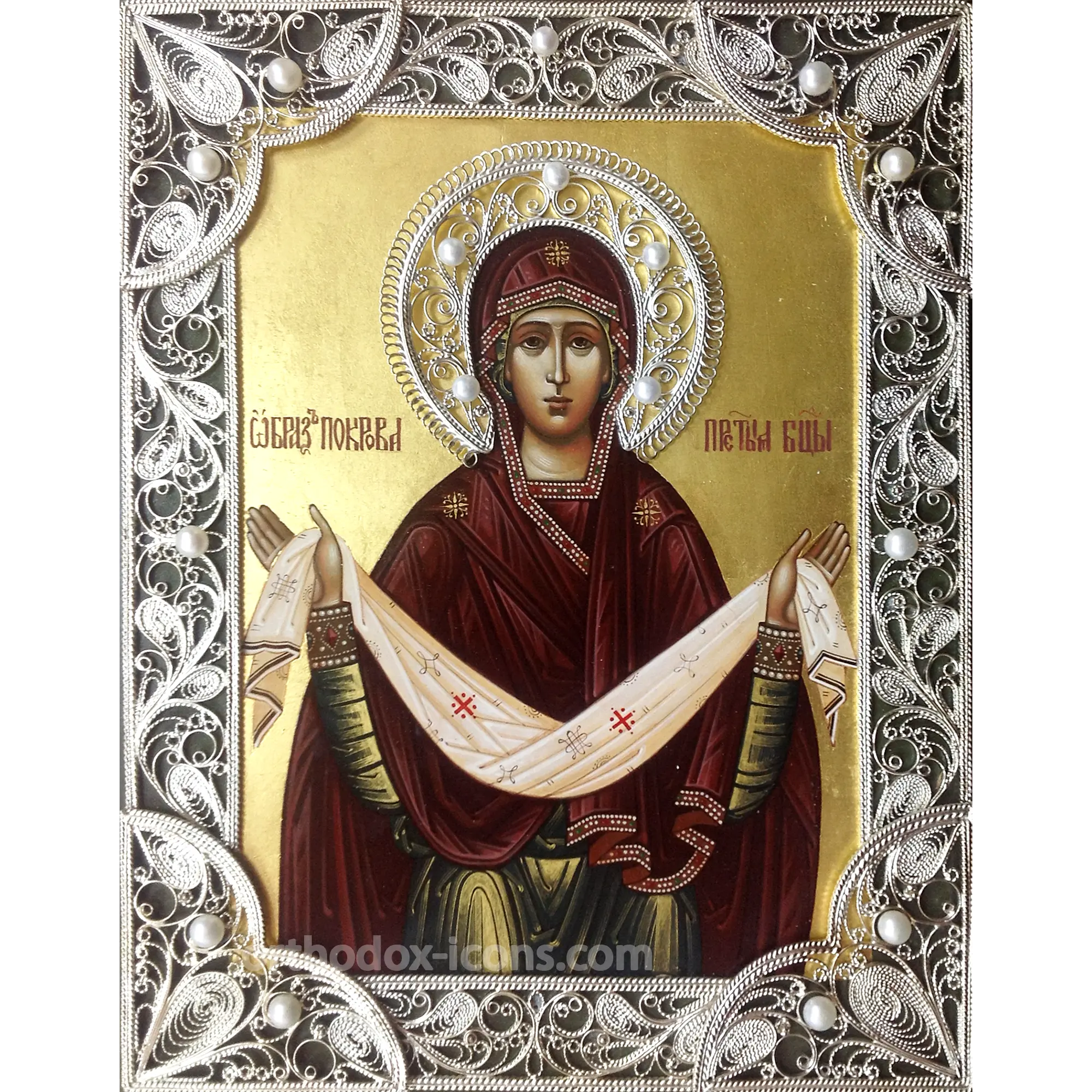
The Protection of the Holy Virgin is a hand-painted Orthodox icon of the Theotokos holding her white omophorion, the protecting veil of mercy and intercession. This compact filigree version focuses on the Mother of God herself rather than the full multi-figure feast composition. She is shown half-length on a 23K gold leaf background, with the white veil marked by red crosses in her raised hands. The icon is painted with mineral egg tempera on a linden board and richly finished with nickel silver filigree around the fields and halo, inlaid with natural white pearls. Free international shipping is included; payment is due upon delivery.
It is possible to paint an image in any size to order
Free shipping worldwide
The Protection of the Holy Virgin is a compact and precious hand-painted icon of the Mother of God holding her protecting veil. In Russian Orthodox tradition this feast is known as Pokrov, the Protection or Intercession of the Most Holy Theotokos. The icon is a visible image of motherly mercy, shelter, and prayerful defense.
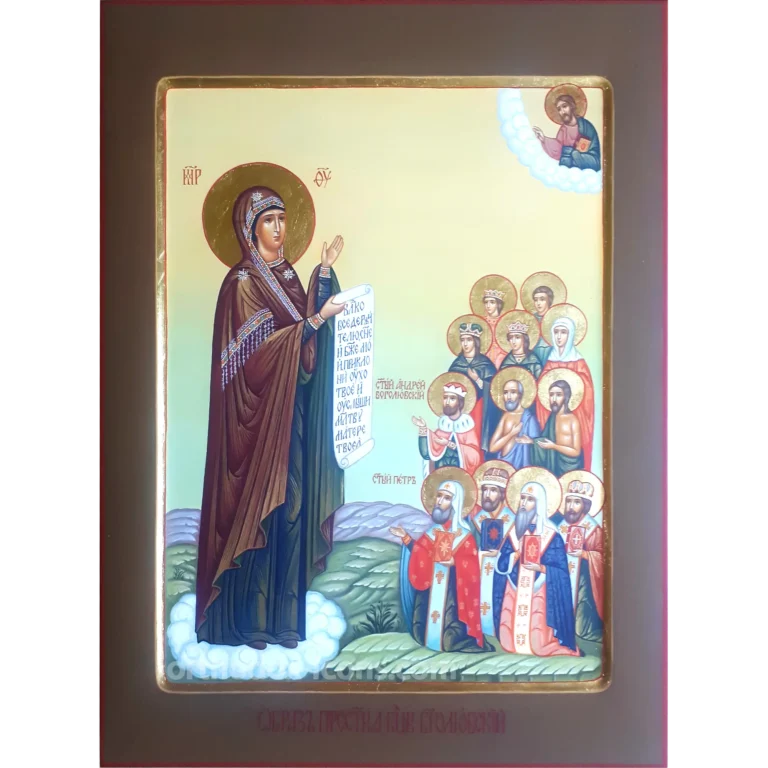
This particular version is not the full multi-figure feast composition with the Blachernae church, Saint Andrew, Epiphanius, and the gathered faithful. It is a more intimate half-length image centered entirely on the Theotokos herself. She holds the white omophorion in her raised hands, showing the protection she extends over every person who turns to her in faith.
The icon is also a work of modern Orthodox jewelry iconography. The painted image is joined with a rich filigree setting: the fields and halo are adorned with delicate nickel silver openwork and natural white pearls. The result is a small but ceremonial icon suitable for family prayer, a wedding gift, or a treasured home shrine.
The Protection of the Holy Virgin – The Miracle in Constantinople
The historical foundation of the feast goes back to the beginning of the tenth century, around the year 910, during the reign of the Byzantine emperor Leo VI the Wise. Constantinople was in great danger from an enemy army. Realizing that human strength alone could not save the city, the faithful gathered in the Blachernae church, where some of the most revered relics of the Mother of God were kept: her robe, veil, and part of her belt.
During the all-night vigil, Saint Andrew the Fool-for-Christ was present in the church with his disciple Epiphanius. Suddenly Andrew raised his eyes and saw a wondrous vision. The Most Holy Theotokos appeared in the air, surrounded by angels, prophets, and apostles, shining with heavenly light. She approached the ambo, knelt, and prayed with tears for the Christian people.
After her prayer, the Mother of God took the shining veil from her head and spread it over the faithful in the church as a sign of protection from enemies. The veil shone brighter than the sun. Saint Andrew asked Epiphanius whether he saw the Queen and Lady praying for the whole world, and Epiphanius answered that he saw and was filled with awe.
The vision later disappeared, but the grace of the protection remained. According to tradition, the enemy army withdrew from Constantinople without battle. Although the event took place in Byzantium, the feast became especially loved in Rus. In the twelfth century, under Saint Andrew Bogolyubsky, the feast of the Protection became one of the most cherished Orthodox celebrations.
Iconography of This Half-Length Protection Icon
Classic icons of the Protection often show a large and complex scene: the church interior, the Mother of God above the faithful, Saint Andrew and Epiphanius below, angels, saints, and sometimes Saint Romanos the Melodist. The present icon is different. It belongs to a more personal and concentrated form of the image.
The Mother of God is shown half-length in the center of the composition. She wears a deep dark cherry or purple maphorion, symbolizing royal dignity and motherly sorrow, over a dark green chiton. On her forehead and shoulders are golden cross-stars, signs of her ever-virginity before, during, and after the Nativity of Christ.
The main spiritual center of the icon is the long white veil, or omophorion, which the Theotokos holds in her raised hands. The veil is marked with red crosses. Its white color speaks of purity, grace, divine light, and the shelter of mercy that covers the faithful. Her raised hands also recall the Orans posture, the ancient image of prayer.
Gold Background and Filigree with Pearls
The background behind the Mother of God is covered with 23K gold leaf. In Orthodox iconography gold points to divine light, heavenly glory, and the spiritual world. Here the gold also gives the compact icon a solemn and luminous character.
The distinctive feature of this icon is the filigree setting. Filigree is an ancient jewelry technique in which very fine metal wire is twisted and arranged into an openwork ornamental pattern. In this icon, the fields and halo are decorated with intricate nickel silver filigree, forming a lace-like plant ornament.
Natural white pearls are placed within the filigree ornament and around the halo. The pearls add a gentle, pure, and royal beauty to the icon. They do not distract from the face of the Mother of God, but frame the image as a precious family shrine.
Prayer Before the Protection Icon
The Protection icon is one of the strongest and most beloved images of the Mother of God as intercessor and defender. Orthodox Christians pray before it for protection of the home, peace in the family, deliverance from disasters, and help in difficult or dangerous circumstances.
Because the feast is historically connected with the deliverance of a city under threat, the Protection icon is especially close to soldiers and those who pray for them. Mothers and wives may pray before it for the safety of sons, husbands, and relatives serving in danger, for healing from wounds, and for peace.
In Russian tradition, the feast of the Protection on October 14 was also connected with the beginning of the wedding season. The white veil of the Theotokos was often associated with the bridal veil. For this reason, this icon is a meaningful wedding gift and an image before which people pray for blessed marriage, family harmony, and a faithful spouse.
The icon is also approached in prayers for healing, for deliverance from despondency and harmful habits, for clarity of mind in studies and work, and for protection of children.
Materials and Mstyora Technique
The creation of this icon requires the work of several craftspeople: the board maker, gesso preparer, gilder, icon painter, and filigree jeweler. The base is a dry linden board strengthened with inserted oak braces to help prevent warping. Linen is applied to the board, and 10 to 15 layers of natural gesso are built up and polished.
The painted image is made in the canonical Mstyora tradition with mineral egg tempera. The pigments are prepared from natural mineral colors and mixed with egg emulsion. These paints penetrate the gesso ground and remain durable for many years.
The background is gilded with 23K gold leaf. At the final stage, the filigree master creates the openwork ornament from fine nickel silver wire, inlays it with natural pearls, and fixes it to the icon fields and halo. This makes the icon both a devotional image and a work of refined Orthodox craftsmanship.
Available Size
The available size is 17×21 cm (6.7×8.3 in). This compact format suits the intimate character of the half-length Protection image. Because of the filigree and pearls, the icon has the presence of a small precious shrine, appropriate for a home icon corner, a bedroom, a child’s room, or a wedding gift.
Larger sizes such as 27×31 cm (10.6×12.2 in) and 30×40 cm (11.8×15.7 in), as well as church formats, can be discussed individually when a more ceremonial version is needed.
Free international shipping is included; payment is due upon delivery.
Icon Characteristics
| Feature | Description |
|---|---|
| Subject | Protection of the Most Holy Theotokos, half-length version |
| Main image | The Mother of God holding the white omophorion with red crosses |
| Board | Linden wood with linen, natural gesso, and inserted oak braces |
| Painting | Mineral egg tempera in the Mstyora tradition |
| Gold | 23K gold leaf background |
| Filigree | Handmade nickel silver filigree on the fields and halo |
| Inlay | Natural white pearls |
| Available size | 17×21 cm (6.7×8.3 in) |
| Prayer use | Protection of the home, family peace, wedding blessing, help for soldiers, healing, and guidance |
The Protection of the Holy Virgin is a luminous image of shelter and intercession. Its white veil, gold background, filigree ornament, and pearls make it both a prayerful Orthodox icon and a precious family keepsake.
Questions and Answers
What does Protection of the Holy Virgin mean?
The Protection, or Pokrov, refers to the veil or omophorion of the Mother of God, which she spread over the faithful as a sign of her protection and intercession.
What event is behind this icon?
The feast recalls the vision in the Blachernae church of Constantinople, where the Mother of God appeared in prayer and spread her shining veil over the people.
Who saw the vision of the Protection?
The vision was seen by Saint Andrew the Fool-for-Christ and his disciple Epiphanius during an all-night vigil in the Blachernae church.
How is this icon different from many Protection icons?
Many Protection icons are large multi-figure feast compositions. This version is more intimate and shows the Mother of God half-length, holding the white omophorion herself.
What is filigree on this icon?
Filigree is a jewelry technique using very fine twisted metal wire arranged into an openwork pattern. Here it decorates the fields and halo of the icon.
Are real pearls used?
Yes. The filigree ornament is inlaid with natural white pearls, giving the icon a gentle and ceremonial appearance.
What materials are used?
The icon is painted on a linden board with natural gesso, mineral egg tempera, 23K gold leaf, nickel silver filigree, and natural white pearls.
What size is available?
The available size is 17×21 cm (6.7×8.3 in). Larger sizes can be discussed individually for home or church use.
What are people accustomed to pray for before this icon?
People pray before the Protection icon for family peace, protection of the home, help for soldiers, healing, blessed marriage, and guidance in studies and work.
Do you ship internationally?
Yes. Free international shipping is included, and payment is due upon delivery.
| Dimensions | 17x21cm (6.7×8.3 in) |
|---|---|
| Name | Mary |