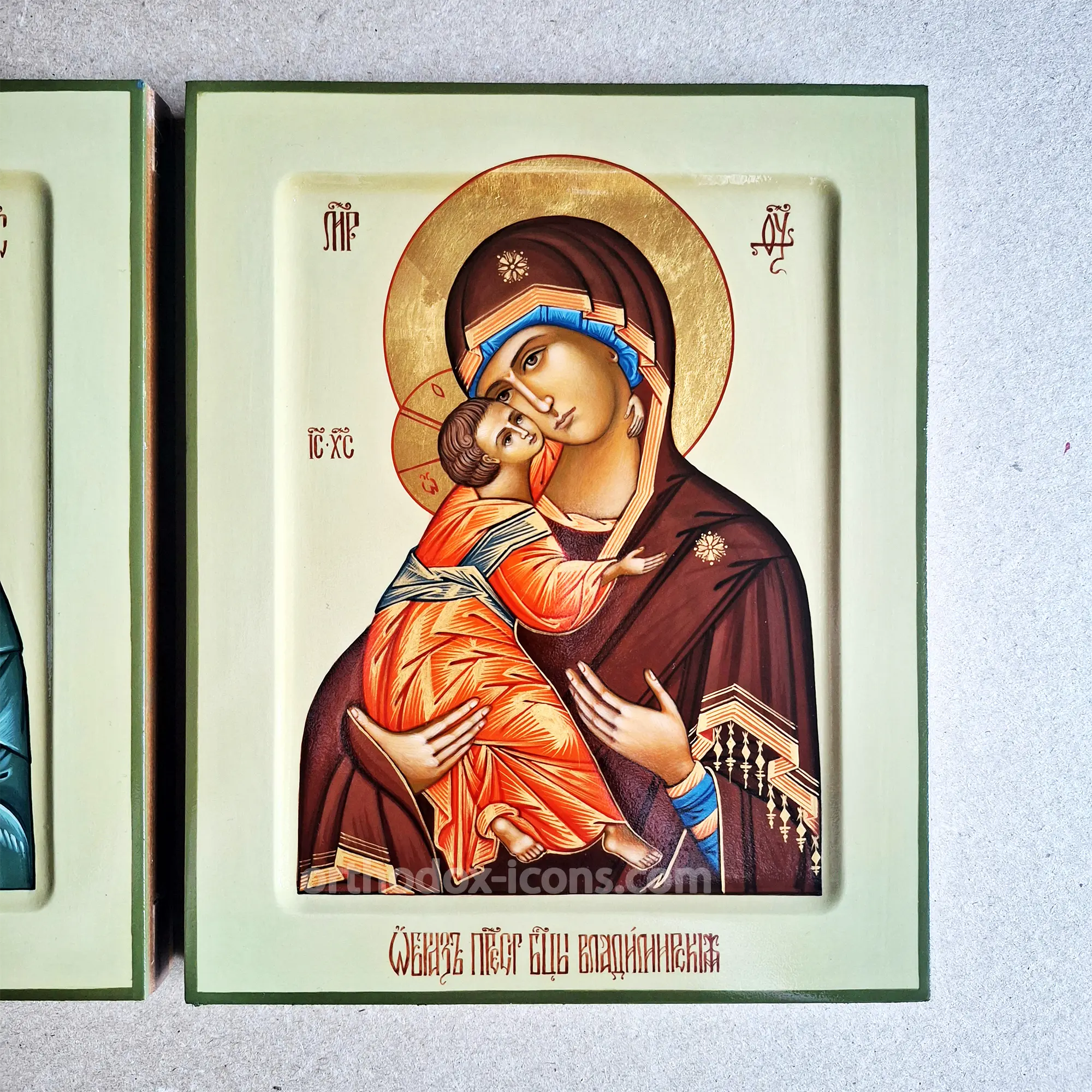
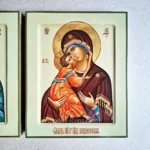
Icon of the Vladimir Mother of God
Price range: $500 through $1600
Available sizes: 17×21 cm (6.7×8.3 in), 20×24 cm (7.9×9.4 in), 27×31 cm (10.6×12.2 in), 30×40 cm (11.8×15.7 in).
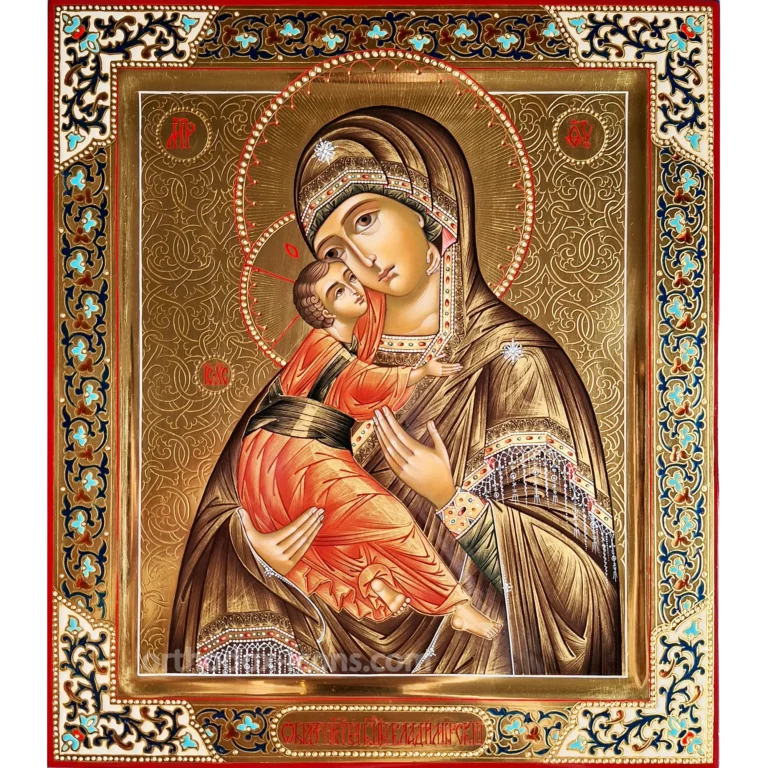
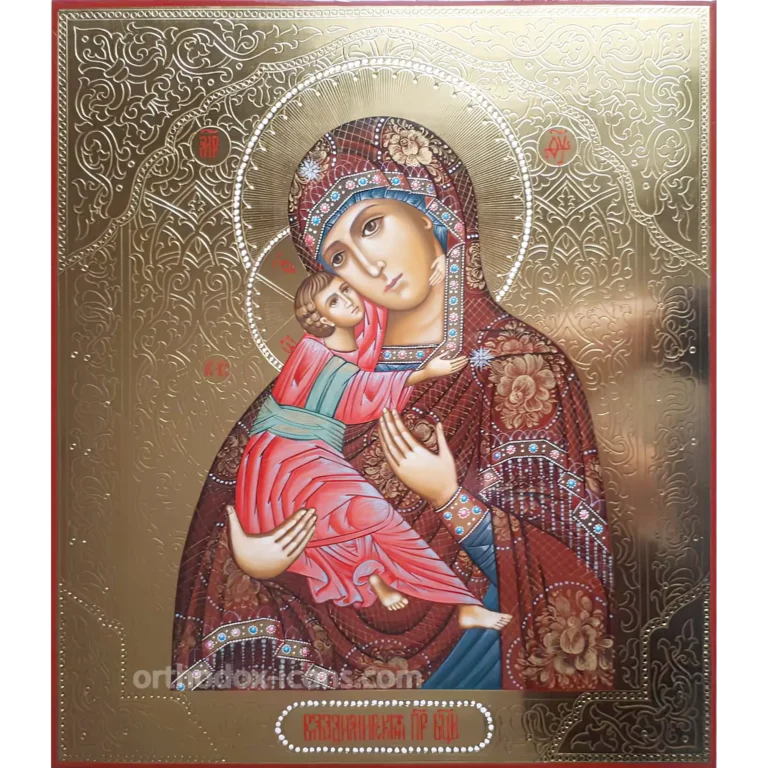
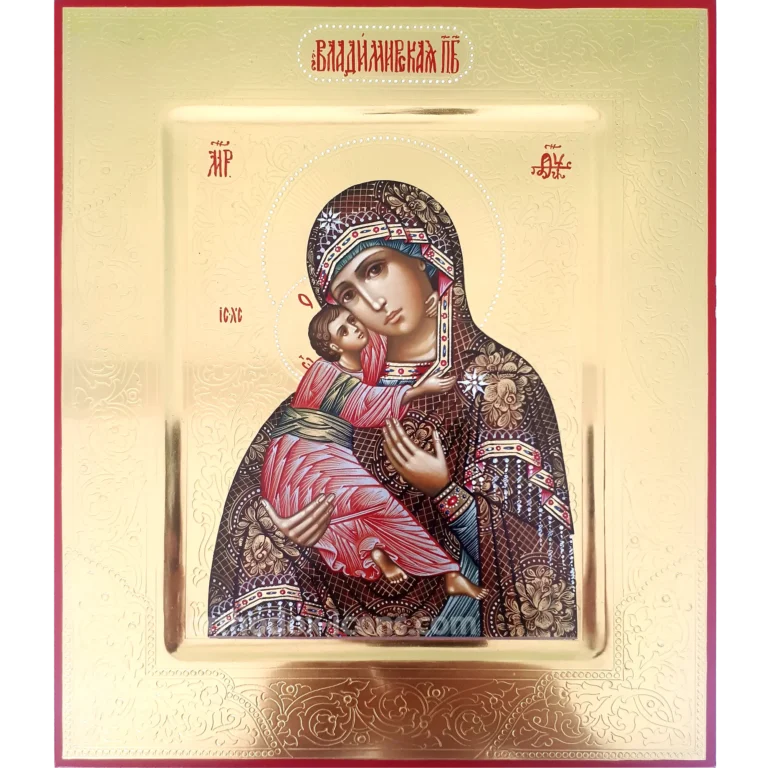
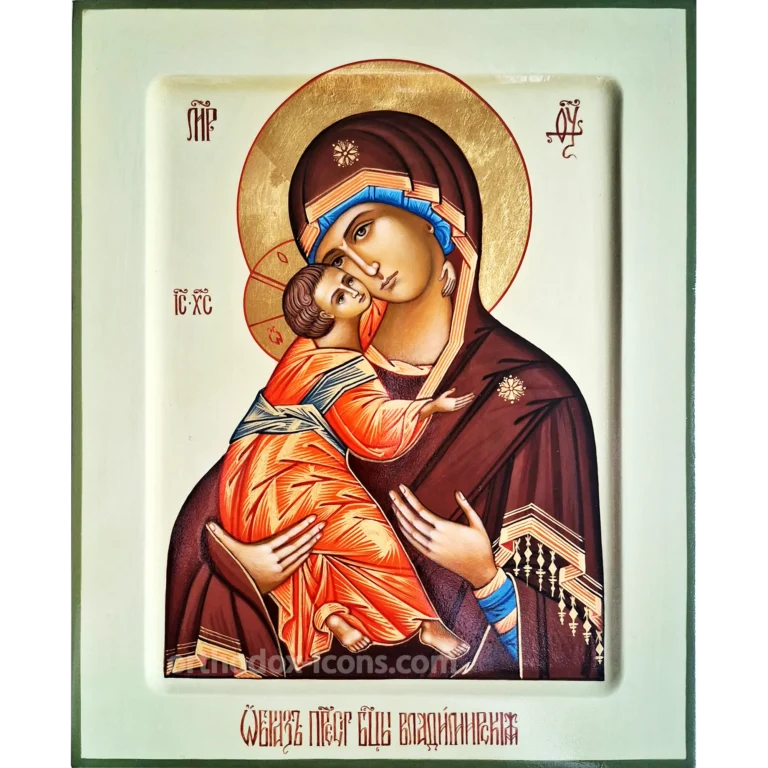
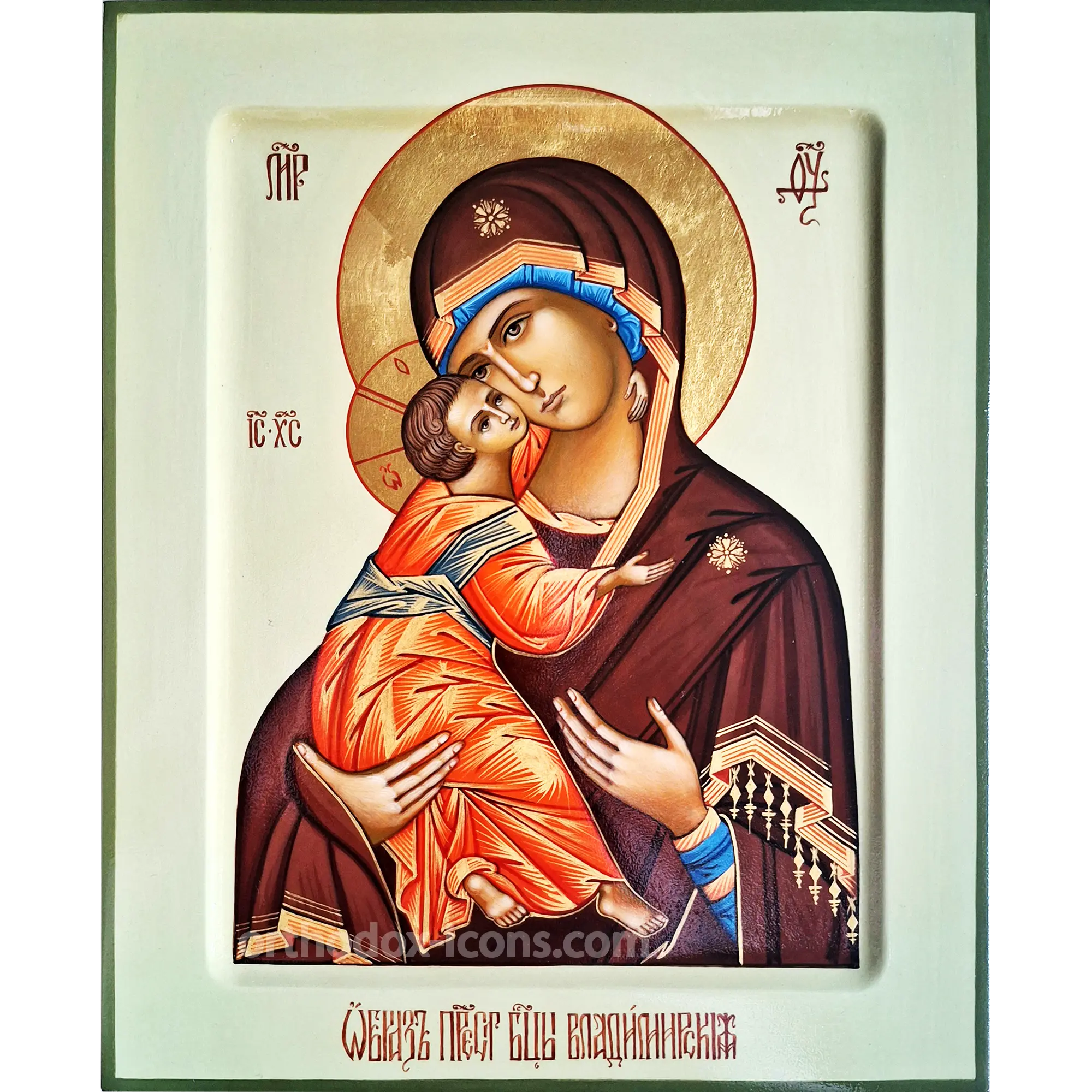
Icon of the Vladimir Mother of God is a hand-painted Orthodox icon of the Theotokos in the Eleusa, or Tenderness, type. The Christ Child presses His cheek to the cheek of His Mother and embraces her, while the visible little foot of the Child is one of the distinctive marks of the Vladimir icon.
The icon is painted on a linden board with a kovcheg, mineral egg tempera, warm ocher background, green fields, and 23K gold leaf (960 purity) on the halos and gold assist. Free international shipping is included, with payment due upon delivery.
It is possible to paint an image in any size to order
Free shipping worldwide
Icon of the Vladimir Mother of God is a hand-painted Orthodox icon of one of the most beloved and revered images of the Theotokos. The Vladimir icon belongs to the Eleusa type, also called Tenderness. The Christ Child presses His cheek to the cheek of His Mother, and the Mother of God holds Him close while looking outward toward the person who prays before the icon.
This image is full of both tenderness and sorrow. It reveals the intimate love between Mother and Son, yet the gaze of the Theotokos already carries the knowledge of the Passion. In one icon, the joy of the Incarnation and the foreknowledge of Golgotha meet quietly and deeply.
Icon of the Vladimir Mother of God – Meaning
The Vladimir Mother of God is one of the classic Orthodox images of maternal love, intercession, and consolation. In the Eleusa type, the emphasis is not on royal distance, but on closeness. Christ embraces His Mother, and she receives Him with profound tenderness. At the same time, her eyes are not turned only toward Him. They meet the faithful, drawing the person who prays into the mystery of Christ’s saving love.
The icon has long been associated with protection, family blessing, peace in the home, and help in times of danger. It is especially fitting for a home icon corner, a wedding icon pair, a child’s room, or a family shrine passed from one generation to another.
History of the Vladimir Icon
According to Orthodox tradition, the first image of the Mother of God was painted by the Apostle and Evangelist Luke during the earthly life of the Theotokos. The tradition says that when the Mother of God saw the image, she blessed it, saying that the grace of her Son and her own blessing would remain with it.
The ancient icon was kept in the Holy Land and then in Constantinople. In the twelfth century, around 1131, it was sent from Byzantium as a gift to Prince Yuri Dolgoruky of Kiev. Later, in 1155, Prince Andrei Bogolyubsky took the icon north. Near Vladimir, the horses carrying the icon stopped and would not move. The prince understood this as a sign, left the icon in Vladimir, and built a cathedral for it. From that time the icon became known as the Vladimir Mother of God.
One of the most famous events connected with the icon took place in 1395, when the army of Tamerlane was approaching Moscow. The Vladimir icon was brought in procession from Vladimir to Moscow, and the faithful prayed for deliverance. According to tradition, Tamerlane saw a terrifying vision of a majestic Woman surrounded by heavenly warriors and turned his army away. The icon was then venerated as a protector in times of danger.
Iconography: Tenderness, Sorrow, and the Little Foot
In this hand-painted icon, the Christ Child sits on the right arm of His Mother and presses His cheek to hers. He embraces her neck, seeking the warmth and closeness of His Mother. The most recognizable feature of the Vladimir icon is the visible left foot of the Christ Child, shown bare up to the knee. This small detail, often called the little heel, distinguishes the Vladimir image from many other icons of the Tenderness type.
The visible foot also carries theological meaning. It points to the true humanity of Christ, who became a real child and took on vulnerable human flesh. At the same time, it quietly foreshadows the Passion, when His feet would be pierced on the Cross for the salvation of the world.
The face of the Mother of God is the emotional center of the icon. Her eyes are deep, attentive, and sorrowful. She holds her Son with love, but she also knows that He is given for the life of the world. The icon therefore unites maternal tenderness with the sacrifice of Christ.
Color and Symbolism
The Mother of God is clothed in a dark cherry-brown maphorion, which expresses her human nature, dignity, and sorrow. The gold fringe and stars on the maphorion point to her holiness and ever-virginity. The stars traditionally signify her virginity before, during, and after the Nativity of Christ. Beneath the maphorion, the blue head covering suggests heavenly purity and grace.
The Christ Child is shown not simply as an ordinary infant, but as Emmanuel, the eternal Word of God. His garment is painted in orange-red and golden ocher tones, enriched with gold assist. The gold lines are not mere decoration; they symbolize divine, uncreated light shining through the garments of the Savior.
The background of this icon is painted in warm ocher tones, passing into green fields. The halos of the Mother of God and Christ, including the cross halo of the Savior, are gilded with 23K gold leaf (960 purity), giving the icon a quiet and solemn radiance.
Mstyora Technique and Kovcheg Board
This icon is painted by hand in the Mstyora tradition, known for refined line, soft tonal transitions in the faces, and a noble, restrained color palette. The base is a seasoned linden board with a kovcheg, a recessed central area where the holy image is painted. The raised borders form a natural frame and help create the sense of a sacred window.
The board is strengthened with oak braces. Linen cloth is applied to the front surface, then covered with layers of natural chalk gesso and polished smooth. The painting is made with mineral egg tempera, prepared from natural pigments and an egg-based emulsion. The gold halos and assist are made with 23K gold leaf (960 purity).
Prayer Before the Vladimir Mother of God
Before the Vladimir icon, Orthodox Christians pray for peace and harmony in the family, reconciliation between spouses, understanding between parents and children, and protection of the home. The tenderness of the image makes it especially close to family prayer.
People also pray for healing, especially in serious illness, for help in difficult life decisions, for protection in times of danger, and for the strengthening of faith. Mothers pray before this icon for children, pregnancy, childbirth, and the spiritual growth of the family.
Available Sizes
Available sizes: 17×21 cm (6.7×8.3 in), 20×24 cm (7.9×9.4 in), 27×31 cm (10.6×12.2 in), and 30×40 cm (11.8×15.7 in). Larger iconostasis sizes may be discussed individually before the icon is made. Free international shipping is included, with payment due upon delivery.
Icon Characteristics
| Name | Icon of the Vladimir Mother of God |
| Icon type | Eleusa / Tenderness |
| Composition | The Mother of God holding the Christ Child cheek to cheek, with the visible little foot of the Child |
| Board | Linden wood with kovcheg, linen cloth, natural gesso, oak braces |
| Painting | Mineral egg tempera in the Mstyora tradition |
| Gold | 23K gold leaf (960 purity) for the halos and gold assist |
| Colors | Cherry-brown maphorion, orange-red garment of Christ, warm ocher background, green fields |
| Available sizes | 17×21, 20×24, 27×31, and 30×40 cm |
| Main prayer themes | Family peace, protection, consolation, healing, help in difficult decisions, blessing for marriage and children |
Questions and Answers
What type of icon is the Vladimir Mother of God?
The Vladimir Mother of God belongs to the Eleusa, or Tenderness, type. It emphasizes the intimate love between the Mother of God and Christ, shown cheek to cheek.
What is the distinctive detail of the Vladimir icon?
A characteristic detail is the visible left foot of the Christ Child, sometimes called the little heel. It distinguishes the Vladimir icon from many other Tenderness-type icons.
What does the visible foot of the Christ Child mean?
It points to the real human nature of Christ and the tenderness of His infancy, while also foreshadowing the Passion, when His feet would be pierced on the Cross.
Why does the Mother of God look toward the viewer?
Her gaze is directed toward the person praying, while she holds Christ close. This gaze unites maternal love, sorrow, intercession, and the knowledge of the Cross.
What does the cherry-brown maphorion symbolize?
The dark cherry-brown maphorion expresses the human nature, dignity, and sorrow of the Mother of God. The gold stars on it symbolize her ever-virginity.
What do the stars on the maphorion mean?
The stars traditionally signify the ever-virginity of the Mother of God: before, during, and after the Nativity of Christ.
What is a kovcheg on an icon board?
A kovcheg is a recessed central area of the icon board. It creates a visual sacred space for the holy image and leaves the raised borders as a natural frame.
What do people pray for before the Vladimir Mother of God?
People pray for family peace, protection of the home, help in difficult decisions, healing, protection of children, a safe pregnancy and birth, and consolation in sorrow.
Can this icon be used as a wedding icon?
Yes. The Vladimir Mother of God is traditionally suitable for a wedding icon pair together with an icon of Christ Pantocrator, as a blessing for family life.
What materials are used for this icon?
The icon is painted on a linden board with a kovcheg, linen cloth, gesso, and mineral egg tempera. The halos and gold assist are made with 23K gold leaf (960 purity).
| Dimensions | 17x21cm (6.7×8.3 in), 20x24cm (7.9×9.4 in), 27x31cm (10.6×12.2 in), 30x40cm (11.8×15.7 in) |
|---|---|
| Name | Mary |