Orthodox Icon Seven Arrows
Price range: $700 through $2250
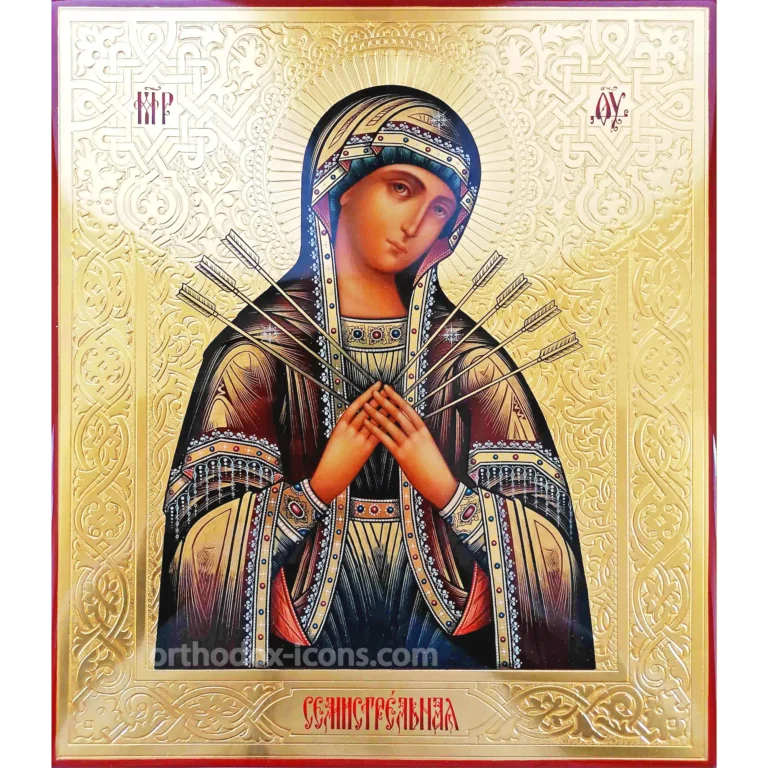
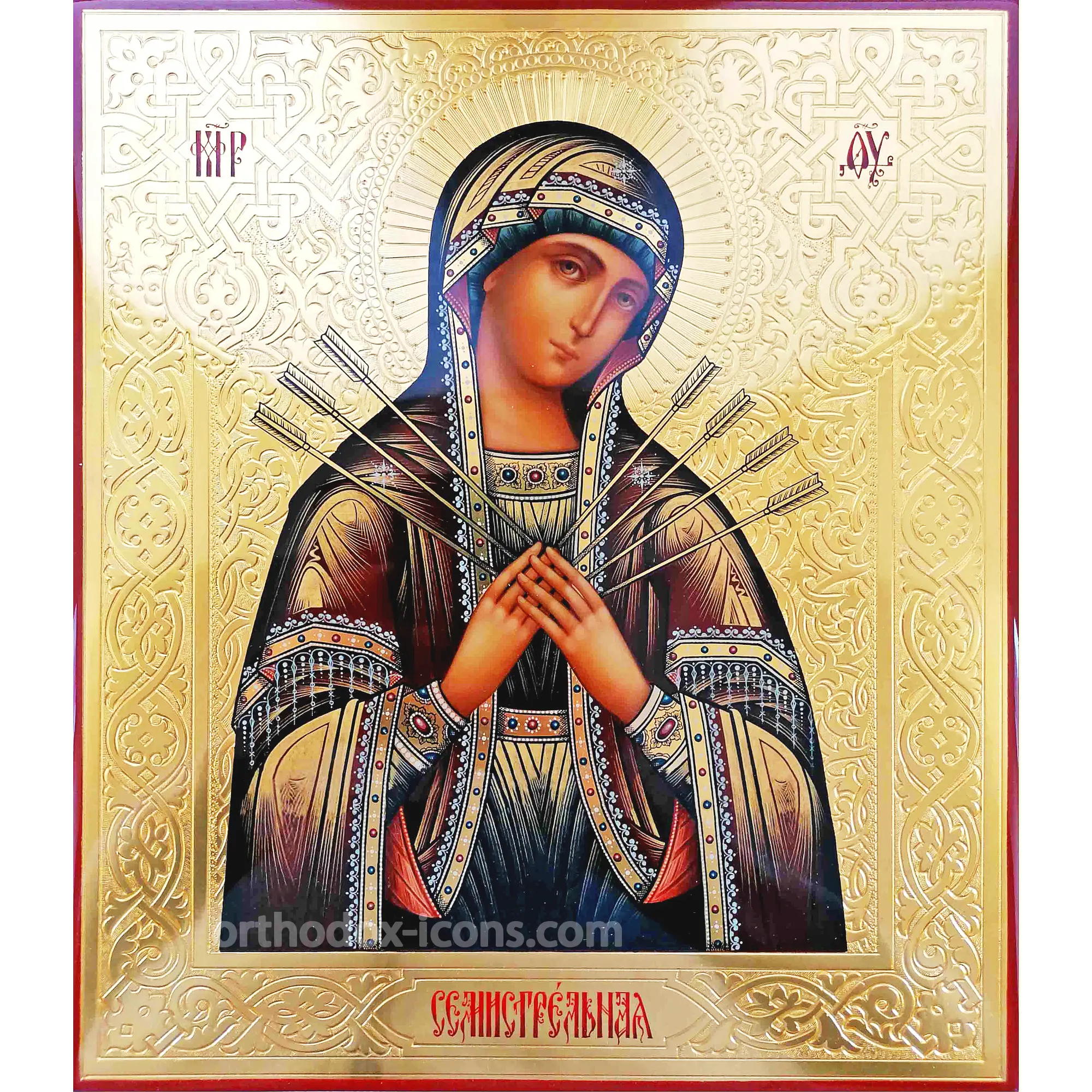
Orthodox Icon Seven Arrows is a hand-painted icon of the Mother of God in the Semistrelnaya iconographic type, with seven swords, an academic-style face, 23K gold leaf (960 purity), and a richly tooled gold background.
Available sizes: 17×21 cm (6.7×8.3 in), 20×24 cm (7.9×9.4 in), 27×31 cm (10.6×12.2 in), 30×40 cm (11.8×15.7 in). Larger sizes may be discussed before painting.
Materials: linden board with oak braces, linen pavoloka, chalk levkas, 23K gold leaf (960 purity), egg tempera, protective lacquer.
Technique: hand icon painting on wood, gilding, tooling over levkas beneath the gold, painted imitation of pearls and precious stones.
It is possible to paint an image in any size to order
Free shipping worldwide
Orthodox Icon Seven Arrows presents one of the most poignant and spiritually direct images of the Mother of God in Orthodox iconography. In this icon the Theotokos is shown alone, without the Christ Child. Devotional attention is drawn to her face and to the seven swords that pierce her breast. The image unites maternal sorrow, intercession, repentance, and mercy toward a wounded human world.
The Seven Arrows icon is especially loved as an icon of reconciliation. It is kept in homes and prayer corners when a family asks the Mother of God for peace, protection from envy and malice, healing of old offenses, and the softening of angry or hardened hearts. The composition is simple at first glance, yet spiritually very concentrated: the whole icon leads the one who prays toward the compassionate gaze of the Mother of God and the mystery of suffering love.
This version is not a printed reproduction; it is a fully hand-painted Orthodox icon made in a refined academic style, with a warm, realistic face, 23K gold leaf (960 purity), and a complex tooled background. The gold ornament gives the icon a solemn, almost jewel-like presence, while the face remains gentle, restrained, and suitable for prayer.
Orthodox Icon Seven Arrows: Meaning of the Seven Swords
The iconographic meaning of the Seven Arrows image is connected with the Gospel account of the Meeting of the Lord in the Temple. When the righteous elder Symeon held the Christ Child in his arms, he foretold the suffering that would be revealed through the Savior and said to the Mother of God that a sword would pierce her own soul also. Orthodox iconographers expressed this prophecy through the visible form of swords piercing the heart of the Virgin Mary.
The number seven is not accidental. In biblical symbolism it often suggests fullness and completion. Here the seven swords express the fullness of the sorrow borne by the Mother of God, especially as she stood by the Cross of her Son. The image does not present despair; rather, it reveals a sorrow transfigured by love, compassion, and intercession.
There is also a personal moral meaning for every Christian. The swords can be understood as the wounds caused by human sin: anger, envy, pride, resentment, hardness of heart, despair, and lack of love. Before this icon, the believer does not only ask for protection from enemies; he also asks that his own heart may become more merciful, patient, and truthful.
Prayerful Help and Devotional Use
The Seven Arrows icon is traditionally approached when hatred and division have entered life with unusual force. It is a strong image for prayer in difficult family situations, long-standing quarrels, unjust accusations, conflicts at work, and moments when a person feels surrounded by envy, slander, or hostility.
- For reconciliation: prayer before this icon asks the Mother of God to calm quarrels between spouses, parents and children, relatives, neighbors, or colleagues.
- For protection from ill will: the icon is often kept as a spiritual shield against envy, slander, hidden hostility, and unfair treatment.
- For softening one’s own heart: the image reminds the believer that peace begins with repentance, humility, patience, and the refusal to answer evil with evil.
- For peace in society: Orthodox Christians also pray before this icon during wars, unrest, and serious public conflict, asking that the hearts of rulers and peoples may be softened.
Academic Icon Painting and the Face of the Mother of God
This icon is painted in an academic, pictorial manner that became widespread in Russian church art in the eighteenth and nineteenth centuries. Unlike more austere Byzantine stylization, academic icon painting uses softer modeling, realistic facial features, delicate transitions of light, and carefully observed human expression. In a devotional icon, this approach must still remain modest and prayerful; the painting should not become theatrical or sentimental.
The face of the Mother of God is written with fine glazes and gentle tonal transitions. The painter gives attention to the soft blush of the cheeks, the depth of the eyes, the calm line of the mouth, and the subdued sorrow of the whole expression. Her gaze is direct and compassionate, as if meeting the prayer of the person standing before the icon.
The seven swords are arranged according to the Semistrelnaya type: asymmetrically, with four swords on one side and three on the other. This distinguishes the image from the closely related Softener of Evil Hearts icon, where the sword arrangement is usually different. The asymmetry gives the composition an inner tension while keeping the face of the Mother of God as the spiritual center.
Gold Leaf, Tooling, and Painted Ornament
The most luxurious artistic feature of this icon is the gold background. The surface is covered with real 23K gold leaf (960 purity) and then decorated by hand. The ornament is not a flat printed pattern: it is tooled into the gesso beneath the gold with special tools, creating relief, light, shadow, and the impression of a precious metal cover.
This work requires several stages and several kinds of mastery. First, the linden board is prepared. Linen pavoloka is applied to the front surface, then multiple layers of chalk levkas are laid and polished until the surface is smooth and stable. Only after this preparation can the gilding and the icon painting be done properly.
The gilding is done with high-purity 23K gold leaf (960 purity). After application, the gold is polished to bring out a deep metallic shine. Then the master works the ornament by hand, pressing the pattern into the levkas beneath the gold. The relief may include floral and geometric motifs, covering the background and margins and giving the icon the visual dignity of a richly adorned shrine.
The maphorion of the Mother of God is also carefully decorated. Its edges are painted with the illusion of precious embroidery, pearls, gold thread, and colored stones. This is not a separate metal setting; it is painted by hand with fine brushes, in a painstaking technique that requires accuracy and restraint.
Board, Materials, and Protective Finish
The icon is painted on a solid linden board. Oak braces are used to help stabilize the wood and reduce the risk of warping caused by changes in humidity and temperature. Over the board come the traditional layers of pavoloka and levkas, which create the proper ground for gilding and egg tempera painting.
The painting is done with egg tempera, a traditional medium used in Orthodox iconography for its clarity, durability, and luminous matte surface. After the painting is completed, the icon receives a protective lacquer coating. This helps protect the painted and gilded surface from dust, moisture, and fading, while preserving the devotional character of the icon.
Sizes and Recommendations
The icon can be ordered in the following sizes: 17×21 cm (6.7×8.3 in), 20×24 cm (7.9×9.4 in), 27×31 cm (10.6×12.2 in), and 30×40 cm (11.8×15.7 in). Larger sizes may also be discussed before painting.
Because this particular icon includes a detailed tooled gold background, the larger sizes reveal the ornament much better. The size of 27×31 cm (10.6×12.2 in) and above is especially recommended if you want the richness of the relief pattern to be clearly visible. A smaller board remains beautiful for prayer, but the finest decorative work will naturally be more compact.
| Iconographic type | Seven Arrows Mother of God, also called Semistrelnaya |
|---|---|
| Painting style | Academic, pictorial, realistic Orthodox icon painting |
| Background decoration | 23K gold leaf (960 purity) with hand tooling over levkas beneath the gold |
| Board | Solid linden board with oak braces |
| Ground | Linen pavoloka and chalk levkas |
| Painting medium | Egg tempera |
| Available sizes | 17×21 cm (6.7×8.3 in), 20×24 cm (7.9×9.4 in), 27×31 cm (10.6×12.2 in), 30×40 cm (11.8×15.7 in) |
| Recommended size | From 27×31 cm (10.6×12.2 in) for best readability of the tooled ornament |
| Making time | Usually about 4 to 7 weeks, depending on size and workload |
| Shipping | Free international shipping is included; payment is due upon delivery. |
A Spiritual Gift and Family Icon
An icon of this level can become a meaningful family shrine and a lasting spiritual gift. It is appropriate for a wedding, a house blessing, a family prayer corner, or as a gift to a person who carries responsibility and needs peace, patience, and wise judgment.
For a wedding or marriage anniversary, the Seven Arrows icon is a spiritual wish that the family may be protected from quarrels, envy, and resentment. For a new home, it is often chosen as an icon near the entrance, asking the Mother of God to guard the household and bring peace to all who enter. For a leader, teacher, or business partner, the icon may serve as a reminder to act with mercy, calmness, and justice in difficult situations.
The icon is made to order by hand. Small variations in tone, ornament, and expression are natural in traditional icon painting and make each finished icon a unique work rather than a mechanical copy. The result is a reverent Orthodox image intended for long use, careful keeping, and family remembrance.
Questions and Answers
What is the difference between the Seven Arrows icon and the Softener of Evil Hearts icon?
The spiritual meaning and devotional purpose of the two icons are very close. The main difference is iconographic: in the Seven Arrows icon the swords are arranged asymmetrically, with four on one side and three on the other. In the Softener of Evil Hearts, also associated with Simeon’s prophecy, the swords are usually arranged more symmetrically, with one sword pointing upward from below.
Why is the size of 27×31 cm recommended for this icon?
The main decorative feature of this icon is the fine tooled ornament on the gold background. On a small 17×21 cm board, there is less space for the relief pattern to reveal its depth and detail. At 27×31 cm and larger, the gold tooling looks richer and more readable.
Will the gold on the icon darken over time?
The icon is decorated with real 23K gold leaf (960 purity), not imitation metal leaf. High-purity gold does not oxidize in ordinary air, so its brightness is preserved when the icon is kept in proper indoor conditions and handled with care.
What does tooling over levkas mean?
Tooling over levkas is a traditional decorative technique. After the board is prepared and gilded, the master uses special metal tools to press a relief ornament into the ground layer beneath the gold. This creates the effect of a precious metal cover while remaining part of the painted icon.
Where may the Seven Arrows icon be placed in a home?
It may be placed in the family icon corner together with other holy images. There is also a common pious custom of placing the Seven Arrows icon near the entrance or opposite the door, as a devotional reminder that the Mother of God protects the home and softens hostile thoughts.
Does an icon with tooled gold require special care?
Yes. Dust can collect in the relief ornament, so the icon should not be wiped with a wet cloth. Use only a very soft, dry brush. For long-term protection from dust, candle soot, and accidental contact, a wooden kiot with glass is recommended.
How are the garments of the Mother of God painted on this icon?
The maphorion is painted with an imitation of precious embroidery. With fine brushes, the icon painter creates the appearance of pearls, gold thread, and colored stones along the garment, giving the icon a solemn and jewel-like character.
Why are oak braces used on the back of the board?
Wood reacts to changes in humidity and temperature. Oak braces help keep the linden board stable, reducing the risk of warping and protecting the levkas and painted surface from stress over time.
Is the icon sent already blessed?
The icon is painted according to Orthodox tradition, but it is normally sent unblessed. After receiving it, the owner may bring the icon to an Orthodox church for blessing, making this part of the family’s own spiritual life.
Can one pray before this icon during lawsuits or family conflicts?
Yes. The Seven Arrows icon is often approached in situations of serious conflict, legal disputes, accusations, envy, and hostility. The prayer is for justice, reconciliation, patience, protection, and the softening of hardened hearts.
| Dimensions | 17x21cm (6.7×8.3 in), 20x24cm (7.9×9.4 in), 27x31cm (10.6×12.2 in), 30x40cm (11.8×15.7 in) |
|---|---|
| Name | Mary |