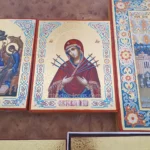
Orthodox Icon of Seven Arrows
Price range: $700 through $2250
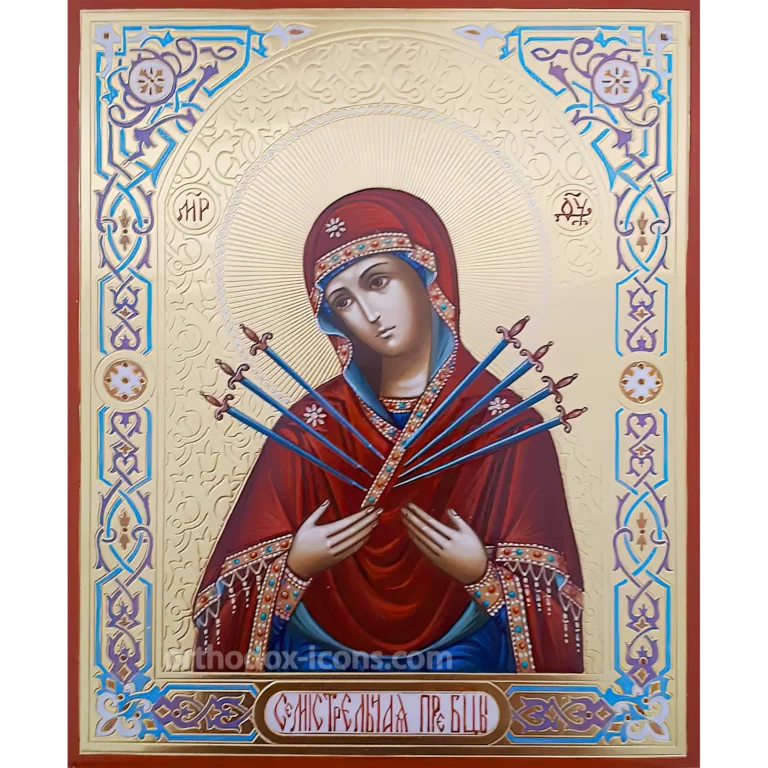
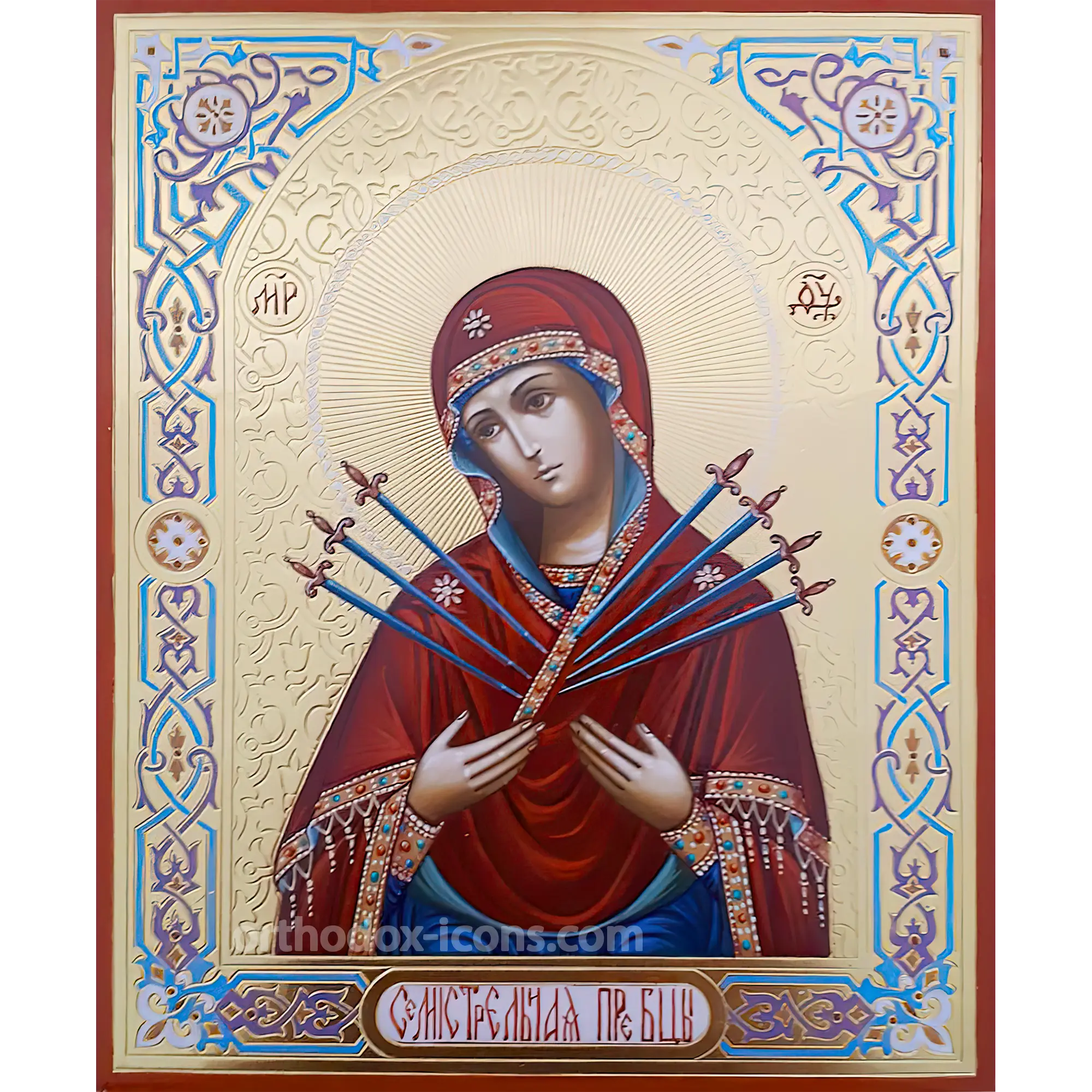
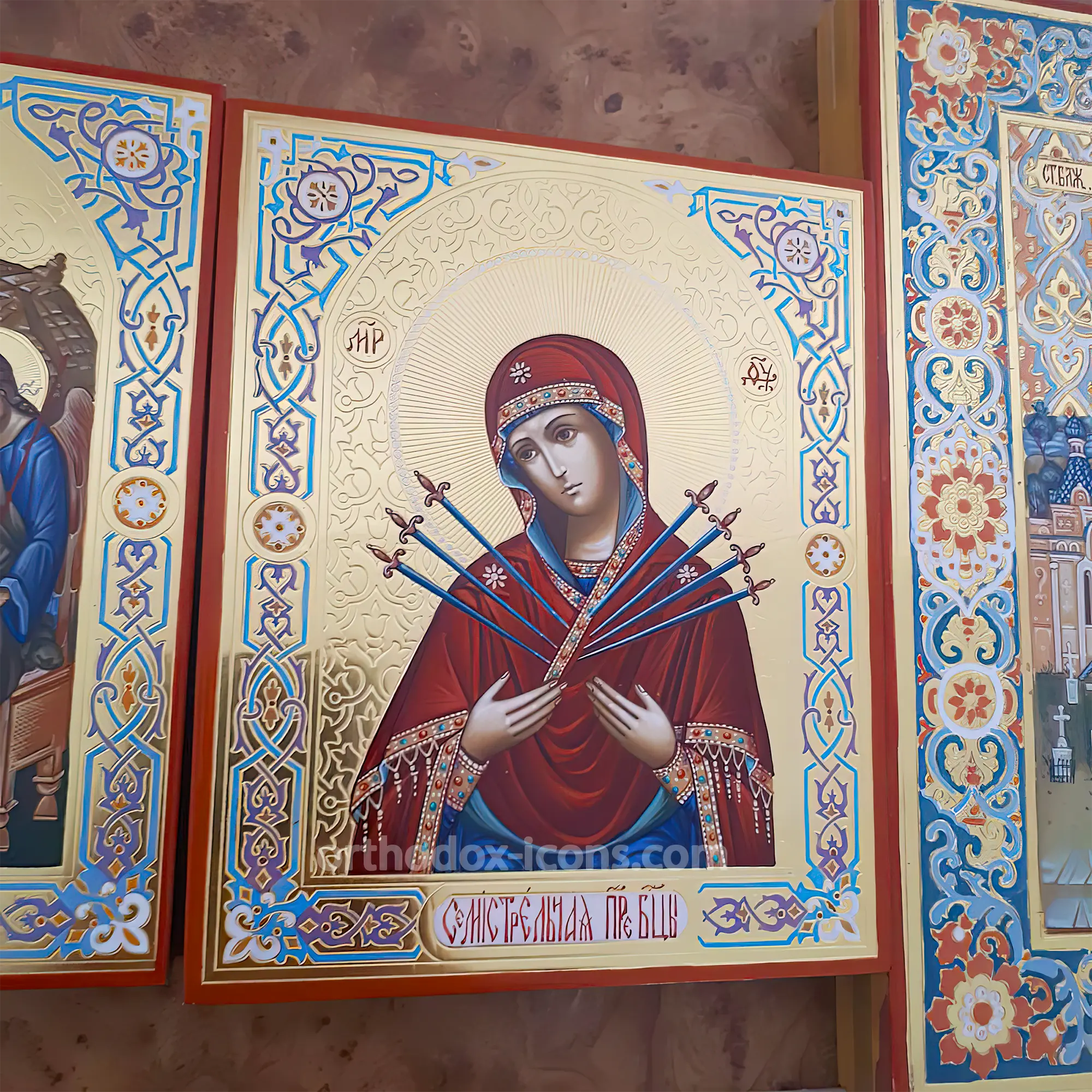
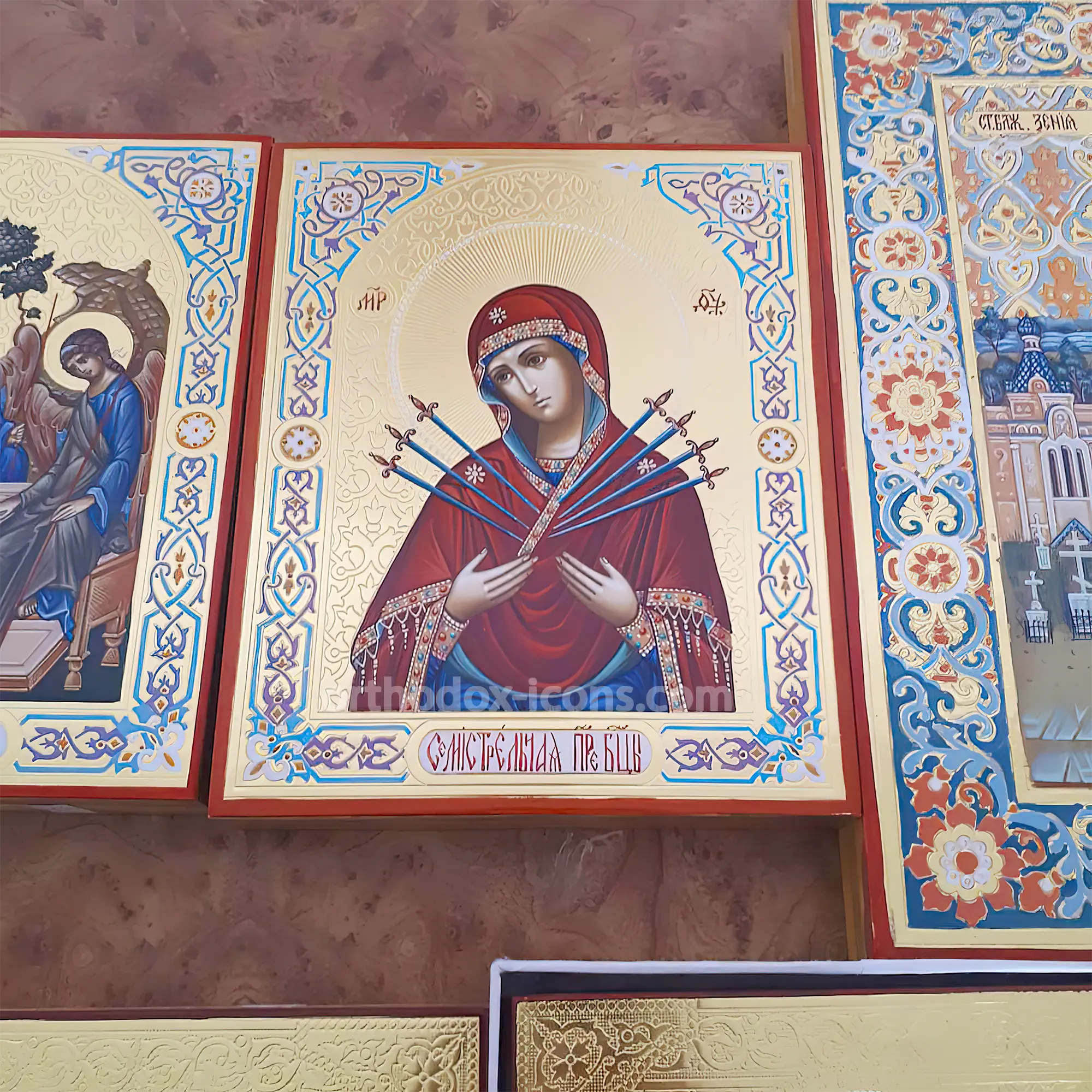
Orthodox Icon of Seven Arrows is a hand-painted Semistrelnaya icon of the Mother of God, with seven swords, a radiant gold halo, 960 gold leaf, and rich polychrome ornament on the margins.
Available sizes: 17×21 cm (6.7×8.3 in), 20×24 cm (7.9×9.4 in), 27×31 cm (10.6×12.2 in), 30×40 cm (11.8×15.7 in). Larger sizes may be discussed before painting.
Materials: linden board with kovcheg and oak braces, linen pavoloka, chalk levkas, 960 gold leaf, egg tempera, protective lacquer.
Technique: academic hand icon painting, gold leaf, relief tooling on the gold background, engraved rays in the halo, and painted enamel-like ornament on the margins.
It is possible to paint an image in any size to order
Free shipping worldwide
Orthodox Icon of Seven Arrows is a hand-painted image of the Mother of God in the Semistrelnaya iconographic type. Among Orthodox icons of the Theotokos, this image has a particularly direct and moving force. There is no scene of heavenly triumph and no Christ Child in her arms. The Most Holy Virgin is shown alone, and seven sharp swords pierce her breast.
The subject is sorrowful, yet the icon is not dark in spirit. It speaks of maternal love, intercession, mercy, and hope. Orthodox Christians turn to the Seven Arrows icon in times of family conflict, hostility, quarrels, envy, accusations, and painful crisis, asking the Queen of Heaven for protection, peace, and the healing of wounded relationships.
This version is a richly decorated work of church art. It combines soft academic painting, the warm shine of 960 gold leaf, relief tooling on the gold background, a radiant engraved halo, and complex polychrome ornament on the margins. The festive blue, light-blue, violet, and gold tones give the icon a solemn appearance while the face of the Mother of God remains gentle and prayerful.
Orthodox Icon of Seven Arrows: Prophecy and Fullness of Sorrow
The iconography of the Seven Arrows image is rooted in the Gospel account of the Meeting of the Lord in the Temple. According to the Gospel of Luke, the Virgin Mary and righteous Joseph brought the Child Jesus to the Temple, where they were met by the holy elder Symeon.
Symeon held the Savior in his arms and spoke prophetic words about His future ministry, contradiction, and suffering. Then he turned to the Mother of God and foretold that a sword would pierce her own soul also, so that the thoughts of many hearts would be revealed. Icon painters expressed this invisible sword of sorrow through the visible form of seven swords.
In Holy Scripture, the number seven often suggests fullness and completion. The seven swords therefore express the fullness of the suffering that the Mother of God bore for her Son and for the human race. They also remind the faithful of the human passions and sins that wound the heart: pride, greed, impurity, envy, gluttony, anger, and despondency.
For this reason, prayer before the Seven Arrows icon is not only a request for protection from other people. It is also a call to repentance, to purification of thoughts, and to the healing of one’s own anger, envy, resentment, and hardness of heart.
Prayer Before the Holy Image
The grace associated with this icon is directed toward the healing of human relationships and the restoration of peace. In popular devotion, the Seven Arrows icon is closely connected with the Softener of Evil Hearts, because both images are approached when hostility has become especially painful.
- For the end of family conflicts: prayer before the icon asks the Mother of God to restore love between spouses and bring understanding between parents and children.
- For protection from malicious people: the icon is kept with prayer against envy, gossip, slander, hidden intrigue, and unfair treatment.
- For softening one’s own heart: the Theotokos helps the believer see personal pride, anger, and impatience, and gives strength to ask forgiveness.
- During legal disputes: Orthodox Christians pray for justice, truth, mercy, and a peaceful resolution where possible.
Polychrome Ornament, Gold Background, and Radiant Halo
The distinctive feature of this icon is its rich, multi-part decoration. The wide margins are painted with an elaborate floral pattern in blue, light-blue, violet, and gold tones. This ornament recalls the appearance of precious cloisonne enamel, the kind of decorative cover once used for especially honored icons.
The gold background behind the figure is not simply flat. It is decorated with a fine relief pattern of floral scrolls, worked by hand over the gilded surface. This tooling makes the gold play with many reflections, giving the background depth and movement while preserving a reverent liturgical character.
The halo of the Mother of God is also carefully decorated. Fine rays are engraved or tooled into the gold, symbolizing divine, uncreated light and the spiritual glory of the Most Holy Virgin. Together with the colored margins, the radiant halo gives the icon an especially festive and solemn appearance.
The face of the Mother of God is painted in an academic, realistic manner with delicate glazes. The expression is alive, deeply compassionate, and forgiving. The painter also gives attention to the folds of the crimson maphorion, the details of the garments, and the metallic shine of the sword hilts.
Making the Icon: From Board to Protective Lacquer
The creation of such an icon takes several weeks of careful handwork. The process includes the preparation of the wooden board, the application of pavoloka and levkas, gilding, ornament, icon painting, and protective finishing.
The icon is painted on a solid linden board. A kovcheg is cut on the front side, separating the central sacred image from the margins. Oak braces are inserted into the back of the board to help prevent warping when humidity and temperature change indoors.
Linen pavoloka is glued to the board, and multiple layers of chalk levkas are applied over it. The levkas is polished to a smooth surface. The background, halo, and margins are then covered with high-purity 960 gold leaf, which does not darken or oxidize like imitation metal leaf.
After gilding, the master works the relief ornament on the gold background and the rays in the halo with special tools. Then the ornament painter uses fine brushes to decorate the margins with a multicolored enamel-like pattern. The figure of the Mother of God is painted with light-resistant colors, and the completed icon is covered with protective lacquer against dust and moisture.
Characteristics of the Hand-Painted Icon
| Iconographic type | Seven Arrows Mother of God, Semistrelnaya |
|---|---|
| Painting style | Academic, pictorial, realistic Orthodox icon painting |
| Background decoration | 960 gold leaf with hand relief tooling and floral scrolls |
| Halo | Gold halo with engraved or tooled rays |
| Margin decoration | Polychrome painted ornament, enamel-like floral pattern |
| Board | Solid linden board with kovcheg and oak braces |
| Ground | Linen pavoloka and chalk levkas |
| Available sizes | 17×21 cm (6.7×8.3 in), 20×24 cm (7.9×9.4 in), 27×31 cm (10.6×12.2 in), 30×40 cm (11.8×15.7 in) |
| Making time | Usually about 4 to 7 weeks, depending on size and ornament complexity |
| Shipping | Free international shipping is included; payment is due upon delivery. |
A Solemn Orthodox Gift
An icon in this richly decorated style can become a memorable Orthodox gift and a central holy image in a home. It is appropriate for a wedding or church marriage blessing, as a prayer that the family may live without destructive quarrels and learn to forgive one another.
It is also suitable for an anniversary, birthday, or housewarming. Placed near the entrance or in the family icon corner, the Seven Arrows icon is kept with prayer that the home may be guarded from evil intentions, envy, and bitterness from outside.
Because the icon is painted and ornamented by hand, small differences in tone, line, ornament, and expression are natural. They are part of the living character of a hand-painted icon and make each finished work unique.
Questions and Answers
How does the Seven Arrows icon differ from the Softener of Evil Hearts icon?
The spiritual meaning and prayerful purpose are essentially the same: both icons are approached for reconciliation, protection from malice, and the softening of hardened hearts. The difference is in the placement of the swords. In the Seven Arrows icon, as here, they are arranged asymmetrically, four on one side and three on the other. In the Softener of Evil Hearts, they are usually arranged three on each side, with one sword from below.
What does the colored ornament on the margins mean?
The multicolored floral ornament is a decorative element that emphasizes the solemn, festive character of the icon. Technically, the painted ornament imitates the appearance of precious cloisonne enamel covers used on especially honored icons in the Russian tradition.
What do the rays in the halo of the Mother of God symbolize?
The radiating lines in the gold halo symbolize divine, uncreated light, grace, and the spiritual glory of the Most Holy Theotokos. Visually, they make the icon brighter and give the halo a more luminous and dimensional appearance.
Will the colors fade or the gold darken over time?
The icon is painted with high-quality, light-resistant colors and decorated with real 960 gold leaf. Unlike imitation metal leaf, high-purity gold does not oxidize in ordinary air. Proper care helps preserve the icon for many years.
Why is the Mother of God shown in a red garment?
The outer garment of the Mother of God is called the maphorion. In Orthodox iconography it is often painted in deep red, crimson, or cherry tones. The color expresses royal dignity, suffering, and the sorrow connected with the Passion of her Son.
How should an icon with gold tooling be cared for?
Because the gilded and tooled surface is delicate, the icon must not be washed with water or wiped with wet cloths. Dust should be removed only with a very soft, dry brush. A wooden kiot with glass gives the best protection from dust and accidental contact.
Why are wooden braces inserted on the back of the board?
These braces help keep the linden board stable. Wood reacts to humidity and dry indoor heat, so oak braces are set across the grain to reduce warping and help the icon remain flat over time.
Which size is best for a wedding gift?
For a wedding or marriage blessing, the medium and larger sizes are especially suitable: 27×31 cm (10.6×12.2 in) or 30×40 cm (11.8×15.7 in). These formats allow the colored ornament, gold background, and painted details to be seen clearly.
Where may this icon be placed in an apartment or house?
The icon may be placed in the main family icon corner with icons of Christ and other holy images. There is also a strong pious custom of placing the Seven Arrows icon above the entrance or on the wall opposite it, with prayer for protection of the home.
Will the icon be blessed before delivery?
The icon is painted according to Orthodox tradition and church canons, but it is normally sent unblessed. After receiving it, the owner may bring the icon to an Orthodox church, where a priest can bless it with the appointed prayers.
| Dimensions | 17x21cm (6.7×8.3 in), 20x24cm (7.9×9.4 in), 27x31cm (10.6×12.2 in), 30x40cm (11.8×15.7 in) |
|---|---|
| Name | Mary |