Tenderness Mother of God Orthodox Icon: Meaning and How to Choose
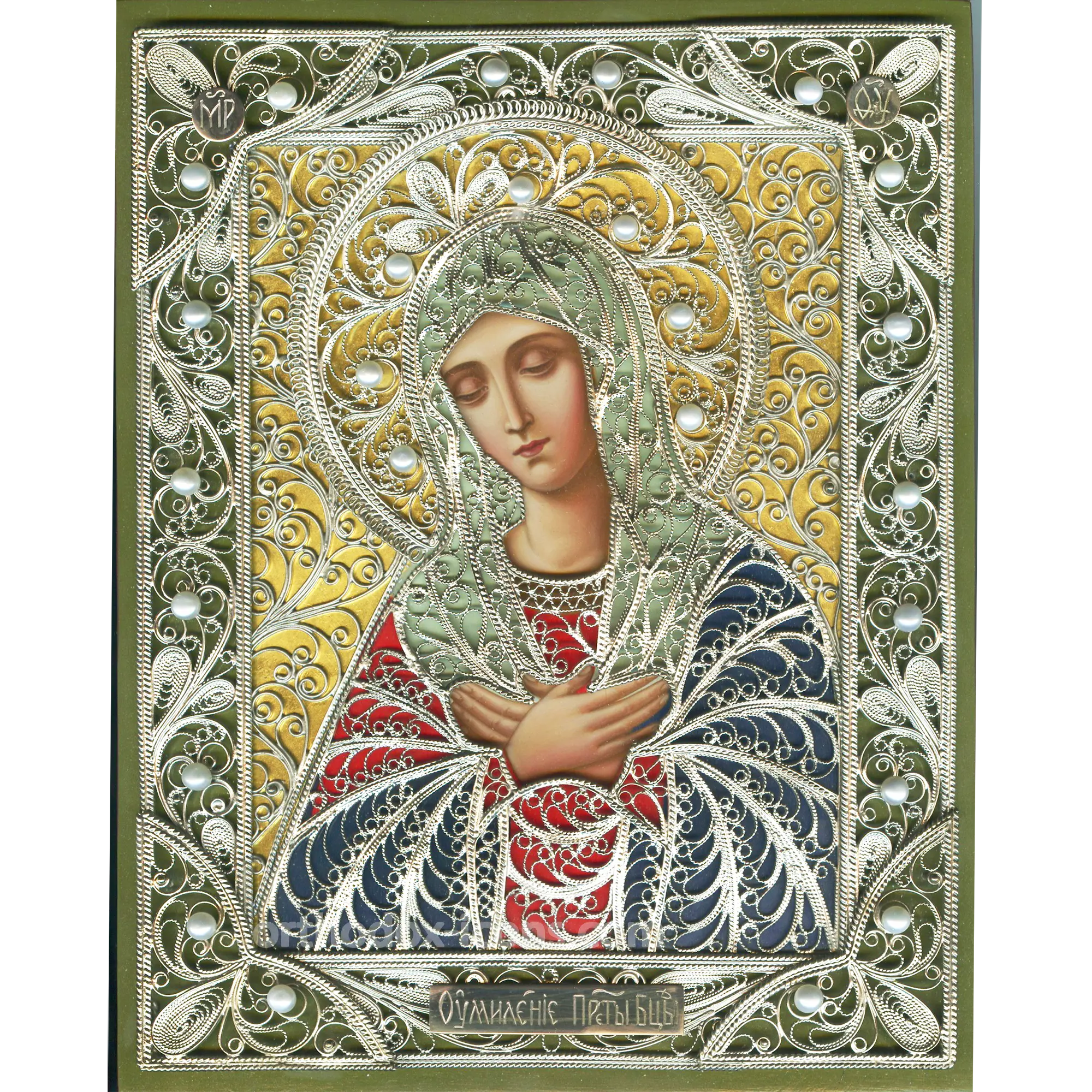
The Tenderness Mother of God icon, known in Russian as Umilenie, is a deeply prayerful icon of the Theotokos. In this category the name most often refers to the Seraphim-Diveyevo icon of the Mother of God Tenderness, where the Virgin Mary is shown without the Christ Child, with lowered eyes and crossed hands.
This icon is closely connected with Saint Seraphim of Sarov, who called it Joy of All Joys. It is often chosen for home prayer, young women, brides, mothers, baptism gifts, and personal devotion to the Mother of God. Its meaning is not sentimental softness, but humility, obedience, purity, and quiet prayer.
What the Tenderness icon depicts
Unlike the Vladimir Mother of God icon, where the Theotokos and Christ Child are shown cheek to cheek, the Seraphim-Diveyevo Tenderness icon shows the Mother of God alone. Her eyes are lowered, her hands are crossed on her chest, and the whole image is filled with stillness and inward prayer.
The icon is often understood as connected with the Annunciation. It expresses the moment of humble acceptance, when the Virgin Mary receives the word of God and answers with obedience and faith.
Tenderness, Eleusa, and Glykophilousa
In English, the word Tenderness can be confusing because it is used for several related but different iconographic ideas. Eleusa and Glykophilousa icons usually show the Mother of God and Christ Child in a tender embrace. The Seraphim-Diveyevo Umilenie icon is different: the Christ Child is not shown.
For this reason, when ordering or choosing an icon, it is useful to specify whether you mean the Seraphim-Diveyevo Tenderness icon, the Vladimir Eleusa type, or another tender Theotokos image. This helps avoid confusion and makes the commission more accurate.
Saint Seraphim of Sarov and Joy of All Joys
The Tenderness icon is especially revered because it was the cell icon of Saint Seraphim of Sarov. According to tradition, he prayed before this image throughout his life and reposed before it in 1833.
This connection gives the icon a particular spiritual tone. It is associated with humility, repentance, consolation, and the quiet joy of prayer. For many Orthodox Christians, the image is inseparable from the memory of Saint Seraphim and the Diveyevo tradition.
When this icon is chosen as a gift
The Tenderness Mother of God icon is often chosen for a young woman, a bride, a mother, a baptism gift for a girl, or a person who needs consolation and a gentle image for private prayer. It can also be a meaningful icon for a bedroom prayer corner or a personal icon shelf.
For a gift, the icon may be ordered with a simple gold background, delicate ornament, or a protective kiot. A commemorative inscription can be added on the back of the board if the icon is intended for baptism, a wedding, a birthday, or a family blessing.
How to choose a Tenderness Mother of God icon
For private prayer, sizes such as 17×21 cm or 20×24 cm are often practical. For a gift, 27×31 cm can give the image more presence while still remaining suitable for a home prayer corner. For a church, chapel, or monastery, a larger custom size may be appropriate.
Because this icon is quiet and face-centered, the quality of the drawing matters more than heavy decoration. The expression, hands, garment lines, and gold background should support a calm and prayerful atmosphere.
Materials and hand-painted work
A traditional hand-painted Tenderness icon is made on a prepared wooden board with gesso ground, egg tempera, mineral pigments, and gold leaf. These materials are especially suitable for subtle facial work, soft highlights, and restrained color.
In the Mstyora tradition, the image is painted with fine drawing and careful tonal transitions so that the icon remains gentle without becoming decorative or sentimental.
Hand-painted Tenderness icons from Mstyora
Our workshop paints Tenderness Mother of God icons in the traditional Mstyora manner, using prepared wooden boards, egg tempera, gold leaf, and careful canonical drawing. You can view available works in the Tenderness Mother of God Orthodox icons catalog or browse the wider collection of Virgin Mary Orthodox icons.
Frequently asked questions
What does Umilenie mean?
Umilenie is often translated as Tenderness or compunction. In this icon it points to humility, inward prayer, and the quiet acceptance of God’s will.
Is this the same as the Vladimir icon?
No. The Vladimir icon is an Eleusa image with Christ Child. The Seraphim-Diveyevo Tenderness icon shows the Mother of God alone, with crossed hands and lowered eyes.
Why is this icon connected with Saint Seraphim of Sarov?
It was his beloved cell icon, known as Joy of All Joys. Orthodox tradition remembers Saint Seraphim praying before this image throughout his life.
Is the Tenderness icon suitable as a gift for a girl or bride?
Yes. It is often chosen for girls, young women, brides, mothers, and baptism or wedding gifts because of its themes of humility, purity, and prayer.
Can a gift inscription be added?
Yes. A commemorative inscription or prayer can be added on the back of the icon board on request.
Can this icon be painted in a custom size?
Yes. It can be commissioned in a custom size, with gold leaf, ornament, a carved frame, or a protective kiot.
FAQ about the Tenderness Mother of God icon
What does the Tenderness icon mean?
It emphasizes the tender relationship between the Mother of God and Christ, as well as humility, love, and prayerful closeness.
Is Tenderness the same as Umilenie?
Yes, Umilenie is often translated as Tenderness, though specific local icon types may have their own traditions.
Is this icon suitable as a gift?
Yes. It is often chosen for home prayer, women, families, namedays, and personal devotion.
Can it be custom painted?
Yes. Size, inscription, background, and finish can be selected before painting.