Protection of the Mother of God Orthodox Icon: Meaning and How to Choose
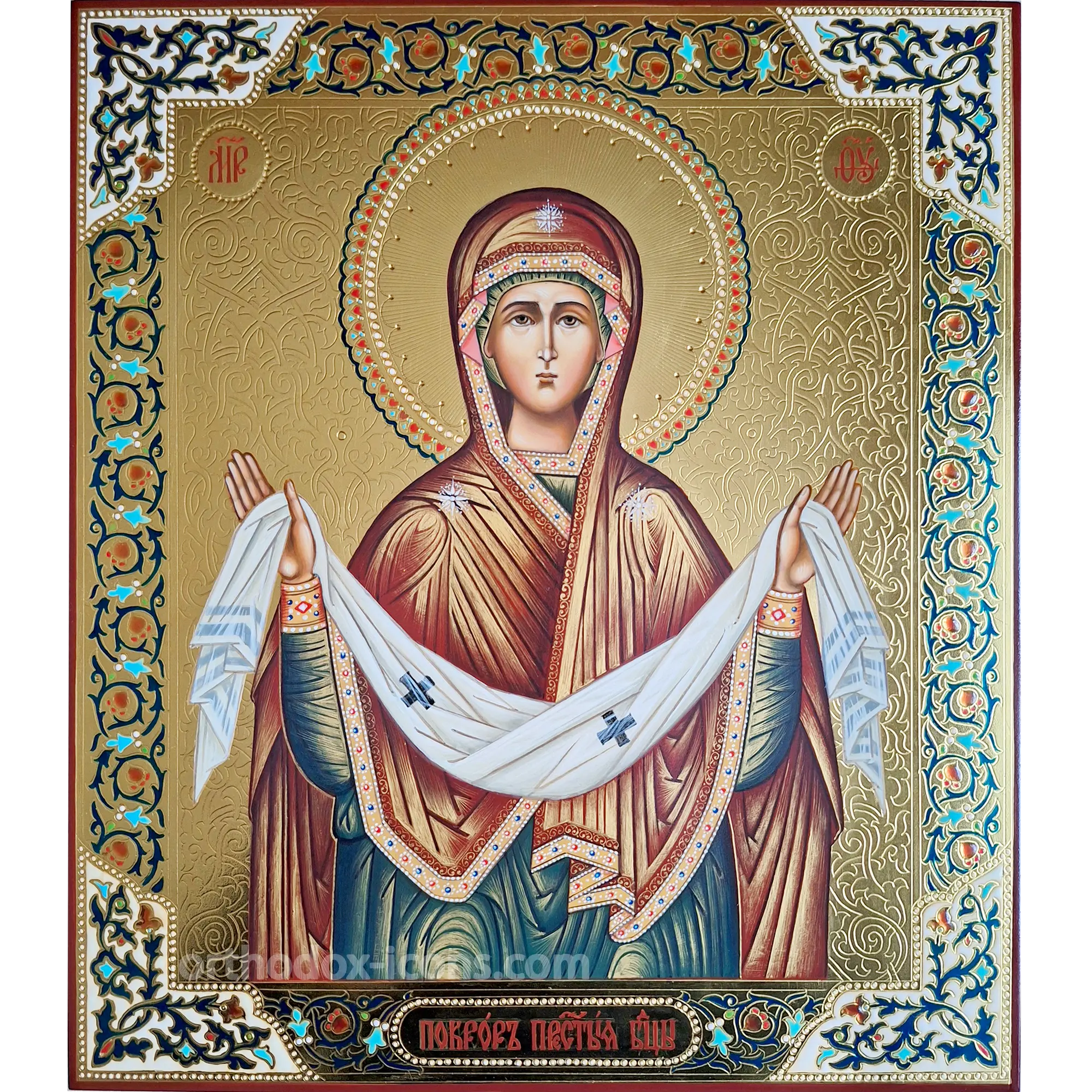
The Protection of the Mother of God icon, known in Slavic tradition as Pokrov, commemorates a vision of the Theotokos spreading her veil, or maforion, over the faithful. The feast is especially beloved in the Russian Church, where it became one of the most important celebrations connected with the Mother of God.
The icon is often chosen for a home prayer corner, a wedding gift, a family blessing, or a church interior. Its meaning is not mechanical protection. It is an image of the prayerful intercession of the Theotokos and a reminder that Christian protection begins with faith, repentance, and trust in God.
The story behind the Protection icon
According to Orthodox tradition, the event took place in Constantinople around the year 910, during a vigil in the Blachernae church. The church preserved relics connected with the Mother of God, including her robe and veil. Saint Andrew the Fool-for-Christ and his disciple Epiphanius saw the Theotokos standing in prayer and extending her veil over the gathered faithful.
The vision was understood as a sign of the Mother of God’s intercession before Christ. In Slavic Orthodox tradition, this event became the feast of the Protection of the Most Holy Theotokos, a feast closely associated with prayer for families, homes, communities, and those facing danger or uncertainty.
What the icon depicts
The Protection icon is usually built in several levels. At the top, Christ may be shown blessing from heaven. In the center stands the Mother of God, often surrounded by saints and angels. Her veil, or maforion, is spread over the faithful as a sign of prayerful shelter and maternal care.
Below, the icon often shows the people gathered in the church. Saint Andrew the Fool-for-Christ and his disciple Epiphanius may be included because they witnessed the vision. Saint Romanos the Melodist is also frequently shown with a scroll, connecting the image with liturgical praise and the hymn tradition of the Church.
The meaning of the veil, or maforion
In the Protection icon, the veil is the maforion, the head-covering of the Theotokos. Iconographically it becomes a visible sign of her prayerful intercession and maternal care for the faithful. It is not a generic decorative cloth, but a meaningful element of the iconographic tradition.
This is why the image is often understood as an icon of spiritual shelter. The Theotokos does not replace Christ, and the icon is not treated as a charm. It directs prayer toward God through the intercession of His Mother.
Novgorod and Suzdal iconographic traditions
Two major versions of the Protection icon became especially known in Russian Orthodox iconography. In the Suzdal, or Vladimir, version, the Mother of God is shown in the center holding the veil (maforion) herself. This gives the image a direct and maternal character.
In the Novgorod version, the Theotokos stands in prayer while angels hold the veil above the people. This version emphasizes the heavenly and liturgical character of the vision. Later icons may combine details from both traditions, but the essential meaning remains the same: the Mother of God intercedes before Christ for the faithful.
When the Protection icon is chosen
The Protection of the Mother of God icon is often chosen for families, newlyweds, new homes, and churches dedicated to the Theotokos. It can be a meaningful Orthodox wedding gift because the veil is often seen as a symbol of blessing a new family, while the theological focus remains on prayer and church tradition.
The icon is also suitable for a home prayer corner when a family wants a traditional image of the Theotokos associated with intercession, peace, and spiritual shelter. In church interiors, the image is often chosen for chapels, side altars, or iconostases connected with the Mother of God.
How to choose a Protection of the Mother of God icon
For a small home prayer corner, sizes such as 17×21 cm or 20×24 cm are often practical. For a wedding or family gift, 27×31 cm or 30×40 cm usually gives the composition more presence and allows the details of the saints, angels, and architecture to be seen more clearly. For a church, chapel, or iconostasis, a larger custom size may be more appropriate.
The Protection icon can be visually complex, so the size matters more than it does for simpler shoulder-length icons. If the image includes Christ above, the Theotokos in the center, the gathered faithful below, and architectural details of the Blachernae church, a medium or large board will usually look more balanced.
Materials and hand-painted work
A hand-painted Protection icon is made on a prepared wooden board with gesso ground, egg tempera, mineral pigments, and gold leaf. The gold background and halos are not just decoration; in Orthodox iconography they help express the heavenly, liturgical space of the image.
For a more solemn gift or church icon, the image can be supplemented with ornament, a carved frame, filigree decoration, or a protective kiot. A kiot is especially useful when the icon will be placed in a church, public chapel, or a home where long-term protection from dust and touch is important.
Hand-painted Protection icons from Mstyora
Our workshop paints Protection of the Mother of God icons in the traditional Mstyora manner, with careful drawing, restrained color, egg tempera, gold leaf, and respect for Orthodox iconographic tradition. You can view available works in the Protection of the Mother of God Orthodox icons catalog or browse the wider collection of Virgin Mary Orthodox icons.
Frequently asked questions
What does Pokrov mean?
Pokrov means protection, veil, or covering. In this icon it refers to the veil of the Mother of God spread over the faithful as a sign of her prayerful intercession.
Is the feast especially connected with the Russian Church?
Yes. The event is connected with Constantinople, but the feast became especially beloved and widespread in Slavic Orthodox tradition, particularly in the Russian Church.
What is the veil called in this icon?
In this icon the veil is better described as the maforion, the head-covering of the Theotokos. It is the key visible sign of her prayerful intercession.
What is the difference between the Novgorod and Suzdal versions?
In the Suzdal, or Vladimir, version, the Mother of God usually holds the veil herself. In the Novgorod version, angels often hold the veil while the Theotokos stands in prayer.
Who are Saint Andrew and Epiphanius in the icon?
Saint Andrew the Fool-for-Christ and his disciple Epiphanius are connected with the vision in the Blachernae church and may be shown among the faithful below.
Who is Romanos the Melodist?
Saint Romanos the Melodist is a famous hymnographer. In Protection icons he is often shown with a scroll, emphasizing the liturgical and hymnographic setting of the feast.
Is the Protection icon suitable as a wedding gift?
Yes. It can be a meaningful Orthodox wedding or family gift, especially when chosen as a prayerful sign of blessing and spiritual shelter for a new home.
Where should the icon be placed at home?
The most traditional place is the home prayer corner with other Orthodox icons. It should be placed respectfully, in a clean and prayerful setting.
Which size should I choose?
For home prayer, 17×21 cm or 20×24 cm may be enough. For a wedding gift or a detailed composition, 27×31 cm or 30×40 cm is often better. For a church, a custom larger size may be needed.
Can a Protection icon be painted to order?
Yes. It can be commissioned in a custom size, with gold leaf, ornament, filigree decoration, a carved frame, or a protective kiot.
FAQ about the Protection of the Mother of God icon
What does the Protection of the Mother of God icon show?
It shows the Mother of God extending her veil as a sign of prayer and care, with figures connected to the feast and its liturgical memory.
Is this icon suitable for a family prayer corner?
Yes. It is often chosen for homes, families, churches, and communities that venerate the feast of the Protection.
What is the veil in this icon called?
In this context it is commonly described as the veil or maforion of the Mother of God.
Can this icon be custom painted?
Yes. The composition, size, background, and level of detail can be selected before painting.