Vladislav of Serbia Orthodox Icon
Price range: $500 through $1350
Available sizes: 13×25 cm (5.1×9.8 in), 18×31 cm (7.1×12.2 in), 30×50 cm (11.8×19.7 in); iconostasis formats can be made by individual request.
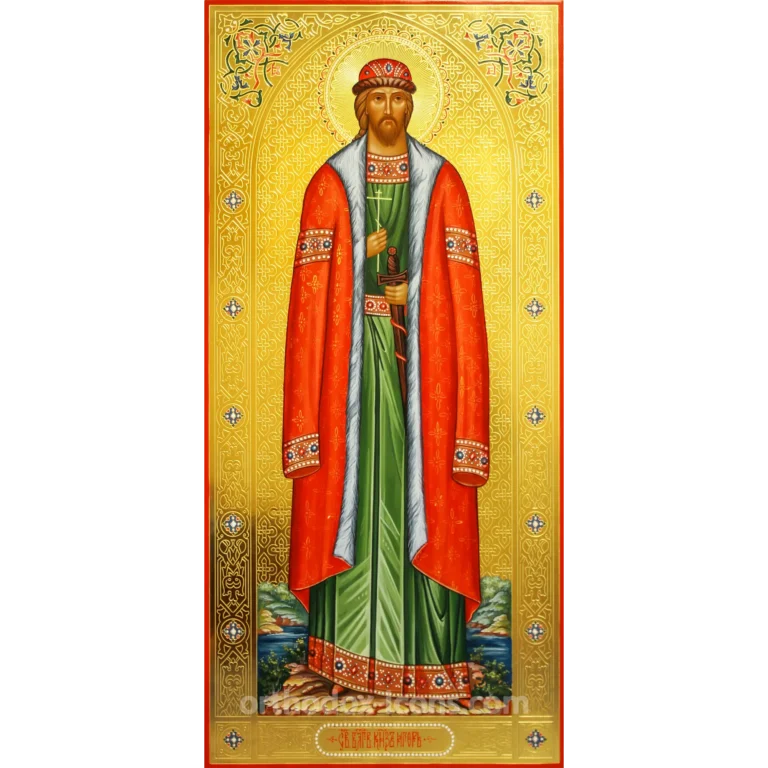
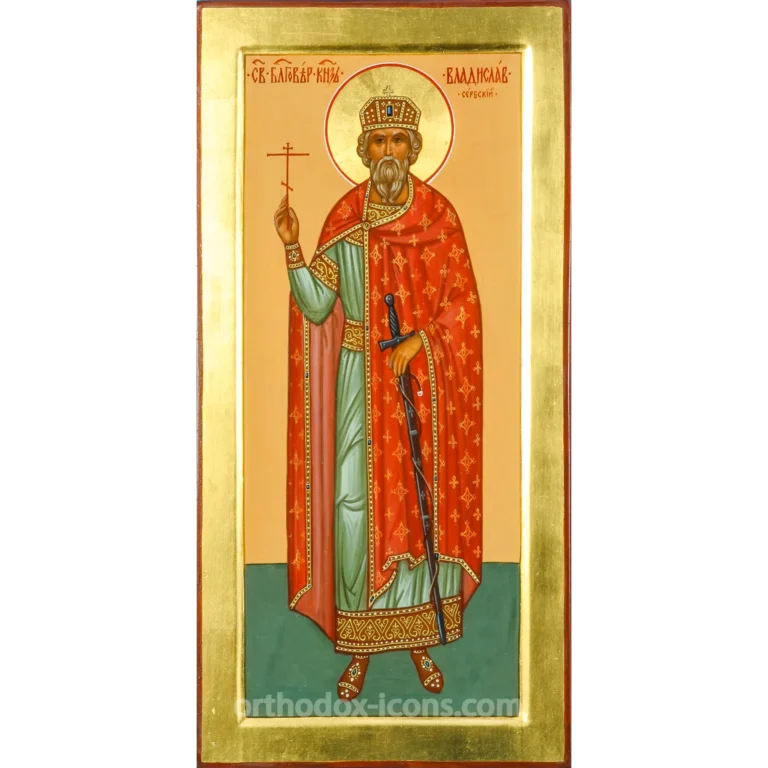
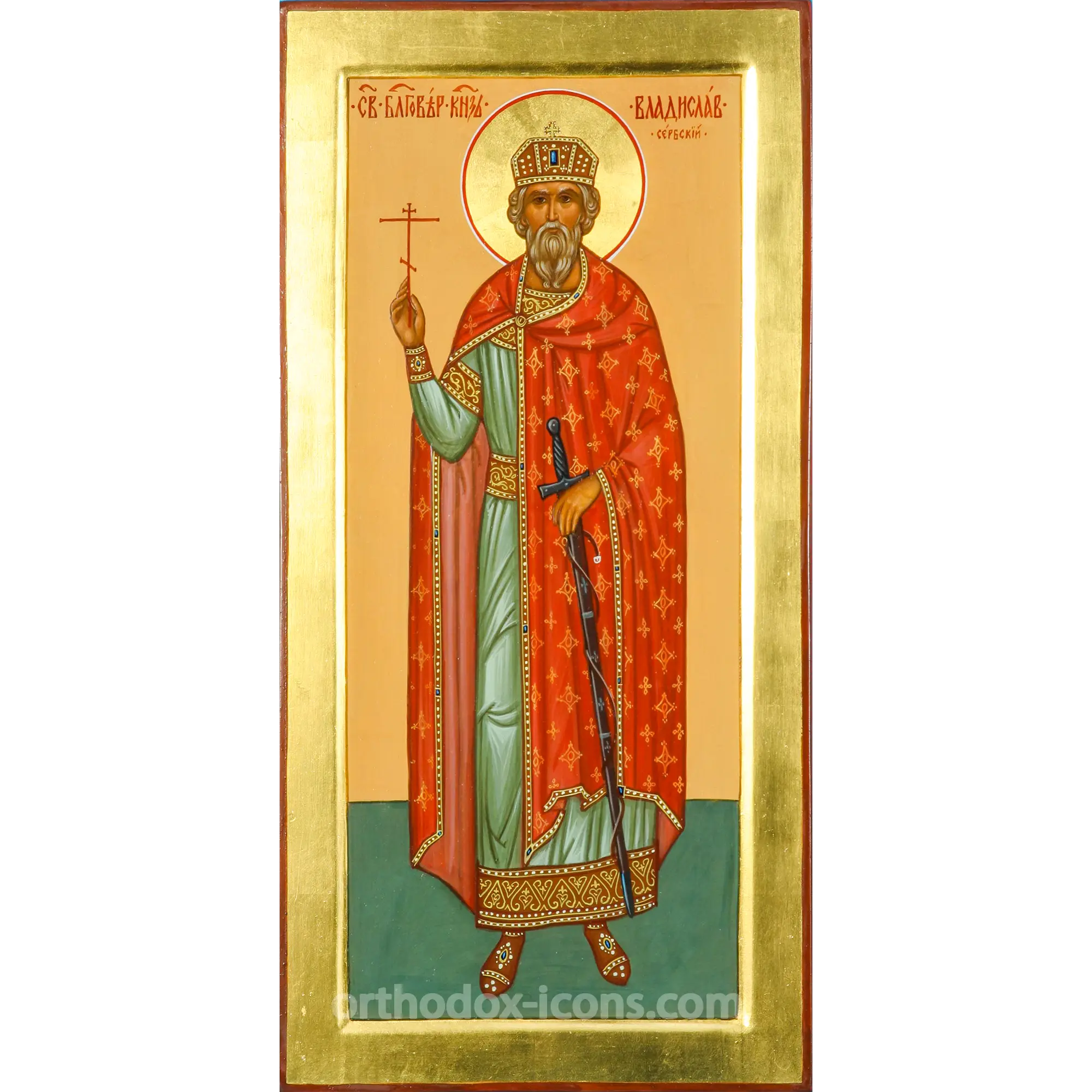
Vladislav of Serbia Orthodox Icon is a hand-painted full-length icon of the holy right-believing King Vladislav of Serbia. He is shown in royal garments, with a jeweled crown, a cross in his right hand, and a lowered sword in his left hand as a sign of protection, not aggression.
The icon is painted in egg tempera on a linden wood panel with gold leaf on the halo and wide fields, an ocher-sand sky, olive ground, and detailed gold ornament on the red mantle. Free international shipping is included. Payment is made after you receive and approve the icon.
It is possible to paint an image in any size to order
Free shipping worldwide
Vladislav of Serbia Orthodox Icon is a hand-painted Orthodox icon of the holy right-believing King Vladislav of Serbia, a ruler remembered not as a conqueror, but as a builder, peacemaker, and defender of Orthodoxy. Created in the traditions of the Mstyora school, this full-length image unites royal dignity with prayerful humility. The icon is richly decorated with gold leaf and painted in mineral egg tempera, making it a solemn named icon for Christians bearing the name Vladislav and a meaningful image for homes, churches, and prayer spaces.
Icon Characteristics
| Holy image | Holy Right-Believing King Vladislav of Serbia |
| Iconography | Full-length figure in royal garments, with a cross and sword |
| Panel | Dried linden wood, oak splines, and levkas |
| Painting | Egg tempera with ground mineral pigments, traditional Mstyora style |
| Gilding | Gold leaf on the wide fields and halo |
| Color scheme | Ocher-sand sky, olive ground, red royal garments |
| Available sizes | 13×25 cm (5.1×9.8 in), 18×31 cm (7.1×12.2 in), 30×50 cm (11.8×19.7 in) |
What People Pray for Before Saint Vladislav
The name Vladislav means one who possesses glory. In Christian life, true glory is not domination, but service to God and to people. Saint Vladislav is remembered as a just and merciful ruler, and Orthodox Christians may turn to him in prayer for wisdom, responsibility, protection, and faithful service.
- For wisdom in leadership: rulers, officials, managers, and those responsible for others may pray for honest and useful decisions.
- For protection of home and homeland: as a king who guarded Serbia, Saint Vladislav is honored as a prayerful patron of defenders and families seeking peace.
- For building and good beginnings: his life is connected with the monastery of Mileseva, so people may pray before beginning a home, church, or important work.
- For health and consolation: his memory is connected with mercy toward the sick, the poor, widows, and orphans.
- As a named icon: this is a meaningful spiritual gift for boys and men named Vladislav.
Prayer before the icon is not a magical promise of success. It is a turning to God through the intercession of a saint whose life teaches responsibility, mercy, courage, restraint, and service.
Life of Saint Vladislav: King and Builder of Mileseva
Saint Vladislav lived in the thirteenth century. He was the son of Serbian King Stefan the First-Crowned and the nephew of Saint Sava, one of the greatest saints of Serbia. Vladislav came to the throne in 1234, during a difficult period in Serbian history. His reign lasted only nine years, yet it left a deep mark on the history of the Orthodox Church.
Unlike many rulers of his age, Vladislav did not seek glory through bloodshed. He strengthened the country through faith, mercy, and building. He was known for generosity to the poor, orphans, widows, and the sick, and he supported places of hospitality and care.
The main work connected with his name is the monastery of Mileseva, with the Church of the Ascension of the Lord. Vladislav gave his resources and heart to this holy place. In 1236, after great diplomatic effort, he transferred the relics of his uncle Saint Sava from Tarnovo to Mileseva. When the tomb was opened, the relics were found incorrupt, and healings began to occur. Through Vladislav, Serbia received one of its greatest national shrines.
At the end of his life, after losing the throne amid political struggle, Vladislav did not begin a fratricidal war. He withdrew and reposed peacefully around 1269. He was buried in his beloved monastery of Mileseva, where miracles later became associated with his tomb.
Royal Authority and Humility in the Icon
This icon is a classic example of Orthodox royal iconography. Saint Vladislav is shown full-length, standing in a strict frontal position. His figure is stately, expressing firmness in faith and the dignity of a Christian ruler.
The saint’s face is noble and restrained. Gray hair and a neat, slightly divided gray beard suggest experience and wisdom. On his head is a royal crown decorated with pearls and colored enamel-like stones. The crown is not a sign of pride; in Orthodox iconography it shows authority received from God and used for service rather than vanity.
The garments are painted with the fine detail typical of the Mstyora school. A light green tunic falls in graceful folds to the feet, with a gold border at the hem. Over it lies a long bright red mantle, or royal cloak. Red is the color of royal dignity, but also of readiness to sacrifice oneself for one’s people and faith.
The red mantle is covered with a fine gold pattern of diamonds and crosses, imitating heavy Byzantine brocade. In his right hand, raised near the chest, Saint Vladislav holds a slender eight-pointed cross, a sign of personal faith and confession. His left hand rests calmly on the hilt of a long sword in a dark scabbard. The sword is lowered point-down, showing not aggression, but readiness to defend his land and the Orthodox faith.
Mstyora Painting and Gold Leaf
The artistic and spiritual value of this icon is connected with the careful technology of its creation. The image is painted in the Mstyora icon-painting tradition, known for fine detail, bright color, and rich gold ornament.
The base is a carefully prepared dried linden wood panel reinforced with oak splines to help prevent warping. Levkas, a chalk ground, is applied and polished to a smooth surface. The painting is done in egg tempera: mineral pigments are ground and mixed with egg yolk, creating colors that remain stable for many years.
Gold leaf gives the icon particular solemnity. In this image, not only the halo but also the wide fields of the board are gilded, creating the impression of a precious frame. The inner background is divided into warm ocher-sand sky and muted olive-green ground. The contrast between ocher, green, red garments, and gold fields makes the icon festive and expressive.
Choosing the Size
Because the saint is shown full-length, the icon uses special vertical proportions. The 13×25 cm (5.1×9.8 in) size is an elegant compact format, suitable as a named gift for baptism, nameday, birthday, or personal prayer. It can be placed on a small shelf or in a home icon corner.
The 18×31 cm (7.1×12.2 in) size is a balanced home format. In this size the gold brocade pattern on the red mantle, the crown, the cross, and the sword are easier to read. The 30×50 cm (11.8×19.7 in) size has a more monumental presence and is suitable for a spacious home, chapel, church, or family shrine.
Care for the Icon
A hand-painted icon with gold leaf and mineral tempera should be protected from direct sunlight, heaters, moisture, and sudden changes in temperature. Dust may be removed only with a soft dry brush or cloth, without pressure. Do not use water, alcohol, household cleaners, wet wipes, or abrasive materials. A glazed wooden kiot gives the best long-term protection.
Shipping and Payment
Free international shipping is included. The icon is packed carefully for safe transport. Payment is made after you receive and approve the icon.
Questions and Answers
Who is shown on this icon?
The icon shows Holy Right-Believing King Vladislav of Serbia, a thirteenth-century Orthodox ruler, builder, and defender of the Church.
Why is Saint Vladislav shown with a crown?
The crown shows his historical royal dignity and authority, which in the Christian understanding should be used for service, mercy, and responsibility.
What does the lowered sword mean?
The lowered sword means readiness to protect the people and the Orthodox faith, not aggression or conquest.
What does the cross in his hand mean?
The cross points to Saint Vladislav’s personal faith, confession of Christ, and understanding of true glory as service to God.
What is Saint Vladislav best known for?
He is especially remembered for founding the monastery of Mileseva and transferring the incorrupt relics of Saint Sava there.
Is this icon suitable for someone named Vladislav?
Yes. It is a meaningful named icon for boys and men named Vladislav and may be given for baptism, nameday, birthday, or another important occasion.
What sizes are available?
The icon is available in 13×25 cm, 18×31 cm, and 30×50 cm, with iconostasis formats possible by request.
What materials are used?
The icon is painted on a linden wood panel with oak splines, levkas, egg tempera, mineral pigments, and gold leaf on the fields and halo.
When is Saint Vladislav commemorated?
His memory is celebrated on October 7 according to the new calendar, or September 24 according to the old calendar.
How is the icon shipped and paid for?
Free international shipping is included, and payment is made after you receive and approve the icon.
| Dimensions | 13x25cm (5.1×9.8 in), 18x31cm (7.1×12.2 in), 30x50cm (11.8×19.7 in) |
|---|---|
| Name | Vladislav |