
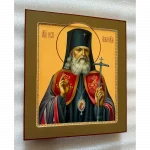
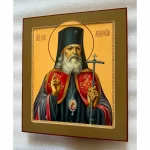
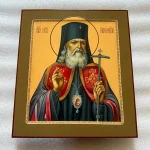
Saint Luke of Crimea Hand-Painted Orthodox Icon
$750
Hand-painted icon in stock, dimensions: 27×31 cm (approx. 10.6×12.2 in).
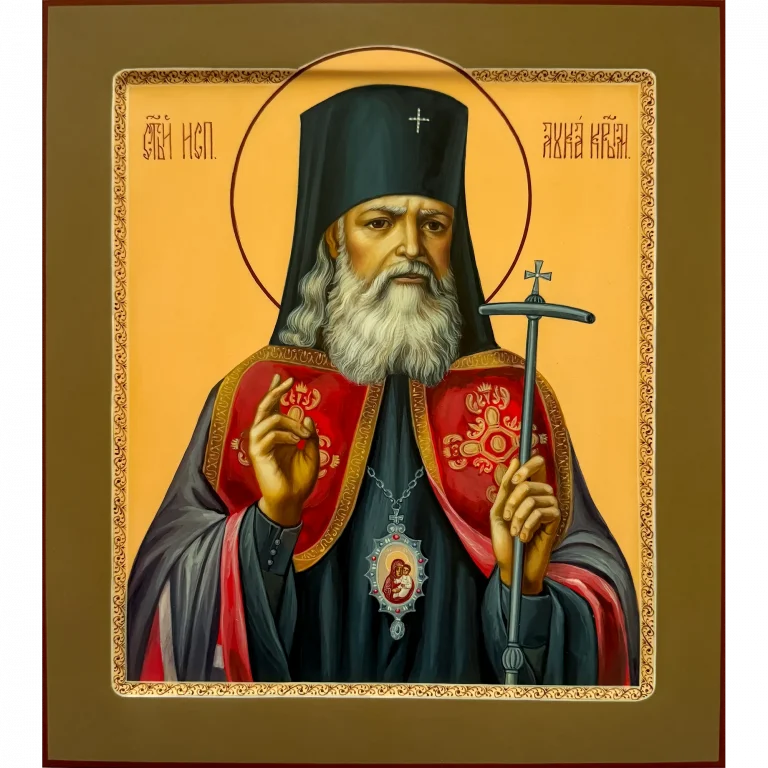
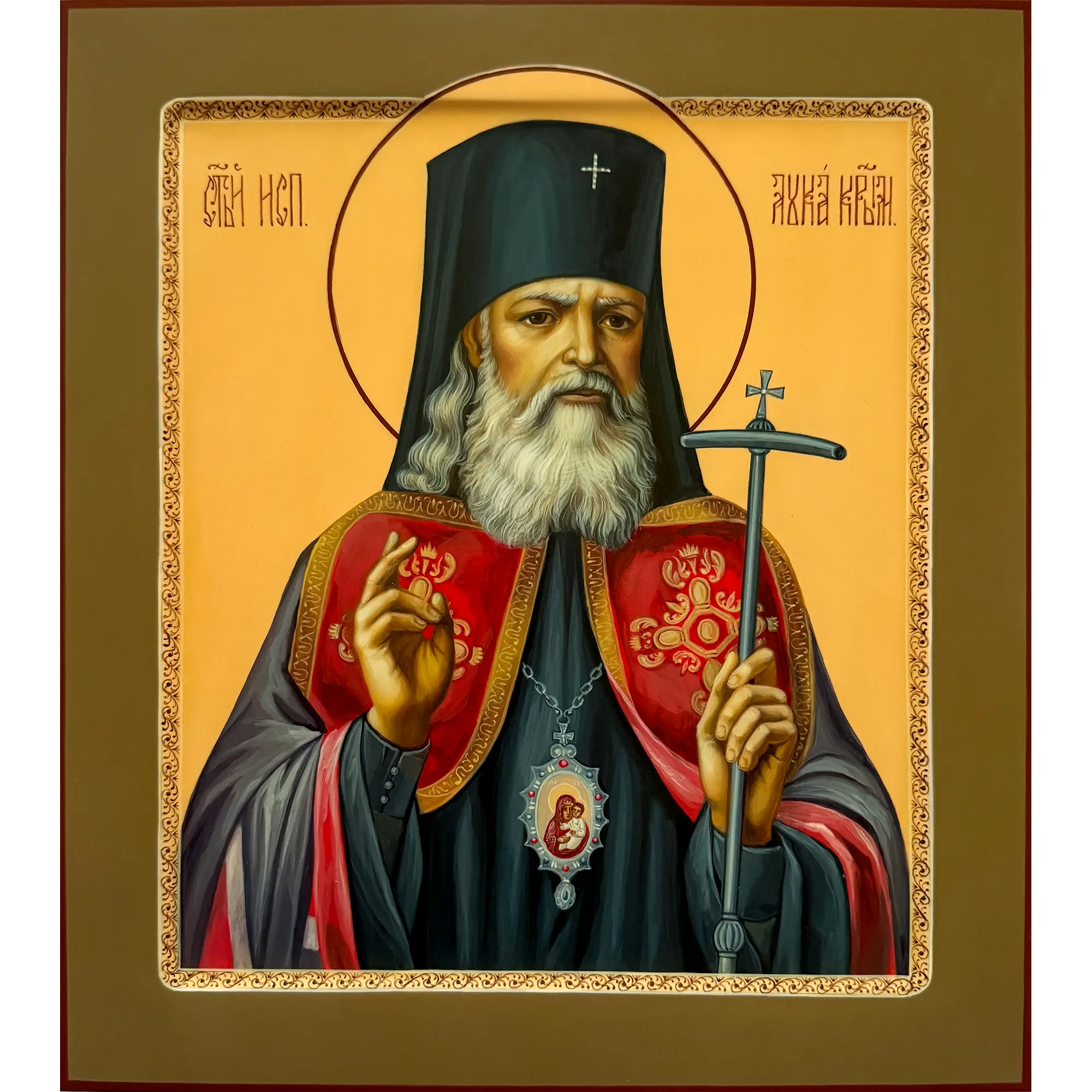
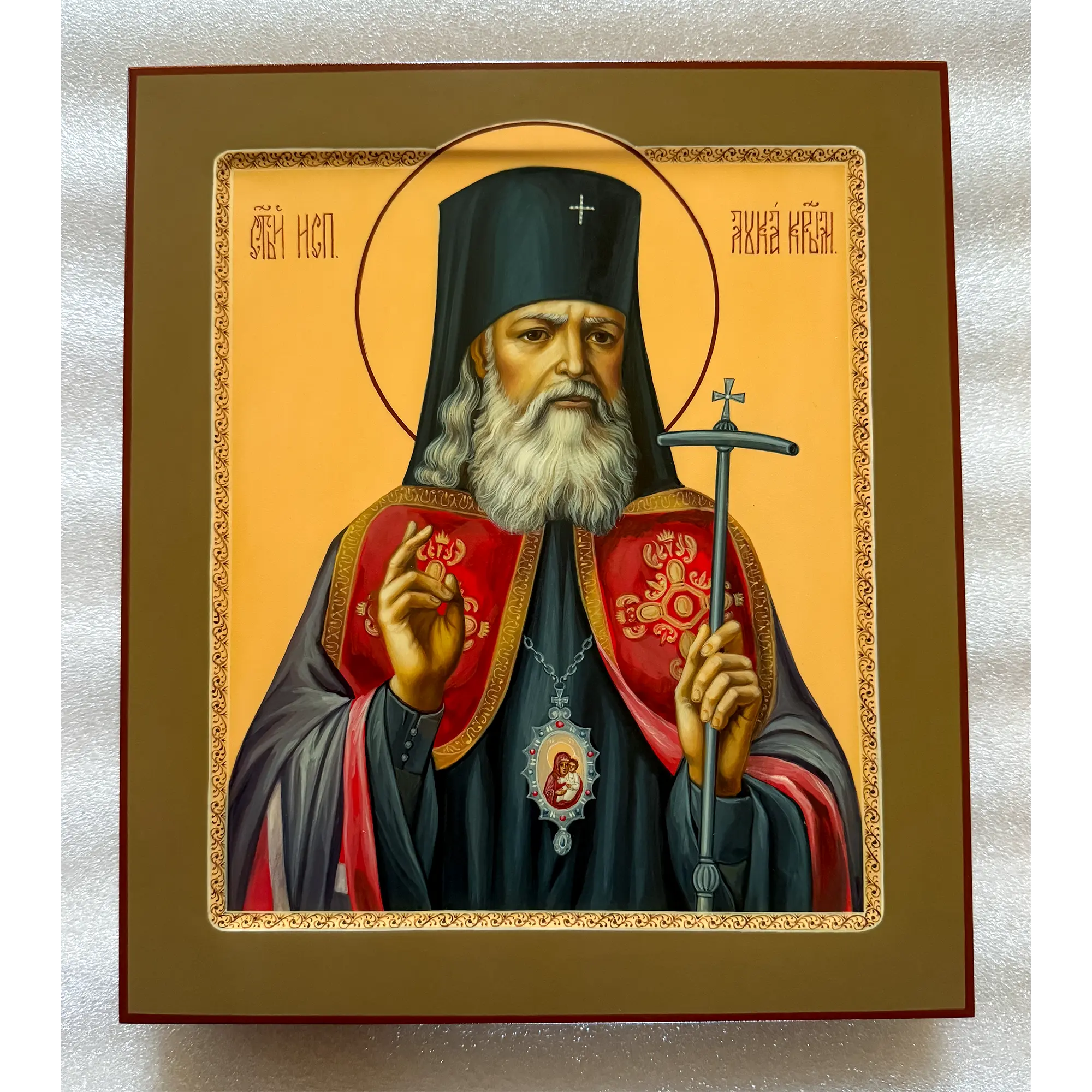
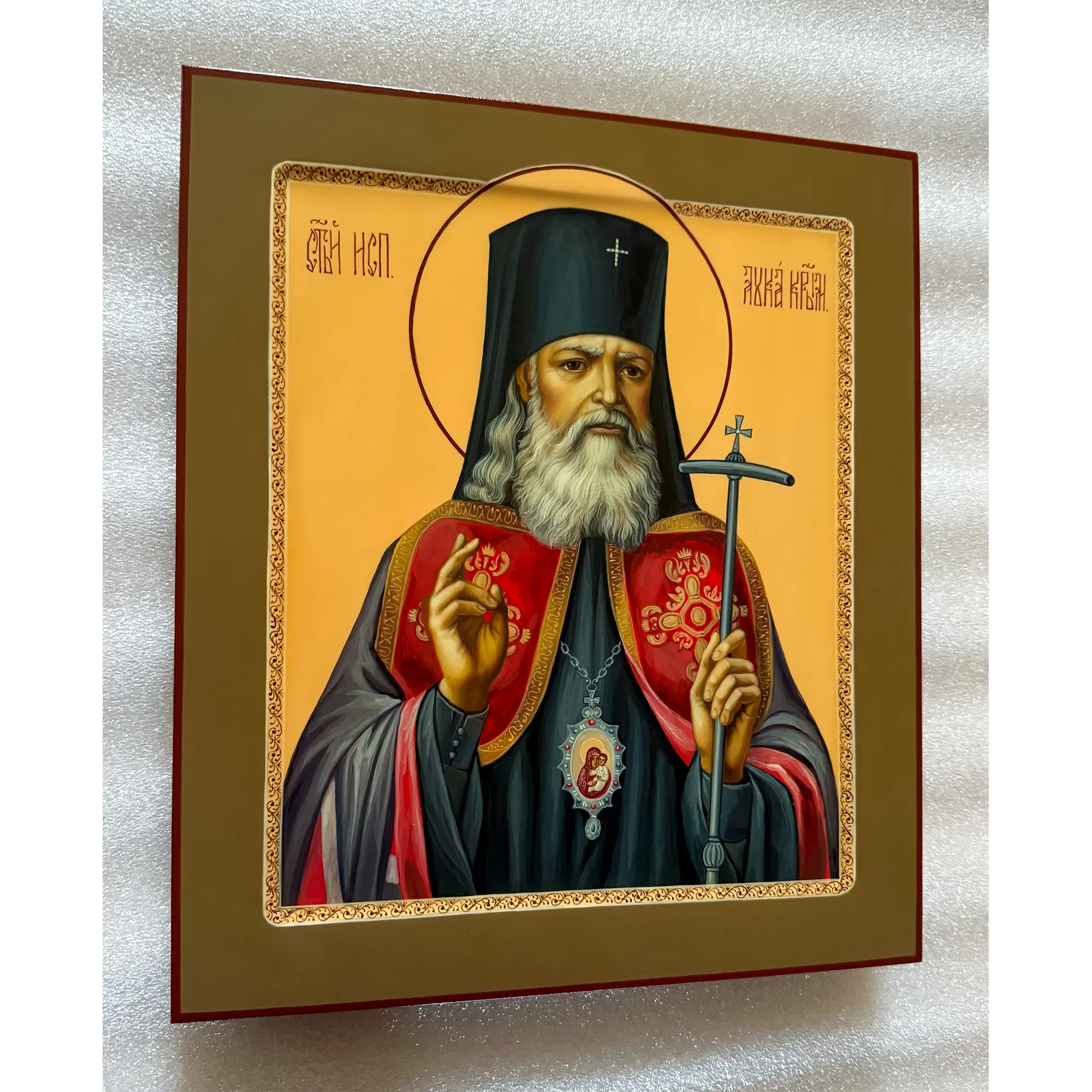
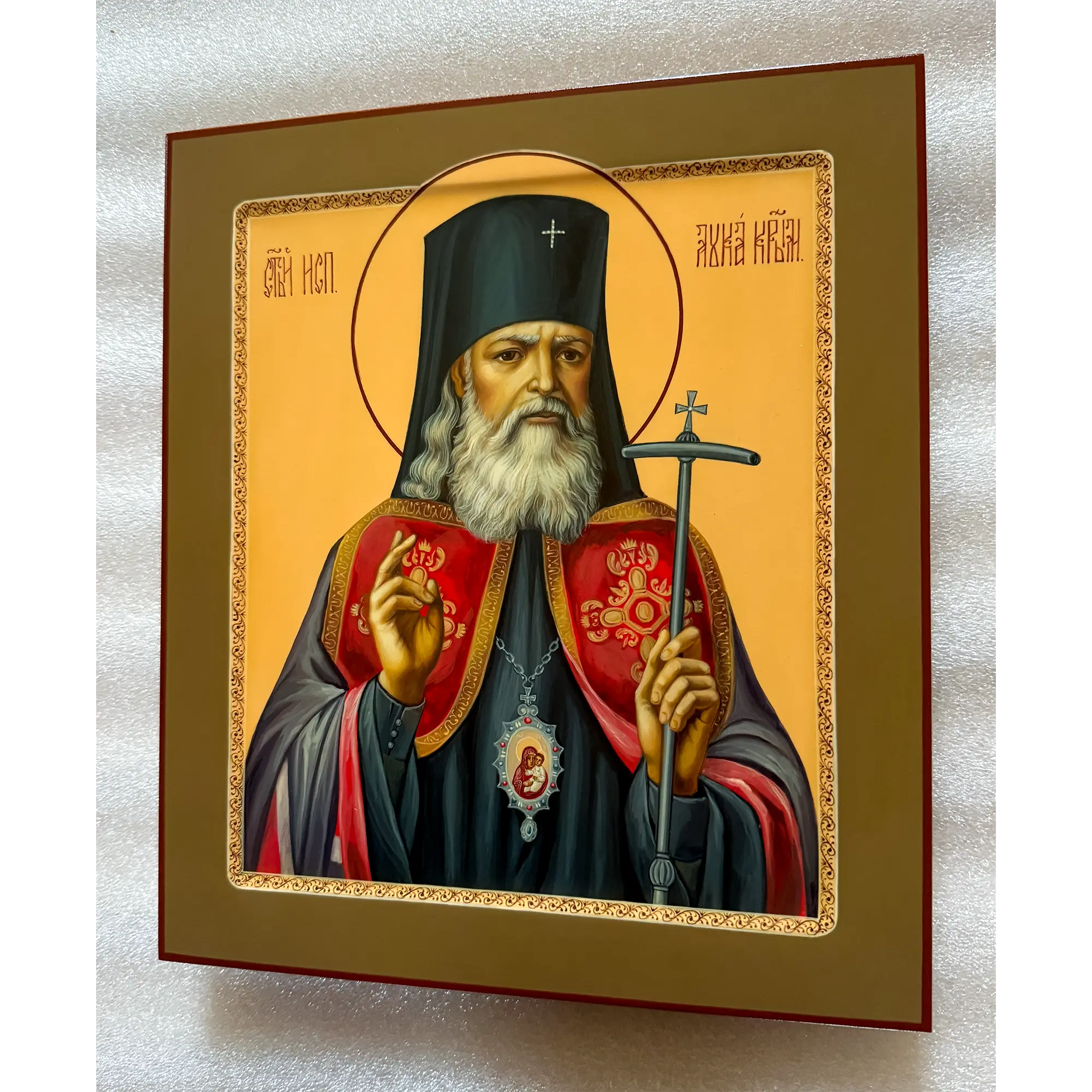
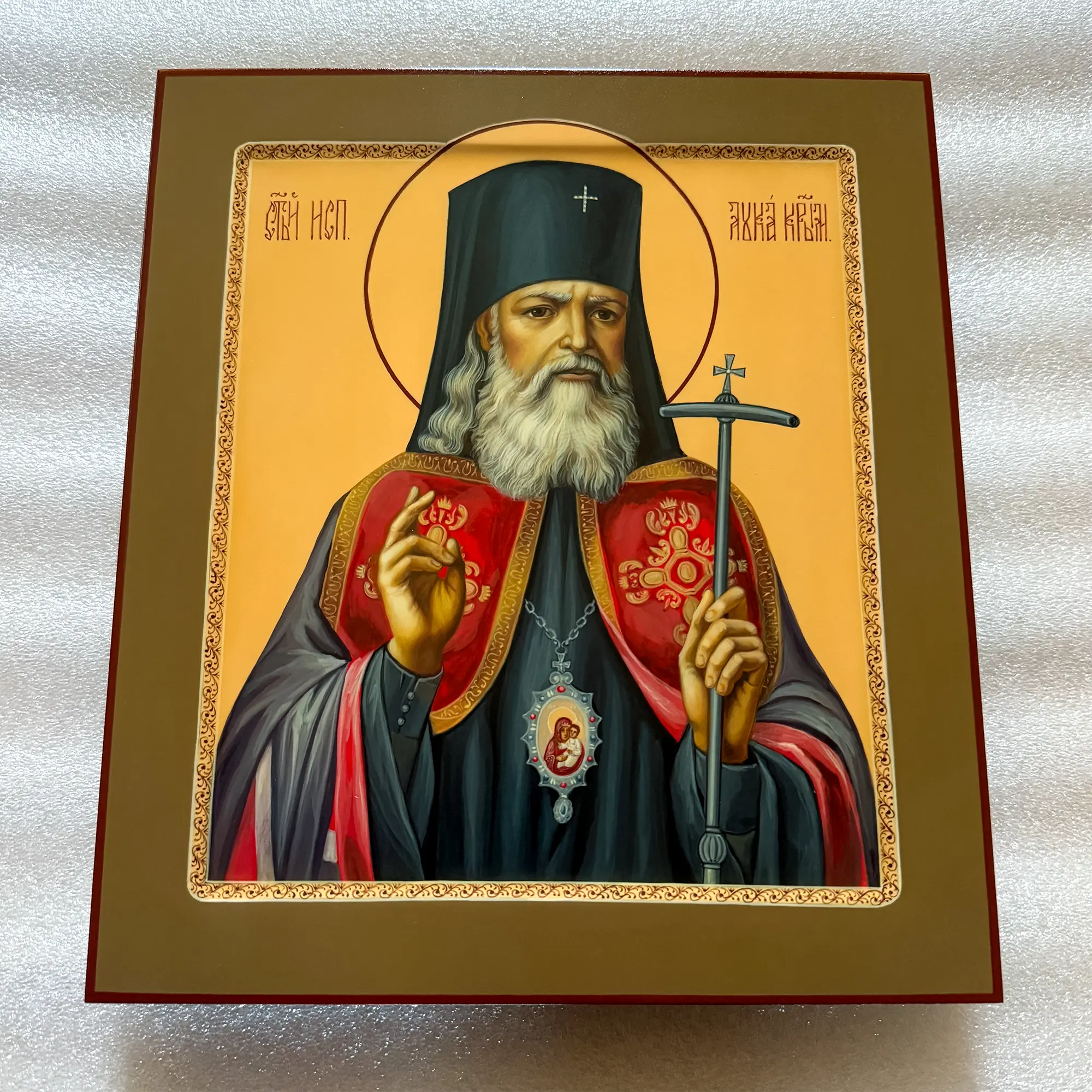
The Saint Luke of Crimea Hand-Painted Orthodox Icon is an authentic sacred depiction of Saint Luke the Surgeon, Archbishop of Simferopol and Crimea, Confessor of the Faith. The holy hierarch is depicted in episcopal dignity: wearing a black monastic klobuk with a cross, surrounded by a radiant golden halo, with silvery hair, a full white beard, a raised hand of blessing, an episcopal crosier, and a pectoral panagia displaying the Mother of God. Red episcopal vestments highlighted with gold ornamentation, a warm golden background, and traditional inscriptions make this a solemn, reverent, and deeply inspiring image.
- What believers pray for: Healing for the sick, divine guidance for doctors and surgeons, successful medical treatments and surgeries, patient endurance during illness, fortitude in faith, and comforting help in spiritual trials.
- Materials: Solid linden wood panel, inset oak splines, linen pavoloka, natural chalk levkas (gesso), egg tempera with hand-ground mineral pigments, genuine gold leaf.
- Ideal gift: For an icon corner (krasny ugol), a physician’s office, a hospital chapel, a nursing station, or as a meaningful gift for medical professionals, medical students, patients, and those bearing the Christian name Luke.
- Iconographic attributes: Finished 27×31 cm panel, St. Luke in monastic klobuk, blessing right hand, episcopal staff, pectoral panagia, red vestments with gold detailing, and luminous gilded field.
Availability: In stock and ready for immediate worldwide dispatch with an official certificate of authenticity from the Mstyora icon-painting workshop.
It is possible to paint an image in any size to order
Free shipping worldwide
The Saint Luke of Crimea Hand-Painted Orthodox Icon is an authentic sacred portrayal of Saint Luke the Confessor, Archbishop of Simferopol and Crimea, fully completed and available for acquisition. The finished piece measures 27×31 cm (approx. 10.6×12.2 in). On this panel, the holy hierarch is depicted in his episcopal majesty: wearing a high black klobuk adorned with a cross, with a prominent golden halo, silvery hair, and a wide white beard. His right hand is raised in a gesture of blessing, while his left hand holds an episcopal crosier surmounted by a cross. Suspended upon his chest is a pectoral panagia bearing the sacred image of the Most Holy Theotokos, while vibrant red liturgical vestments embellished with delicate gold ornamentation rest over darker inner robes. The inscriptions on the gold field read in church shorthand: “St. Confessor” and “Luke of Crimea.”
This completed hand-painted icon is ideally suited for those who require an existing, finished work rather than waiting for a custom commission: it is ready to grace a family icon corner, a physician’s private office, a hospital church, a chapel, or to be presented as a patronal gift to someone named Luke. The icon of St. Luke of Crimea is especially dear to those who offer prayers for the sick, doctors, surgeons, nurses, medical personnel, for patience in bodily suffering, and for the deepening of spiritual faith. Significantly, the composition does not focus on surgical instruments: before us stands first and foremost a holy bishop, archpastor, and confessor of Christ, blessing the faithful and carrying out his apostolic ministry.
Specifications of the Hand-Painted Icon
| Product Name | Saint Luke of Crimea Hand-Painted Orthodox Icon |
|---|---|
| Saint Portrayed | Holy Hierarch and Confessor Luke, Archbishop of Simferopol and Crimea (St. Luke the Surgeon) |
| Availability | In stock, completed hand-painted work (ready for immediate dispatch) |
| Dimensions | 27×31 cm (approx. 10.6×12.2 in), traditional analoy format |
| Composition | Half-length depiction of the saint with blessing right hand, episcopal crosier, and pectoral panagia |
| Execution | Hand-painted icon on seasoned solid linden wood panel, inset oak splines, linen pavoloka, chalk levkas (gesso), natural egg tempera, genuine gold leaf |
| Feast Days | June 11 (May 29 O.S.): Repose of Saint Luke; March 18 (March 5 O.S.): Uncovering of his holy relics |
The Image of Saint Luke of Crimea
In this icon, Saint Luke is portrayed as a twentieth-century bishop and confessor of the faith. His countenance is immediately recognizable: the tall black monastic klobuk with a cross, silver hair, an expansive white beard, an attentive gaze, and a composed posture. The face is neither abstract nor generalized; it carries the serene gravity of a man who traveled an arduous path of pastoral duty, Soviet persecutions, scientific medical labor, and archpastoral courage. A large golden halo radiates behind his head, and the warm golden background accentuates the solemn liturgical presence of the image.
The saint’s right hand is raised in a pastoral blessing. This canonical gesture emphasizes that Saint Luke of Crimea is venerated not merely as a pioneering surgeon, but as a bishop of the Church, an inspired preacher, and an archpastor of souls. In his left hand, he holds an episcopal crosier topped with a cross—the enduring emblem of episcopal authority and spiritual shepherdhood. Upon his chest rests a pectoral medallion (panagia) depicting the Mother of God; the chain and silver setting are painted with fine precision and accented with red jewels. These liturgical attributes distinguish the icon as an authentic sacred portrayal of a saintly hierarch, far removed from a secular medical portrait.
Episcopal Vestments and Painting Details
The color harmony of this composition is marked by an expressive interplay of deep dark tones and luminous vermilion. The black klobuk and dark monastic undergarments form a dignified vertical axis. The bright red elements of the bishop’s vestments, adorned with delicate gold ornamentation, introduce a joyful liturgical accent celebrating the saint’s episcopal dignity. Soft grayish-blue folds along the mantle temper the overall palette, while warm rose-red highlights beneath the garments impart lifelike depth and transparency.
Along the margin of the gilded central field runs a subtle foliate vine ornament that delicately frames the figure without distracting from the sacred face. The inscriptions on the margins provide the abbreviated church title: Saint Confessor Luke of Crimea. In the lower section, the strong hand grasping the pastoral staff is rendered with great anatomical care and soft transitions of light. In the other hand, the blessing gesture stands out distinctly against the crimson ornamental vestment, ensuring immediate visual clarity even across a distance.
Brief Life of the Holy Hierarch
Saint Luke of Crimea, born Valentin Felixovich Voino-Yasenetsky in 1877, was an exceptionally gifted physician, pioneering surgeon, and professor of medicine who authored groundbreaking treatises on regional anesthesia and purulent surgery. While widely celebrated as a medical scientist, he answered God’s call and accepted holy orders to the priesthood, followed by monastic tonsure under the name of Luke—in honor of Saint Luke the Apostle and Evangelist, who was likewise a physician.
The saint lived during an era of fierce Soviet persecution against the Orthodox Church. He endured multiple arrests, harsh prison interrogations, brutal Siberian exiles, and severe deprivations, yet he never renounced his episcopal ministry nor ceased treating the suffering. During the Second World War and the post-war reconstruction, Archbishop Luke served as chief surgeon in major military hospitals while simultaneously preaching in open churches and composing theological and surgical texts. From 1946 until his repose in 1961, he governed the Crimean diocese from Simferopol. Saint Luke reposed in the Lord on June 11, 1961; his memory is commemorated on June 11 (May 29 O.S.), and the uncovering of his incorrupt relics is celebrated on March 18 (March 5 O.S.).
Bishop, Physician, and Confessor
The distinctive glory of Saint Luke’s veneration lies in the harmony of three callings: episcopal, medical, and confessional. He was neither an ordinary doctor who entered the clergy late in life nor merely a bishop with casual medical knowledge. His life demonstrates how profound Christian faith can unite with professional excellence, compassionate clinical care, scientific integrity, and unyielding readiness to suffer for Christ.
On this icon, the medical dimension is expressed through the saint’s personal holy name and the living memory of the Church rather than external surgical tools. The iconographer represents Saint Luke in liturgical vestments with crosier and blessing because he is venerated first and foremost as an archpastor and confessor. For the faithful, this distinction is vital: before this icon, believers pray to Saint Luke for the sick and for their caregivers, yet the sacred image remains an authentic Orthodox icon of a saintly bishop rather than a hospital insignia.
What Believers Pray for Before the Icon
Before the icon of Saint Luke of Crimea, the faithful offer prayers for those suffering from severe illnesses, for the guidance of doctors, surgeons, and nurses, for favorable outcomes in surgeries and medical therapies, for patient fortitude in bodily infirmity, for spiritual perseverance during tribulations, and for the comfort of families caring for ill relatives. Patients, their families, surgeons, physicians, nurses, and medical students turn to Saint Luke to unite professional duty with a Christian conscience.
Prayer before the icon is never a substitute for medical treatment, medical advice, or responsible healthcare. An Orthodox Christian petitions God through the prayers of Saint Luke while respecting the healing profession as a God-given ministry. This principle is central to the saint’s legacy: his own life demonstrated profound reverence for scientific medicine, active compassion toward patients, and the harmonious union of faith with practical works of mercy.
Liturgical Feast Days and Occasions for a Gift
The primary feast day of Saint Luke of Crimea is celebrated on June 11 (May 29 O.S.), the anniversary of his blessed repose. Additionally, on March 18 (March 5 O.S.), the Church commemorates the uncovering of his holy relics in Simferopol. These calendar dates represent timely occasions for prayer, church offerings, or giving an icon as a gift.
This completed 27×31 cm icon is a thoughtful gift that requires no production wait. It can be presented to a physician, surgeon, nurse, medical student, a patient preparing for surgery, a family undergoing long-term treatment, or to a hospital chapel. Such a gift carries no superficial promises; its value is spiritual: it provides prayerful solidarity, commemorates a modern saintly physician, and inspires Christian fortitude during illness.
Iconographic Technique and Traditional Materials
This hand-painted work was executed on a seasoned linden wood panel reinforced on the reverse with inset oak splines (shponki) to resist warping. The panel is surfaced with linen cloth (pavoloka) and coated with 10–15 micro-layers of chalk levkas (gesso), hand-polished to a smooth ivory finish.
The painting is carried out exclusively in natural egg tempera prepared with hand-ground mineral pigments. Egg tempera allows subtle gradations on the mature face of the saint: warm ochre shadows, soft highlights in the silver beard, and serene, compassionate eyes. Distinct calligraphic care is devoted to the cross on the klobuk, the episcopal staff, the panagia, and the ornamental borders with genuine gold leaf.
Dimensions and In-Stock Availability
Measuring 27×31 cm (approx. 10.6×12.2 in), this icon represents the traditional analoy format. It is ideally sized for a home prayer corner: compact enough for domestic placement, yet large enough to appreciate every fine detail of the facial features, beard, vestments, and inscriptions.
Because this icon is currently in stock, there is no waiting period for painting. It is ready for immediate worldwide dispatch, making it an excellent choice when an icon is needed promptly for a baptism, name day, feast celebration, hospital dedication, or medical milestone.
Placement in the Home, Hospital, or Office
The finished icon of Saint Luke of Crimea is suitable for a home icon corner (krasny ugol), a physician’s consulting room, a hospital room, a nursing office, a chapel, or a parish church. In the home, it provides a dedicated place to pray for suffering loved ones and physicians. In a clinical environment, it serves as a quiet reminder of compassion, moral duty, and the sacred dignity of every human life.
Questions and Answers
1. Is the icon of Saint Luke of Crimea in stock?
Yes, this is a completed hand-painted icon of Saint Luke of Crimea, currently in stock and available for immediate worldwide dispatch.
2. What are the dimensions of this finished icon?
The finished piece measures 27×31 cm (approximately 10.6×12.2 in), which is the traditional analoy format in Orthodox icon painting.
3. Who is depicted on this icon?
The icon depicts Holy Hierarch and Confessor Luke, Archbishop of Simferopol and Crimea (St. Luke the Surgeon), in episcopal vestments holding an episcopal staff and a pectoral panagia.
4. When is the feast day of Saint Luke of Crimea celebrated?
The main feast day of Saint Luke is celebrated on June 11 (May 29 O.S.), and the uncovering of his holy relics is commemorated on March 18 (March 5 O.S.).
5. What do believers pray for before the icon of Saint Luke?
Believers pray for the healing of the sick, divine guidance for doctors, successful surgeries and medical treatments, patience during illness, fortitude in faith, and comforting help in spiritual trials.
6. Is this icon suitable as a gift for a physician or medical worker?
Yes, the icon of Saint Luke of Crimea is an esteemed Orthodox gift for a physician, surgeon, nurse, medical student, or anyone serving in healthcare.
7. Can this icon be given to someone who is ill?
Yes, this icon is often given as a token of prayerful support, keeping in mind that prayer works alongside proper medical treatment and professional healthcare.
8. What traditional materials were used to create this icon?
The icon was painted on a prepared linden wood panel with inset oak splines, linen pavoloka, chalk levkas (gesso), natural egg tempera with hand-ground mineral pigments, and genuine gold leaf.
9. How does this icon differ from a custom commission?
This is a fully completed, finished work measuring 27×31 cm that is ready to ship immediately without waiting for custom studio production.
10. Is this icon suitable for a home icon corner?
Yes, the 27×31 cm format is ideally suited for a home icon corner (krasny ugol), a private study, a medical office, or a church setting.
| Dimensions | 27x31cm (10.6×12.2 in) |
|---|---|
| Name | Luke |