Ivan Kovsharov Orthodox Icon
Price range: $500 through $1600
Available sizes: 17×21 cm (6.7×8.3 in), 20×24 cm (7.9×9.4 in), 27×31 cm (10.6×12.2 in), 30×40 cm (11.8×15.7 in). Larger iconostasis sizes can be made by agreement.
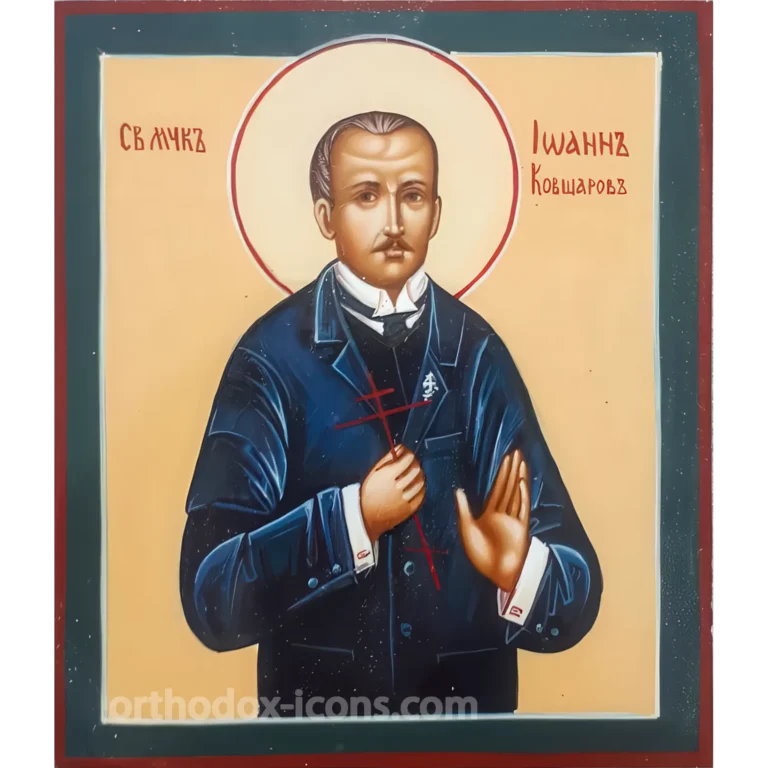
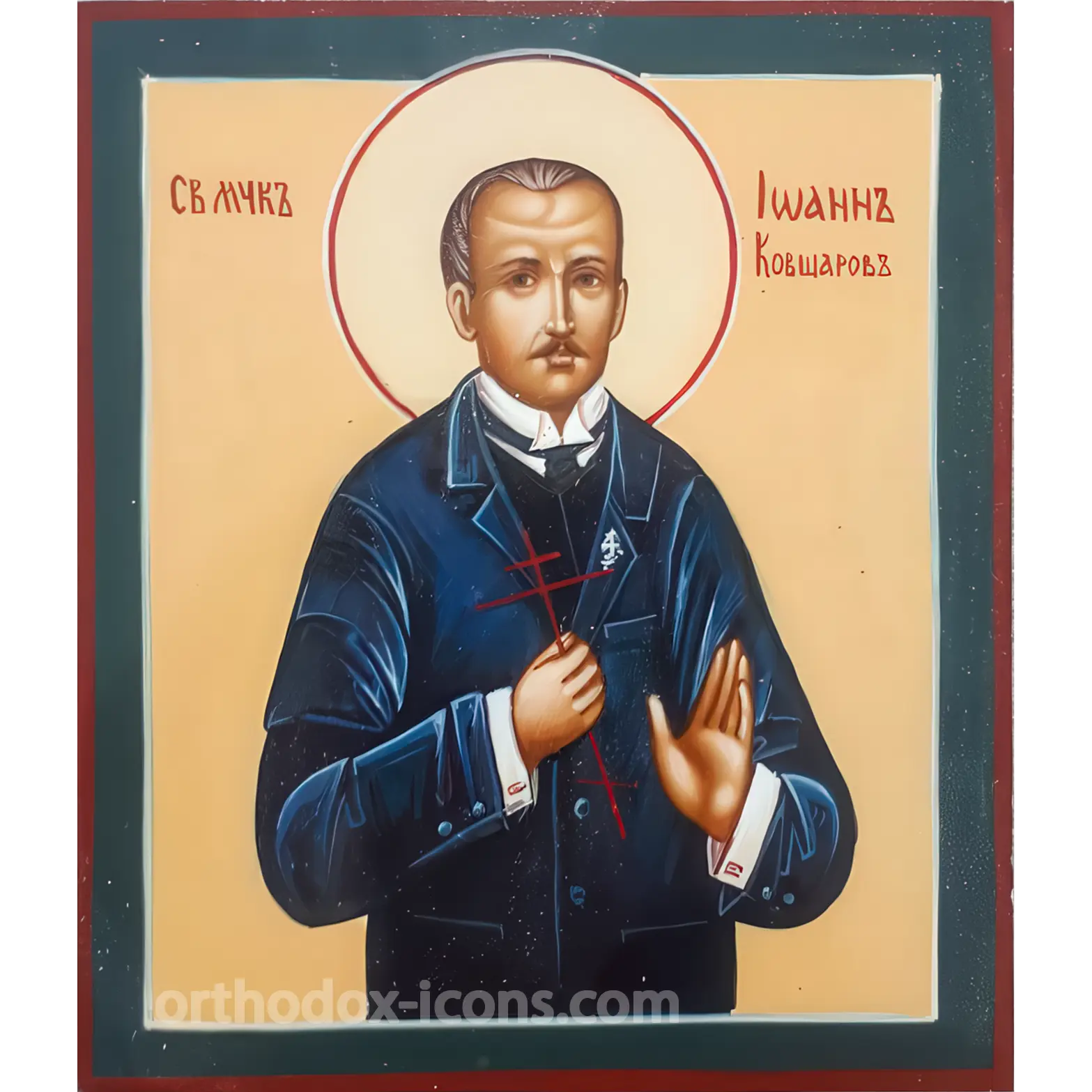
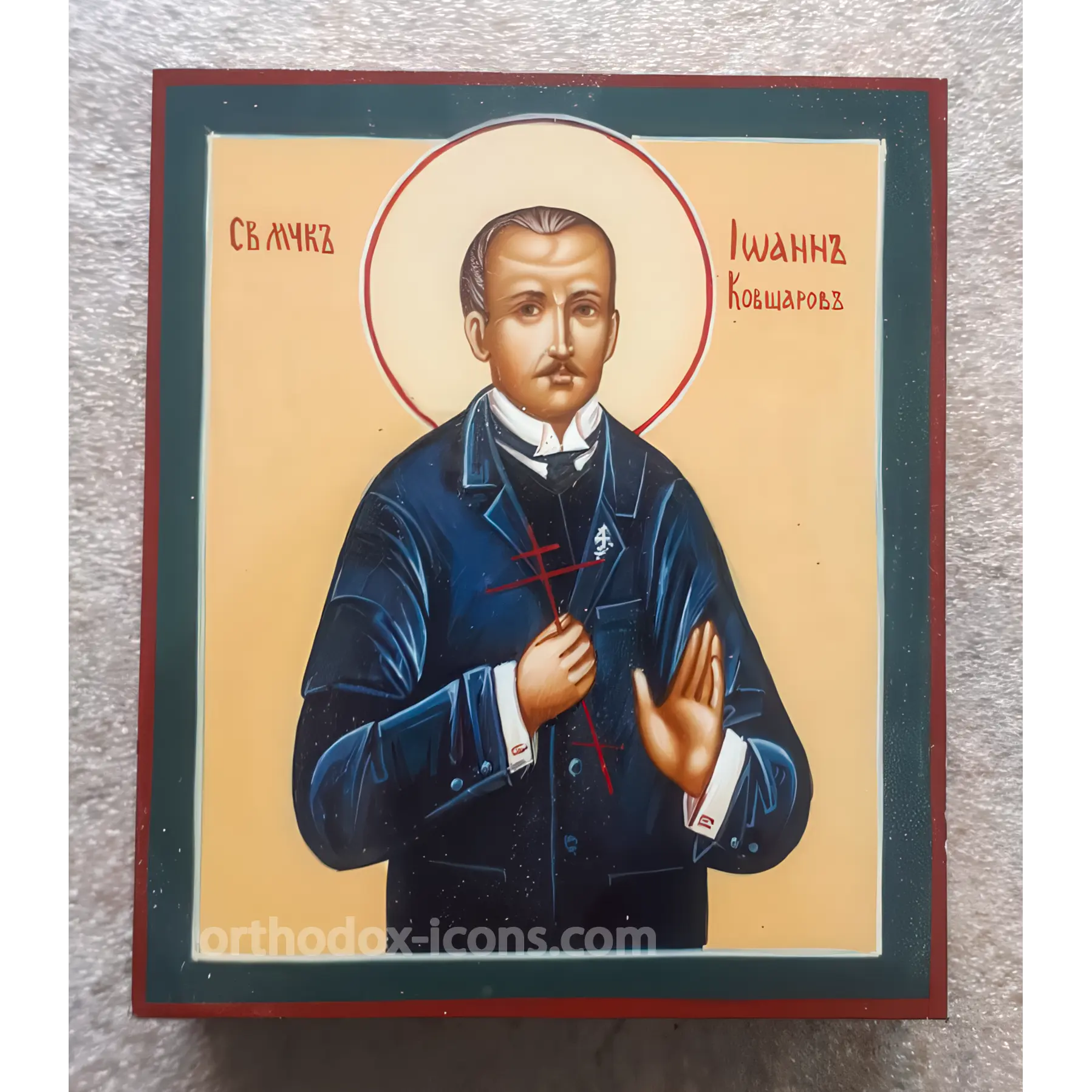
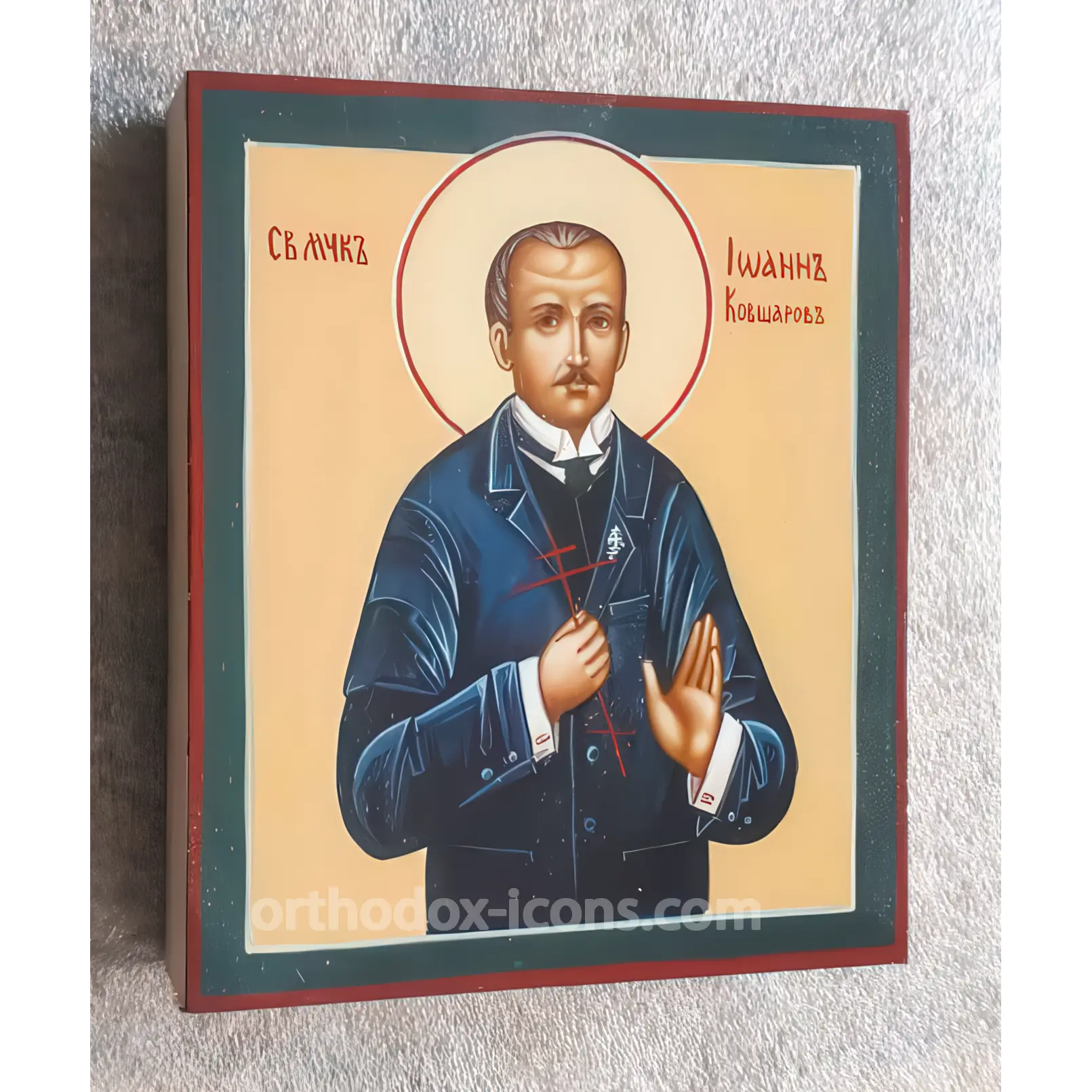
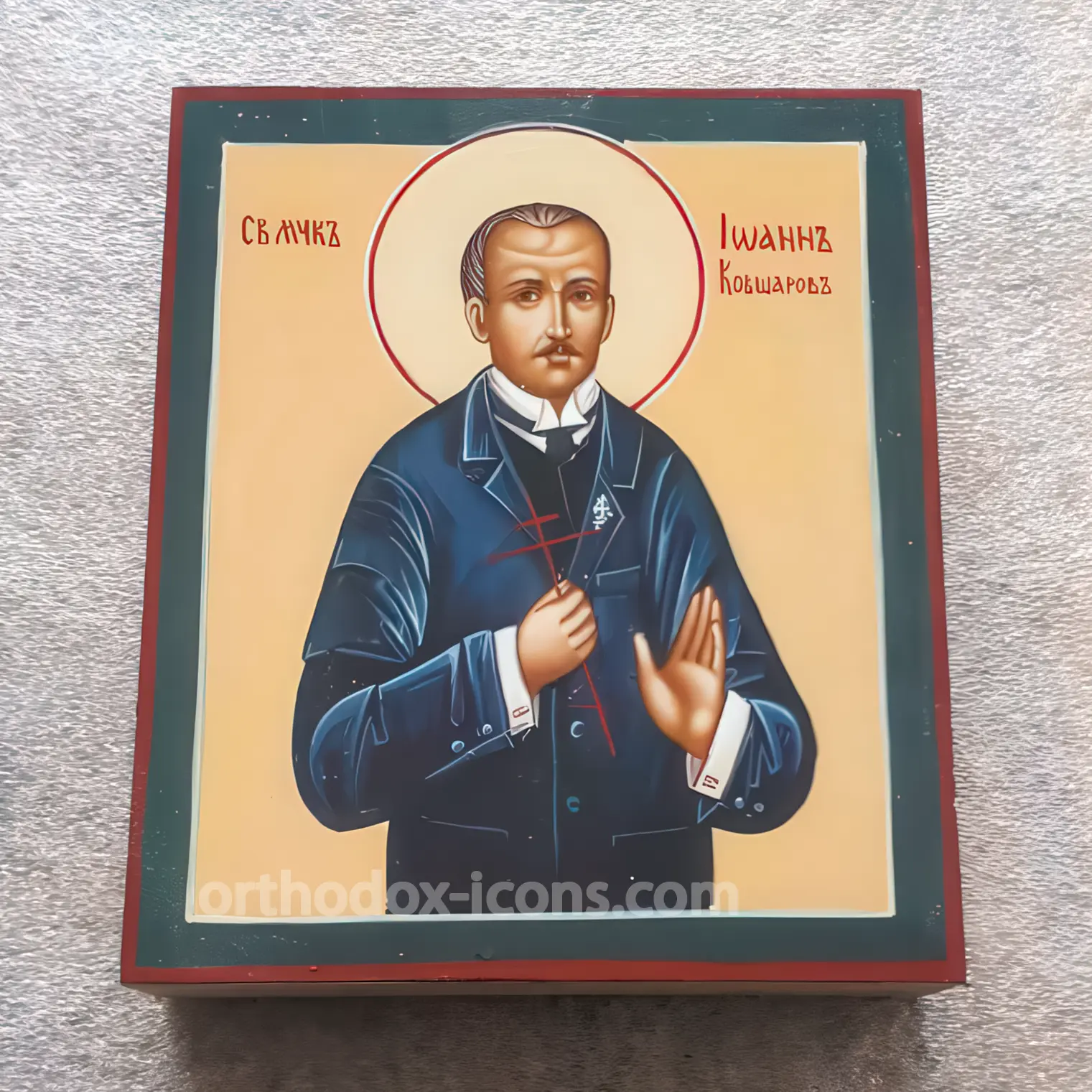
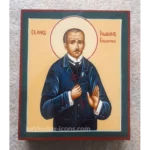
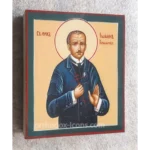
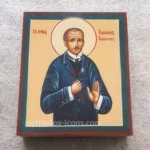
This hand-painted Ivan Kovsharov Orthodox Icon depicts the holy martyr John, known in the world as Ivan Mikhailovich Kovsharov, an Orthodox layman, lawyer, attorney, and defender of Church rights who suffered during the persecution of the Church. He is shown half-length in civilian clothing, holding a cross at his breast, with an open hand, gold halo, red name inscriptions, and a strict prayerful face.
Prayer before this icon is often connected with strengthening of faith, courage before injustice, help in legal and court matters, honest service, protection of family, steadfastness in trials, and patron saint protection for people named Ivan or John. The icon is painted on a linden wood board with braces, pavoloka, chalk gesso, egg tempera, 23K gold leaf (960 purity), and a protective finish. Free international shipping is included. Payment is made after you receive and approve the icon.
It is possible to paint an image in any size to order
Free shipping worldwide
This hand-painted Ivan Kovsharov Orthodox Icon is a rare image of the holy martyr John, known in the world as Ivan Mikhailovich Kovsharov, an Orthodox layman, lawyer, and confessor of faithfulness to the Church during a time of severe persecution. Ivan Kovsharov was not a priest, did not wear monastic clothing, and did not hold a church see. Yet his earthly path became an example of how a Christian can serve God in his own place: honestly, calmly, professionally, and courageously. He was a lawyer, attorney, legal adviser of the Alexander Nevsky Lavra, defender of Church rights, and a man who, in a time of trial, did not abandon his faith or responsibility.
In this icon Saint Ivan Kovsharov is shown half-length, in dark civilian clothing, holding a cross at his breast and with one hand open before the viewer. This image is immediately different from familiar icons of hierarchs, monastics, or warrior saints. Here we see a holy layman: a person who bore Christian witness not in a monastery and not on a battlefield, but in the world of law, public service, court cases, and defense of Church interests. For this reason the icon is especially close to people whose work is connected with law, responsibility, speech, the defense of truth, and moral choice.
The gold halo around the saint’s head emphasizes his glorification in the Church. Red inscriptions identify him as the holy martyr Ivan Kovsharov. The face is strict, but not coldly severe. It carries inner collectedness, calm resolve, and readiness to answer for his convictions. The cross at his breast is the sign of martyrdom, while the open hand is a quiet gesture of confession and openness. The whole composition is restrained and very contemporary in feeling: this is the image of a person who lived quite recently, spoke a language close to ours, faced state pressure, and preserved faithfulness to Christ.
Available sizes: 17×21 cm (6.7×8.3 in), 20×24 cm (7.9×9.4 in), 27×31 cm (10.6×12.2 in), and 30×40 cm (11.8×15.7 in). Larger iconostasis sizes can be made by agreement. The 17×21 cm format is suitable for a small home prayer shelf, study, personal prayer place, or compact patron saint gift. The 20×24 cm size remains convenient for the home and reveals the saint’s face, hand gesture, cross, halo, and inscriptions more clearly. The 27×31 cm format is suitable for a family iconostasis or separate kiot, while the 30×40 cm size may be chosen for a spacious home, church, chapel, legal office, church reception room, or iconostasis row.
The icon of the holy martyr John Kovsharov is especially appropriate as a patron saint icon for a man or boy named Ivan, John, or Ioann. It is more than a name saint image; it is a strong reminder of the Christian dignity of a layperson. Saint Ivan shows that the path of holiness is open not only to monastics and clergy. Faithfulness to God may be shown in a profession, in civic responsibility, and in readiness to defend the Church when doing so becomes dangerous.
Features of This Icon
The main feature of this icon is the saint in civilian clothing. Ivan Kovsharov is not shown in vestments, armor, or monastic robes, but as an Orthodox layman of the early twentieth century. This makes the icon especially expressive. It reminds us that holiness does not cancel a person’s earthly vocation, but sanctifies it. A lawyer can be not merely a specialist, but a defender of truth. A father of a family can be not only a provider, but also a confessor of faith. An educated person can serve the Church with his mind, experience, and honest position.
The dark suit of the saint is painted in a deep blue-black range. Against the warm golden field, this clothing looks strict and collected. The white collar and cuffs add historical precision and show his connection with an educated urban setting. The icon does not become a secular portrait, however. The clothing helps reveal his earthly service. He was a layman, advocate, and man of law, and in precisely that calling he preserved Christian faithfulness.
The cross in the saint’s hand is the central detail of the image. It recalls not only his martyrdom, but also his voluntary acceptance of the Christian path. Ivan Kovsharov did not seek suffering or external heroism. Yet when faced with a choice, he did not renounce the Church or truth. The cross at his breast connects his personal fate with confession of Christ. This is especially important for people who face moral choices every day: to remain silent or speak truth, yield to pressure or preserve conscience, defend the weak or choose convenient silence.
The open hand is painted softly and expressively. This gesture may be understood as a sign of honest witness, calm refusal of falsehood, and inner openness before God. There is no aggression in it. The saint does not argue by force; he stands before Christ and before people with a clear conscience. This detail makes the icon especially close to those who seek not conflict, but firmness without bitterness.
The halo is set against a light gold background. A fine red line around the halo echoes the red inscriptions and the frame of the icon. The borders are restrained and not overly decorative, so attention does not scatter. The eye returns to the face, the cross, and the hands. For an icon of a new martyr, this strictness is fitting: it does not distract from the main theme, which is faithfulness to Christ in real historical circumstances.
Iconography of Saint John Kovsharov
The iconography of Saint John Kovsharov belongs to the images of the New Martyrs and Confessors of Russia. Unlike ancient martyrs, who are often shown in tunics, cloaks, or traditional clothing with a martyr’s cross, here the recognizable appearance of an Orthodox layman of the twentieth century is preserved. This is an important feature. The Church glorifies not an abstract symbol, but a concrete person: Ivan Mikhailovich Kovsharov, lawyer, defender of Church rights, and participant in the events connected with the Petrograd trial of 1922.
There is no complicated narrative background in the icon. There is no courtroom, crowd, execution place, or historical scene. This is not an accidental simplification, but a correct iconographic decision. An icon is not an illustration of a criminal case or a historical chronicle. It shows the saint standing prayerfully before God. His earthly profession is revealed through his clothing, his martyrdom through the cross, and his spiritual dignity through the halo and calm face.
This image is especially important for a modern Orthodox home. It helps us see that the holiness of the new martyrs is not a distant ancient story, but a very recent history. Ivan Kovsharov lived in an age when legal language, public institutions, state power, and Church life met in tragic conflict. He was not a man of the sword, but he became a witness to truth. His icon reminds us that truth can be defended by word, knowledge of law, endurance, and readiness to suffer for what is sacred.
Prayer Before the Icon of Ivan Kovsharov
Before the icon of the holy martyr John Kovsharov, Orthodox Christians may pray for strengthening of faith, courage, honesty, help in legal and court matters, protection from falsehood, and spiritual steadfastness. His image is especially close to lawyers, attorneys, human rights defenders, law teachers, public servants, leaders, civic workers, and everyone who must make decisions under pressure.
- for strengthening of faith in times of pressure, fear, or uncertainty;
- for help in honest professional service;
- for truth and just resolution of legal or court matters;
- for protection from slander, false accusations, and injustice;
- for courage not to step back from conscience;
- for wisdom for lawyers, attorneys, judges, teachers, and leaders;
- for help in defending Church, family, and personal rights;
- for steadfastness in persecution, trials, and public pressure;
- for raising children in honesty, faith, and responsibility;
- for heavenly patronage for people named Ivan, John, or Ioann.
Prayer before this icon should not be understood as a request to win an argument at any cost. Saint Ivan Kovsharov reminds us of something different: truth is inseparable from conscience, and law without a moral foundation can become an instrument of falsehood. Before his image it is especially fitting to ask God not only for outward protection, but also for inner honesty: not to distort truth, not to betray another person, not to give in to fear, and not to use knowledge for harm.
Brief Life of Saint Ivan Kovsharov
Ivan Mikhailovich Kovsharov was born in 1878 in Odessa. He received a legal education, graduated from the law faculty of Novorossiysk University, and became a professional lawyer. His later life was connected with Saint Petersburg, where he entered the legal profession and became an attorney. His work, however, was not limited to private legal practice: he gradually became closely connected with Church life and the defense of Orthodox institutions.
From 1912 Ivan Kovsharov served as legal adviser to the Alexander Nevsky Lavra in Petrograd. He handled property matters of Church organizations, worked with questions requiring precise knowledge of law, and helped the Church under growing pressure. In 1918 he was elected commissioner for diocesan affairs to represent and defend the common rights and interests of the Petrograd diocese. This service was especially difficult: Church property, parish life, the rights of clergy, and the rights of believers were increasingly subjected to administrative and political pressure.
In 1922 the campaign to seize Church valuables began. The Church was ready to help the starving, but insisted that help should be offered as the voluntary sacrifice of believers, not as the forced taking of sacred things. Around these events arose the Petrograd trial. Ivan Kovsharov was among those who defended the Church position, acting as a lawyer and representative of the diocese while trying to uphold truth by lawful means.
In May 1922 Ivan Mikhailovich was arrested. Together with Metropolitan Veniamin of Petrograd and Ladoga, Archimandrite Sergius Shein, and Professor Yuri Novitsky, he was sentenced to death. In the night of August 13, 1922, the sentence was carried out. The holy martyrs were buried in an unknown grave. In 1992 Ivan Kovsharov was glorified among the holy New Martyrs and Confessors of Russia.
The theme of lay witness is especially strong in his Life. He did not perform miracles before crowds and did not leave monastic teachings behind. His feat was different: honest defense of the Church, professional responsibility, refusal to accept falsehood, and readiness to accept martyrdom. This is why his image is so important today, when many Christians serve God in ordinary professions – among documents, decisions, negotiations, responsibilities, and difficult moral choices.
Commemoration and Patron Saint Meaning
Saint John Kovsharov is commemorated on August 13 according to the new calendar, corresponding to July 31 according to the old calendar. He is also remembered among the New Martyrs and Confessors of the Russian Church and among the saints of Saint Petersburg. For a man or boy named Ivan, John, or Ioann, this image may be a patron saint icon if the holy martyr John Kovsharov was chosen as his heavenly patron at baptism.
An icon of Saint John Kovsharov is an appropriate gift for baptism, name day, birthday, entrance into law school, beginning of professional work, receiving attorney status, appointment to a responsible position, a new home, or an important family occasion. Such a gift is especially precise for a person close to the themes of truth, law, responsibility, protection of the weak, and faithfulness to conscience.
The name Ivan or John is very common, and the Orthodox calendar includes many saints named John. Therefore, when choosing a patron saint icon, it is important to know in honor of which saint the person was baptized. The image of the martyr John Kovsharov is especially fitting for those who wish to connect heavenly patronage with lay service, the legal profession, defense of truth, and the memory of the Russian New Martyrs.
Materials, Gold Leaf, and Custom Options
The icon of the holy martyr John Kovsharov is painted on a linden wood board. Applied or mortise braces are used for stability. Pavoloka and chalk gesso are applied to the board, and then the image is painted in egg tempera. This traditional method allows the icon painter to render the saint’s face, hands, cross, clothing, halo, inscriptions, and soft golden field with care.
In this version, 23K gold leaf (960 purity) is used. The gilding is especially important for the halo and background: it does not turn the icon into a decorative object, but helps reveal its spiritual meaning. Saint Ivan Kovsharov is shown as a glorified martyr, and the gold points to the light of God’s grace shining through human faithfulness to Christ even in an age of persecution.
The color harmony is restrained: gold background, dark clothing, red inscriptions, and a deep green-blue frame. This range is well suited to the image of a new martyr. It does not overload the icon or make it excessively festive, but preserves dignity and prayerful strength. The face, hands, cross, clothing, halo, background, and inscriptions are all painted by hand.
For an individual commission, the size, background tone, degree of gilding, inscription style, overall color harmony, kiot, and format for a home, office, church, chapel, or iconostasis row can be discussed. In a larger version it is especially important to preserve the softness of the face, clarity of the cross, expressiveness of the open hand, and calm strictness of the whole image.
Choosing the Size
The 17×21 cm (6.7×8.3 in) size is suitable for a small home shelf, personal prayer place, work study, or compact patron saint gift. In this format the main details remain readable: the saint’s face, halo, cross in the hand, open palm, and name inscriptions.
The 20×24 cm (7.9×9.4 in) size remains convenient for the home, but gives more space for painting the face, hands, folds of clothing, dark suit, and gilded background. This format is often chosen for a family iconostasis, a gift for an adult man, lawyer, teacher, or person named Ivan.
The 27×31 cm (10.6×12.2 in) size reveals the painterly side of the image more fully: the expression of the face, fine highlights on the clothing, gold halo, red inscriptions, and whole color harmony become more visible. This is a good option for a separate kiot, office, or home prayer corner.
The 30×40 cm (11.8×15.7 in) size is suitable for more solemn placement in a spacious home, church, chapel, church reception room, legal office, or iconostasis row. Iconostasis sizes are selected individually with attention to placement height, lighting, neighboring icons, and the whole rhythm of the church space.
Placement, Blessing, and Care
The icon of the holy martyr John Kovsharov may be placed in a home icon corner beside icons of Christ, the Mother of God, the Guardian Angel, Saint Nicholas the Wonderworker, Saint John the Forerunner, the New Martyrs and Confessors of Russia, and other patron saints of the family. For a person named Ivan, John, or Ioann, this image can become a personal patron saint icon and a constant reminder of heavenly intercession.
After receiving the icon, it may be blessed in an Orthodox church. A blessed icon is intended for prayer, thanksgiving to God, and asking Saint John Kovsharov for strengthening of faith, help in honest service, protection from falsehood, wisdom in difficult circumstances, and courage to preserve conscience.
A hand-painted icon should be protected from direct sunlight, moisture, overheating, smoke, soot, and sudden temperature changes. Do not wipe the surface with wet cloths, alcohol, household cleaners, or rough fabric. The saint’s face, gilded background, halo, hands, cross, and inscriptions require especially careful handling.
Dust should be removed gently with a soft dry brush and without pressure. For protection of the painting and gilding, a wooden glazed kiot is recommended. It helps preserve the icon from dust, humidity, and accidental damage, especially when the image is placed in an active home area, office, church, or intended for long-term use.
Questions and Answers
Who is depicted in the Ivan Kovsharov Orthodox Icon?
The icon depicts the holy martyr John, known in the world as Ivan Mikhailovich Kovsharov, a lawyer, attorney, and legal adviser of the Alexander Nevsky Lavra.
Why is Ivan Kovsharov honored as a martyr?
He suffered in 1922 in connection with the campaign to seize Church valuables and accepted death while remaining faithful to the Church and Christian conscience.
Why is the saint shown in civilian clothing?
Ivan Kovsharov was an Orthodox layman and lawyer, so he is shown in civilian clothing rather than priestly or monastic vestments.
What does the cross in his hand mean?
The cross points to martyrdom, faithfulness to Christ, and the saint’s readiness to suffer for truth and the Church.
What does the open hand signify?
The open hand may be understood as a quiet gesture of honest witness, openness before God, and refusal to cooperate with falsehood.
What do Orthodox Christians pray for before this icon?
Prayer before this icon is often connected with faith, courage, honest service, help in legal matters, protection from slander, and steadfastness before injustice.
Who may choose this icon as a patron saint icon?
This icon is especially suitable for a person named Ivan, John, or Ioann, and also for lawyers, attorneys, human rights defenders, teachers, leaders, godsons, husbands, or fathers.
When is Saint John Kovsharov commemorated?
Saint John Kovsharov is commemorated on August 13 according to the new calendar, corresponding to July 31 according to the old calendar.
Where can this icon be placed?
The icon is suitable for a home icon corner, personal prayer place, study, legal office, church, chapel, or iconostasis row.
How should a hand-painted icon with gold leaf be cared for?
Keep the icon away from moisture, direct sunlight, heat, smoke, and mechanical damage. Dust it gently with a soft dry brush, and consider a glazed kiot for long-term protection.
| Dimensions | 17x21cm (6.7×8.3 in), 20x24cm (7.9×9.4 in), 27x31cm (10.6×12.2 in), 30x40cm (11.8×15.7 in) |
|---|---|
| Name | Joannes, John |