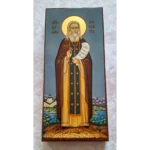
Barnabas of Gethsemane Orthodox Icon
Price range: $550 through $1350
Available sizes: 13×25 cm (5.1×9.8 in), 18×31 cm (7.1×12.2 in), 30×50 cm (11.8×19.7 in). Larger iconostasis sizes can be made by agreement.
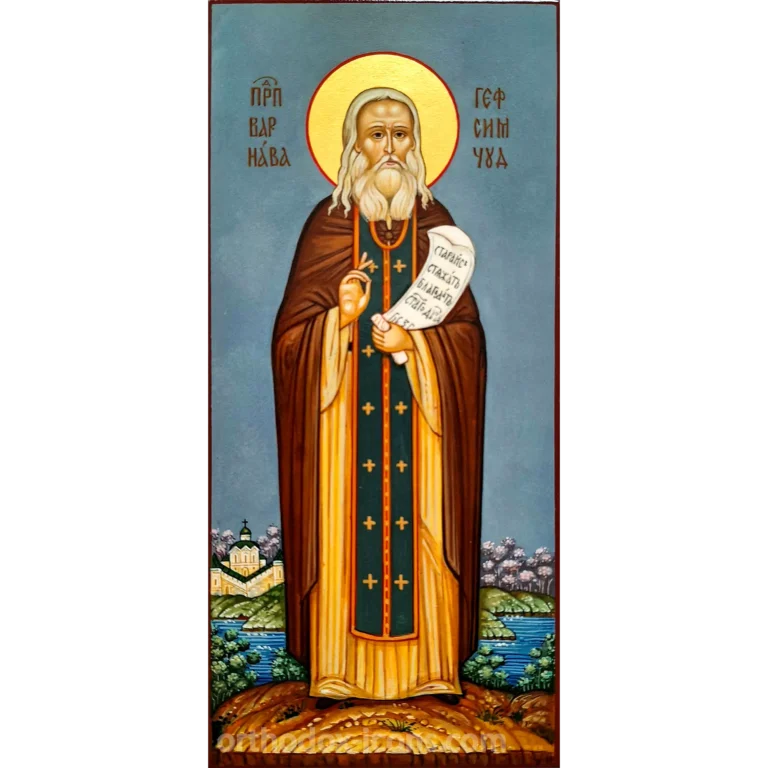
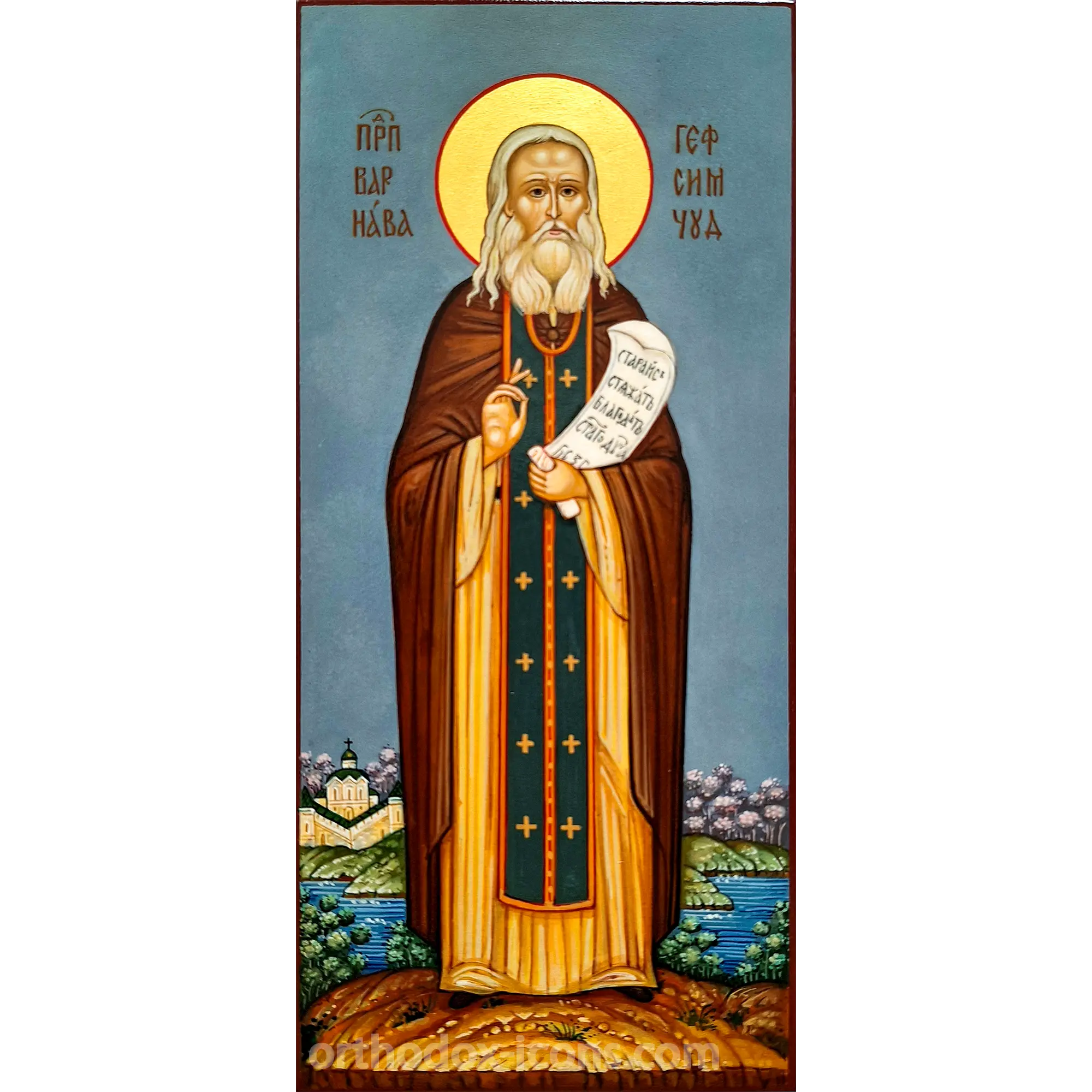
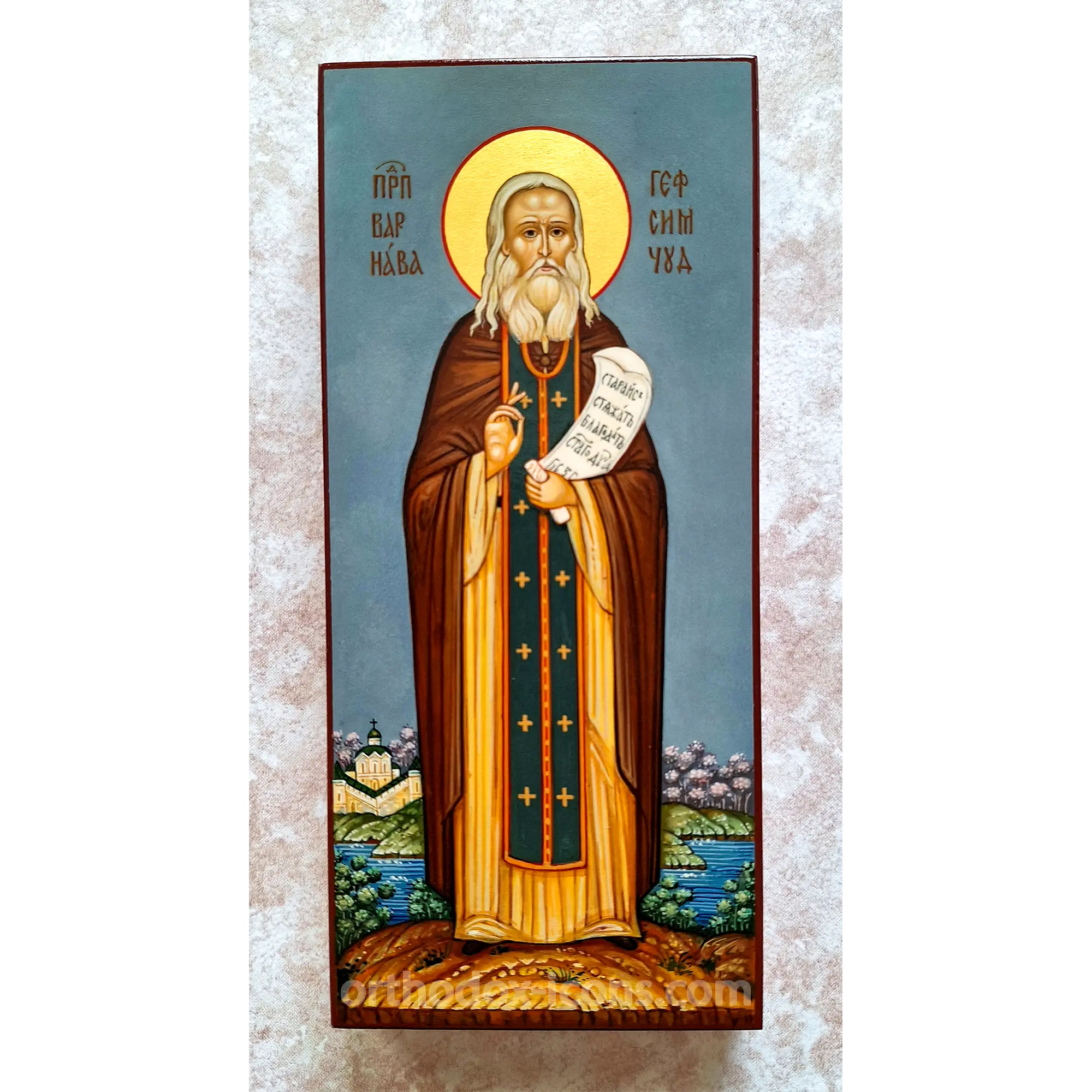
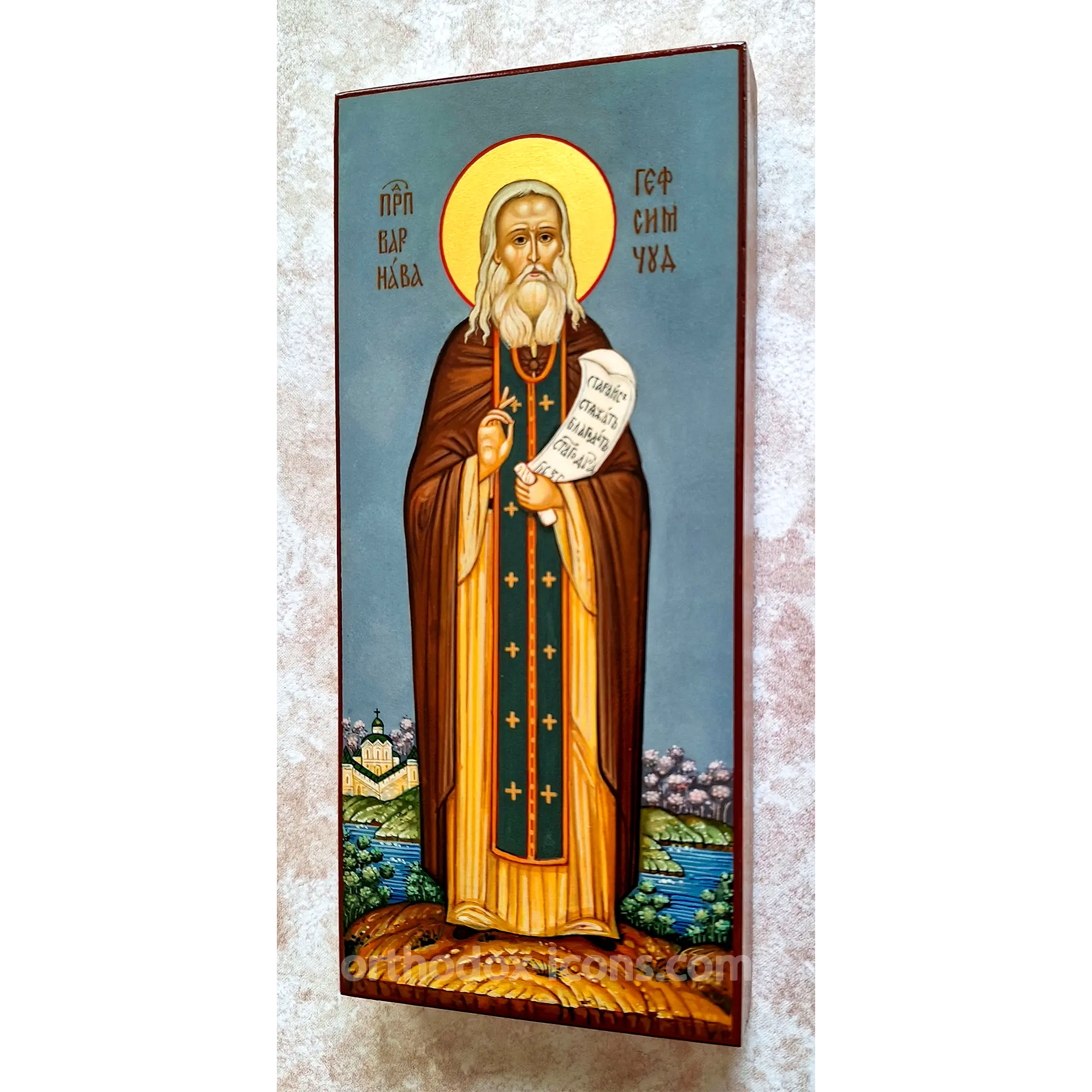
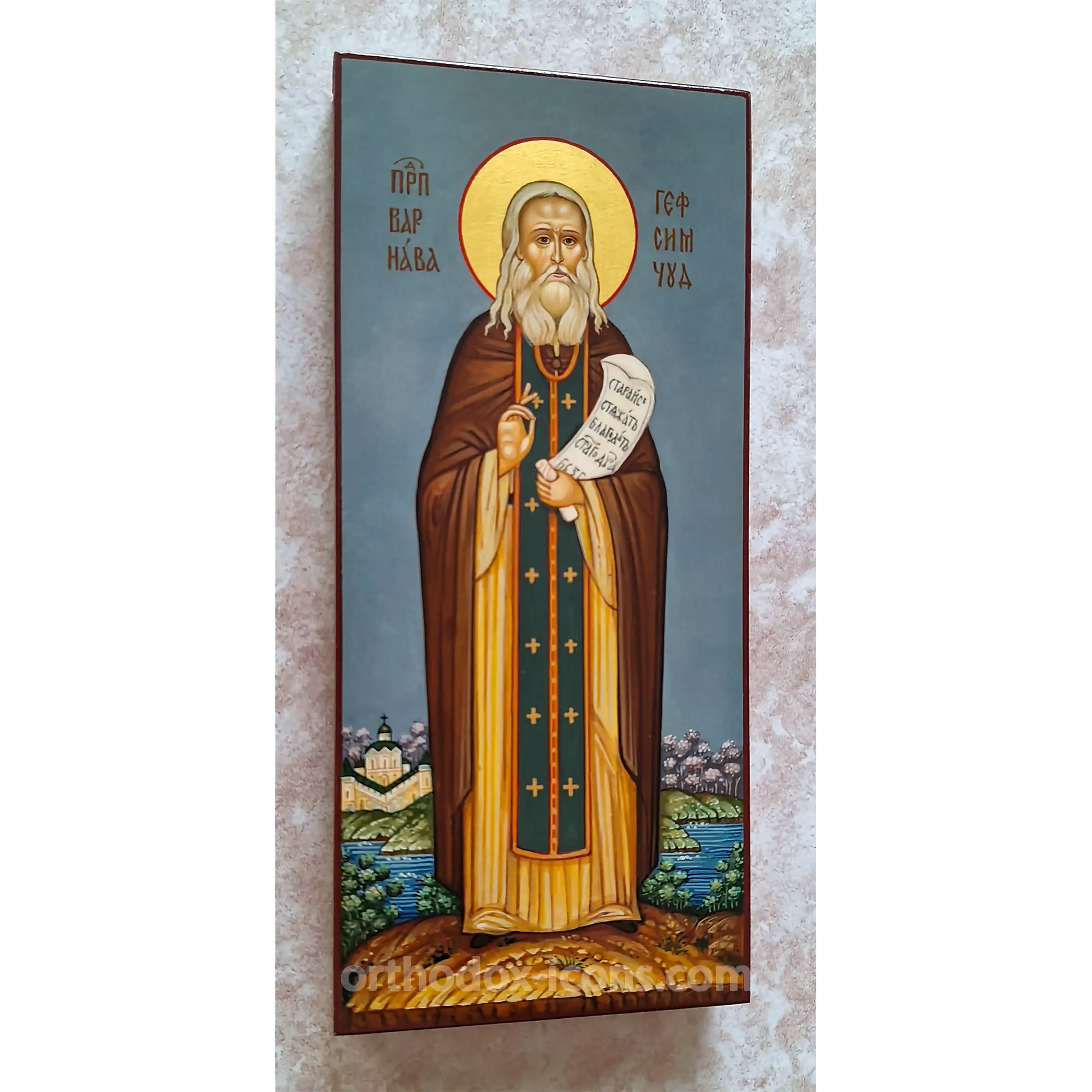
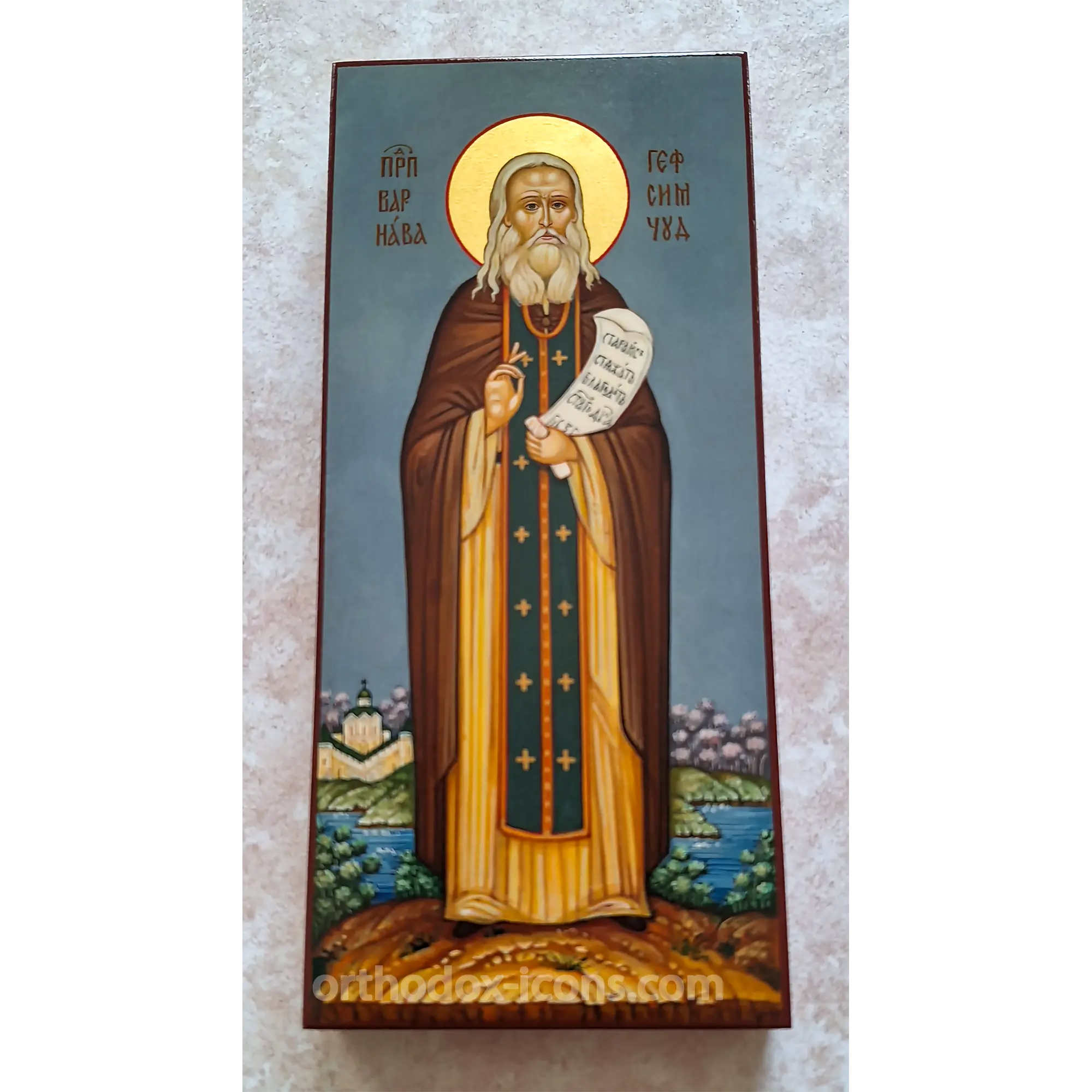
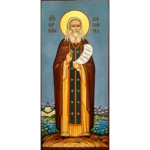
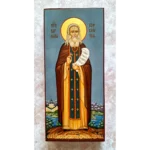
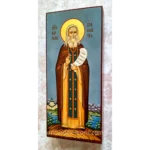
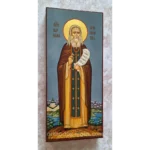
This hand-painted Barnabas of Gethsemane Orthodox Icon depicts Saint Barnabas of Gethsemane, elder and confessor of the Gethsemane Skete of the Trinity-Sergius Lavra, a Russian ascetic, comforter, spiritual guide, and man of prayer. He is shown full-length in monastic clothing, with a blessing right hand, an open scroll in his left hand, a gold halo, and a quiet landscape with water, green banks, and a monastery.
Prayer before this icon is often connected with comfort in sorrows, strengthening of faith, repentance, spiritual discernment, help in temptations, healing of inner wounds, guidance toward a good path, and patron saint protection for people named Barnabas. The icon is painted on a linden wood board with braces, pavoloka, chalk gesso, egg tempera, 23K gold leaf (960 purity), and a protective finish. Free international shipping is included. Payment is made after you receive and approve the icon.
It is possible to paint an image in any size to order
Free shipping worldwide
This hand-painted Barnabas of Gethsemane Orthodox Icon is a prayerful image of Saint Barnabas, elder of the Gethsemane Skete of the Trinity-Sergius Lavra. He was a Russian ascetic of the nineteenth and early twentieth centuries, remembered by the Church as a meek pastor, confessor, comforter of the sorrowful, and guide on the path of repentance. In the world he was Vasily Ilyich Merkulov. He came from a simple peasant family, was drawn from childhood to church and prayer, and later passed through the path of monastic obedience, priestly service, and elder-like spiritual care. People of many walks of life came to Saint Barnabas with griefs, illnesses, family anxieties, spiritual questions, and the desire to hear a simple honest word spoken with love.
In this icon Saint Barnabas is shown full-length in monastic clothing against a quiet landscape with water, green banks, and a church monastery. A gold halo sets apart the face of the saint; his right hand is formed in a blessing gesture, and his left hand holds an open scroll with spiritual instruction. The name inscriptions identify him as Saint Barnabas of Gethsemane. The whole composition is calm and elder-like in tone: before us is not a severe judge, but a man of prayer who knows how to comfort, correct, and return hope to the human heart.
Available sizes: 13×25 cm (5.1×9.8 in), 18×31 cm (7.1×12.2 in), and 30×50 cm (11.8×19.7 in). Larger iconostasis sizes can be made by agreement. The 13×25 cm format is convenient for a small home shelf, personal prayer place, study, or compact patron saint gift. The 18×31 cm size better reveals the full-length figure, scroll, blessing hand, monastic garments, and landscape background. The 30×50 cm format is suitable for a spacious home iconostasis, monastic cell, church, chapel, parish office, or iconostasis row.
The icon of Saint Barnabas of Gethsemane is especially appropriate as a name saint icon for a man or boy named Barnabas. This is a rare name, so such a gift feels very personal and precise. Yet the prayerful meaning of the image is wider than name patronage alone. Saint Barnabas is close to those who experience despondency, inner weariness, family anxiety, prolonged temptations, loss of inner peace, or need for spiritual counsel. His name is connected with consolation, and his life confirms this meaning: people came to him not for beautiful phrases, but for living support.
Features of This Icon
The main feature of this icon is the warm elder-like image of Saint Barnabas. He is not painted in an abstract decorative manner, but as a living spiritual guide turned toward the one who prays. His figure stands straight and calm. The light beard, attentive gaze, soft folds of the mantle, and blessing hand create a feeling of inner quiet. Before such an image it is natural to pray for help in sorrows, discernment, patience, and the strength not to lose faith during a difficult period.
The face of the saint is painted with special expressiveness. In his eyes there is not only the seriousness of monastic life, but also compassion. This is important for Saint Barnabas of Gethsemane: he was not a bookish teacher distant from human pain, but an elder who received people daily, listened, confessed, comforted, and guided them. His face conveys the experience of a person who knows that spiritual life is not built on quick solutions. It requires patience, repentance, obedience, and constant return to God.
The right hand of the saint is formed in a blessing gesture. It is gentle and pastoral rather than forceful. It speaks of prayerful support and spiritual guidance. For an elder’s icon this is especially fitting: Saint Barnabas blesses not in an abstract way, but as a spiritual father who helps a person gather himself, avoid being scattered by anxiety, and continue the path.
The scroll in the left hand strengthens the teaching meaning of the icon. In the iconography of venerable saints, a scroll often points to a spiritual word, commandment, counsel, or prayerful instruction. For Barnabas of Gethsemane this is very organic: he is honored as an elder to whom people came for spiritual direction. The scroll reminds us that his consolation was not empty gentleness. It led toward repentance, correction of life, prayer, and trust in God.
The monastic clothing is painted in a warm and quiet range of colors. The brown mantle, ocher garments, dark analav with crosses, and blue head covering create the image of an elder who has walked a long path of obedience. The dark and earthy tones speak of humility, labor, and renunciation of vanity, while the gold halo and light background reveal the spiritual light born not from outward effect, but from a grace-filled life.
The landscape with water, greenery, and a monastery makes the icon especially vivid. It recalls the monastic setting, the quiet of the skete, and the prayerful life that is revealed not only in church services, but in every step of obedience. The white church by the water and the soft bluish-grey background help the image sound calm and unforced. This version is well suited for a home, because it does not overload the prayer space and still preserves the expressive full-length composition.
Iconography of Saint Barnabas of Gethsemane
Saint Barnabas of Gethsemane is shown in Orthodox iconography as a monk and elder: in monastic clothing, with a halo, blessing hand, scroll, or prayer rope. In this icon his elder-like ministry is especially clear. Before us is not only a monk, but a confessor to whom people came for counsel, confession, prayer, and comfort. The icon therefore joins the strictness of the monastic path with remarkable human warmth.
The halo around the saint’s head is a sign of glorification in the Church. It is painted in gold and outlined with a fine red line. Against the calm landscape, the halo immediately gathers attention to the face of the venerable father. This is important: the main subject of the icon is not an external story about places and events, but a holy person through whom God’s grace worked in the lives of many people.
The scroll makes the image especially close to those who seek guidance. Saint Barnabas was known for spiritual discernment, the ability to encourage the sorrowful, support the repentant, and guide a person without cruelty. The word of an elder did not replace personal responsibility, but helped reveal the path. Therefore before this icon one may pray not only for help in circumstances, but also for right understanding: what to do, what to change in oneself, where to show patience, and where to stop sin.
The full-length format emphasizes the wholeness of the ascetic path. The saint is shown standing in prayerful presence. It is an image of steadiness: Saint Barnabas seems to stand between the world of human anxieties and heavenly help, reminding the faithful that Christian life requires not a one-day impulse, but constancy. This is felt especially strongly in the combination of the saint’s figure with the quiet landscape and the small monastery by the water.
Prayer Before the Icon of Saint Barnabas
Before the icon of Saint Barnabas of Gethsemane, Orthodox Christians may pray for consolation, strengthening of faith, help in repentance, and spiritual discernment. His image is especially close to people who experience grief, weariness, family difficulties, inner temptations, or need kind spiritual direction. Saint Barnabas was a confessor, so people also ask for help in confession, correction of life, and overcoming habitual sins.
- for comfort in sorrows, illness, and inner anxiety;
- for strengthening of faith, hope, and trust in God;
- for repentance and correction of life;
- for spiritual discernment in a difficult choice;
- for help in temptations, despondency, and inner confusion;
- for peace in the family and reconciliation after conflicts;
- for support for monastics, clergy, and church workers;
- for a good spiritual guide and a right attitude toward counsel;
- for preservation of prayer amid everyday cares;
- for heavenly patronage for people named Barnabas.
Prayer before the icon of Saint Barnabas is not a request for instant escape from all difficulties. The elders always taught more deeply: sorrow can become a path toward purification if a person passes through it with prayer, repentance, and trust in God. Before the image of Barnabas of Gethsemane it is especially fitting to ask not only for outward help, but also for inner ordering: not to grow bitter, not to lose hope, not to fall into complaint, and not to destroy good relationships with loved ones.
Brief Life of Saint Barnabas
Saint Barnabas of Gethsemane, in the world Vasily Ilyich Merkulov, was born on January 24, 1831, in the village of Prudishchi in Tula province, in the family of serf peasants Ilya and Daria Merkulov. His parents raised him in piety. In childhood Vasily learned church literacy, became familiar with liturgical books, loved the church, and gradually grew in the desire to dedicate his life to God.
The youth of the future elder was connected with labor and trials. He learned a trade, but his heart was increasingly drawn toward monastic life. Contact with ascetics and visits to holy places were important for him. After a visit to the Trinity-Sergius Lavra, the desire to serve God became especially strong. Soon Vasily came to the Gethsemane Skete, where his long path of obedience began.
In 1857 he became a novice of the Gethsemane Skete, and in 1866 he received monastic tonsure with the name Barnabas. Later he was ordained hierodeacon and then hieromonk. His spiritual maturity, heartfelt attention, and gift of consolation gradually made him known as an elder. Many people came to him for confession, prayer, counsel, and help in sorrows.
Saint Barnabas was not a public teacher seeking fame. His service was quiet, daily, and deeply pastoral. He listened to people, called them to repentance, strengthened the weak, and helped those who had lost hope. His elderhood was marked by compassion without indulgence and firmness without cruelty. This is why his memory remains especially close to those who need consolation and a truthful spiritual word.
Commemoration and Patron Saint Meaning
Saint Barnabas of Gethsemane is commemorated on March 2 according to the new calendar, corresponding to February 17 according to the old calendar. He is also remembered on July 19 among the Radonezh saints. For a person named Barnabas, these dates may be connected with a name day if Saint Barnabas of Gethsemane is the heavenly patron chosen at baptism.
A patron saint icon of Saint Barnabas is suitable as a gift for baptism, name day, birthday, monastic tonsure, ordination, a new home, or an important family event. It is also appropriate for a person who needs consolation, support in repentance, or a reminder of prayer, patience, and spiritual discernment.
The name Barnabas has the apostolic meaning of son of consolation. In the life of Saint Barnabas of Gethsemane this meaning was revealed with particular clarity. He became a person to whom people came in sorrow and left with hope. Therefore this icon is close not only by name, but also by spiritual mood: to those who wish to learn gentleness without weakness, firmness without harshness, and consolation without empty words.
Materials, Gold Leaf, and Custom Options
The icon of Saint Barnabas of Gethsemane is painted on a linden wood board. Applied or mortise braces are used for stability. Pavoloka and chalk gesso are applied to the board, and then the image is painted in egg tempera. This traditional method allows the icon painter to render the face of the saint, grey beard, hands, scroll, monastic garments, halo, inscriptions, and landscape background with care.
In this version, 23K gold leaf (960 purity) is used. Gold is especially important in the halo and light parts of the background: it separates the holy image from ordinary space and creates a quiet ecclesiastical radiance. At the same time, the icon does not look overloaded. The gold works softly, supporting the prayerful character of the image and setting apart the face of the venerable father.
The color harmony is built on a calm combination of golden, brown-red, blue, green, and ocher tones. The dark monastic clothing and warm mantle speak of humility and spiritual labor, the bluish-grey background gives the image quiet, and the landscape with water and the monastery makes the icon vivid and recognizable. The face, hands, scroll, crosses, folds of clothing, inscriptions, and background are all painted by hand.
For an individual commission, the size, degree of gilding, background tone, inscription style, general color harmony, kiot, and format for a home, church, chapel, or iconostasis row can be discussed. In a larger version it is especially important to preserve the softness of the elder’s face, readability of the scroll, clarity of the blessing hand, and harmony between the figure of the saint and the landscape setting.
Choosing the Size
The 13×25 cm (5.1×9.8 in) size is suitable for a small home shelf, bedside prayer place, study, or compact patron saint gift. In this format the main details remain readable: the saint’s face, halo, blessing hand, scroll, and silhouette of the monastic garment.
The 18×31 cm (7.1×12.2 in) size remains convenient for the home, but gives more space for the full-length figure. It reveals the scroll, folds of clothing, gold halo, landscape background, monastery by the water, and inscriptions more clearly. This format is a good choice for a family iconostasis or as a gift for an adult named Barnabas.
The 30×50 cm (11.8×19.7 in) size is chosen for more solemn placement in a spacious home, prayer room, church, chapel, monastic cell, or iconostasis row. In the larger format the full-length composition becomes especially expressive, and the image of the saint can become a clear prayerful center.
Placement, Blessing, and Care
The icon of Saint Barnabas of Gethsemane may be placed in a home icon corner beside icons of Christ, the Mother of God, the Guardian Angel, Saint Sergius of Radonezh, Saint Seraphim of Sarov, the Optina Elders, and other saints close to the family. For a person named Barnabas, this image may become a personal patron saint icon and a constant reminder of heavenly intercession.
After receiving the icon, it may be blessed in an Orthodox church. A blessed icon is intended for prayer, thanksgiving to God, and asking Saint Barnabas for comfort, repentance, patience, spiritual discernment, strengthening of faith, and help in life’s sorrows.
A hand-painted icon should be protected from direct sunlight, moisture, overheating, smoke, soot, and sudden temperature changes. Do not wipe the surface with wet cloths, alcohol, household cleaners, or rough fabric. The saint’s face, gold halo, hands, scroll, inscriptions, and landscape background require especially careful handling.
Dust should be removed gently with a soft dry brush and without pressure. For protection of the painting and gilding, a wooden glazed kiot is recommended. It helps preserve the icon from dust, humidity, and accidental damage, especially when the image is placed in an active home area, study, church, or intended for long-term use.
Questions and Answers
Who is depicted in the Barnabas of Gethsemane Orthodox Icon?
The icon depicts Saint Barnabas of Gethsemane, born Vasily Ilyich Merkulov, elder and confessor of the Gethsemane Skete of the Trinity-Sergius Lavra.
Why is he called of Gethsemane?
This name is connected with the Gethsemane Skete near the Trinity-Sergius Lavra, where Saint Barnabas served in monastic life and became known as a spiritual elder.
What does the scroll in Saint Barnabas’s hand mean?
The scroll points to spiritual instruction, elder-like counsel, and a call to repentance, prayer, and attentive Christian life.
What do Orthodox Christians pray for before this icon?
Prayer before this icon is often connected with comfort in sorrows, strengthening of faith, repentance, spiritual discernment, peace in the family, and protection from despondency.
Why is Saint Barnabas called an elder and comforter?
Many people came to him for confession, counsel, and prayer. He comforted those in sorrow, guided the repentant, and supported those who were losing hope.
Who may choose this icon as a patron saint icon?
This icon is especially suitable for a person named Barnabas, monastics, clergy, spiritual mentors, and those who need comfort, patience, and prayerful support.
When is Saint Barnabas of Gethsemane commemorated?
Saint Barnabas of Gethsemane is commemorated on March 2 according to the new calendar, corresponding to February 17 according to the old calendar. He is also remembered on July 19 among the Radonezh saints.
What sizes are available?
Available sizes are 13×25 cm, 18×31 cm, and 30×50 cm. Larger iconostasis sizes can be made by agreement.
Where can this icon be placed?
The icon is suitable for a home icon corner, personal prayer place, study, monastic cell, church, chapel, or iconostasis row.
How should a hand-painted icon with gold leaf be cared for?
Keep the icon away from moisture, direct sunlight, heat, smoke, and mechanical damage. Dust it gently with a soft dry brush, and consider a glazed kiot for long-term protection.
| Dimensions | 13x25cm (5.1×9.8 in), 18x31cm (7.1×12.2 in), 30x50cm (11.8×19.7 in) |
|---|---|
| Name | Barnabas |